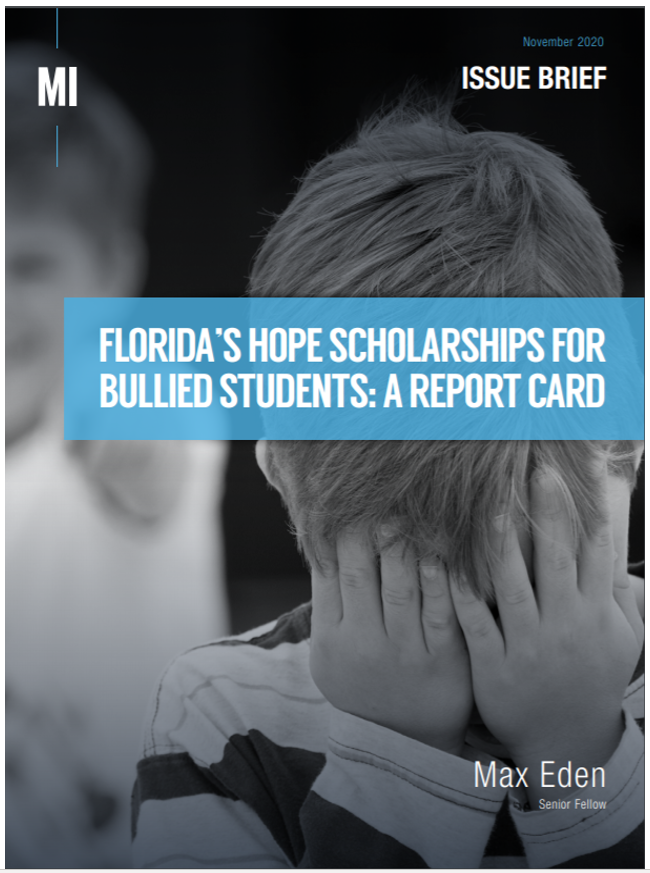
 Manhattan Institute senior fellow Max Eden recently authored a report on the legislative origins and history of the first education choice program for students who have experienced bullying in public schools.
In the report, Eden wrote:
“Education reformers have long lamented America’s persistent racial and socioeconomic achievement gap and framed school choice as a means to provide low-income students of color trapped in failing schools with a ticket to a better education. Yet when parents who participate in school choice programs in states like Georgia or Indiana have been surveyed, at least half of them cite safety as a primary motivating factor.”
Eden familiarized himself with the subject of bullying in Florida public schools when he co-authored the book Why Meadow Died about the Parkland, Florida, school shooting. Why Meadow Died lays out a methodical case regarding the dozens of times a disturbed and violent public school student has been mishandled by school and police authorities before finally going on a murder spree.
In this new report, Eden more happily profiles a program designed to allow the victims of bullying to escape from their tormentors. He writes:
“The Speaker’s office noticed that they were receiving e-mails from parents who were upset at the school’s inability to protect their kids. Parents were saying, ‘This has been happening for years, and they do nothing. They just, at most, give the kid a detention or an in-school suspension and say, ‘That’s the most we can do.’
“Corcoran and his staff reviewed data from Florida’s School Environmental Safety Incident Reporting (SESIR) system, which showed 47,000 incidents in the latest reported year (2015–16) — a figure they felt certain represented only a small fraction of the total. They estimated that there could be as many as 100,000 victims of bullying and abuse. ‘We started brainstorming,’ Ochs says. ‘What could we do? There were already policies in place to address bullying. Maybe we could increase the penalties based on the number and type of an incident? Then a lightbulb just kind of went on for us: this fits with the school choice paradigm. We need to empower parents. They just want their kids protected, and that’s not always happening, so we need to give them the power to force the school’s hand or just get their kid to a safer environment.’ ”
The report quotes several families whose lives have been transformed by the program. One parent described their child as having previously been through “daily torture” while another described a public school whose discipline was so ineffective that that the family sought and received a restraining order from a judge.
In Year 2 of existence, the Hope Scholarship remains a small program. A lack of public awareness and a seeming unwillingness on the part of school district officials to follow the law seem to be contributing factors.
A spring 2020 survey of participating parents by Florida State University’s Learning Systems Institute found that about 70% of respondents learned of the Hope Scholarship on their own or from a third party, not from the school district that had a legal obligation to inform them of it. Some parents reported resistance from public school officials. According to one parent, “The school seemed very hesitant to give me the form. I had to go to the office and basically demand it and make them sign it.”
Another group of parents indicated that the school had refused to acknowledge that bullying had occurred. One parent indicated “the Hope notification form was a challenge because the principal and dean at [school name redacted] refused to acknowledge that the bullying was taking place. They refused to communicate with me in a timely manner. I had to make threats to go to the school board commissioner to get them to respond to the bullying issues.”
While Florida’s bullied children have access to a variety of education choice programs beyond the Hope Scholarship, the Florida Legislature should make this program more accessible. Expecting district school principals to investigate and acknowledge in writing that bullying may be occurring in their schools is unrealistic and is an obstacle that few families are able to overcome.
A program for bullied children would be substantially more useful if it were not so easily thwarted.
 Beginning this school year, Florida public school districts will be required to report to the Florida Department of Education how many families they have informed of the availability of a scholarship for victims of bullying.
The Florida Board of Education approved the changes earlier today as part of its consent agenda, typically reserved for non-controversial items. The measure is included in rule changes that govern the Hope Scholarship.
Prior to the rule change, school districts were required to inform parents about the Hope Scholarship within 15 days after a bullying incident was reported and provide the parent with a completed Hope notification form verifying that the incident was reported. The form was needed to start the scholarship application process.
But 71 percent of Hope parents surveyed by the Learning Systems Institute at Florida State University said they learned of the scholarship through other means, such as private schools, internet searches and social media. Two-thirds disagreed or strongly disagreed that the incidents were investigated in a timely manner, and many expressed frustration with district officials who they said didn’t know the legal requirements or didn’t appear to want to follow them.
Former Florida House Speaker and now Florida Education Commissioner Richard Corcoran spearheaded creation of the Hope Scholarship in 2018. Students are eligible if they report being victims of bullying or similar incidents, including assault, battery, hazing, harassment and sexual misconduct. They can use the scholarship to attend private schools or to transfer to another public school.
At present, 429 students are using a Hope Scholarship, the first of its kind in the United States, at private schools, even though tens of thousands fall into the eligibility categories. State officials projected in 2018 that as many as 7,000 students would use the scholarship, worth about $7,000, annually.
Hope Scholarships are funded by individuals who contribute up to $105 in return for sales tax credits on motor vehicle purchases. So far this year, $60.8 million has been contributed. By law, unused Hope funds can be used for the Florida Tax Credit Scholarship for lower-income students.
Both scholarships are administered by Step Up For Students, the nonprofit that hosts this blog.
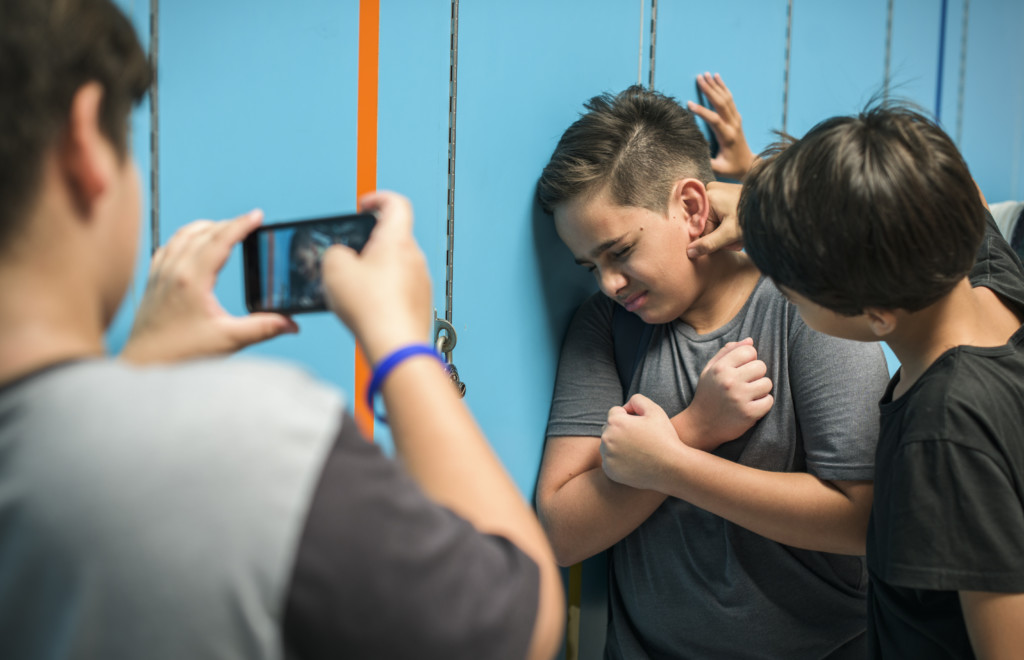 A conservative education group wants state education officials to penalize public school districts that fail to inform parents about the availability of a state scholarship for bullying victims.
Two members of Florida Citizens Alliance told Florida Board of Education members earlier today that rules governing the Hope Scholarship need to be tightened to ensure that districts inform parents they can apply for the scholarship when they report bullying.
“I think there needs to be some teeth in it,” said Keith Flaugh, a managing director of the Naples-based group during a workshop held via conference call to discuss the proposed changes. “The schools are … in many cases, hiding it because they lose funding if a parent takes advantage of it.”
Flaugh added that the state should audit school districts to ensure compliance and levy some type of punishment to those who disregard the rules.
At present, 429 Florida students are using a Hope Scholarship, the first of its kind in America, even though tens of thousands fall into the eligibility categories. State officials projected in 2018 that as many as 7,000 a year would the scholarship, which is worth about $7,000 a year.
To date, the best available evidence suggests a leading reason for the gap is that districts are not telling parents they have this option.
Seventy-one percent of Hope parents surveyed by the Learning Systems Institute at Florida State University said they learned of the scholarship through other avenues, such as private schools, internet searches and social media. Two-thirds disagreed or strongly disagreed that the bullying incidents they reported were investigated in a timely manner, and many expressed frustration with district officials who they said didn’t know the legal requirements.
The survey results prompted the Florida Department of Education to consider rule changes that would require that districts routinely tell the state how many Hope notification forms they have made available to parents.
Currently, there is no such requirement, even though districts are required by law to notify parents about the Hope Scholarship within 15 days of a reported bullying incident and to provide them the Hope form they need to start the application process.
(The scholarship is administered by Step Up For Students, the nonprofit that hosts this blog.)
Rick Stevens, also a managing director of the Florida Citizens Alliance, stressed the need at today’s workshop for follow up to make sure that parents who receive the forms from the districts know how to take advantage of the scholarship opportunity.
“We need to have a way to support the parent, and I’m not sure assuming the districts will provide that is the right approach,” Stevens said, adding that he’s heard reports of parents who had trouble making the connection between receiving the paperwork and applying for the scholarship.
“There needs to be a way to coach them through the process,” he said.
Lawmakers created the Hope Scholarship in 2018, in an effort led by then House Speaker and now Education Commissioner Richard Corcoran. Students are eligible if they report being victims of bullying or similar incidents, including assault, battery, hazing, harassment, and sexual misconduct. They can use the scholarship to attend private schools or to transfer to another public school.
Hope Scholarships are funded by individuals who contribute up to $105 in return for sales tax credits on motor vehicle purchases. So far this year, citizens have contributed $60.8 million. By law, unused Hope funds can be used for the Florida Tax Credit Scholarship for lower-income students.
Laura Mazyck, deputy executive director of independent education and parental choice for the Florida Department of Education, told Flaugh and Stevens that their comments would be taken into consideration.
The rule changes are expected to be discussed at the next state Board of Education meeting July 15.
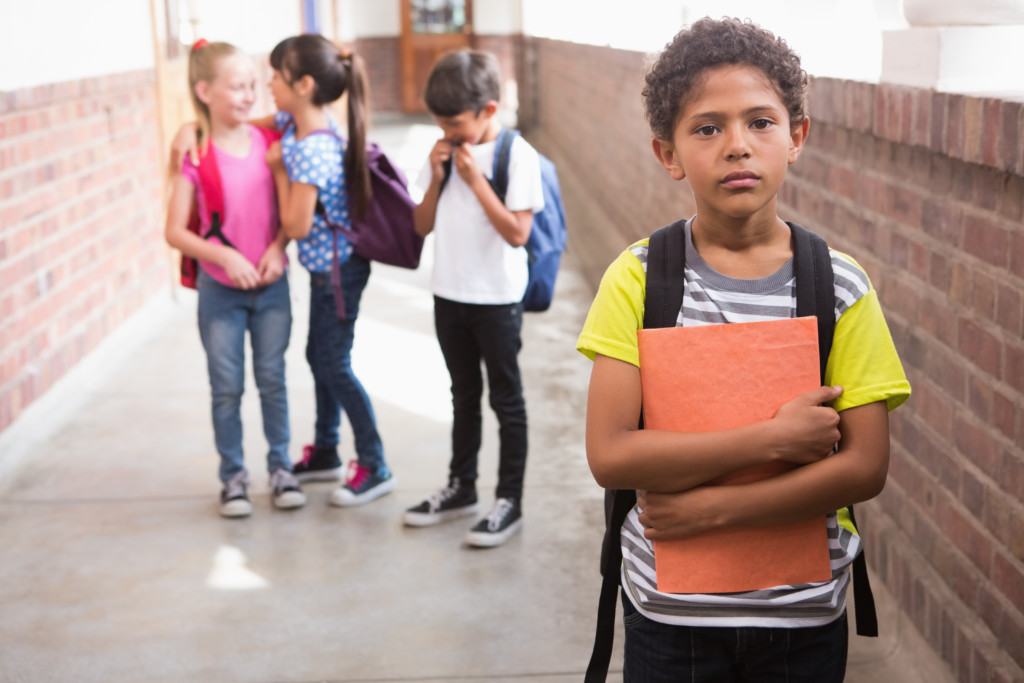 Florida education officials are considering changes that could lead to wider use of a school choice scholarship for bullying victims that has so far seen few takers despite tens of thousands of qualifying incidents each year.
The proposed rule changes to the Hope Scholarship, the first of its kind in America, would require that school districts routinely tell the state how many Hope notification forms they’ve given to parents.
Currently, there is no such requirement, even though districts are required by law to notify parents about the Hope Scholarship within 15 days of a reported incident, and to provide them the Hope form they need to start the application process. (The scholarship is administered by Step Up For Students, the nonprofit that hosts this blog.)
The Florida Department of Education will consider the changes at a June 19 workshop.
Lawmakers created the Hope Scholarship in 2018, led by then House Speaker and now Education Commissioner Richard Corcoran. Students are eligible if they report being victims of bullying or similar incidents, including assault, battery, hazing, harassment, and sexual misconduct. They can use the scholarship to attend private schools, or to transfer to another public school.
At present, 429 students are using Hope at private schools, even though tens of thousands fall into the eligibility categories and state officials projected in 2018 that as many as 7,000 a year would use them. The scholarships are worth about $7,000 a year.
To date, the best available evidence suggests a leading reason for the gap is that districts are not telling parents they have this option.
Seventy-one percent of Hope parents surveyed by the Learning Systems Institute at Florida State University said they learned of the scholarship through other means, such as private schools, internet searches and social media. Two-thirds disagreed or strongly disagreed that the incidents were investigated in a timely manner, and many expressed frustration with district officials who they said didn’t know the legal requirements or didn’t want to follow them.
Hope Scholarships are funded by individuals who contribute up to $105 in return for sales tax credits on motor vehicle purchases. So far this year, they’ve contributed $60.8 million. By law, unused Hope funds can be used for the Florida Tax Credit Scholarship for lower-income students.
 Hope Scholarship: With some Florida school districts saying they're confused by the law that offers state scholarships for bullied K-12 students, state Sen. Manny Diaz, R-Hialeah, has filed a bill intended to clarify the rules and further expand the scholarship. S.B. 1410 would remove school districts from making any decisions about a student's eligibility for a Hope Scholarship. Instead, parents would go directly to the scholarship funding organization for an application and simply have to report a bullying incident to be eligible, with no verification required. The bill would also offer the scholarships to students from private schools. Gradebook. redefinED.
Gardiner Scholarship: Two bills are filed that would expand Gardiner Scholarships for students with special needs and make it simpler for parents to renew them. H.B. 1051, filed by Rep. Elizabeth Fetterhoff, R-DeLand, and S.B. 1380, sponsored by Sen. Keith Perry, R-Gainesville, would allow parents to submit applications when their child turns 3, and use the scholarship to pay for tuition and fees associated with art, music or theater programs. Step Up For Students, which hosts this blog, helps administer the state's Gardiner, Hope, tax credit and reading scholarships. redefinED.

