Last week I had an opportunity to speak in Boise, Idaho, on school choice and the Arizona experience. In an interview on NPR, I addressed claims by choice opponents that Idaho “already has school choice.” I guess you could say I went full Depeche Mode in responding. I’ll explain why here, and I challenge you to try to keep that synthesizer music out of your head while you read on.
Families benefit from schools that are meaningfully diverse, proximate, and that have seats available in the grade levels appropriate for their children. The existence of choice schools is necessary but not sufficient: schools must be close enough to access and have seats available in the grade levels needed. The more schools you have, the more proximate schools you have, the less transportation challenges your families face.
The idea that Idaho, or for that matter anyone else, has “enough” K-12 choice seems highly questionable; in a demand-driven K-12 system families and educators continuously mold the clay of the education space. Educators develop new school models, such as microschools, and families sort through them.
The greater the meaningful diversity of schools proximate to families the better. Consider the Brookings Institution charter access map, showing the percentage of students with one or more charter schools operating in their ZIP code of residence:
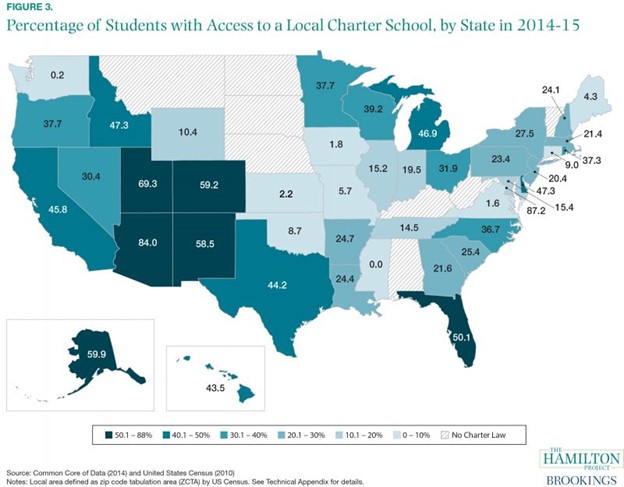
In the 2014-15 school year, 47.3% of Idaho students had one or more charter schools operating in their ZIP code. This means 52.7% of Idaho students did not have a charter school operating in their ZIP code. Having a charter school in your ZIP code represents a minimalist measure of choice. Given the many types of charter schools and families’ needs for a good-fit school with seats available at their child’s grade level, having a nearby charter is not much more than a start. Moreover, charter schools themselves do not capture the full diversity of schooling.
Arizona began creating mechanisms for educators to create meaningfully diverse schools 31 years ago. The quasi-market revealed demand for a wide variety of schools. We learned that parents wanted classical education, rigorous math and science college preparatory schools, and schools focused on a great many things from the arts to the equine arts.
More recently, several charter and private schools focused on the education needs of students with unique needs have emerged. The private choice programs increase access to private schools. Far from having “enough” choice in Arizona, every school waitlist should be viewed as a policy failure.
Modern choice programs have expanded the possibility set for families. Under Arizona’s ESA law, high school students can use their accounts to attend community colleges and simultaneously obtain a high school diploma and an associate degree. Families sometimes team up to hire their own teachers. Families have only begun to scratch the surface of the possibilities.
And then there is this polling research to consider from EdChoice:
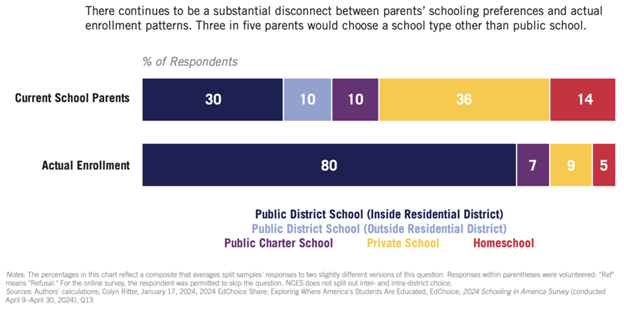
These polls indicate that certain types of schools are oversupplied, but it’s not the type that will become accessible if Idaho lawmakers pass a private choice program. Variety is the spice of life, and no state has yet come close to getting enough.
 Editor’s note: This commentary from veteran educator Laura Fischer, founder of Math with Mrs. Fish and chapter leader of Independent Women’s Network Boise, Idaho, appeared last week on idahostatejournal.com.
I have been a teacher since 1989. Over the last 33 years, I have taught every grade level from kindergarten to college in traditional, private, charter and home schools. The best and worst schools I ever worked for were charter schools, and this broad and diverse option is an important part of school choice. I am delighted that Idaho has it.
But it would be a crucial mistake to claim that charter schools are proof that “Idaho has enough choice,” as some have begun to do. No single option can meet every family’s needs, whether district or charter schools.
It is time for Idaho to take the next step in improving education for its children by passing education savings accounts legislation.
In my experience, the best and most customizable form of education was homeschooling, but this option is not viable for many families, for a variety of reasons. As a result of the education innovation demanded by the catastrophe of pandemic school closures, parents have new education options for their children that may prove to be even more customizable than homeschooling: microschools and learning pods.
Because I am a teacher, I hope readers will indulge my bringing some extra history into this discussion. In the late spring of 1940, Allied troops were cut off and surrounded by German forces after the six-week Battle of France. It was a colossal disaster, and Winston Churchill ordered all ships and boats to evacuate the soldiers from Dunkirk.
In nine days, over 900 fishing and pleasure boats, yachts and lifeboats aided in rescuing 340,000 British and French soldiers. The small and nimble craft could get much closer to the shore where shallow waters prevented access for larger vessels. It was a catastrophe averted.
Today, countless children are facing educational catastrophes, and the “small vessels” of customized education can save them, too.
To continue reading, click here.
 Editor’s note: This commentary from Chris Cargill, president and CEO of Mountain States Policy Center, an independent free-market research organization based in Idaho, appeared this week on idahonews.org.
It’s all about improving outcomes for children. As President of Mountain States Policy Center, I’m proud to announce the launch of “Education Choice Improves Outcomes.”
This interactive effort includes seven new informational videos, an interactive website, a complete listing of programs, debunking myths, and much more. Our recent Idaho poll showed a third of Idahoans are not familiar with education choice, but when they know about it, they overwhelmingly approve.
What if you could use some of the money allocated to your child’s education to get them extra tutoring – something that would supplement your public school? What if you had the resources to send your child to a private or specialty school to focus on a specific subject on which they excelled? What if, like me, you had a special needs child that needed extra assistance outside the classroom – and you finally had the ability to pay for it?
This is not about shutting down public schools. As a state and region, we need to do better to make sure parents and families have more choices, and businesses have a future workforce that is skilled and qualified. When families have more choices, the outcomes for our children improve.
How do we know this? On mountainstatespolicy.org you’ll find a complete list of education choice programs from across the country – which ones succeeded, which ones failed, and which ones made no difference. The vast majority show education choice programs save taxpayers money, allow for more diverse schools, and improve academic outcomes for those participating and those who choose to stay in their local schools.
Unfortunately, those interested in the status quo are frightening citizens with a lot of myths. Here are the top six.
Myth One – Allowing more education choice will harm public schools
In reality, public schools are part of education choice. If your neighborhood public school is working for you, nothing will change. In fact, education choice can help improve your local public school. Why? Because parents will have more resources to get their child extra tutoring or assistance outside of the classroom. This can take some of the burden off your public school.
Myth Two – Education choice violates the separation between church and state
The U.S. Supreme Court has ruled that appropriately designed education choice programs are fully constitutional. And numerous state courts have upheld the constitutionality of education choice.
Still, it’s important to know that most won’t use education choice to send their child to a private or religious school. Most will stay in public schools, and instead might use education choice to help pay for the extra tutoring or help that their child so desperately needs.
Myth Three – Students don’t benefit from education choice
Seventeen major studies have examined academic outcomes for education choice participants. Eleven of them have reported an increase in student outcomes. Four reported no effects. Only two reported negative effects. Education choice has led to higher graduation rates and 43% of students who have used education choice are more likely to enroll in college.
Myth Four – There’s no accountability when it comes to education choice
All education choice programs have a level of administrative and financial accountability. Most have academic accountability. In most states, your student still must either take state assessments or tests to measure whether they are meeting standards.
Furthermore, families must opt-in to education choice programs, and they can opt out at any time. This adds another layer of accountability. If your education choice program isn’t working, you have the greatest accountability tool of all – the ability to leave.
Myth Five – Education choice hurts rural communities
A Brookings Institute report shows a full 70% of rural families live within ten miles of various education choice options, including charter schools and private schools. As other states have advanced education choice, supply has increased to meet demand.
In Florida, the number of private schools in rural areas doubled after numerous expansions of education choice. In Arizona, a public school is 15 times more likely to lose a student to another public school than a private school.
Myth Six – Education choice is anti-public school
Public schools are critical to the success of our region and country. But they don’t always work for everyone. And when that happens, children and families should be able to get the extra help they need.
Every child can learn and should have the chance to do so in a way that meets their individual learning needs. We’re paying to educate the child. That must be what comes first. As state courts have recently ruled, public schools and education choice can exist at the same time.
Education choice is important because education choice improves outcomes for children. Every state does it differently, but the Mountain States are behind the times when it comes to providing your family with more options.
In places where education choice is allowed, the results are impressive and the future for children improves. That is what’s most important.

Cole Valley Christian School in Meridian, Idaho, offers a rigorous academic curriculum taught through a biblical worldview to prepare students to serve Christ in a rapidly changing world. Cole Valley is one of 142 private schools in the state serving more than 17,800 students.
Editor’s note: This commentary appeared last week on idahostateman.com.
Reclaim Idaho claims to be against the political establishment, but its recent actions in the education sphere say otherwise.
On Dec. 8, Reclaim Idaho released a petition telling Idaho legislators to say no to vouchers. In the past, Reclaim Idaho has run powerful citizen-centric campaigns in the state, scoring significant wins on Medicaid expansion and increased public education funding. However, this recent campaign is misguided, maintaining a status quo that disempowers the people they advocate for — Idahoans.
An adversarial stance on educational pluralism is not how an equitable education system is built. Instead, if Reclaim Idaho wants to benefit all Idahoan students’ futures, they must change course and embrace private educational choice programs.
Currently, the Idaho K-12 system has no private educational choice programs. As a result, children from wealthier families receive more access to high-quality educational options than students from lower-income families.
This omission is unjust and inequitable — all Idaho children should have the opportunity to receive a quality education regardless of their family’s income level. Idaho state legislators can rectify this systemic inequity by creating their state’s first private educational choice program.
To continue reading, click here.

Cole Valley Christian School in Boise, Idaho, is one of 143 private schools in the state that serve 17,626 students. Its mission is "to develop each student’s body, mind and spirit in the hope he or she will impact a lost world for Jesus Christ."
Editor’s note: This article appeared Tuesday on idahostateman.com.
Idaho lawmakers on Tuesday narrowly shot down a bill that would create scholarship accounts that families could use for students’ tuition and fees at private grade schools. The motion to hold the bill in committee passed 8-7 after multiple lawmakers and members of the public raised concerns that it would harm public schools and wasn’t a constitutional use of state dollars.
The bill would have allocated an estimated $12.7 million of Idaho public schools’ budget in the first year for the scholarships. Families with children in kindergarten through 12th grade would have been able to receive about $5,950 in state funds, according to the current estimates.
The funds could then be used for expenses including tuition and fees at private schools or non-public online learning systems, certain tutoring services and technology.
Under the bill, parents would have had to apply for the scholarship through the State Department of Education and promised not to enroll their student in public school during the time they’re receiving the funds.
To continue reading, click here.
Tennessee: Gov. Bill Haslam proposes a voucher that's limited to low-income students in low-performing schools, with additional state funding for those schools to boot (KnoxNews). More from timesfreepress.com and Nashville Public Radio. Haslam reiterates that his proposal won't affect funding for public schools (Nooga.com). Both supporters and opponents find details to criticize (KnoxNews). Haslam's administration is also backing a bill that would cap enrollment at a virtual charter school run by K12 Inc, reports timesfreepress.com.
Florida: At a National School Choice Week event, new Florida Education Commissioner Tony Bennett gives some school districts credit for expanding public options such as magnet schools and career academies (redefinED).
Louisiana: The teachers union in New Orleans asks for the names of teachers in the city's charter schools in the hopes of organizing them (The Lens).
Arkansas: Former Florida Gov. Jeb Bush makes an appearance during National School Choice Week, urging lawmakers to expand charter schools and other choice options and calling education reform both the civil rights and economic issue of our time (Associated Press). More from the Arkansas Press-Gazette.
Virginia: Democratic lawmakers kill a charter school bill and snub their party's national platform in the process (Watchdog.org). More from the Associated Press. A bill to allow home-schoolers to play sports in public schools - a so-called "Tebow" bill - passes the House but must still clear the Senate (Associated Press).
Georgia: The state charter schools commission holds its first meeting since being revived by passage of a constitutional amendment (Atlanta Journal Constitution). More than 1,000 charter school supporters gather to celebrate the amendment's passage (Atlanta Journal Constitution).
South Carolina: State Superintendent of Education Mick Zais says at a National School Choice Week event that he supports a legislative proposal for tax credit scholarships (SCNow.com).
North Carolina: An expansion of charter schools brings debate about quality (Durham Herald Sun).
Mississippi: A bill backed by Gov. Phil Bryant to create a tax credit scholarship program clears the Senate education committee (Associated Press).
Texas: A charter school chief executive testifies in a trial about education funding that low state spending is hurting charters too (San Antonio Express News). The Amarillo school district joins others in supporting an anti-voucher resolution (NewsChannel 10). Gov. Rick Perry backs expansion of charter schools and a proposal for tax credit scholarships (Dallas Morning News). (more…)
Louisiana: A district judge deems the state's voucher program unconstitutional because of the funding mechanism it uses to send public dollars to private schools (coverage roundup at redefinED). A federal judge rules the recent expansion of vouchers and charter schools in Lousiana conflicts with one school district's desegregation order (New Orleans Times Picayune).
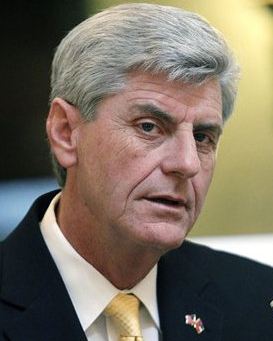
Gov. Bryant
Mississippi: Gov. Phil Bryant is looking to expand school choice next year, announcing proposals last week for tax credit scholarships and more charter schools (Associated Press).
New Jersey: Students in New Jersey charter schools are outperforming their peers in traditional public schools, concludes a new Stanford study (Associated Press).
Tennessee: Key questions remain unanswered in a task force's voucher proposal, including the per-voucher value (The Tennessean). More from timesfreepress.com.
Florida: A failing Orange County charter school that paid its principal more than $500,000 as it was shutting down also paid her husband more than $460,000 during a five-year period (Orlando Sentinel). (more…)

