Editor’s note: Our friend, John E.Coons, has been a regular contributor over the years to Step Up For Students policy blogs. Shortly after the 2021 release of his latest book, “School Choice and Human Good,” he was featured in a podcastED interview hosted by Doug Tuthill, chief vision officer and past president of Step Up For Students.
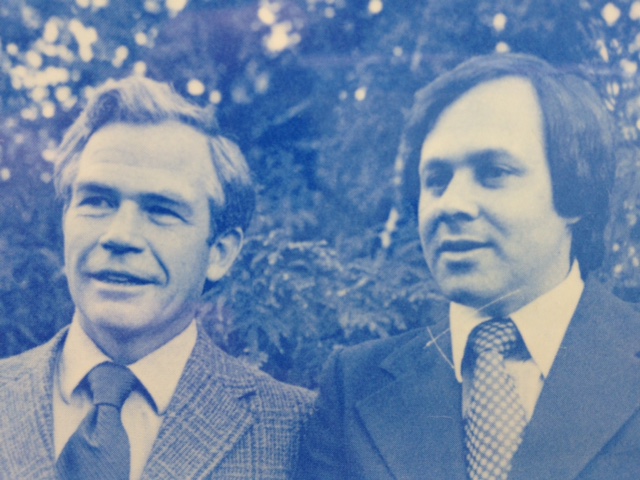
Berkeley Law professors Jack Coons and Stephen Sugarman, circa 1978.
Today is Jack Coons’ 95th birthday. Jack is a legend in the modern education choice movement. Along with former student and longtime colleague at the University of California Berkley Law School, the late Steve Sugarman, Jack wrote two books, "Private 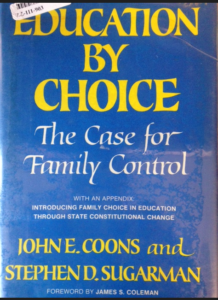 Wealth and Public Education" (1970) and "Education by Choice: The Case for Family Control" (1978). These works inform and inspire our efforts to improve public education by empowering families to access the best learning options for their children.
Jack is a devoted Catholic, a passionate advocate for underprivileged families and their children, and a strong believer in the Catholic concept of subsidiarity, which means decisions should be made at the most local level. Hence, his decades-long advocacy for parental empowerment and education choice, especially for lower-income and minority families.
While I have been honored to do education choice work with Jack for the past 15 years, it is our friendship and his amazing humanity that I value the most. He is the ultimate Renaissance man and speaks intelligently about a wide range of topics.
My favorite Jack Coons story occurred one night while we were having dinner in Berkley with several colleagues. The restaurant was full, and the conversation at our table had wandered onto the theater and various show tunes. Suddenly, Jack burst into song and captivated the entire restaurant for about a minute with his excellent baritone singing voice. The restaurant burst into applause when he finished, and Jack calmly continued with our conversation as if nothing had happened.
He was just living his life. Happy birthday, Jack.
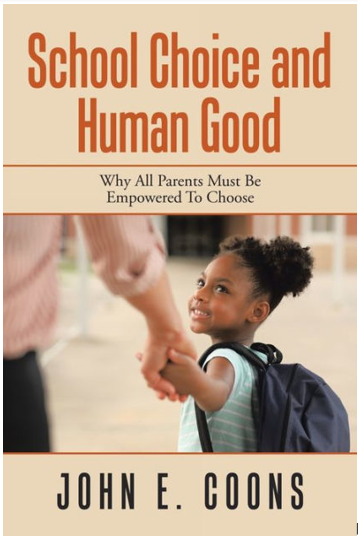 My doom-scroll through “war-breaks-out-in-Europe” news was happily interrupted this weekend by the arrival of Jack Coons new book, “School Choice and the Human Good.”
In the foreword to Coons’ collection of essays orignally published on redefinED/reminaginED,Ron Matus, director of policy and public affairs for Step Up For Students, notes:
Today, Jack Coons, 92, stands as the most thoughtful and prolific school choice advocate in American history. Over the past half century, he has articulated a rationale for choice that is grounded in human dignity and parental authority.
Allowing the state to consign low-income families to its whims through assigned schools, he argues, drives a wedge through that most sacred space between parent and child. “The family,” he writes in one of the posts in this compilation, “needs the chance to regain the muscle that atrophied when the state plucked its authority.”
Jack and his colleague Stephen Sugarman, as faculty at the UC Berkley School of Law, won the Serrano vs. Priest decisions in the California Supreme Court in 1971 and 1977, which created national momentum for states to equalize funding between poor and wealthy school districts. If Jack had turned his attention from education at that point, he could have justifiably exited the field as a champion of education equity.
He was, however, just getting started.
A year after winning the second Serrano case, Coons and Sugarman published “Education by Choice: The Case for Family Control.” Coons and Sugarman envisioned parents, including low-income parents, having the power to create “personally tailored education” for their children, using “divisible educational experiences.”
If this sounds like education savings accounts, it is only because it is exactly like education savings accounts, except it was 33 years before the first education savings account program.
“School Choice and the Human Good” is a feast of moral reasoning. Consider picking up a copy.
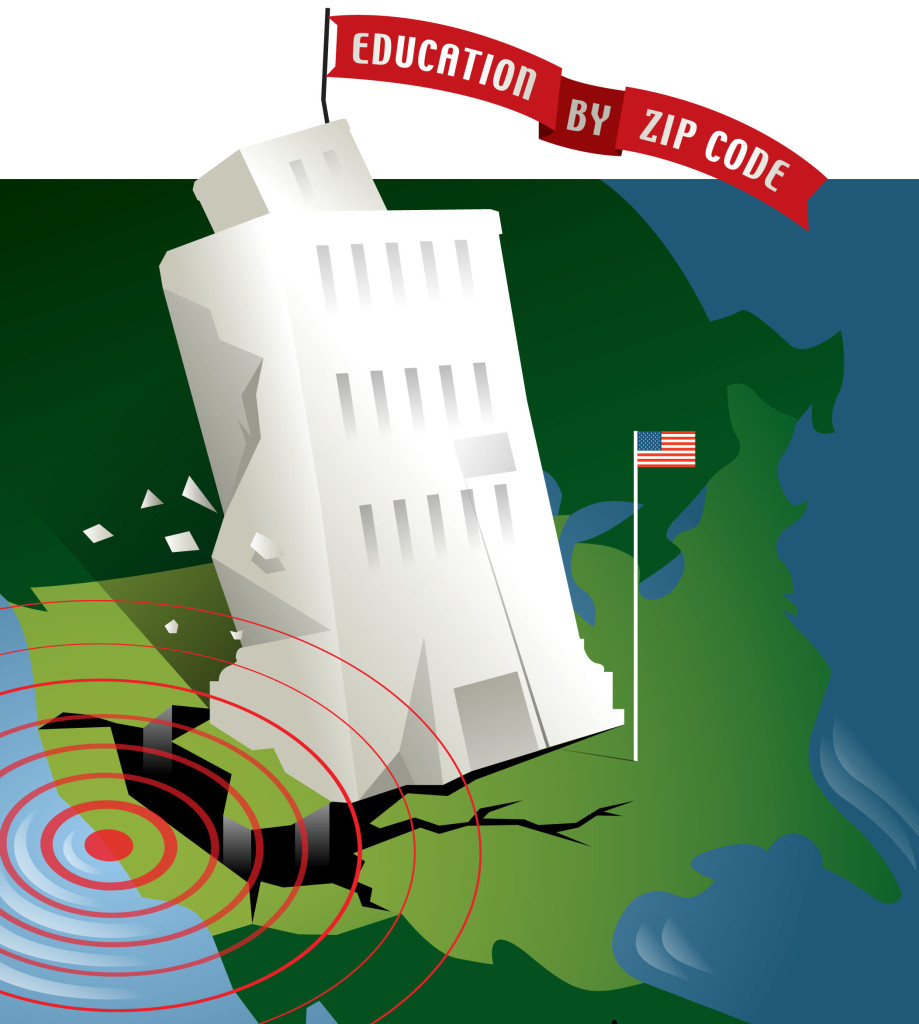
Illustration by Teresanne Cossetta Russell
Editor’s note: This month, redefinED is revisiting the best examples of our Voucher Left series, which focuses on the center-left roots of school choice. Today’s post from December 2015 describes efforts to put school vouchers on the 1980 California ballot.
This is the all-in-one version of our recent serial about efforts to put school vouchers on the 1980 California ballot. It's part of our ongoing series on the center-left roots of choice.
The woman stopped the professor as they were leaving church near campus.
It was the fall of 1978 in northern California, and Jack Coons was a local celebrity. Or at least as much a celebrity as you can be if you’re a legal scholar who specializes in education finance.
He and Stephen Sugarman, a fellow law professor at the University of California, Berkeley, had been central figures in a series of court decisions in the 1970s that would dictate a more equitable approach to how California funds its public schools.
They had also just written a provocative book.
It called for scrapping the existing system of public education, and replacing it with one that gave parents the power to choose schools – even private schools. This stuff about “vouchers” was out there, but intriguing enough to generate some buzz. Newsweek gave it a plug.
My cousin is Congressman Leo Ryan, the woman told Coons. He’s interested in education.
Why don’t you and your wife join us for dinner?
***
It sounds crazy, but that chance encounter could have changed the face of public education in America. For one wild year in late ‘70s California, liberal activists set the stage for the most dramatic expansion of school choice in U.S. history.
Today’s education partisans have no clue it almost happened. But it almost did. And if not for some remarkable twists of fate, it might have.
In the 1960s and ‘70s, school choice was capturing the imagination of progressives who thought poor kids were being savaged by elitist public schools. Liberal intellectuals in places like Harvard and Berkeley were happy to tinker with the notion of school vouchers encapsulated by conservative economist Milton Friedman in 1955. They tried to cultivate varieties that included controls they believed necessary to ensure fairness for low-income families.
John E. “Jack” Coons and Stephen D. Sugarman were among them. And in 1978, they unexpectedly got an opening to put their vision of school choice on the ballot in the biggest state in America.
It started with the dinner invitation.
***
Cue “Staying Alive.”
Disco was king. Jimmy Carter was president. And across the bay from Berkeley, the punk band Dead Kennedys was blasting its first angry chords. But in 1978, Coons and Sugarman still hadn’t gotten the carbon-copy memo that the ‘60s were over.
The ballot initiative they detailed in their 1978 book, “Education by Choice,” wasn’t gradual change, organic growth, nibbling at the edges.
It was revolution. (more…)
Belief has never, for me, been a matter of choice.
A natural universe entails a transcendent (if misty) creator. Even in these times of STEM, from nothing comes nothing. And yet, more than a few human minds, some quite celebrated, simply shun that first principle of the very rationality they strive to personify.
In recent years, I’ve subscribed to the atheist magazine Skeptical Inquirer hoping to better understand this intellectual boycott of the origin of all things “natural.” I even offered an essay of my own, hoping to stir conversation on the cognitive legitimacy of this taboo of theirs and thus play my own part as skeptic. The rejection was polite – maybe deserved. In any case, I grieve that the atheist intellectual finds it so threatening to let his mind glance back over the shoulder of his own natural self and run the risk of a surprise encounter.
The atheist’s denial of all but nature can seem a matter of intense emotion; the true unbeliever often appears as untamed by his conviction as is the believer by his. Recently, the New York Tines ran a full-page front-section Sunday ad celebrating non-belief and declaring that the scummy behavior of a number of Catholic clergy liberates all of us from belief in God. It would seem divinity itself is to be tested by the behavior of hypocrites who betray their own moral code. The bad priest is evil by his own professed standard and, therefore … God is dead: This is a sequitur?
The ad makes clear that the minds of its signatory atheists actually share many of these same moral precepts pretended by these phony clerics – while pursued in practice by the faithful. Unbelievers and believers alike applaud most of the same “goods” and those humans who strive to realize them. It is hard to credit the anti-God mind with full rationality in this reproach to belief. Right or wrong, there seems a good deal more than intelligence at work here.
But what have such appraisals of atheist thought to do with the availability of subsidized school choice for the poor? My own experience as a child makes me grieve that such families to this day remain the indentured clients of a curiously narrow-minded school curriculum.
Such intellectually muffled schools are, by law, forbidden to present a coherent picture of the “good life” or even of life itself. The teacher is forbidden to consider the question of the source of physical nature, and the mind of the child is invited to shrink. Darwin is properly welcomed to the student’s mind; evolution of the natural world is highly plausible. But if the student cannot be encouraged to consider how nature, including Darwin himself, came to be, the mind of the child has been cheated.
This is not an argument against government schools. It is simply the observation that the poor, as a matter of both reason and justice, should be given the same options that, in theory, the Constitution guarantees to all of us. If parents prefer the narrow picture of life available in PS 42, they should have their choice. But so also should those who prefer a curriculum that invites the mind to a less provincial view of realty.
God offers to every mind its choice between truth and repose.
-Emerson, intellect
Picking the school that will teach one’s child is a bracing experience, one not always without issue between the only two persons whose opinions count in American law – or between them and their child.
Where parents vary in their preference of school, the decision requires each to assess his or her own values. These can differ regarding religion, art, science, racial integration, music, athletics or teaching style and atmosphere. And, even if father and mother agree upon curriculum and style, they can divide on which available institution (or home school) would best serve their common objective.
In short, they behave as responsible humans working their way to a decision – even in the end, by the flip of a coin; and, if experience proves them wrong, they can start the process over and maybe get it right.
The solo parent experiences the same re-examinations of values, then must alone decide what is among the truly serious questions of most adult lives: How do I best serve this child of mine as together we face and prepare for the years ahead?
Strangely, in our nation, most parents of modest means will be denied such challenging personal experience. The child will be decided for by an abstraction: The State. No human being who knows and loves and hopes for Susie will decide for her; her fate will be settled by the accident of her family address within some “attendance zone” drawn by strangers from some other social world.
This never-never land of education will be the child’s experience for 180 days a year for 13 years. She will spend her days willy-nilly with teachers, some of whom she will admire and others she won’t. She will, by chance, be now content and next in misery. It won’t matter; this is it for her. Sad tales at the dinner table will be just that, nothing more. Her parents can neither rescue her nor usefully learn from this experience and seek something better. The whole family is stuck and impotent.
The effect upon these choiceless parents? I suppose one could imagine a few of them grateful for the child’s abduction and their own liberation by The State. Who needs to decide such things? Mom is spared, she need only deliver the child to PS 99, there to receive a cheery introduction and farewell from Miss Somebody. She and Susie’s father can then go home or to work and enjoy their acquittal from responsibility and authority.
Is this an enriching experience for them, for Susie and for the rest of us who witness our country’s liquidation of civic and personal duty for this most vulnerable part of our community, with its inevitable effects upon society itself? Is that effect overall positive? I find this hard to believe.
What could be the justification – the excuse – for this prostration of the poor? If society sees that choice is good for the middle class, why is servility best for the not-so-well-off parent and child and, in turn, for society writ large? Why doesn’t the spectacle of poverty call for our encouraging their dignity and responsibility instead of imposing an educational serfdom implying their irrelevance?
Are test scores the measure of some need for this prostration of the poor? Much of the academy and media appear convinced that they are the best measure of a school’s success; scores are, of course, the only “objective” evidence and very available. Many scholars of statistics seem to support our historic disabling of the poor, yet concede that inner-city kids have been doing slightly better on tests when enrolled in charter or private schools – or also by choice in highly selective “public” schools serving young geniuses. (See New York Times 3/19/19 and 3/23/19.) But this apparent success of choice, they say, is merely an effect of such converted schools’ ability to maintain some control over who among the poor get admitted.
Assume that this is true (the question is open), and further assume that this authentic choice for the more gifted is subtly harmful to test scores of those kids unselected by these charters and elite “public” schools. Should it not then follow that we cannot shrink from choice but rather must broaden such programs, perhaps raising test scores for all those children?
So long as these statistical differences remain both disputed and marginal, the test score infatuation appears largely an effect of the special convenience of these numbers to the critic. They are easy to obtain and report. Meanwhile, however, there is a much bigger, if non-numerical, game afoot in the crusade for parental choice. And the very biggest among these are the minds and souls of the parents and children themselves. It is hard to imagine a more effective instrument to maintain the servility and civic irresponsibility of human beings than the message: Don’t worry; we’ll take care of your child’s mind.
By contrast middle-class parents are allowed, encouraged and expected to worry; it is their responsibility, indeed a prized aspect of their human dignity. It is also their constitutional power and right, one that, for the poor, is snatched away simply because their poverty – their vulnerability – allows this dirty trick.
Is there any excuse for such a degrading tactic of our state governments? If society believes that freedom of choice for the middle class (and the very smart) is a good thing, why is servility to The State the best policy for the not-so-well-off parent and child, and for society? Why should the poor be barred from this experience so cherished by the bourgeoisie? The scheme does, of course, maintain the comfort of the teachers union, but can we find something more positive in its favor? I cannot.
If there be anything needed in American education, it is the recognition that no parent should be stripped of authority and responsibility because of her economic status; that no child should be required to witness parenthood as a feeble institution worthy only of pity and escape; and that no society should arrange its schools so as to convince its less monied parents that their authority and capacity are despised by the rest of us. It is a recipe for social disaster, one that may explain much of our current national angst. Let’s fix it.
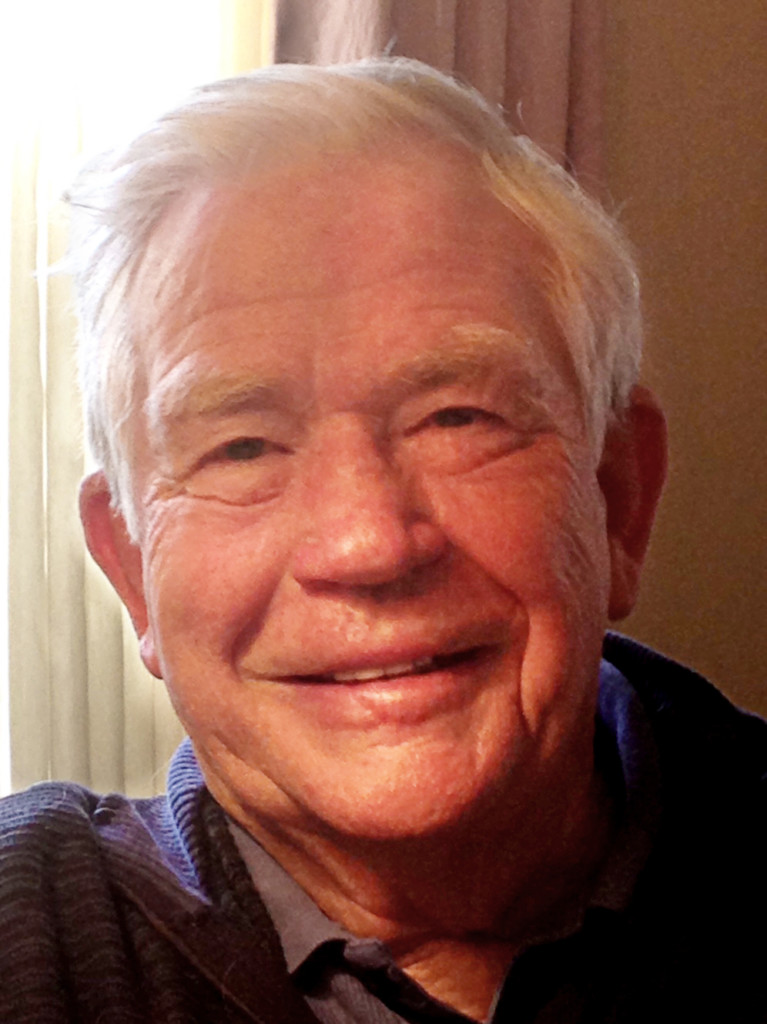
Jack Coons, pictured here, co-authored "Education by Choice" in 1978 with fellow Berkeley law professor Stephen Sugarman.
Law uses the term “right(s)” in various ways; in its most common version, the concept includes a sub-species called “power(s),” a word that I will deploy here: We say that a scoutmaster has the right and power to expel (or not) the miscreant young Henry from Troop 40; my drill sergeant had the power to make me do push-ups. In this brief essay I will suggest that, in dealing with children and families, it could be useful to understand the parents’ authority in this way as a subcategory of right, one quite distinct from what I will call a “pure” right.
That latter term will mean the freedom to engage (or not) in some action that does not diminish any right enjoyed by others. I may stand (or not) for the flag; I may read what I please, swim in the creek, choose my dinner, criticize the government, fly to Chicago. Others have their own right to criticize my choices but not to impede their exercise.
Powers are rights but more than this “pure” version; they do, indeed, diminish the rights of others. A contemporary legal dictionary defines power as follows: Dominance, control, or influence over another … the ability … to alter, by an act of will, the rights, duties, liabilities, or other legal relations … of another.
Could there be a clearer image of the parents’ relation to the child? The not-yet-18 boy or girl must obey a parent’s orders, whether they involve dessert, bedtime, prayers, football, driver’s license, or enrolling in the Joe Smith private school. The parent lays down the law.
Of course, parental power is not without limit. The child has pure rights that formal government is bound to protect; we say that the state has the legal duty to intervene under various circumstances such as physical abuse by, or sheer incapacity of, the parent. For such cases, the state, in the idiom of its own law, acts “in loco parentis”; it becomes mom and dad for basic protections until either things are put right at home or legal adoption of the child identifies a new mom and dad, thus relocating and reanimating the parental power.
Does this word play matter to an understanding of family law? I think it clarifies our discourse and helps the family defender portray to the politician and judge the unique role of parent as lawmaker, one quite distinct from, and in fact superior to, that of the state itself within the broad zone of parental sovereignty.
Further, it clarifies the reality that the source of this power, whatever it be, is not some written constitution, state or federal. Parents enjoy their unique status anterior to and quite apart from any “positive” law; formal government recognizes their status and concedes their authority, short of abuse. Not all American law gets enacted by formal government. Parents constitute 80 million true sovereignties over their minor children.
Has this reality any importance for the world of schooling? It should at least help to clarify our public discourse. To begin, all parents have, not merely the duty, but the legal right and power to choose a school for their child. Sadly, this country has arranged the enjoyment of this power-right for only some families, while deliberately frustrating it for others. It is quite fair to say that we have truly “public” schools for middle-class families like my own; we could afford to, and did, move within a block of the splendid John Muir Elementary in Berkeley, California.
A few blocks to the south, in less affluent neighborhoods, the parents’ power to choose was quite unnecessarily frustrated. According to my dictionary, their schools were anything but “a place to which the general public has a right to resort.” For enrollment in such inner-city schools, the appropriate term is not the “right to resort,” but rather, the “conscription” or “abduction” of the child. The parents’ power to choose has been deliberately and unnecessarily frustrated.
This system for drafting the poor had its origin in the class and religious prejudice of the 19th century. It has survived in large part as the device for protection of the managers of these condemned institutions and the bosses of their teachers unions. As Albert Shanker told me on several occasions, “I will start representing children when they start paying union dues” – which, by the way, each student truly does, providing jobs by his conscripted presence.
It is the lawyers’ duty to help clarify our public discourse about the moral and civic disaster maintained by our very deliberate economic hobbling of the low-income parent for the benefit of a union hierarchy. The power (and right) of every mother and father is a precious thing; and the purposeful confusion about the publicness of these “public” schools that frustrate parental choice needs clarification by the pens and voices of the media and the legal profession.
My wee contribution might be to suggest to the truly “public” lawyer a yet untried constitutional response to the civic tragedy of our schools. The Ninth Amendment in the Bill of Rights purports to protect “rights” that were not “enumerated” in the 1787 text of the Constitution. Some justices of the Supreme Court have taken the Ninth seriously for interests of a sort they felt to be especially deserving of federal protection; others on the court have regarded such “discoveries” as the fruit of an undefinable and dangerously open-ended concept.
Recall again that powers are themselves one form of legal “right.” Those of the parent just might escape these very plausible fears of the justices. The parental regime is, by a millennium or two, older than our constitutions, federal and state. It has since the 1920s been specifically recognized by the Supreme Court under the Due Process guarantee of the Fourteenth Amendment but has never quite escaped the shadow of its legal origin among long-discredited judicial protections of business interests under the same language. Still, the reality of the parental sovereignty is plain, both as right and as power. Poverty lawyers could be invoking the Ninth Amendment to challenge the state’s drafting of inner-city children by government strangers who benefit from their captive status.

Public teachers unions should swallow hard and concede the need for parental sovereignty, “even” for the poor.
There is nothing to prevent teachers unions starting their own charter schools. Indeed, here and there, a few have done so. Yet most union leaders constantly blast this option as “private” and “wasteful” and “un-American” and “segregationist” and . . . (fill in the blank).
At least one of these intended insults seems valid, but an unwitting compliment; most charters are essentially a private undertaking. The degree of their insularity from the “public” system varies depending on state law and the terms of their individual charters, but, after all, any separation of a school from the system in order to do it Joe Smith’s own way will make it more private than P.S. 666. That is the very point of the charter option.
Charters are competitive. Without student applications, there comes no money – and no school; with enough parent customers, it will flourish. Together, parent and school make private enterprise work as it is supposed to. The happy parent tells her neighbor, who tells her neighbor, and so on. Over time, a successful school may even become a collection of such schools strategically located; already, we witness this process in certain large cities.
Is this bad? If the families come to a school by free choice, I can’t think so. It is precisely what middle-class parents do by moving to the suburbs. In theory, we could worry about a private (instead of public) monopoly, but so far, the supply of charters, diverse in type, shows no end, and one good reason is plain. Education is not some unique rare metal. It is a product highly personal and diverse in style and designed (if allowed) to serve a range of parental tastes and their child’s specific needs. The school, of course, must meet some minimum and truly public standard. From there, the only question is whether it can satisfy enough parents to survive.
There are, thus, questions of design and practice. Should a school be free to refuse enrollment to the unpromising child who parents decide could most benefit from its style? And, on the other hand, must a school which is “successful” at academics arrange its own demise by becoming wholly unselective?
Since 1970, in books and essays, Stephen Sugarman and I have together addressed this issue of balance, proposing a variety of approaches to such regulation in very specific model statutes. Each has represented a different form of compromise by which the school could preserve its identity while accepting a number of students who, but for its charter form, would have been denied admission.
Schools that retain total control of admissions would not become charters, but same sex schools would be welcome. Charter schools, as the union complains, are essentially private, and the law should keep them so. One day the Supreme Court may recognize this, making the charter a very plausible constitutional option for the churches of the inner city.
There would, of course, be problems of adaption for such faith-based schools and for the state. Our models have detailed various compromises, for example, recognizing the schools’ duty, at least to some extent, to disregard parental belief when regulating admissions as, for example, by determining a third or half of invitations by lottery among all applicants still unchosen.
The dissenter should, however, if the school prefers, take and pass courses in the creed along with the believer, so long as neither belief nor sectarian behavior is required of the child, and he or she is treated with full respect.
Public teachers unions should swallow hard and concede the need for parental sovereignty, “even” for the poor. As presently established, these organizations are underequipped to serve choiceless low-income families. Instead, they serve the system by a form of bondage.

