The education system shortchanges disadvantaged students, and may violate their civil rights. But can a legal crusade to change the way teachers are hired, fired and assigned to schools fix that problem?
Drawing on the history of education-related civil rights litigation in California, David Boies, a lawyer leading the charge in Vergara v. California and similar lawsuits around the country, argues in a recent opinion column that the state's highest court should hear the case, which an appellate court recently rejected.
In 1971, the California Supreme Court intervened under similarly dire circumstances to invalidate California's school finance scheme. Five years later, the court had the courage to reaffirm the fundamental right to equality of educational opportunity under the California Constitution. By adhering to this bold commitment and recognizing education as a basic civil right, the Supreme Court paved the way for other states to adopt similar holdings.
Now the Vergara case presents the California Supreme Court with an important opportunity to reassert California's bold leadership in the fields of education and civil rights. The high court has an opportunity to correct the injustice of the Court of Appeal's decision, which overturned the trial court's landmark ruling in a flawed and disappointing retreat from California's historic commitment to educational opportunity.
Education researcher Doug Harris, however, argues the plaintiffs in the lawsuit have a tough road ahead of them. (more…)
Coons
Before he became one of the most prolific and thoughtful school choice advocates in America, Jack Coons was a law professor who did what he could to promote civil rights in the 1960s.
His work on potential legal snags with boycotts led to a meeting with Dr. Martin Luther King Jr. His conscience led him to Selma. He participated in demonstrations in Chicago after violence erupted over calls for fair housing.
Those experiences helped fuel the sustained push for school choice that Coons and fellow Berkeley law professor Stephen Sugarman began in the late 1960s and continue to this day. Much of it is detailed for the first time in a fresh set of recorded interviews for Berkeley’s Oral History Center.
The civil rights movement “certainly enhanced my spirit for the job,” Coons told interviewer Martin Meeker, the center’s associate director, for a 165-page transcript. “The work that Steve Sugarman and I have done over the years has been very much animated, I think, by our feeling about its application to families who just haven’t got any authority over their children, because they don’t have any money. They have to send them to some kind of school, that’s required, and so they have to send them to the local public school, which is a junk pile, intellectually and socially. Forgive me for all the good schools in the country that just got defamed, but it’s very much driven our interests.”
Readers of redefinED know Jack Coons. Now 86, he has written dozens of posts, echoing themes he sowed and cultivated over a half-century. Nobody emphasizes parental empowerment as a primary impulse for choice in education more than Coons. Nobody’s better at highlighting the implications for schooling and everything else.
Berkeley’s Oral History Center interviews folks who have made history or been witnesses to key events in California, the West and across America. It’s an honor for Coons to have been selected.
Sugarman is honored, too, with an interview that also sheds light on an earlier era in the choice movement – and how curiously at odds it is with current, common perception.
Critics and the press often suggest school choice is solely a Milton Friedman-inspired impulse from the “right.” Those on the “left” who give the Coons and Sugarman interviews a read will find worldviews not too different from their own. (more…)
This week, an appeals court overturned what had been a legal victory for nine public school children suing to change teacher tenure laws and dismissal procedures in California.
Why does this matter to people who care about school choice? For one thing, it's a setback, though far from a fatal one, to efforts to advance students' legal right to an equitable, high-quality education.
Prof. Jack Coons had more on this point after the trial court first ruled in parents' favor:
Though I consider California’s tenure system an abomination, it is an integral part of the global structure of a basically moribund system.
Its dissolution would be laudable but in fact would introduce similar new hurdles for equity. By empowering the administrator, we substitute one form of tyranny over the child for another. With the continuance of the frozen management structure, choice and retention of teachers may be no less random than today. The judgment of incompetence is both difficult and distasteful. The temptation is strong to avoid decision and assign the teacher to some harmless cloister. Still, I would be glad to see tenure go.
But the scene is tragi-comic, especially given the rational alternative available. I refer to the state’s empowerment of parents to make their own choice among schools, choices which, in a roughly consistent way, identify the good school and its good teachers. That judgment is one the parent makes strictly by the standard of this particular child’s best interest, not for the sake of a school district’s professional correctness.
Judge Treu’s decision may be a step in that direction. Though only obliquely, it raises the core question: who, in the end, is the proper locus of authority over the child. Vergara “empowers” the administrator-stranger, who may be simply another wrong place to locate this prerogative.
Meanwhile...
Charter schools: Segregation problem or segregation solution? Or is that beside the point?
There are good things happening in American public education. Perhaps we shouldn't care whether they can scale.
Anti-charter legislation dies in Louisiana. Pro-charter legislation is signed in Mississippi.
Gov. Rick Scott expands public-school open enrollment in Florida. The impact could be muted in choice-heavy South Florida.
The trouble with treating education like a civil rights issue.
The benefits of black-led charter schools.
A charter school tries its hand at restorative justice. Arkansas explores district-charter collaboration. Nevada gets serious about recruiting charters to low-income neighborhoods.
More on that charter school earnings/attainment study.
Quote of the Week
I have to do this to make his dreams happen. If he’s passionate about it, then I’m going to do whatever it takes in rain, sleet, snow, bus and bike. I’m going to make it happen.
— Detroit mom Monique Johnson, describing her son's extraordinary commute to find a better school.
Transportation deserves more attention from the school choice movement. Students also need more quality options close to home.
Tweet of the Week
Maybe opponents of school choice should consider this point..
This Week in School Choice is redefinED’s weekly roundup of national news related to educational options. It appears Monday mornings on the blog, but you can sign up here to get it Sunday. Please note, however, that we'll be taking the next two weeks off while our editor gets some much-needed R&R.
Did we miss something? Please send tips, links, suggestions and feedback to tpillow[at]sufs[dot]org.
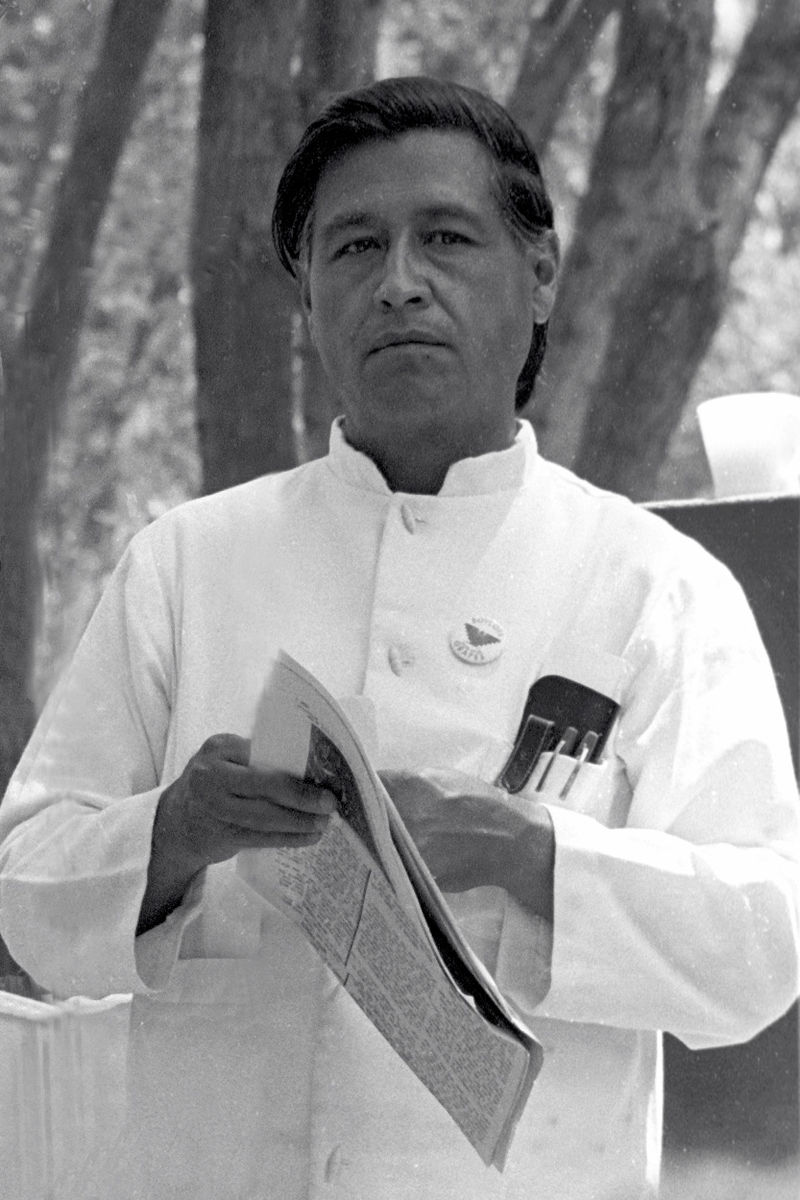
Cesar Chavez (image from Wkimedia Commons).
This is the latest post in our occasional series on the center-left roots of school choice.
More than 30 years ago, liberal activists working to get a revolutionary plan for school vouchers on the California ballot approached labor leader Cesar Chavez, according to one of those activists, Berkeley law Professor Jack Coons. The co-founder of the United Farm Workers (Si Se Puede!) told Coons he liked school choice, but as far as supporting it publicly, No se puede.
Doing so would put the teacher union’s generous financial support for his union at risk, he said.
Other evidence suggests Chavez wasn’t just politely telling a fellow traveler no. More on that in a sec. In the meantime, it’s worth noting the Chavez anecdote isn’t the only example of labor unions occasionally backing school choice or, in a few cases, outright distancing themselves from their teacher union brethren.
Consider:
To be sure, I’m not suggesting union alliances against choice are about to crumble, and I can’t pretend to know if extenuating circumstances led these unions to make a break. But I think it is fair to say these examples shed more light on the myth that only conservatives and libertarians see the value of having more educational options for kids. The Netherlands, a union-friendly nation, and a pretty liberal one at that, embraced one of the planet’s most complete systems of school choice a long time ago.
I also think it’s fair to suggest from these examples that teacher unions, like the NAACP, risk becoming increasingly isolated from traditional allies because of head-scratching positions that leave those allies on the outs with their kids.
In our back yard, more than 800 parents of students using tax credit scholarships in Florida work for public school districts, according to data from Step Up For Students.* Some of those parents are public school teachers. Some, in fact, are teacher union members. But because of the income eligibility requirements, I’d guess the majority are custodians, bus drivers and other blue-collar workers – workers represented by the likes of AFSCME and the SEIU.
If the Florida teacher union succeeds in its lawsuit to kill the scholarship program, some of its members may rejoice. But tens of thousands of parents, including hundreds in other labor unions, will be heartbroken. I can’t imagine how that would be good for solidarity.
Back to Cesar Chavez.
In the early 1970s, farm workers in Blythe, Calif. started their own on-a-shoestring private school because they were fed up with conditions in public schools. Parents met at the local United Farm Workers hall to get the ball rolling, as longtime choice advocate Alan Bonsteel notes in the 1997 book he co-authored, “A Choice for Our Children.” The father of the woman who would become the school’s director, Carmela Garnica, was a UFW organizer.
The Escuela de la Raza Unida became a community gem. Garnica, a Democrat, became a voucher proponent. Chavez became a frequent visitor.
Si se puede? For vouchers?
It’s not as farfetched as people think.
*Step Up For Students is a nonprofit that helps administer the state’s tax credit scholarship program. It also hosts this blog and pays my salary.
From another place I take my name.
— Edmund Spenser
The movement for school choice is principally a work of three quite distinct ideological camps:
(1) Those who would limit parental choice to public schools, typically through open enrollment and charters. Democrats for Education Reform is a leading promoter of this sort of reform that is limited to the government sector.
(2) Those who would subsidize choice among all schools — private and public, religious or secular. Parents would be financially empowered, and participating schools would seek a degree of economic class variety in admissions. This is the oldest of these types, dating to 1978; these activists label their vision “Centrist." The American Center for School Choice was a signal example.
(3) Activists favoring parental empowerment for tuition at all schools but typically leaving participating schools completely in control of admissions and recruiting policy and free to charge add-on tuition. The Friedman Foundation for Educational Choice is an example of those favoring such a seller-controlled market. Many among them prefer the title “libertarian.”
The media have at times dubbed the Centrists the “voucher left”; doubtless, if such a figure of speech is allowed, they third group in turn could be the “voucher right.”
The left-right cartoon amuses, and this blog has occasionally featured it; but it also diverts us from the nature of the significant differences among the three camps favoring some form of choice. I conclude that — barring the case of circles — “centers” do tend to be left of right; but anyone seeking clarity will object to the confusion that “left” causes in the present case considering that Democrats for Education Reform is to the “left” of the American Center. The only valid question is left of what, how far, and in what respects. The Center, so appraised, is left of the Friedman as Bernie is left of Hillary and she of Cruz on the right; which makes her what – a leftist? Think about it. (more…)
The apparent simplicity of Milton Friedman’s free market model of parental choice is truly appealing. Let the parent decide. Here’s the money. Go choose. This is efficient liberty in its purest form – and so simple.
Or is it?
Is subsidized parental choice analogous to my easy liberty to choose Butter Brickel at Safeway, or a Honda at the car dealer? I fear not. It is, rather, the decisions, not even of the intended consumer, but of an adult authority who imposes a thirteen-year, profoundly formative experience upon another human being, who happens to be his or her own child.
The parent issues the command; the child obeys, as does the school, which is bound by contract to harbor the child and to deliver the chosen brand of education. The arrangement is, thus, a choice of the parent and a form of obedience by the child. This, I suggest, is an odd example of free enterprise; it more resembles the choice of diet for the prisoners by the warden.
Does this observation imply that the market conception of parental choice is irrelevant to the debate? Of course not.
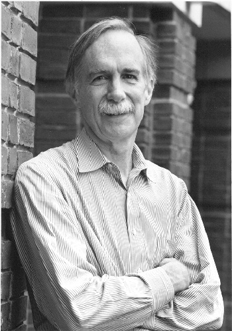
In 1968, Harvard sociologist Christopher Jencks, then a leading light of the Voucher Left, argued for universal school vouchers, primarily to benefit black students: " ... for those who value a pluralistic society, the fact that such a solution would, for the first time, give large numbers of non-Catholics a choice about where they send their children, ought, I think, to outweigh all other objections." (Image from www.hks.harvard.edu)
This is the latest installment in our series on the center-left roots of school choice.
School vouchers won’t drain money from public schools, won’t violate the Constitution, and won’t fray the social fabric. Ultimately, they should be supported by “those who value a pluralistic society.” So wrote liberal Harvard sociologist Christopher Jencks, once a leading light on the Voucher Left, in a lengthy 1968 essay in the New York Times Magazine.
Oh, how times have changed.
Too many of today’s progressives boo and hiss at school vouchers, thinking they’re a Koch brothers weapon to kill public education. They should be reminded, as often as possible, that some of their left-of-center brethren (like him, him and him) see vouchers through a radically different lens and that, in fact, this progressive view goes back decades.
Jencks’s 1968 essay, “Private Schools for Black Children,” is yet more evidence. In the 1960s and ‘70s, Jencks led the team that tried, as part of a federal experiment, to field-test school vouchers in a California school district. He concludes in his NYT piece that vouchers are necessary for political reasons, even if he doubts it will move the ball academically for black students.
Today’s school choice supporters would respectfully disagree on the academic piece, and they have the benefit of evidence (like this, this and this) that wasn’t there 50 years ago. Also and obviously, there are plenty of other good reasons to restore parental power over education, like those thoughtfully laid out by Berkeley Law Professor Jack Coons.
Conclusion aside, what’s striking about Jencks’s essay is how he brushes aside so many anti-choice arguments that so many modern progressives embrace.
Don’t school vouchers defy constitutional restrictions separating church and state? No, Jencks says. At the time of his essay, the U.S. Supreme Court hadn’t ruled on that question. (It would, in favor of vouchers, in 2002). But, writes Jencks, it’s reasonable to think there wouldn’t be constitutional objections as long as the vouchers are “earmarked to achieve specific public purposes … “ Public money flows to Catholic hospitals and Catholic universities, he notes. Why not Catholic K-12 schools? The selectivity question continues to dodge scrutiny. (more…)
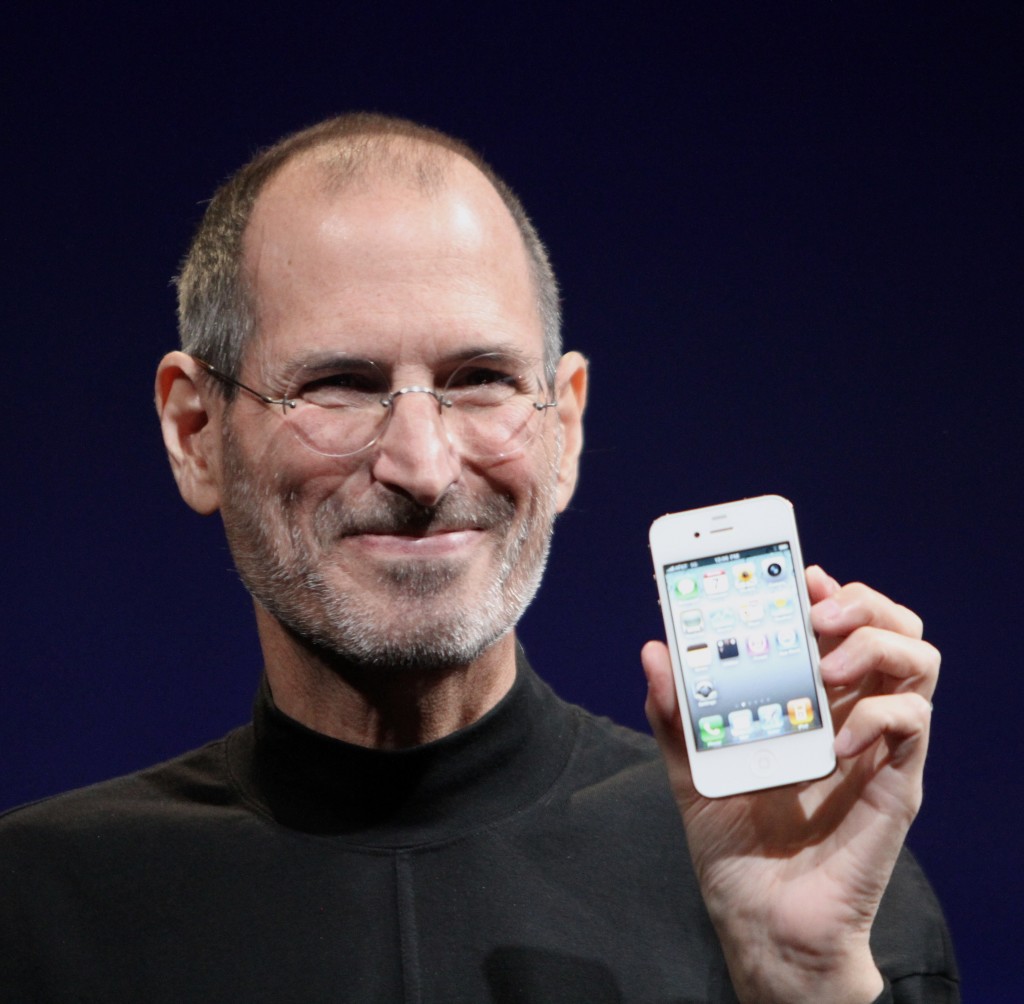
Steve Jobs (photo by Matthew Yohe, accessed from Wikimedia Commons)
This is the latest in our series on the Voucher Left.
Five years after his death, we’re still talking about Steve Jobs. The 2015 movie about him just won two Golden Globes, including one for Aaron Sorkin’s script. His quotes still spur stories. His connection to the San Francisco 49ers somehow inspired an angle for Super Bowl 50.
So now seems as good a time as any to highlight (as other folks rightly did after his death) that Jobs, the Apple visionary, was a passionate supporter for school vouchers, and to add what hasn’t been explicitly noted, which is that he was, by conventional perceptions, an especially liberal one.
Skeptical? Jobs, the adopted son of a repo man, took a deep, lifelong dive into Eastern religions. He cultivated an organic garden. He was pretty much vegan (and at one point, a fruitarian). In his younger days, he dropped a lot of acid, dropped out of college and went to work barefoot. For years, he avoided deodorant. His company was all in for gay rights. He couldn’t get enough of Bob Dylan. And the kicker to his most famous speech, his 2005 commencement address at Stanford, was a quote from the crunchy-granola “Whole Earth Catalog.”
To be clear, I don’t care if Jobs was “conservative” or “liberal.” But tribal politics being what they are, I know many people do put stock in labels, including folks on the left who have somehow come to believe that expanding opportunity through school choice is out of synch with their “progressive” values. So, for them, it’s worth noting what Jobs, this counterculture kind of guy, had to say about school choice:
I believe very strongly that if the country gave each parent a voucher for $4,400 dollars that they could only spend at any accredited school several things would happen. Number one schools would start marketing themselves like crazy to get students.
Secondly, I think you'd see a lot of new schools starting. I've suggested as an example, if you go to Stanford Business School, they have a public policy track; they could start a school administrator track. You could get a bunch of people coming out of college tying up with someone out of the business school, they could be starting their own school. You could have 25-year-old students out of college, very idealistic, full of energy instead of starting a Silicon Valley company, they'd start a school. I believe that they would do far better than any of our public schools would. The third thing you'd see is I believe, is the quality of schools again, just in a competitive marketplace, start to rise. Some of the schools would go broke. A lot of the public schools would go broke. There's no question about it.
It would be rather painful for the first several years, but far less painful I think than the kids going through the system as it is right now. The biggest complaint of course is that schools would pick off all the good kids and all the bad kids would be left to wallow together in either a private school or remnants of a public school system. To me that's like saying "Well, all the car manufacturers are going to make BMWs and Mercedes and nobody's going to make a $10,000 car." I think the most hotly competitive market right now is the $10,000 car area.
It’s worth reading Jobs’ remarks about public education in full (thanks to the Heartland Institute for culling them), because he also says interesting things about unions, monopolies, parents and consumers. For now, a few things worth noting …
First, as Jay P. Greene pointed out after Jobs died in October 2011, the Apple CEO made similar comments as late as 2007. So these snippets above, from a 1995 interview with the Smithsonian Institution, aren’t an anomaly.
Second, Jobs came of age in an era where parental choice wasn’t saddled as it is now with the “right wing” label slapped on by critics and sealed by the press. In fact, he and Cupertino, Calif.-based Apple would have been right there, at the epicenter of a voucher quake, when liberal Berkeley law professors Jack Coons and Stephen Sugarman led a late ‘70s effort to make school choice the law of the land in California. (more…)

Illustration by Teresanne Cossetta Russell
This is the all-in-one version of our recent serial about efforts to put school vouchers on the 1980 California ballot. It's part of our ongoing series on the center-left roots of choice.
The woman stopped the professor as they were leaving church near campus.
It was the fall of 1978 in northern California, and Jack Coons was a local celebrity. Or at least as much a celebrity as you can be if you’re a legal scholar who specializes in education finance.
He and Stephen Sugarman, a fellow law professor at the University of California, Berkeley, had been central figures in a series of court decisions in the 1970s that would dictate a more equitable approach to how California funds its public schools.
They had also just written a provocative book.
It called for scrapping the existing system of public education, and replacing it with one that gave parents the power to choose schools – even private schools. This stuff about “vouchers” was out there, but intriguing enough to generate some buzz. Newsweek gave it a plug.
My cousin is Congressman Leo Ryan, the woman told Coons. He’s interested in education.
Why don’t you and your wife join us for dinner?
***
It sounds crazy, but that chance encounter could have changed the face of public education in America. For one wild year in late ‘70s California, liberal activists set the stage for the most dramatic expansion of school choice in U.S. history.
Today’s education partisans have no clue it almost happened. But it almost did. And if not for some remarkable twists of fate, it might have.
In the 1960s and ‘70s, school choice was capturing the imagination of progressives who thought poor kids were being savaged by elitist public schools. Liberal intellectuals in places like Harvard and Berkeley were happy to tinker with the notion of school vouchers encapsulated by conservative economist Milton Friedman in 1955. They tried to cultivate varieties that included controls they believed necessary to ensure fairness for low-income families.
John E. “Jack” Coons and Stephen D. Sugarman were among them. And in 1978, they unexpectedly got an opening to put their vision of school choice on the ballot in the biggest state in America.
It started with the dinner invitation.
***
Cue “Staying Alive.”
Disco was king. Jimmy Carter was president. And across the bay from Berkeley, the punk band Dead Kennedys was blasting its first angry chords. But in 1978, Coons and Sugarman still hadn’t gotten the carbon-copy memo that the ‘60s were over.
The ballot initiative they detailed in their 1978 book, “Education by Choice,” wasn’t gradual change, organic growth, nibbling at the edges.
It was revolution. (more…)
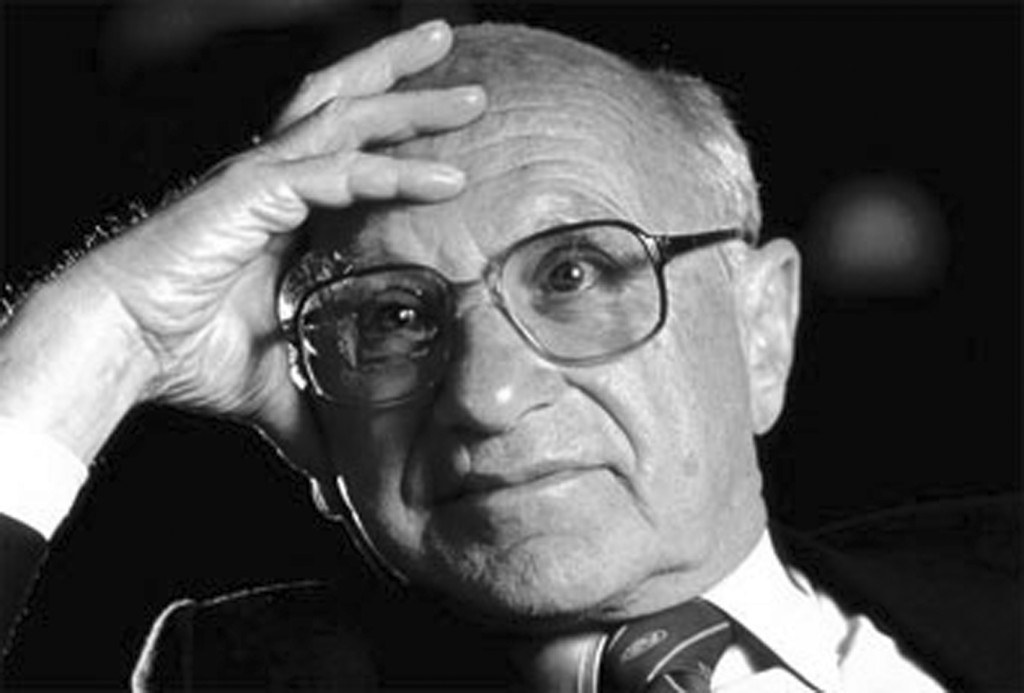
Milton Friedman
This is the latest installment in our series on the center-left roots of school choice, and Part III of a serial about school choice efforts in late ‘70s California. Part II included a closer look at U.S. Rep. Leo Ryan and the game-changing voucher plan he wants to push, while school boards and teachers unions came out swinging.
South of San Francisco, an electronics engineer and inventor in Redwood City read about the liberal-led California Initiative for Family Choice and thought: Disaster.
Not because it would kill the public school system. Because it would perpetuate it.
Jack Hickey saw too many regs, too little freedom, too much potential to “contaminate” private schools. He was certain the massive school choice plan engineered by Berkeley professors Jack Coons and Stephen Sugarman would curtail choice, not expand it.
“I looked at that and said, ‘That’s bad, that’s really bad,’ “ Hickey said in an interview.
Hickey wasn’t content to grump. The libertarian activist would eventually run for office 18 times, including for governor, U.S. Senate and U.S. House of Representatives. In this case, he nimbly sketched out a counter-proposal, something he called a “performance voucher.”
Then he and Roger Canfield, a police consultant in nearby San Mateo, began their own sprint to the ballot.
***
At the time of his meeting with Congressman Leo Ryan, Jack Coons was best known as one of the attorneys who changed how public schools are funded in California.
He and Stephen Sugarman were key players in a legal effort that began in 1968 with a widely publicized case, Serrano v. Priest. It charged that the way California financed public schools – by relying heavily on local property taxes, resulting in huge disparities between rich and poor districts – violated the Equal Protection Clause of the Fourteenth Amendment.
Over the course of a decade, Serrano led to three California Supreme Court rulings that spurred the state legislature to mitigate funding disparities between districts. It’s also credited with sparking school finance reform in other states, even though a ruling from a similar case in Texas was struck down in a 5-4 decision by the U.S. Supreme Court.
Coons’s embrace of school choice flowed, initially, from the funding inequities he saw. Ultimately, he and Sugarman, his protégé and intellectual partner, came to this conclusion: Giving poor parents more power to choose schools for their children best allowed them to rise above an entrenched education system blatantly rigged against them.
The professors first fleshed out their voucher idea in 1971, in a 118-page treatise for the California Law Journal. In the foreword, another Berkeley professor channeled a view about public schools that wasn’t uncommon for progressive thinkers of the era:
If a set of families enters a state park to go hiking, that group would be shocked indeed to discover that the scenic trails were reserved for its richer members and that only barren and rocky paths were held open for the poor. Nevertheless, our public schools operate in such a discriminatory way.
Not all choice enthusiasts looked primarily through that lens.
***
Like Coons and Sugarman, the libertarians wanted to end the old regime, not modify it.
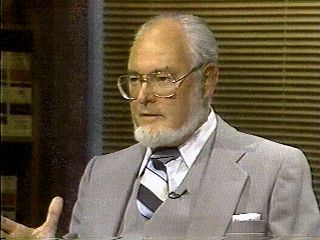
Libertarian Jack Hickey didn't like the Coons-Sugarman school choice proposal, and crafted a competing proposal for "performance vouchers."
Jack Hickey and Roger Canfield’s proposal would abolish government-run schools, end compulsory education and stop measuring academic progress merely by number of instructional days (wonks call that “seat time.”) Every parent would be given a voucher of equal value, $2,000 per year. (Per-pupil spending in California at the time was about $3,000 per year.) Through a contract with the state, the parents could spend the money on a school, on a teacher or teachers, on educational materials, or on any number of other things and combinations.
The performance voucher had, in the words of Hickey and Canfield, “divisibility.” In that respect, they, like Coons and Sugarman, foreshadowed today’s latest spin on vouchers – education savings accounts – years before think tanks fleshed them out.
But the performance voucher also had another irregular feature that made it distinct: It couldn’t be redeemed until the student showed progress, as determined by a standardized test.
No progress. No payment. (more…)

