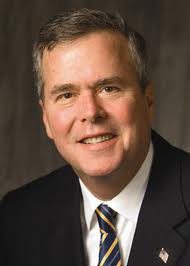
 Jeb Bush on FCAT, Common Core, bipartisanship. He tells StateImpact Florida, “Education is one of the few places where you have left-right coalitions that are for reform and left-right coalitions that are against reform. It’s not as monolithic as other areas of policy.”
Orange school board considers more school choice. It’s considering a policy that would allow students at over-capacity schools to enroll at under-capacity schools, reports the Orlando Sentinel.
More on charter school funding. Orlando Sentinel.
Charter school teacher raises. Represented by the Broward Teachers Union, the charter school teachers in the Pembroke Pines system win a raise through arbitration, reports the South Florida Sun-Sentinel.
Proposed cut scores. For biology and geometry end of course exams and FCAT science. From Gradebook. From Sentinel.
FEA talks teacher evaluations today. From the News Service of Florida: Members of the Florida Education Association discuss impacts of the new teacher evaluation system that was created as a result of SB 736 setting up merit pay. FEA President Andy Ford and teachers participate.
Discussions about how best to improve student learning often get contentious, so at redefinED we try to make a positive contribution by identifying areas of possible common ground and clarifying the historical record when we see errors or omissions. Rita M. Solnet’s recent Huffington Post column on how Florida might better utilize its standardized testing data gives us an opportunity to do both.
Rita is a founder of Parents Across America, a group that opposes excessive reliance on high-stakes standardized tests. And since Rita lives in Florida, she is particularly unhappy with how Florida uses – or, she would say, abuses - its state testing data. Rita ends her column with some ideas that provide the basis for common ground, but her piece also includes some erroneous Florida history, which I want to correct.
In 1991, the Florida Legislature passed the Education Reform and Accountability Act, commonly known as Blueprint 2000. Florida had experimented with giving teachers and schools more decision-making power in the late 1980s, and Blueprint 2000 was intended to accelerate this effort. The grand bargain was that state and local government would stop micromanaging schools in exchange for individual schools being held accountable for results.
While the legislation passed with strong bipartisan support, the primary advocates were all Democrats. They included Gov. Lawton Chiles, Lt. Gov. Buddy McKay, Commissioner of Education Betty Castor, Rep. Doug “Tim” Jamerson and Sen. George Kirkpatrick.
Two months after the legislation passed, the Florida Commission on Education Reform and Accountability was convened to create the legislatively mandated standards, assessments and accountability system. I was the teachers union president in Pinellas County in 1991, and Commissioner Castor appointed me to be one of three teacher representatives on the commission.
The U.S. Department of Labor released the Secretary of Labor's Commission on Achieving Necessary Skills (SCANS) report in June 1991, outlining the knowledge and skills students would need to succeed in the 21st Century. Our commission was impressed and decided to base Florida’s standards on the SCANS recommendations, which included literacy skills (reading, writing, mathematics), thinking skills (problem solving, decision making), personal qualities (honesty/integrity), resource management (time, money), information management (organizing, processing, interpreting), and technological competence.
Several commissioners argued that we could measure the SCANS standards using an International Baccalaureate-type assessment system that included multiple internal and external assessments, but the Florida Department of Education’s student testing staff strongly disagreed. Its concerns were legal and operational. (more…)

