
Editor’s note: Former Florida Gov. Jeb Bush, chairman and founder of the Foundation for Florida’s Future, issued the following statement in response to the filing of HB 1. The bill would significantly expand eligibility for education choice options to all K-12 students in Florida.
“The right to a publicly funded education is a promise our state makes to every student and yesterday, Speaker Paul Renner and members of the legislature took bold steps to ensure each and every Florida student can access the education of their choice.
“Florida stands on the monumental verge of restoring the original intent of publicly funding education – by funding individual students – so each child can reach their God-given potential. HB1 is a forward thinking and important move toward ensuring Florida remains the nation’s leader in student-centered solutions. I applaud Speaker Renner and the Florida House for their vision and leadership in creating this unmatched opportunity for Florida students and families.”
House Bill 1, released by Speaker Paul Renner and sponsored by Rep. Kaylee Tuck, will significantly expand school choice options for all Florida K-12 students.
You can read the full test of the bill here.
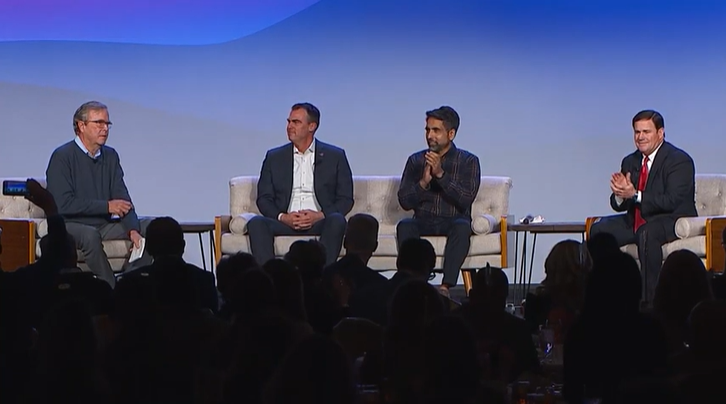
Former Florida Gov. Jeb Bush, far left, with Oklahoma Gov. Kevin Stitt, Kahn Academy CEO Sal Kahn, and Arizona Gov. Doug Ducey
Editor’s note: Former Florida Gov. Jeb Bush leads a discussion with Arizona Gov. Doug Ducey, Oklahoma Gov. Kevin Stitt, and Kahn Academy CEO Sal Khan for an inside look at the education innovations unfolding across the country.
In this video recorded as the keynote session at ExcelinEd’s recent education summit, Bush shines a light on Kahn World School’s groundbreaking partnership in Arizona with ASU Prep and the policies that can foster such innovations.
(You can read reimaginED senior writer Lisa Buie’s story about the partnership here.)
Bush also prompts Ducey and Stitt to discuss policy innovations unfolding in their states, how they overcame political obstacles, and their take on what the future holds for students and families.
You can watch the video here.
 Editor’s note: This commentary from former Florida Gov. Jeb Bush, founder and chairman of ExcelinEd and ExcelinEd in Action, appeared last week on wsj.com.
While much of the U.S. has returned to normal after the pandemic, the long-term academic harm to students endures.
This school year is the first time many public-school students returned to in-person learning without mask requirements or learning disruptions. That’s nearly 2½ years since the beginning of the pandemic. For younger children, that’s 25% or more of their lives so far.
Since March 2020, we’ve seen the largest learning loss in modern history. This catastrophe wasn’t inevitable. But what began as school closings in response to COVID-19 morphed into an intentional effort by teachers unions to block the schoolhouse door. On Monday, the 2022 National Assessment of Educational Progress scores will be released, and they are likely to be appalling.
(Editor’s note: You can read about the results here.)
This congressionally authorized 50-state analysis, officially styled the Nation’s Report Card, will show exactly how much U.S. students have fallen behind. Last month, the NAEP long-term trend assessment was released. That report found that between 2020 and 2022, average reading scores for 9-year-olds declined 5 points, nearly half a grade level, and math scores dropped 7 points, more than half a grade level. This is the greatest average score decline in reading since 1990, and the first ever score decline in mathematics.
The U.S. has a choice: Give up on a generation or confront this challenge head-on.
Some adults find it easier to give up. They won’t say it out loud; they’ll simply lower expectations. Or, they’ll explain away the drop in scores, blaming the pandemic when scores had already begun to decline before Covid hit. Rather than raise the bar, they’ll dodge accountability, allowing today’s low math and reading scores to become tomorrow’s ceiling.
That is unacceptable.
We can move forward rather than back. Doing so is a priority if the U.S. is to be a competitive nation in a competitive world. It also is a human necessity, as every student has God-given potential and deserves a great education.
The solutions are simple. There are math and reading policies every state should immediately enact and there are ways parents can contribute. Start with a call to all parents, guardians, and families—those who know their children best. You were called on to step up when Covid kept kids at home. Now you are needed again to help close those learning gaps.
Any trusted adult in a child’s life—parent, grandparent, uncle, aunt, whoever—should lean into this moment. Help students recover lost learning by reading for 20 minutes a day. That can be a parent reading to a child, a child reading to a parent or children reading to themselves. In addition, research has found that 30 minutes a week of extra math work can help students who are struggling or behind. If you aren’t up to writing math equations for your kids, seek out free, high-quality online math tools.
Lawmakers must step up, too. One way to help parents is eliminating the barriers students face in accessing a better education. This year, Arizona became a national model by creating a universal education savings account program with flexible, portable and customizable funding. That kind of legislation is transformative for student learning.
Early literacy is the foundation for long-term reading success. To ensure every child can read by the third grade and be ready to succeed in life, policy makers must ensure that all educators are trained in phonics and the science of reading—an evidence-based approach to teach the understanding of sounds, decoding, fluency, vocabulary and comprehension. This may require changing teacher-prep programs in colleges of education as well as installing literacy coaches in every elementary and middle school.
Literacy practices and curricula that fail to teach students how to decode words should be banned. Teaching models that include the “3-cueing” approach, which asks students to look at pictures and guess instead of sounding out words, should be scrapped. It’s a failed approach.
Every state should require that students be screened in reading three times a year in grades K-3 and offer assistance to those struggling to learn to read. These critical years are too often ignored until it’s too late to catch up.
The same is true for math instruction. States should ensure that students have access to trained, effective math teachers. That may mean not all elementary teachers should teach math, only those who specialize in it.
Students graduating from high school should have mastered at least Algebra I. Curriculum should have high-quality content focused on procedural and conceptual problem-solving skills and knowledge of whole numbers, fractions and geometry. Students who are behind need personalized math support, including tutoring two to three times a week.
Overcoming the pandemic-related education crisis is possible. For the next generation, we must abandon failed practices, rally around education excellence, and commit to helping children reach their full potential.
 The Thomas B. Fordham Institute’s Dale Chu provided an excellent summary of the reading controversies in the pages of the National Review in an article titled “Casualties of the Reading Wars.”
Chu walks readers through the research on reading methodology and outlines what might be described as a “poor reading industrial complex,” including but not limited to colleges of education, textbook publishers and many educators.
He opines, and I have never seen anything that would incline me to disagree, that proponents of “Whole Language” and the duplicitous rebrand of “Balanced Literacy” have proved themselves entirely unconcerned with research or evidence.
Citing progress on reading in Florida, and more recently Mississippi, Chu hopefully suggests: “But in the last few years, the momentum has been in the right direction. With a well-informed consensus on what constitutes effective reading instruction ascendant, an end to the reading wars could finally be in sight.”
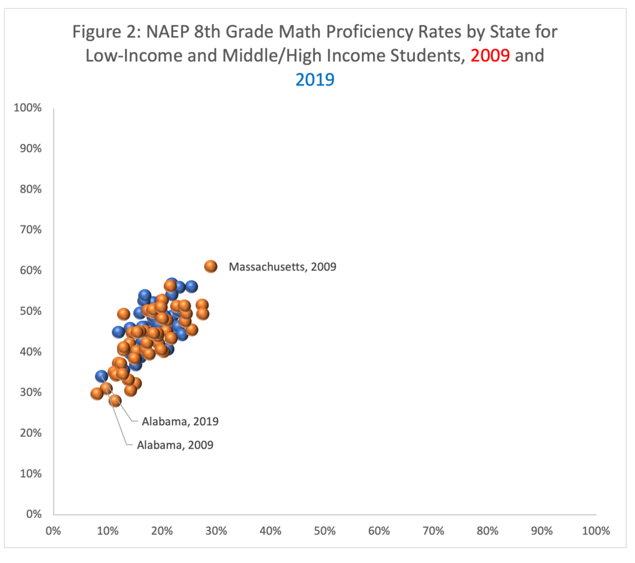
In a post for Empower Mississippi, I outlined the evidence on the last decade of NAEP progress in Mississippi. This chart plots math proficiency rates for poor and non-poor students. Every red dot is a state from the 2009 NAEP, every blue dot a state from 2019.
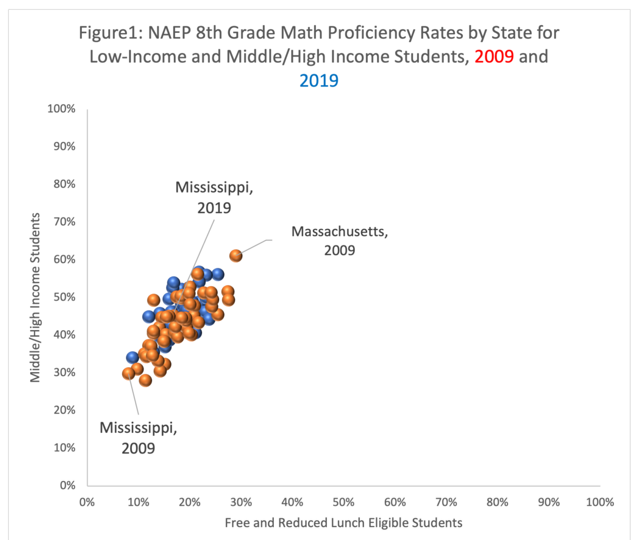
Ladies and gentlemen: That was indeed an impressive decade of improvement.
Just in case you think that regression to the mean is somehow inevitable, take a look at what happened in Alabama, Mississippi’s neighbor, during the same decade.
Is it time to unfurl the “Mission Accomplished” banner on our aircraft carrier? Possibly. Mississippi’s gains are indeed impressive. I live in Arizona, and I’d be pleased as punch to adopt scientific reading curriculum along these lines.
As former Florida Gov. Jeb Bush sagely notes: “Reform is never final and success is never finished.” The political coalition that spent decades keeping Mississippi’s success an isolated exception will actively seek to undo what has been done in the Magnolia State.
Chu accurately characterized the opponents of the “Science of Reading” and noted their immunity to research and evidence. The Science of Reading faction has been bringing evidence to a knife fight.
 Editor’s note: This commentary from William Mattox, a resident fellow at the James Madison Institute and a reimaginED guest blogger, originally appeared in the Summer 2022 issue of Education Next.
My son Richard has the chutzpah of Hank Greenberg, the greatest Jewish baseball player of all time. So, soon after we moved to Florida, Richard tried out for the baseball team at Tallahassee’s Leon High, even though he didn’t go to school there.
Richard was considered a home schooler at the time, but “hybrid schooler” would have been more accurate: He took classes from an online provider, a small private school, and a performing arts program.
Richard made the team, and by midseason lots of new baseball buddies were hanging around our house on weekends. Soon we discovered that Richard wasn’t the only “hybrid student” on the ball club that year.
Leon’s first baseman spent his mornings taking online courses through the Florida Virtual School, the knuckleball pitcher was taking a “dual enrollment” English class through the community college, and the left-handed pro prospect had enrolled in a financial management course at a local college (in case he was drafted).
Moreover, one of Leon’s outfielders had figured out an ingenious way to get a music education few families could afford out of pocket. This kid took mostly music classes at Leon by day and then several online courses at night and during the summer. He ended up being a four-time All-State musician and getting a college offer from Juilliard.
When I first encountered all these hybrid students, I figured there must be something in the water at Leon High. But I came to realize that many of these unconventional schooling options were the by-product of reforms former governor Jeb Bush had initiated, especially the creation of the Florida Virtual School.
The rise of hybrid schooling bodes well for students whose needs, gifts, interests, and learning styles do not align with the factory school model of the 20th century, and for parents who know that no school can maximize the potential of every child every year in every way.
There is a Magic School Bus, but no magic school.
Customized education is good for all kids and not just for academic reasons. Several years ago, Richard entered a local talent competition structured much like American Idol. Different singers would perform at big community gatherings and then people would vote for the ones they considered the best.
Richard kept advancing week after week, until on the night of the finals, one of the organizers took me aside and said, “I don’t get it. You guys just moved here a year or so ago, and yet Richard seems to have a really strong base of support.”
As Richard’s proud papa, I wanted to tell this guy, “Of course, Richard’s got lots of support—he’s the best one.” But I knew what this guy was getting at, so I explained, “See that guy over there? That’s Richard’s drama teacher at Young Actors Theatre. He gets all his thespian friends to vote for Richard.”
Then I said, “See that family over there? They know Richard from baseball. Those kids over there took classes with Richard at the classical Christian school. The college students way back there know Richard from Young Life youth ministry. And those kids over there are in the AP classes Richard is taking at Leon.”
The contest organizer realized that Richard’s social network was far larger than he’d expected. What I marveled at was how diverse his friendship network was. Gay. Straight. Christian. Non-Christian. Jocks. Thespians. Nerds. Cool kids. Richard’s friends reflect the diversity of his hybrid-schooling life.
Now, I’m not so naive as to think that hybrid schooling will eradicate high school cliques or classroom bullying. But customized schooling can offer kids a far richer, and more varied, social experience than they might otherwise get.
And when you add these social benefits to the educational advantages of customized schooling, you can see why I’m glad that Jeb Bush and other reformers had the Hank Greenberg–like chutzpah to change the way Florida does education.
 Editor’s note: Former Florida Gov. Jeb Bush advocates for teacher education reform to better improve the talent pipeline and encourage new educators in this opinion piece circulated by ExcelinEd, the organization for which he is founder and chairman. The commentary published originally in the Miami Herald.
Across the country, schools are struggling to hire enough teachers, and long-term trends suggest the problem could get worse. A number of factors contribute to this shortage, and even prior to the pandemic, the number of young people enrolling in traditional teacher preparation programs has been in decline since 2010.
We owe it to our nation’s 61 million students to reimagine how we support our hardworking, professional educators.
Here in Florida, Gov. Ron DeSantis and the Legislature included $800 million for teacher pay raises, and while teacher pay is one important component to attracting and retaining talent, elected officials and education leaders nationwide need to do more. Another critical barrier is the teacher preparedness and licensing process.
Today’s model is largely outdated, and it’s costly. Those interested in being teachers are required to spend years in college classes, then take their certification exams, before entering the classroom with maybe a semester’s worth of on-the-job training.
This system is not setting up these educators or the students they’re expected to serve for success. It forces new teachers to start their careers with tens of thousands of dollars in debt and little hands-on experience. The system prioritizes seat time with a professor in a college classroom over hands-on training alongside an experienced educator in an actual classroom.
Burdensome teacher preparation also keeps the diversity of our teacher workforce from keeping pace with the growing diversity of the country’s population. Research has shown that teacher preparation programs are less likely to attract aspiring Black and Hispanic teachers, who are more likely to follow non-traditional paths into the profession.
In Florida, 36% of public-school students, but just 17% of teachers, are Hispanic. And more than 21% of students, but just 14% of teachers, are Black — and other states see similar disparities. Thankfully, some states are building a better way.
Last Tuesday, I had the privilege of talking with Penny Schwinn, the state education commissioner of Tennessee, which earlier this year became the first state in the nation with a federally approved teacher apprenticeship program. Tennessee’s innovative approach allows future teachers to work with students in a classroom, receive coaching from experienced mentor teachers and be paid along the way.
The program is designed to allow the future teachers to obtain a bachelor’s degree in three years, debt-free, while being paid, and enter the teaching profession with at least three years’ classroom experience under their belt. All of which is paid for by leveraging federal funding for apprenticeships.
Schwinn designed the program by taking into account the barriers that often keep new and talented educators from entering the field: Graduating college with debt and entering the field feeling unprepared. The program is even attracting career-switchers like Nahil Andujar, who left her job at a healthcare company after discovering she loved working with kids. As she told an education-focused media outlet: “I wasn’t planning to become a teacher, but I noticed how a teacher could transform a student’s life.”
School districts that participate in the apprenticeship program partner with a local college or university — with the goal to recruit future educators from within the community they’ll serve. Each resident teacher, while paired with a mentor, receives at least 6,000 on-the-job learning hours in the program.
Upon graduation, the resident teacher becomes fully state certified teacher and receives full-time employment, with the requirement that the new teacher provide at least three years of teaching services. Other states, like Texas, are designing similar “grow-your-own” teacher preparation programs. It’s easy to see why.
This new approach to attracting talented professionals to the teaching profession is vital to the success of students. Florida reports critical teacher shortages in core subjects like English, math and science, as well as critical specialty areas, like English as a second language and special education.
Teacher apprenticeships can be one part of an effort to address these gaps, and part of a broader and bolder strategy to reimagine America’s teaching profession — to build a sustainable, long-term solution to recruiting the highest qualified professionals into the teaching field. States should create as many diverse pathways into the teaching field as possible, investing in alternative certification programs that attract more diverse pool of talent than traditional preparation programs.
But they should also explore proven policies that redefine who can teach and what teaching looks like. Professionals in other fields, doctors, lawyers and accountants have a choice: They can work for large public institutions, like hospitals. Or they can go into private practice, serving clients or patients on their own terms.
Indiana is working on a first-in-the-nation policy that would allow teachers to do the same, while retaining their pay and benefits through the state. The new law, which is in its initial phase, would allow teachers to contract with parents to design learning environments around an individual student’s needs.
Another new law in Indiana is similar to a policy offered here in Florida and would allow districts to hire adjunct teachers — professionals from outside education who want to share their skills with students. A retired engineer could teach an algebra class. A professional builder could spend an hour a day helping high school students earn industry credentials in their trade.
As school systems grapple with teacher shortages, communities across this country are full of talented people who would love to make a career helping students learn. Just as the future of education rests on reimagining education around individual students, the future also relies on reforming the teaching profession to better improve the talent pipeline and empower new educators with diverse pathways to the classroom.
Editor’s note: Former Florida Gov. Jeb Bush advocates for an “unbundled” education of the future after two years of disrupted schooling in this opinion piece circulated by ExcelinEd, the organization for which he is founder and chairman. The commentary published originally in the Miami Herald.
Last month marked two years since the pandemic swept across the country, causing the largest disruption to our nation’s education system in modern history. But at last, this spring brings an academic revival of sorts.
Schools are remaining open, mask mandates are disappearing and plexiglass dividers between students in their classrooms are coming down. In the rush to return to normal, we owe it to our nation’s children to emerge from this pandemic transformed, not by going backwards, but ready to forge a better future for them with all we’ve learned.
Our starting point is challenging. Prior to the pandemic, America’s public schools were struggling to serve the needs of students, and since the pandemic, a study by McKinsey found students have fallen months behind as a result of school closures and disruptions.
There were severe impacts on student mental health, too. Pew Charitable Trusts found students are reporting significantly increased levels of grief, anxiety and depression. It’s also no surprise that there’s a growing distrust in public education. A survey by Ipsos found trust in teachers declined during the pandemic, and there’s been a subsequent decrease in the number of students enrolling in public school.
Those are serious setbacks, but there are reasons for optimism. The pandemic put a spotlight on a myriad of possibilities for the future of education. Notably, it illustrated a desperate need by families for a broadened ecosystem of options for their children, with funding flexibility to create more equity in choice.
And it elevated the power of parents to blaze new educational pathways for their children. The Associated Press recently reported that homeschooling remains a popular choice for parents, despite schools reopening.
And, private schools and public charter schools have witnessed increased enrollment. But choice, in and of itself, isn’t enough. Policymakers must continue to seek new ways to unbundle education systems, transforming old approaches into new and better learning options.
In Indiana, lawmakers, led by House Speaker Todd Huston, took the first step toward creating the nation’s first “parent-teacher compact” law. This innovative policy would allow parents to directly hire teachers. Educators would continue to be paid by the state and receive their health and retirement benefits, but this policy would enable parents and educators to enter into a peer-to-peer relationship to benefit individual students, without the hurdle of a district middleman.
This individualized approach to education would give educators more freedom, families more flexibility and individual students the personalized experience they may need.
As we unbundle education, we need to reimagine all aspects of how education is delivered to students. One approach is enacting new part-time enrollment policies. Right now, students are defined by the school in which they’re enrolled. Lawmakers can improve the education experience by allowing students to have more flexibility, whereby a student can enroll in their local public school and easily access a portion of their education funding to also enroll part-time in a private school, with an online provider, or engage in another learning experience that benefits the child’s education.
Another approach that complements unbundling is rethinking education transportation options. Last year, Gov. Doug Ducey awarded $18 million in grants to modernize Arizona’s K-12 transportation system, including direct-to-family grants to help close transportation gaps.
In Oklahoma this year, Gov. Kevin Stitt proposed changing Oklahoma’s school transportation funding formula to expand how public school buses can serve students.
And Florida’s Legislature recently passed legislation to create a new $15 million transportation grant program that encourages districts to create innovate approaches to school transportation, including carpooling and ride sharing apps, for both school-of-choice families and traditional school students.
Those are just a few examples, and we must continually look for more ways to unbundle and reimagine education. The pandemic saw an explosion of families, in all communities and from all demographics, embrace micro schools, homeschooling and customized learning pods. Rather than trying to limit these families, we should give them access to direct funds to further personalize and benefit their child’s out-of-school learning experience.
That’s what Gov. Brad Little has championed in Idaho. In response to school closures in 2020, Little used federal emergency COVID relief funds to provide direct grants to families to support students who were no longer learning in school. And this year, Little signed the Empowering Parents Grant Program into law, giving qualifying families up to $3,000 to use for tutoring, educational material, digital devices or internet connectivity.
All of this and more is possible, but it requires policymakers to embrace something many have heard me repeat: Reform is never finished, and success is never final. Transforming our nation’s education system and ensuring students receive the individualized experience to unlock potential and lifelong success require continual forward momentum, especially after two years of disruptions. We have to keep moving, keep reimagining, keep transforming.
This commitment to excellence is a point of pride for Florida. Last year, Florida’s Legislature passed some of the most significant improvements and expansions to the state’s school-choice programs. And this year, lawmakers strengthened the charter school law, expanded the Florida Empowerment scholarship program, created a new financial literacy requirement for high school graduates and ensured parents are better informed of their child’s progress through online diagnostic progress monitoring and end-of-year summative tests.
Settling for familiar, traditional approaches to education shortchanges our children. They deserve more learning options today and skills for a future we’ve yet to imagine. Coming out of this pandemic, lawmakers across the country should embrace every student-centered policy possible and make year-after-year progress in transforming education the guaranteed way to improve their state, serve their constituents and deliver on the promise of a quality education for all their students.

