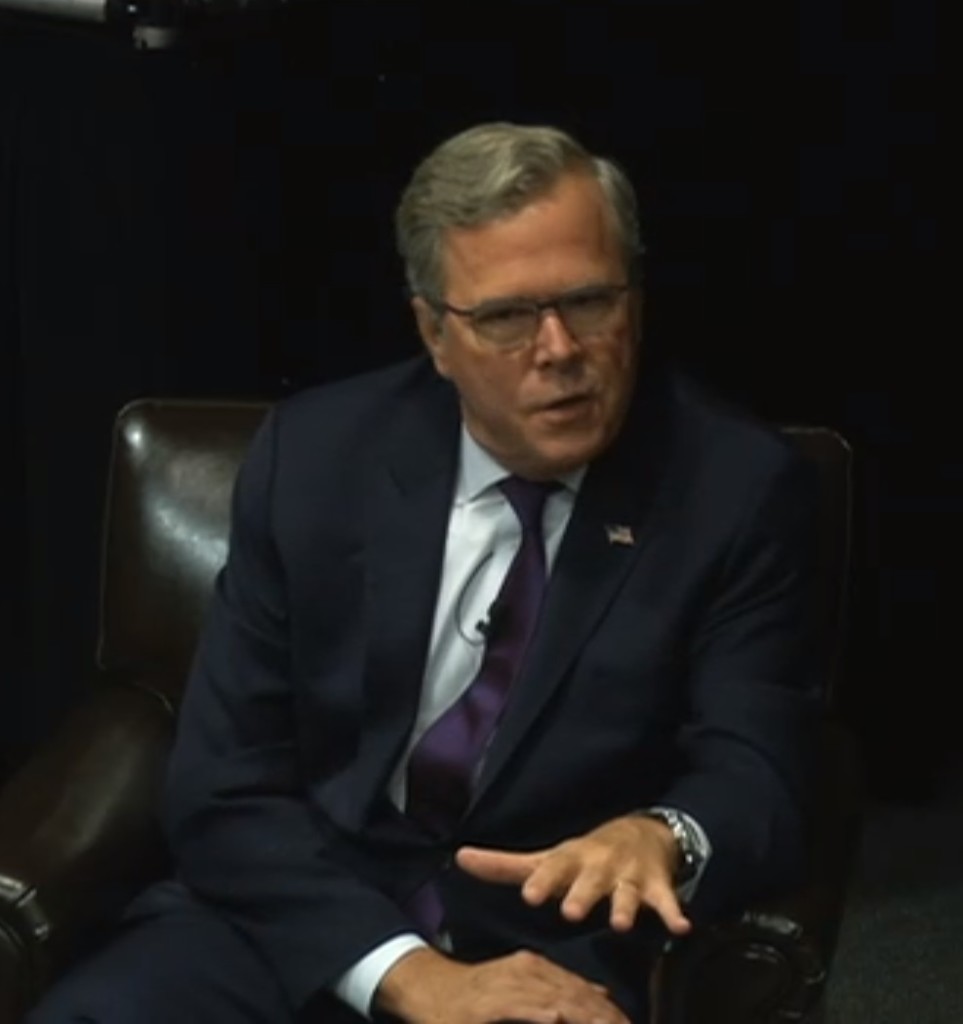
Former Florida Gov. Jeb Bush speaking with Florida House members during a rare visit to the Capitol in 2017.
On this episode, Tuthill and Bush look back at the 20-year history of the Florida Tax Credit Scholarship program and the education revolution that was launched with Bush’s A+ Plan, signed into law in June 1999 with the goal of toughening standards for teachers, students and schools.
The most controversial provision of Bush’s plan allowed students in failing public schools to obtain vouchers that would pay tuition and fees at participating private schools, including nonsectarian and religious institutions, which set off a firestorm of controversy.
Fast forwarding to 2022, when education choice has become normalized in Florida, Tuthill and Bush discuss their shared belief that the future of education choice lies in expansion of choice options for families, namely creation and availability of education savings accounts.
"We're transitioning, and the future [will look] very different from where we are today. Where we are today is dramatically different from 20 years ago. These transitions are not easy ... We can always do better, but we are way better off than we were 20 years ago."
EPISODE DETAILS:
 Editor’s note: This commentary from former Florida Gov. Jeb Bush appeared earlier this week on RealClear Education.
The past two years have shined a bright light on widespread inequalities in education. As state after state dealt with pandemic disruptions, we’ve seen painful reminders of what’s always existed: some kids have access to great schools, multiple options for learning, and abundant resources like computers and high-speed internet access, advanced courses, online classes, and modern buildings with science labs and excellent libraries.
And other kids are left behind, decade after decade, assigned to government-run underperforming and failing schools, without a chance for anything better. That’s painfully true in Michigan, where a student’s ability to move to a better school is limited by antiquated state laws that don’t serve the needs of each and every individual student.
Consider Michigan’s failure in teaching students to read according to the “Nation’s Report Card.” For a dozen years, Michigan’s 4th grade reading scores have been below the national average, and, in 2019, six out of 10 Michigan 4th graders were not proficient in reading. These scores touch all parts of Michigan, including the urban centers of Detroit, Flint, and Grand Rapids, and rural communities throughout the state. Math scores are below the national average, and there’s a growing achievement gap between white and Black students.
But why?
If we’ve learned one thing from the pandemic, it’s that our education system must be flexible and centered around students. A single, one-size-fits-all pathway for every kid will never deliver great results. A quality education that meets a child’s needs unlocks countless doors. It can break cycles of poverty, lift up communities, and help ensure all students can reach their God-given potential.
To read more, click here.

Daniel Martinez, former aide to Sen. Manny Diaz Jr., is Florida coalitions leader for the LIBRE Initiative.
As a kid whose family immigrated to the United States from Cuba in 1992, Daniel Martinez knows what it’s like to suddenly have choices after years of living without them.
He also knows it takes hard work to build the American dream from scratch.
“My mom taught herself cosmetology, and she’s a nail technician, so she would work from home to raise my brother and me,” said Martinez, a longtime legislative aide who recently was tapped to be Florida coalitions director of the LIBRE Initiative. “My mom, I believe, is the American dream.”
The LIBRE Initiative is the Hispanic-facing affiliate of Americans for Prosperity, a national grassroots activist group that espouses small government and greater individual freedom, including education choice. Earlier this year, Americans for Prosperity and LIBRE sponsored a six-figure public relations campaign to help pass the largest expansion of school choice in Florida’s history.
Martinez sees education choice as a key issue for all Floridians, but especially for the Hispanic community, whose members may not always live in the ZIP code of their dream district school.
“Too many people just send their kids there because ‘that’s where we go,’” said Martinez, who graduated from a South Florida district high school in 2000, two years before Florida Gov. Jeb Bush signed landmark legislation that established the Florida Tax Credit Scholarship Program. The program, which provides tax credits to corporate donors, funds scholarships for students who meet state income guidelines. Step Up For Students, which helps manage the scholarship program, hosts this blog.
Martinez sees his new role at LIBRE as a natural next step in his career after spending nine years working as a legislative aide for state Sen. Manny Diaz Jr., R-Hialeah.
While working at Publix, Marinez considered a career in business but discovered his passion for policy and politics while studying at Florida International University. Two of his professors, U.S. Sen. Marco Rubio, and another who worked as a pollster, held political discussions after class. Martinez rarely missed a session and devoured books on the subject.
In 2012, he found his niche as a volunteer for Diaz, who had just won his party’s primary for a House seat.
“That was like getting your master’s and your doctorate,” he said.
Martinez loved interacting with policymakers, lobbyists, parents and educators and signed on as Martinez’s aide after he won the seat. When Diaz won his state Senate seat in 2018, Martinez followed him.
“He’s like family,” he said of the former Senate education committee chairman. He said working with Diaz prepared him well for his role at LIBRE.
“While others might say, ‘Print something,’ or ‘Get me a soda,’ I was taught ‘You need to learn and be able to explain this because there is going to be a time when I can’t,’” he said. “Those are the tools that helped me so much. Leading LIBRE in Florida, my job is to create more leaders. We want more leaders for the next generation.”
For that to happen, he said, education freedom is paramount. Even in Florida, which already has one of the most robust choice programs in the United States, he said, “It’s not about whether we have school choice; it’s about how far do we want to go.”
As Martinez sees it, the goal is universal choice.
“Really, it’s about the erasing of district lines,” he said. “The money should follow the students.”
Martinez also is interested in homeschooling, learning pods and other innovative forms of education that involve unbundled services from various providers and which are made possible for all regardless of income through a choice system that uses flexible spending accounts, also known as education savings accounts or ESAs.
For him, learning doesn’t just happen in the classroom; it continues during tennis practice and music lessons and evening tutoring sessions.
“That to me is the ultimate endgame,” he said.
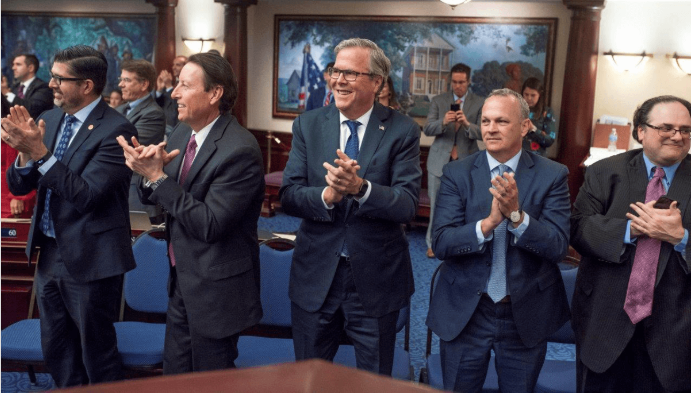
Former Florida Gov. Jeb Bush, center, applauds on the floor of the Florida House of Representatives after the passage of the Family Empowerment Scholarship program in 2019.
Twenty years ago, on June 13, 2001, Gov. Jeb Bush signed HB 21, a taxation relief bill that carried within it Florida’s third private school scholarship program. The program, then called the Florida Corporate Income Tax Credit Scholarship, would enroll its first students in the spring of 2002 and would grow to award more than 1 million scholarships by 2021.
But the Florida Tax Credit Scholarship was not destined to become the nation’s largest private school scholarship of its kind. In fact, it almost didn’t happen.
The bill carrying the program, SB 1048, was nearly killed on the second day of the legislative session. Politics, budget pressures, competing voucher ideas, the need to overhaul Florida’s election system after the debacle of the 2000 presidential election, and an anti-scholarship lawsuit looming overhead, meant the new scholarship’s future was far from certain.
The scholarship program was introduced under companion bills HB 271, sponsored by then-freshman Rep. Joe Negron (R-Stuart), and SB 1048, sponsored by Sen. Ken Pruitt (R-Port St. Lucie). Both versions allowed corporations to earn a dollar-for-dollar tax credit when donating to low-income scholarships.
The House version limited corporate donations to 75% of the taxes due but otherwise did not cap the total available tax credits. The Senate’s bill capped the program at $50 million in available tax credits and limited corporate donors to $200,000 in total tax credits annually.
The House version offered scholarships worth up to $4,000 for private school students, $1,000 for home education students, and $500 to cover transportation costs for students wishing to attend out-of-district public schools. The Senate’s bill offered no scholarships for home education, while the private school scholarship was worth $3,500. The public-school transportation scholarship remained the same.
Florida was spending $7,512 per pupil in public schools at the time according to the U.S. Department of Education.
Both bills limited scholarships to the more than 1 million students who were eligible for the National School Lunch Program, a federally assisted meal program operating in public and nonprofit private schools and residential childcare institutions.
School choice advocates quickly organized the handful of existing scholarship parents to meet with legislators, a move that put Democrats in a tough spot publicly.
“I personally resent the parading of Black parents through the halls of this Legislature and holding them up as examples of people who will receive vouchers,” Rep. Frederica Wilson (D-Miami) fired back. “I personally resent the stereotype.”[1]
But it was no stereotype.
 Those “parading” about the halls of the Legislature were parents of the 51 students on the Opportunity Scholarship in 2001, a program that offered scholarships to students attending public schools the state had given a letter grade of F. At the time, only students attending two high-poverty elementary schools in the entire state qualified, and most of those students happened to be Black.
The House moved swiftly before passing the bill 71-46 on March 8.
The Senate’s bill did not fare as well.
It nearly met disaster in the Senate Education Committee on March 7. Two Republicans, Sen. Alex Diaz de la Portilla of Miami and Sen. Donald Sullivan of Seminole, joined Democrats to vote down the scholarship bill 8-5.
Diaz de La Portilla argued the bill was “poorly written,” and cited confusion as to whether corporate donors could earn tax credits by buying books rather than funding private scholarships.[2]
Sullivan, however, would provide a way forward by moving to reconsider the vote, which according to the Associated Press, was “a procedural move that kept the bill alive.”[3]
The Senate’s scholarship bill would re-emerge in the Senate Education Committee on March 13, where it passed on a party line vote. It reached the Senate Finance and Taxation Committee on March 28 and again scraped by on a party line vote.
Despite passing in the House weeks before, the senate’s companion bill would linger on life support in the Appropriations Subcommittee on Education. By April 11, the bill was dead.
During this time, the Legislature had been negotiating with Bush over his priorities, which included eliminating the intangibles tax and $300 million in tax cuts.
Senators were unsure of where the money might come from. The proposed voucher programs could cost around $50 million or more, while fixing the electoral system could cost another $40 million. Other spending priorities also competed for tax dollars.
"The last couple of years it has sort of been his way or the highway," Sen. Jim King told the Associated Press about the legislature's relationship with the governor.[4]
Something would have to give.
The Legislature had been working on two other voucher bills, the smaller of which garnered the most attention and criticism. HB 303 and its Senate companion, SB 504, would create $3,000 private school scholarships for students attending overcrowded public schools.
Bill sponsor Rep. Carlos Lacasa (R-Miami) argued the program was necessary to relieve crowding because the state’s spending of $8.5 billion on school construction had failed to remedy the situation.[5]
An estimated 40,000 to 235,000 students would be eligible -- a fraction of those eligible under the tax credit scholarship bill.
“Here we see the main character, Hannibal Voucher, attempting to cannibalize our public school system,” Rep. Bob Henriquez (D-Tampa) said of the bill.[6]
Columnist Daniel Ruth called it the “Gutting Public School System Act.”[7]
Wilson, the representative from Miami, predicted public schools would still be struggling in five years, while Rep. Eleanor Sobel (D-Hollywood) argued it would be helping mostly children from well-off families.[8]
HB 303 passed the House 63-54 on March 21, 2001, but Senate President John McKay and Senate Education Committee Chair Pruitt had no intentions of moving the bill forward. The tax credit scholarship faced criticism too.
“The tax credit bill is a gimmick to get around potential constitutional pitfalls for existing voucher programs,” said Rep. Lois Frankel (D-West Palm Beach). “It’s very clever and very scary.”
“I don’t feel that taking money out of public schools is right,” said Sen. Ron Klein (D-Delray Beach), who sent his own children to private schools.
According to a Tampa Tribune survey at the time, legislative Democrats were more likely than Republicans (32% to 27%) to send their own children to private schools.[9]
By April 24, the specter of a voucher defeat in the Florida Supreme Court passed as the justices declined to hear the case and allowed the October 2000 First District Court of Appeal ruling to stand. That ruling declared the Opportunity Scholarship program did not violate the state’s “paramount duty” to fund public schools.
However, the tax credit scholarship still had no active bill in the Senate.
On May 4, during the waning hours in the last day of the 2001 session, Pruitt filed an amendment to HB 21, a bill that eliminated the intangibles tax, a priority of Bush. The amendment included a $50 million tax credit scholarship program with scholarships worth up to $3,500. The bill passed 25-14 at 8:30 p.m.
As the midnight deadline ticked closer, the bill was sent to the House, where it passed 72-44 at 9:45 p.m.
Bush would fulfill his promise to eliminate the intangibles tax and get $175 million in tax cuts -- and Florida would get a new tax credit scholarship program. Two decades later, the program would raise more than $4 billion to fund more than one million scholarships for low-income and working-class students.
It is a success that has never been duplicated by any other state -- and one that almost didn’t happen.
[1] Staff Writer. (March 9, 2001). School vouchers lawmaker says blacks are being stereotyped. Miami Herald.
[2] Twiddy, D. (March 7, 2001). Panel Rejects GOP Voucher Bill. Tallahassee Democrat.
[3] Staff Writer. (March 7, 2001). Bush’s priorities seem in jeopardy from start. Associated Press/Bradenton Herald.
[4] Kallestad, B. (March 6, 2001). Tax cut, vouchers and election reform agreement far away. Associated Press.
[5] Kleindienst, L. (February 21, 2001). Key house committee Oks voucher bill; foes said measure would let students avoid the state assessment test that public-school students take. Orlando Sentinel. See also, Hegarty, S. (March 18, 2001). Lawmakers debate 2 new voucher bills. St. Petersburg Times.
[6] Staff Writer. (February 10, 2001). House Democrats criticize school voucher plan. Florida Times-Union.
[7] Ruth, D. (February 9, 2001). A voucher is a voucher is a… Tampa Tribune.
[8] Hallifax, J. (March 22, 2001). Debate on the floor. Tallahassee Democrat.
[9] Feller, B. (April 10, 2001). Voucher views based on beliefs. Tampa Tribune.

 “Jeb!” Doc screams, leaping from the time machine. “You’ve got to come back with me!”
“Where?!”
“Back to the Future!” Doc replies as he scrambles through Jeb’s trash. “It’s the kids Jeb, something has got to be done about the kids!”
After completing a hovercar retrofit to his DeLorean in 2015, Doc travels back to 2006 for what he thought would be a relaxing Florida vacation. Instead, he discovers a surprise Florida Supreme Court decision that overturned his friend’s 1999 voucher program, the Opportunity Scholarship.
Having explained the future to Jeb, they would travel to 2001 to create a new scholarship program to evade the flawed but inevitable 2006 ruling.
Of course, this is nonsense, but many school choice opponents make a very similar argument.
But the ruling didn’t kill vouchers,” Frank Cerabino wrote of the 2006 Supreme Court cases in a Palm Beach Post column. “It just made voucher entrepreneurs more crafty and meant that the public dollars being siphoned to private — and often religious — schools would have to be managed with the same bit of clever opacity that drug dealers employ when laundering their riches.”
Somehow, a 2006 Florida Supreme Court ruling caused “voucher entrepreneurs” to get “more crafty” when they created the Florida Tax Credit Scholarship back in 2001.
Florida’s collective memory on Bush v. Holmes apparently has been lost. Here’s what actually happened.
Bush v. Holmes, a widely panned ruling, was decided on Jan. 5, 2006. The ruling struck down the Opportunity Scholarship, a private school voucher that served 734 students, 86% of whom were Black or Hispanic.
The Florida Tax Credit Scholarship, which was known as the Florida Corporate Income Tax Scholarship at the time, was pre-filed by the Florida House of Representatives on January 25, 2001. Gov. Jeb Bush signed it into law on June 13, 2001.
Not only was the program created years before the Florida Supreme Court ruling, but the program was debated and passed at a time when it was 100% constitutional!
In fact, school choice opponents actually were losing in court.
On Oct. 3, 2000 (114 days before the tax-credit scholarship was pre-filed with the House), the Florida Court of Appeal overturned Judge Smith’s lower court ruling. In a unanimous decision, the justices declared, “Article IX does not unalterably hitch the requirement to make adequate provision for education to a single, specified engine, that being the public school system.”
This was a rejection of the future Supreme Court’s 2006 ruling that the state’s paramount duty to public education meant the Legislature could provide no alternatives.
Best of all, the Florida Supreme Court actually agreed.
On April 24, 2001, by a 4-1 decision, it declined to hear the case and allowed the Court of Appeal ruling to stand. That was 10 days before the Florida Legislature passed the scholarship bill and 50 days before Jeb Bush signed it into law.
Ironically, Justices Pariente, Wells, Anstead and Lewis were the majority in 2001. Five years later, they’d make a surprise reversal by declaring the program unconstitutional on the very same constitutional issues they rejected years before.
Yes, you read that right.
 The very constitutional issues that overturned the Opportunity Scholarship in 2006 were not even in play when the new scholarship was created because the courts had tossed those arguments out.
Maybe Jeb knew this would happen because the Doc’s mindreading machine actually worked.
But that’s a conspiracy for another day.
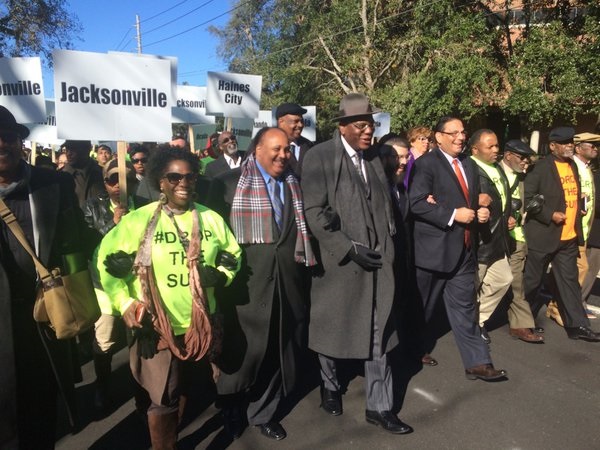
Martin Luther King III led a rally in January 2016 that drew more than 10,000 people to Tallahassee in support of education choice in response to a lawsuit brought by the Florida Education Association demanding that the courts shut down scholarship programs in the state.
Editor’s note: During the holiday season, redefinED is reprising the "best of the best" from our 2020 archives. This post originally published Oct. 14.
 Nearly two decades after Step Up For Students began awarding tax credit scholarships for lower-income students to fulfill their school choice dreams, the organization is marking another milestone: the funding of its 1-millionth scholarship.
Over the years, as the concept of education choice has evolved, the scholarship offerings managed by Step Up For Students have changed to fit families’ needs. Today, students can choose from a variety of offerings ranging from the original tax credit scholarship to a flexible spending account for students with special needs to scholarships for victims of bullying. There’s even a scholarship for public school students who need help with reading skills.
“I’ve said from the very beginning my goal was that someday every low-income and working-class family could choose the learning environment that is best for their children just like families with money already do,” said John F. Kirtley, founder of Step Up for Students, the state’s largest K-12 scholarship funding organization and host of this blog.
Kirtley started a private, nonprofit forerunner to Step Up For Students in 1998 and since then has experienced all the milestones and challenges leading up to the millionth scholarship.
At the beginning, “It was just me, and I had enough money to fund 350 scholarships,” recalled Kirtley, who can recite statistics about the scholarship program the way a baseball fan quotes facts and figures about a favorite player.
Soon after, he learned of a new national non-profit, the Children’s Scholarship Fund, started by John Walton of the famous retail family and Ted Forstmann, chairman and CEO of a Wall Street firm. Kirtley connected with that group, which was seeking to match funds raised by partners in different states for economically disadvantaged families to send their children to private schools of their choice.
“We hardly did any advertising at all,” Kirtley said. “It was just me walking around to churches and housing projects talking about the program.”
Truth be told, he didn’t need glitzy marketing. The program drew 12,000 applications in just four months, confirming what Kirtley already suspected: Parents of modest means wanted the best education for their children just as much as people who could afford to pay private school tuition or buy homes in desirable neighborhoods.
In 2001, Kirtley took his pitch to Gov. Jeb Bush, House Speaker Tom Feeney and Senate President John McKay, all of whom strongly supported the creation of the Florida Corporate Tax Credit Scholarship program. When the program, capped at $50 million, began awarding scholarships worth $3,500 in 2002, there were just 15,000 scholarship students. Joe Negron, who sponsored the bill while serving as a state representative and later supported scholarship expansion as a state senator, recalled the strategy he employed to get the bill passed.
“My best argument was that the liberal establishment also supported school choice – for their children, but not for families with modest means,” said Negron, who is now a business executive. “In addition, the personal stories from parents whose students were benefitting from the privately funded program were very powerful.”
High demand created wait lists, prompting lawmakers to raise the cap to $88 million in 2005. The next year, the award increased from $3,500 to $3,750. The state required students to take a nationally norm-referenced test to ensure accountability.
Families kept coming. By 2009, the cap stood at $118 million, with awards at $3,950. Despite the increases, the state’s Office of Program Policy Analysis and Government Accountability reported that the program had saved taxpayers $38.9 million in 2007-08.
Shortly after the program was renamed the Florida Tax Credit Scholarship, the first state-commissioned evaluation report showed students on the program in 2007-08 experienced learning gains at the same pace as all students nationally. Then in 2010, with bipartisan support, the Legislature approved a major expansion of the program. The bill allowed tax credits for alcoholic beverage excise, direct pay sales and use, and oil and gas severance taxes. The program also could grow with demand.
The Legislature returned again in 2014 to provide another significant boost in response to growing demand, prompting the Florida Education Association, the state’s largest teachers’ union, to bring a lawsuit demanding that the courts shut down the program. Education choice supporters responded with a rally that drew more than 10,000 people to the steps of the state Capitol, including Martin Luther King III, son of civil rights icon Rev. Martin Luther King Jr.
King told the crowd, more than 1,000 of whom had ridden buses all night from Miami to attend: “Ultimately, if the courts have to decide, the courts will be on the side of justice. Because this is about justice, this is about freedom—the freedom to choose what’s best for your family, and your child.”
The lawsuit failed in two lower courts and ultimately was rejected by the Florida Supreme Court in 2017.
The Tax Credit Scholarship was joined in 2014 by an attempt to give educational flexibility to students with severe special needs. Florida became the second state in the nation after Arizona to offer educational savings accounts to such students. Named the Gardiner Scholarship program in 2016 in honor of state Sen. Andy Gardiner, a strong supporter who shepherded the bill through the legislative process, the accounts could be used to reimburse parents for therapies or other educational needs for their children.
The state set aside $18.4 million for the program, enough for an estimated 1,800 students. A scant three months later, 1,000 scholarships had been awarded, and parents had started another nearly 3,700 applications. By 2019, the program was serving more than 10,000 students, making it the largest program of its kind in the nation.
Understanding the need for expanding the program so more families could participate, Gov. Ron DeSantis in 2020 approved a $42 million increase to the program, bringing the total allocation to nearly $190 million. The program which served 14,000 students during the 2019-20 school year, expects to serve approximately 17,000 students during the 2020-21 school year.
Choice programs also expanded in 2018 to help two groups of students dealing with challenges. The Hope Scholarship program became the first of its kind in the nation to offer relief to victims of bullying by allowing them to leave their public school for a participating private school. Reading Scholarship Accounts were aimed at helping public elementary school students who were struggling with reading.
Meanwhile, growing demand among lower-income families for Florida Tax Credit Scholarships prompted the Legislature to create the Family Empowerment Scholarship program in 2019. The program operates similarly to the tax credit scholarship program but is funded through the state budget.
Today, the five scholarships serve approximately 150,000 Florida students. As the number of students in the programs has grown, so have educational options available to them.
Charter schools, magnet schools, homeschools and co-ops, learning pods and micro-schools all address different needs. About 40% of students in Florida now choose an option other than their traditional zoned schools. In the Miami Dade district, the state’s largest, that figure is more than 70%.
Step Up For Students founder Kirtley sees a vital need to keep pace with that evolution and to eliminate the inequities these new programs can create for those of modest means.
“I have changed my stated goal to ‘Every lower-income and working-class family can customize their children’s education so they reach their full potential,’ ” Kirtley said, “just like families with more money do.”

