The financial crisis ahead gives state lawmakers the chance to reconsider notoriously complicated school spending formulas to get the most out of available resources and to consider alternative options, such as education savings accounts, that put spending decisions in the hands of families.
Editor’s note: This post from redefinED guest blogger Jonathan Butcher published earlier this week on The Federalist.
With students quarantined at home, is this really the right time for a movie about public school fraud? You bet.
After getting an extra $13.5 billion in March’s “Phase 3” stimulus bill, the education lobby is now asking Congress for another $175 billion as it ponders a Phase 4 bill. With that kind of money on the line—about three times Washington’s annual K-12 funding—a film on school fraud should be considered essential viewing.
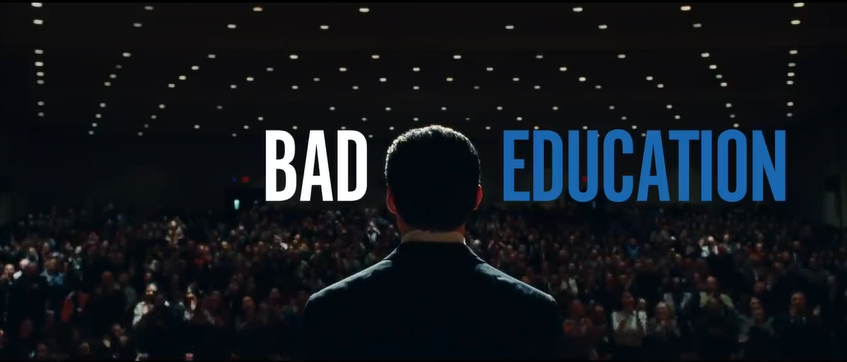
HBO’s “Bad Education,” released April 25, dramatizes a real-life incident of school funds embezzlement in Roslyn, Long Island. In telling the tale, the film indicts an entire education system, one plagued with a morass of forms to fill out and weak oversight that makes it easy for school bureaucrats to fudge the numbers and pay for a beach house, a sports car, and more.
As the plot unfolds, the school district auditor tells Hugh Jackman’s character that the state comptroller could “barge in this office at any given moment” to review their finances.
“Has he ever done that in your 30 years of experience?” Jackman’s character, district superintendent Frank Tassone, asks. The auditor shakes his head.
“Exactly,” Tassone says.
To read more, go to https://thefederalist.com/2020/05/04/bad-education-underscores-why-public-schools-shouldnt-get-big-bailouts/.
 Robert C. Enlow at Ed Choice crunched some numbers on how things might look if 10 percent to 30 percent of private school students migrate to public schools this fall. The state-by-state analysis is not an unimaginable scenario, given our suddenly massive unemployment rate – one in five American workers currently are out of work.
Enlow points out what might happen if private school students can no longer attend those schools due either to their families’ financial hardships or due to drops in charitable giving that supports scholarships for students in need.
Click on this link and you’ll see that Florida is the fifth state from the top of the chart. The 10 percent scenario would cost the state an additional $161.5 million; the 30 percent scenario would precipitate a drift closer to half a billion in added costs.
The total state and local cost scenarios for Florida are $363 million and $1.1 billion for the 10 percent and 30 percent scenarios, respectively.
I use the term “added costs” rather than “increased revenue” because it is easy to estimate even from a distant patch of cactus that Florida is unlikely to have a lot of extra cash available next fall. Even if there were a spare billion dollars available, hospitals are in terrible shape (they make most of their money from elective procedures), universities around the country have begun closing and/or furloughing staff, and there is no telling what other calamities await.
Could K-12 enrollment go up and state funding go down? It’s hard to rule anything out in a world where oil producers pay people to carry away oil at a negative price.
Nationally, the 30 percent scenario looks like $10 billion in added costs at a time when state budgets will be under fantastic strain with a great many competing demands for funds. So public schools could get lots of new students and budget cuts at the same time if this goes poorly.
So, to our friends out there with lamentably traditional K-12 policy preferences, please be careful what you wish for – you might just get it.

