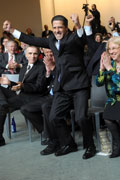
Miami-Dade Superintendent Alberto Carvalho reacts to the award announcement.
More Broad Prize coverage. As we noted yesterday, the Miami-Dade school district won this year’s Broad Prize, which goes to the urban district with the most academic progress. More from the Orlando Sentinel, Christian Science Monitor, Associated Press, Education Week. The Palm Beach school district was a finalist, which is also impressive. All this is more reason to routinely compare achievement data district by district in Florida. Also worth noting: Miami-Dade is a poster child for the new definition of public education, with a broad menu of learning options and huge numbers of parents embracing them.
Charter school issues in Volusia. The Volusia school board approves improvement plans for two F-rated charter schools, reports the Daytona Beach News Journal.
PTA doesn’t like it. The Florida PTA pans the Board of Education’s decision to set steeper improvement goals for low-income and minority students, reports the Gradebook blog.
More on Amendment 8. The Tampa Bay Times gets credit for going into detail about the legal case that’s at issue here – a case that has nothing to do with vouchers. ICYMI, our take on Amendment 8 here and here.
So the Democrat supports vouchers? In this state senate race in Central Florida, yes, notes the Orlando Sentinel.
 Florida’s next education commissioner will inherit a job that makes juggling chainsaws look easy. He or she must get under the hood of a complicated accountability system, ride herd on a historic shake-up of public education, dodge slings and arrows while walking a political tight rope and leap tall buildings in a single bound.
And yet, the job remains so compelling. Florida is the nation’s most promising bridge to an education system that can more fully give teachers and parents real power to help kids live out their dreams. In the last 10 to 15 years, no state has focused more on the low-income and minority students who are now a majority in Florida public schools. Simultaneously, no state has opened the door more to alternative learning options – options that have both empowered parents and multiplied the potential for educators to innovate. The result has been both dramatic and nowhere near enough. The next commissioner must find ways to continue the momentum.
To that end, we hope he or she can nimbly rotate hats long enough to also assume the role of explainer-in-chief. We know this won’t be easy; education reformers in Florida operate in an environment that is particularly tense and, in the past couple of years, has become downright ugly. But we can’t help but think that maybe, just maybe, the temperature will drop a few degrees if fair-minded people can be persuaded that not every education idea and not every education reform is a zero-sum proposition. Sometimes, they really can work in harmony with the other parts.
This is especially true with school choice. The sincere goal here isn’t “privatization,” it’s personalization. It’s about expanding options so more kids can be matched with settings that maximize their potential, and yes that includes private and faith-based options.
There’s no reason, and so far in Florida no demonstration, that these options have to come at the expense of traditional schools. It’s entirely possible – and many of us think it’s absolutely necessary – to support traditional public schools at the same time we push for additional options that, for individual students, may work better. (more…)
A few months ago, 13-year-old ninth-grader Giovanni Munnerlyn was in a public middle school in Tampa, Fla., being shuffled from one math class to another. He felt like giving up on the subject. His mom felt helpless. But last night, he and Mom (shown here) sat side by side in the computer lab at his new school, Gateway Christian Academy, taking on numbers that used to be his nemesis.
On the screen in front of him, math problems adding fractions were being served up by Khan Academy, the California-based phenomenon that is turning heads with its educational videos.
“Find the common denominator,” Giovanni said softly to himself before typing in an answer. The Khan Academy’s response: Smiley face. Giovanni squeezed his hand into a victory fist.
This little moment in a little school reflects a bigger project helping kids like Giovanni.
The new school year marks the beginning of a partnership between Khan Academy, which has drawn flattering coverage from “60 Minutes” and The New York Times, and Step Up For Students, the Florida nonprofit that administered 40,000 scholarships last year to low-income students. If I could narrate this story like Sal Khan narrates one of his videos, I’d say in his calming, authoritative voice, “Cutting-edge technology … plus school choice … equals more opportunity for low-income kids.” I’d use one of Khan's colored pens to underline the word “opportunity.”
The venture is one of only a handful that Khan Academy has forged with school systems nationwide. It’s the only one in the Tampa Bay area, and it’s the only one outside of California with a private school network. The pilot involves math instruction at 10 private schools in the Tampa area, all of which accept tax credit scholarships.
Khan Academy’s interactive tools, including thousands of short, engaging videos, are available for free to anyone who wishes to use them. But the partnership schools get additional materials so their teachers can even more effectively pinpoint where students are falling short – and then efficiently get them up to speed.
For schools in the Step Up partnership, there’s also a parental engagement piece. (more…)

