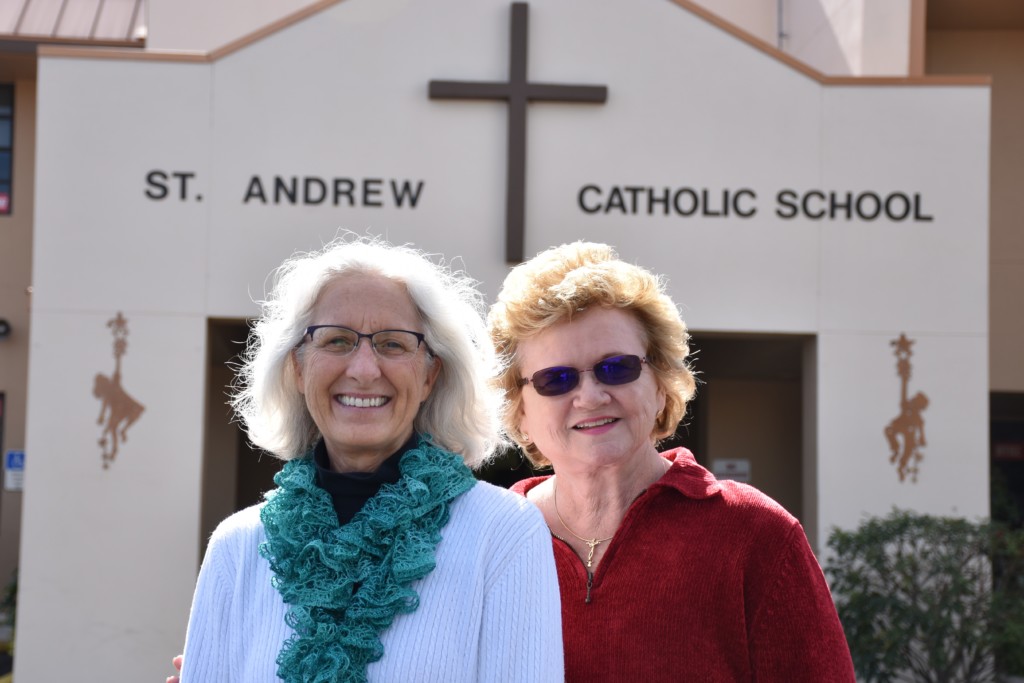
St. Andrew assistant principal Bambi Giles, left, and principal Judi Hughes worked together for more than four years in Lee and Collier county district schools
CAPE CORAL, Fla. – Judi Hughes is a serial retirer.
Nowhere is her quick wit more evident than when she explains why she came out of retirement a third time – after more than 40 years in the School District of Lee County – to be principal at St. Andrew Catholic School in this sprawling, sun-soaked suburban city.
“Irish Catholic guilt,” she says with a rhythmic chuckle, adding that she only had intended to help with the hiring process when the school drafted her.
Five years later, she’s still brimming with infectious energy that flashes from her baby blue eyes, and she’s found a way to marry her knack for building relationships with a natural instinct for being a private school administrator.
Some folks just aren’t meant to retire.
“I know!” she beams. “I’ve tried it a few times. I think I’m getting the hang of it now.”
Hughes did it all in Lee County public schools. A teacher in the county’s first middle school program, a principal, district director for elementary and secondary education. She opened a few schools, won blue ribbons and other awards, worked as a curriculum director in jails, retention centers, and drug rehabilitation centers before twice being coaxed out of retirement to start ninth-grade programs.
Now she’s the leader and beating heart of a thriving Catholic school – 315 K-8 students, up from 295 last year and 275 the year before – and she couldn’t be happier. Seventy-nine students use a Florida Tax Credit Scholarship for lower-income families. Step Up For Students, which hosts this blog, administers the scholarships.
“This place is just different, and it’s a pleasure,” she said during a recent tour. “These folks have known each other for years, but they welcome new people in. The understanding is that you join the culture of caring and building faith. Hearts and minds, it’s not just words in a mission statement. They pondered it. These teachers do more. They know every child by name.”
It’s no coincidence that Hughes and assistant principal Bambi Giles, who spent more than four years in Lee and Collier county schools, have hired educators with a similar public school background. Ten of the school’s 23 teachers, in fact.
It’s also no surprise that Hughes and those teachers have maintained their ties. For years, teachers at St. Andrews have participated in professional development with the Lee County district, learning about classroom management, teaching strategies and exceptional student education.
“Once you’re a member of the school district of Lee County, you’re part of our family,” said Lynn Harrell, executive director of leadership, professional development and recruitment for Lee County schools. “Judi was for lots and lots of years. That makes it just a little bit easier, just like in any family, to keep and maintain that relationship so that we’re working together. Because in the end, we’re all working for children.”
Hughes was a mentor to Harrell earlier in her career when Harrell was a school administrator. It’s just one of myriad relationships forged through years of work and trust and common goals.
“Our relationship with Lee County is really wonderful,” said Giles, noting the weight that Hughes’ name carries. “They are very professional. They’ll answer any questions. They’ll contact us. It’s never a problem.”
James Herzog, associate director for education with the Florida Conference of Catholic Bishops, is encouraged by this example of public-private school partnership.
“It shows that education is not an us-against-them proposition,” he said. “Instead it’s all about collaboration to benefit all of Florida’s school children. Hopefully we can encourage other schools and districts to work together.”
Every Wednesday at St. Andrew there is early dismissal for teachers to collaborate and do professional development.
“I just think that’s what runs everything,” Hughes said.
Some of those former public school educators at St. Andrew, like first-grade teacher Crystal Melton, get two emails every Monday morning about professional development offerings – one from Giles and one from a former public school mentor.
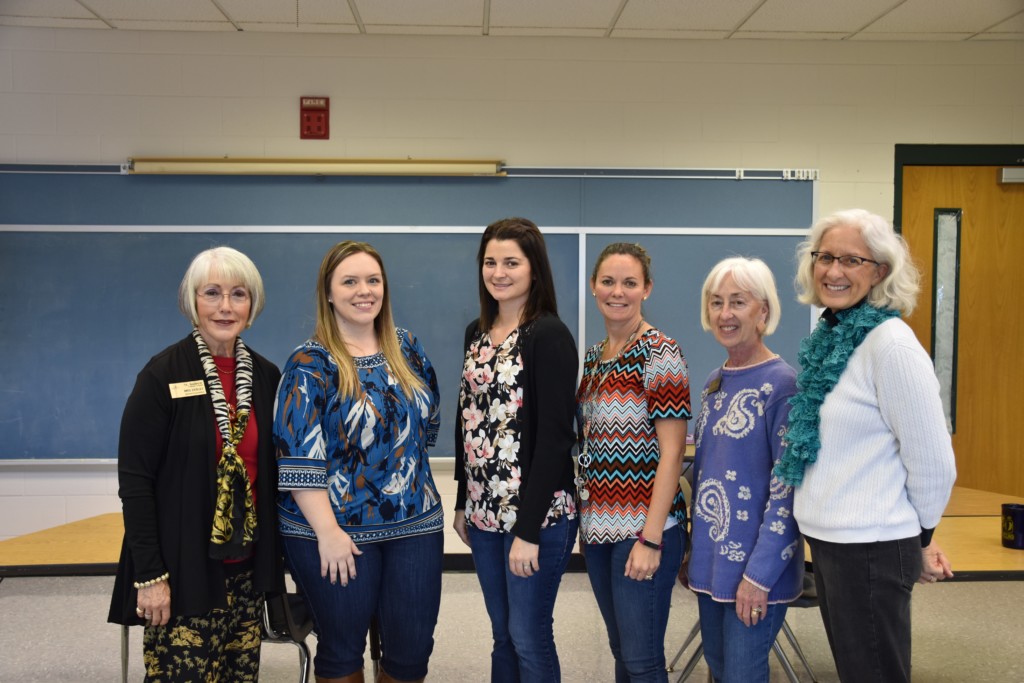
St. Andrew educators, from left, Sharon Zebley, Crystal Melton, Lisa Olson, Susie Loughren, Cathy Calcaterra and Bambi Giles, come together as a family to nurture students and each other.
This group-within-a-group of teachers has helped the members transition from public to private. They’re all grateful for the extensive training they received in the public school system, but they’re also quick to state their reasons for choosing to teach at a private school.
Music teacher Julius Davis simply feels more at home in a spiritual environment. Davis, in his first year at St. Andrew, said he feels “set free” to be himself and exude his principles. Christmastime was particularly satisfying after nearly 20 years in public schools.
“I grew up in a black Baptist church, and I’ve played (music) for Methodist churches,” he said. “Coming here, the emphasis on the spiritual, this is the first time I’ve been able to teach stuff I grew up with. I wasn’t allowed to do that in the public school.”
Others, like Melton, kindergarten teacher Susie Loughren, and fifth-grade teacher Lisa Olson, have children at St. Andrew. But while the family atmosphere contributes greatly to their happiness, their choice to teach in private school was more complex.
Loughren, in her second year at St. Andrew after seven years teaching in public schools, feels she can be more creative, has more freedom and less test anxiety.
“The administration trusts us that we’re going to do what’s best in the interests of those children,” she said. “So if something goes on in your classroom and you need to focus on a social, emotional skill, you take that liberty to do it. It’s not just about getting in the academic rigor. We do it on a daily basis, but we have the opportunity to stop and do those teachable moments.”
Hughes recognized that stress, saw the anxious teachers who were afraid to break from the mold, “afraid of their own shadow,” as she saw it. There was more and more emphasis on tests and fewer field trips.
At St. Andrew, she works to pump confidence and empowerment into her staff.
“I’m happy I made the choice to come here, because I didn’t end my teaching career at a time when things weren’t going as positively,” she said. “I felt the stress of the teachers and couldn’t do anything to help them. They were losing their identity, feeling like they don’t have any choice or any power.
“Here they are free to make sound educational choices. And they have to be sound, because they have to show how it’s going to help with the standards. We give them as much freedom as we can. And they really own part of this school.”
The students at the City of Palms Charter High School in Fort Myers, Fla., had good reason to be excited. In a few hours, buses would take them to Howl-O-Scream at Busch Gardens in Tampa. The annual trip rewards students who come to school regularly during the first months of the school year and complete some of their courses.
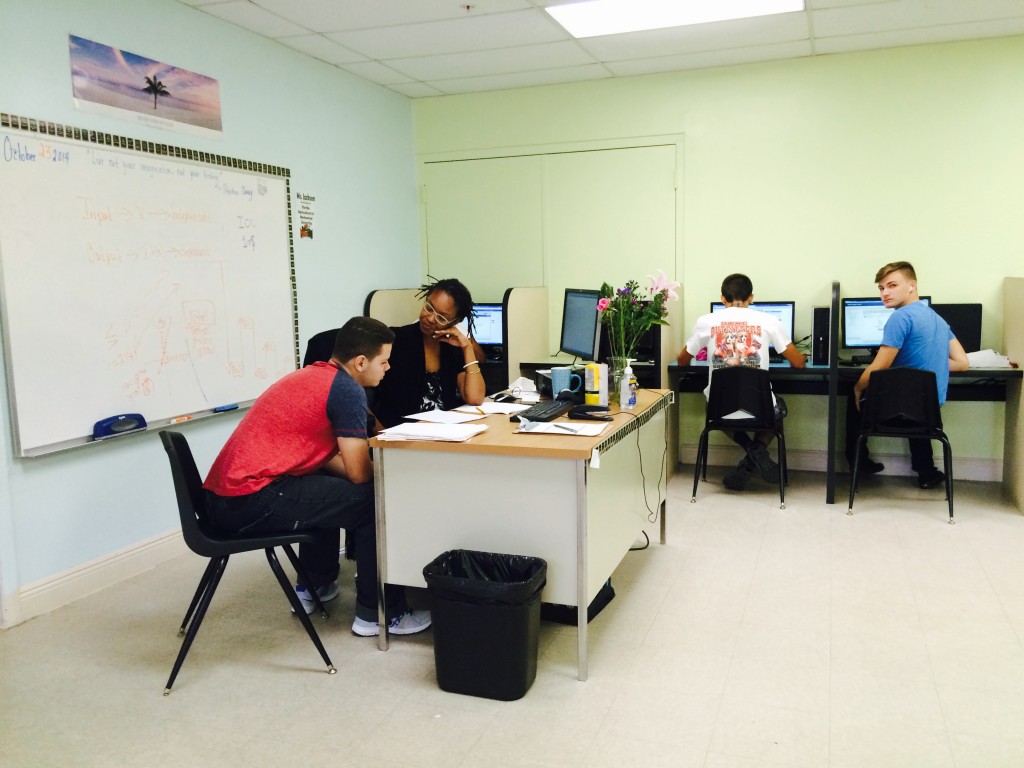
Math teacher Keisha Jackson helps one student at Palm Acres Charter High School while others complete online coursework.
For many students at City of Palms and a growing array of similar schools, that’s no small feat.
Charter schools like it are growing to fill a vaguely defined, little-studied and often-overlooked niche in Florida’s increasingly diverse education landscape. They carry descriptors like "dropout prevention," "alternative schools," and "credit recovery."
In plain terms, they are schools of last resort. They cater to students who dropped out or at risk of doing so, or who have failed courses or “aged out” of traditional high school. They use blended or online lessons to help students rack up credits. The goal is for them to make up for lost time, and leave with a standard diploma.
As the principal, Sarah White, moved through the warren of computer desks inside City of Palms' main campus, she asked students: "Everybody get their five quizzes" for the day? If they have, they're on track.
City of Palms targets students aged 16-21. When students enroll at the school, or at a new, second campus in nearby Lehigh Acres, they receive a transcript, which lists the courses they've completed and the courses they need to graduate. Using the Apex online curriculum, they take their courses one at a time, immersing themselves in a single subject until they pass the final exam and are cleared by their teachers. Finishing a course can take about a month.
"I've had kids finish a P.E. class in a week. I've had kids finish English in two months," White said. "The biggest thing is making them accountable for their education."
The classrooms contain large banks of computers, with teachers offering help to students who need it. There are no class changes in the halls, and there is no cafeteria. When students arrive, for morning or afternoon sessions (another common feature of credit recovery charters), they're free of distractions.
While there have long been alternative schools aimed at students who have fallen behind, City of Palms is part of a relatively new breed of alternative charter schools that specialize in credit recovery. The rise of credit-recovery programs, aided by the growth of online learning, is only beginning to get attention from education researchers.

