
A study released last week by the Leroy Collins Institute delivered mixed news about Florida’s charter schools.
On the positive side, the report concludes that charters are as racially diverse as traditional public schools. But, the researchers caution, there is room for improvement in accountability and transparency, and innovation isn’t adequately measured or shared.
Titled “Florida Charter Schools: Not as Good, Or as Bad, as Advertised,” the report draws primarily on Florida data and research but also reviews nationally conducted research. Some notable findings:
· Florida’s charter schools are not less racially diverse than traditional public schools, but they are less economically diverse.
· Despite a common misperception, charter schools do not adversely affect the racial and economic segregation of nearby traditional schools.
· While charter schools were created in part to spur innovation, the schools have not been held accountable for it, there are no metrics to measure it, and there is no infrastructure to share innovative ideas with other schools.
The report notes that while the number of charter schools in Florida has remained fairly stable in recent years, the number of students attending those schools has continued to grow. Approximately 10 percent of Florida students were enrolled in charter schools in 2016 compared with the national average of 6 percent.
More recent data reported in Step Up For Students’ Education Landscape document shows charter schools continue to be Florida’s most popular school choice option, with more than 300,000 students in attendance for the 2018-19 school year, a 6.1 percent increase from the previous year.
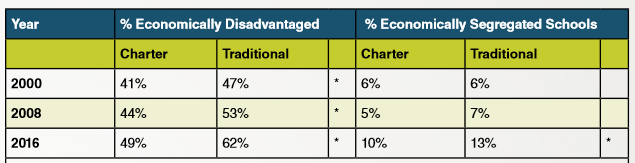
Included in the report is the finding, illustrated by the table below, that charter schools have significantly fewer economically disadvantaged students than traditional schools measured by free and reduced-price lunch eligibility, and that this gap has widened over the past 17 years. The table also compares charter and traditional schools by the percentage of economically segregated schools with at least 90 percent of students qualifying for free or reduced-price meals. The gap is smaller here, although still statistically significant, the researchers say.
Also included in the institute’s report are recommendations for increased accountability, racial and economic diversity and innovation. Among them is the suggestion that the state revisit the purpose of charter schools, analyze how state policy has evolved, and review how the charter school sector has changed since charter schools were created.
The report additionally suggests the state reaffirm its original commitment to racial diversity in charter schools, adding a goal to diversity of students with varying economic backgrounds, and take a more proactive role in identifying innovative schools and sharing successful practices with both charters and traditional public schools.
Established in 1988, the LeRoy Collins Institute is a nonpartisan, statewide policy organization located at Florida State University.
By Lloyd Dunkelberger
The News Service of Florida
Although Florida is becoming a more racially diverse state, its public-school system is becoming more segregated, a new study from the LeRoy Collins Institute shows.
“Student enrollment trends in Florida over the past decades show growing racial isolation for Hispanic and black students on some measures, with signs of continuous segregation on others,” the study said.
Some 32 percent of Hispanic students and 35 percent of black students in Florida attend “intensely segregated” schools, defined as have a nonwhite student body of 90 percent or greater, according to the study.
One out of every five schools was intensely segregated in the 2014-2015 academic year, about double the 10.6 percent of the schools that fell into that category in 1994-1995. (more…)
 School resegregation: Florida's public schools are resegregating, according to a study by the LeRoy Collins Institute. “Student enrollment trends in Florida over the past decades show growing racial isolation for Hispanic and black students on some measures, with signs of continuous segregation on others,” the study says. About 35 percent of black students and 32 percent of Hispanic students attend "intensely segregated" schools, defined as schools with a nonwhite population at 90 percent or higher. About 20 percent of the state's schools were intensely segregated in the 2014-2015 school year, double the number in the 1994-1995 school year. News Service of Florida. WFSU. WLRN. Politico Florida.
Storm aftermath: Florida schools are bracing for an influx of new students arriving from Puerto Rico after Hurricane Maria battered the island. Expecting to get the most students are Miami-Dade, Orange and Hillsborough counties, all of which have a substantial number of residents of Puerto Rican descent. Tampa Bay Times. Gradebook. WOFL. NPR. Florida Politics. Several Florida colleges are offering in-state tuition to new students from Puerto Rico. Orlando Sentinel. Miami Herald. Setting up and cleaning up hurricane shelters cost the Duval County School District about $300,000, school officials estimate. They're asking state legislators for the money. WJXT. Monroe County students are beginning to return to schools in the Florida Keys. WLRN. Miami Herald.
Makeup days: Collier County students will make up four of the days lost to Hurricane Irma by attending school on previously scheduled vacation days. In Manatee County, students also have four days to make up. Two early release days will be converted into full days, two days during the Thanksgiving holiday break will now be full days, and 10 minutes will be added to several other days. Students in Palm Beach and Indian River counties will lose three vacation days, and Broward County students will likely have two vacation days converted into school days. Naples Daily News. Bradenton Herald. Sarasota Herald-Tribune. Palm Beach Post. Sun-Sentinel. TCPalm.
High school protests: A 6-year-old Pasco County 1st-grader took a knee during the pledge of allegiance Monday at Wiregrass Elementary School. His teacher instructed him to stand, angering the boy's mother. "She told him right away, based on what he told me, to stand up and to stop it... That's not her right," says Eugenia McDowell. Wednesday, assistant superintendent Kevin Shibley issued a memo that said, in part: "Kneeling or other non-disruptive forms of non-participation should generally be considered as permissible alternatives” to reciting the pledge. WFTS. Gradebook. Palm Beach County school officials announce that students who kneel during the playing of the national anthem won't be punished. Palm Beach Post.

