Editor's note: This post initially appeared as an op-ed over the weekend in the Pensacola News Journal. The tax credit scholarship program is administered by Step Up For Students, which co-hosts this blog.
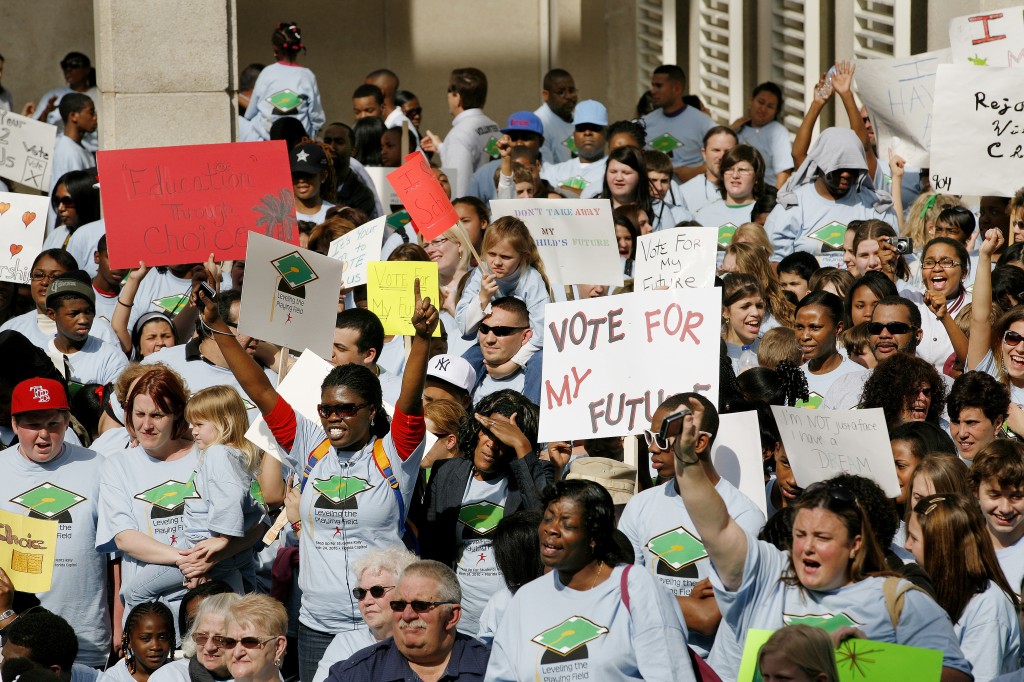
Low-income parents are clamoring for more school choice options for their kids, and the results to date are encouraging. Why would anyone interested in the public good want to block them?
Thanks to Florida’s tax credit scholarship program, nearly 60,000 low-income students in grades K-12 attend 1,425 participating private schools, including 19 in Escambia County. That’s 1,425 options those students would not have had otherwise. That’s 1,425 options that are embracing the students who struggle the most.
So how jarring, then, to read a Florida teachers union leader saying “vouchers do not give parents real educational choice.”
The piece by Joanne McCall, vice president of the Florida Education Association, (Viewpoint, “Vouchers don’t offer a real choice in a child’s education,” March 23) took plenty of liberties with facts about the program and a bill that would strengthen and expand it. But more concerning were the notions that anchored it:
• That expanding choice for low-income students comes at the expense of district schools.
• That low-income parents don’t know whether their schools are high quality.
Let’s start with the indisputable: taxpayers pay about half as much per tax credit scholarship ($4,880 this year) as they do per pupil for public schools. Five independent groups looked into concerns of scholarship money being “siphoned” from public schools and all reached the same conclusion: not true. Rather than hurting public schools, the program saves money that can be invested in them.
McCall would also have readers believe the program exists in a regulatory Wild West. This is also not true. Scholarship students are required, by law, to take state-approved tests. The results are analyzed by a researcher whose work is highly regarded by all sides in the choice debate. The average gains or losses for schools with more than 30 tested students are posted publicly.
The evidence shows scholarship students were the lowest-performing students in the public schools they left behind – a finding at odds with McCall’s suggestion that private schools are cherry picking. (more…)
 Teacher union sentinels warn us that school choice will rescue only the more promising students from a rejected public school, damaging that school further by their absence. The parents most likely to exercise their new authority - say the critics - will be those more concerned and sophisticated. In any case, the private schools chosen will then cull and reject the less attractive applicants; this predicted behavior is labeled “creaming,” “cherry-picking” and the like. Empirical study of private school admission practices puts this latter rap in serious question. Further, the design of state systems of choice in years ahead seem increasingly likely to assure fair inclusion of the poor without threatening the school's identity.
But private school behavior will not be my subject. My focus, rather, will be the likelihood of change over time in the behavior of those parents who do not participate in the first round of choice and who seem out of the game. Will these fathers and mothers in due course become aware? And, once they grasp that they have authority, will they use it? What will be the effect on child and society?
One begins by asking: How do residents of lower-income neighborhoods today learn about change in the life styles of their neighbors? The urban sociologists whom I know seem to this day to recognize the efficacy of the grapevine. Its enhancement by the Internet is hard to estimate, but surely the overall effect of the modern organs of scuttlebutt will be to increase connectivity. Together, these social twines should be sufficient to spread the word in the neighborhood that Alice’s kid has left P.S. 99 for St. Mary’s.
But the most effective messengers of this sad news will be children themselves. The departing student’s stay-behind friend will be disappointed; his or her mother will get the message at dinner. Indeed, once defection has begun, there will be no hiding the new game, even from the duller parent. In addition one must remember: once choice has at last created competition for less well-off students, it will behoove every school to advertise its special charms in the most inventive ways to all families.
It is highly improbable that the slower-motion parent, once she really knows, will forever sit on her hands. She will, instead, begin to fumble and stumble toward participation. She will make mistakes, and there will be no want of charlatans and incompetents who, on occasion, will get the advantage of her. There will, in short, be a burst of variety, good and bad; and if - in the long run - one brand proves ideal for all of us, we will be happily surprised. However, there could well be one best educational recipe for that very specific person, little George. Experimentation by his parent may work its discovery for him; and that would now be possible for every child.
But is this a good idea? Society has for very long trusted only the haves among us with their own child; yet should that trust be extended to the have-nots? Apart from test scores, what will be the social and civic consequences?
As the nation gradually faces this issue, what is often overlooked is the positive effect of empowerment upon the parent herself. She becomes the groping, striving hopeful creature that is the rest of us. She can at last seek her own child’s way like the luckier among us. And, if she is not presently their equivalent in savvy, here is her opportunity - if only gradually - to become so by steady application of the three qualities that are unique to parents: love, insight and personal responsibility. (more…)

When Step Up parents talked about their personal circumstances, the scholarship program stopped being this abstract idea and started becoming something much more real.
Earlier this month, the Florida PTA held its annual convention with at least 20 new members in attendance: parents of children who receive tax credit scholarships to attend private schools.
Many of them took time off from one or two jobs to attend. And in doing so, they participated in what is, if not a historic first, certainly very unusual – private school inclusion in an organization that historically has been devoted to public schools.
Who knows where this will lead. But good things can happen when people who are supposedly on different sides of an issue actually meet face to face. Even when the issue is something like private school “vouchers.”
As an organizer for Step Up For Students, the nonprofit that administers the scholarships (and co-hosts this blog) my job was to attend the convention as well and facilitate a meeting between PTA leaders and scholarship parents.
One of the first things we all noticed was the PTA’s platform, included in the tote bag that participants received. The platform explained that while the PTA opposes vouchers in all its forms, including tax credit scholarships, it urges the Legislature to impose strict eligibility requirements and accountability measures on all private schools participating in these programs.
“What does this mean?” one mother asked me.
“It means they’re against our program, but believe private schools should administer the same standardized tests, like FCAT,” I said.
It’s easy to be against a program you don’t know about or really understand. So, I told our parents, go to the sessions, visit the vendors, and attend receptions. “Meet with these folks and make sure they put a face to this program,” I said. “You’re our ambassadors and I’m sure this weekend will lead to understanding and a better relationship between Step Up For Students and the PTA.” (more…)

