The Cato Institute’s Jason Bedrick was unimpressed with my explanation for why I expect a growing embrace of Common Core State Standards by parents in Florida’s tax credit scholarship program and the private schools that serve them – and why I think that’s a good thing. Jason is a school choice stalwart with whom I often agree, so let me try again.
Common Core standards in math and English/language arts are widely adopted, high quality and transparent. They’re obviously not a silver bullet. But if implemented properly, they can help parents and teachers better educate the low-income children that are part of the tax credit scholarship program.
The reason? Academic stability and continuity are essential for these kids. When they apply for scholarships, they tend to be the lowest-performing students in the lowest-performing district schools. They face extraordinary personal and academic obstacles. Within the scholarship program, they tend to change private schools frequently.
And all too often, here’s what happens: They’re told by their current school that they’re excelling in Algebra, for instance, only to be told when they transfer to another school that they’re a year behind. We hear this complaint regularly from parents. We know this discontinuity is an issue for them.
My guess is, as more of them learn about these new multi-state standards, they will increasingly choose private schools that are using them. This consumer pressure, in turn, will spur more private schools to adopt the common standards, so they can successfully compete in Florida’s robust school choice market.
Private schools that adopt all or parts of these new standards will not sacrifice independence, flexibility or creativity, although assessments do guide curriculum and instruction. There are many ways to teach students how to, for instance, understand and solve polynomial expressions employing multiplication and division. Students who move from a New Age Montessori school to a fundamentalist Southern Baptist school will still be exposed to different curricula, teaching methods and school cultures, even if both schools are using the same content and performance standards in math and reading.
It’s true Florida’s private schools are being pressured to adopt these new standards. But the pressure is coming from the market, not the state or federal government. (more…)
Tuthill
School choice in general is in the news a lot nowadays. And lately and more specifically, so is Florida’s tax credit scholarship program for low-income students. Administered by Step Up For Students (which co-hosts this blog), it’s the largest private school choice program in the country; it will serve about 60,000 students this fall; and as a number of stories in recent weeks have noted, including this one by the Tampa Bay Times/Miami Herald capital bureau, it continues to grow rapidly.
We know there are many questions about the program and its expansion, so we’ve asked Step Up President Doug Tuthill to do a live chat on the blog next week. He’ll answer as many questions as possible over an hour or so.
Doug joined Step Up in 2008. Before then, he had been a college professor, a classroom teacher, the president of two teachers unions and a driving force behind the creation of Florida's first International Baccalaureate high school.
At redefinED, we strive not to be an echo chamber, so we’re hoping we’ll get questions from a wide range of folks, including (and maybe even especially from) people who are skeptical or critical of what we do. We also strive not to be a promotional vehicle for Step Up, but we thought the recent news coverage justified a spotlight. Quite frankly, we’re also new to this live chat thing, and Doug is our guinea pig. 🙂
To participate in the chat, come back to the blog on Tuesday, Aug. 6. We’ll start promptly at 10:30 a.m., so click in to the CoveritLive program a few minutes before then.
In the meantime, if you have questions for Doug that you’d like to send in advance, please email them to [email protected], tweet them to @redefinedonline or post them on our facebook page.

(books on tape and caffeine are highly recommended for long road trips in western states!)
After 2,500 miles through high deserts, forested mountains, windswept prairies, and boggy woodlands – and 190 gallons of gas and one flat tire – I’ve reached my education destination. For the past five years in Nevada, I made a consistent pitch to my colleagues and lawmakers and the governor: “Copy Florida.” Now I live here in Tampa.
Resident Floridians may not realize how well their state actually performs on the education front. You may not even recognize the similarities between Nevada and Florida.
Yes, Nevada and Florida have a very different geography and climate. For one thing, Nevada is the driest state in the U.S., and Florida will receive twice as much rain in July as Nevada gets in an entire year. Florida’s tropical climate is thick with forests, swamps and beautiful beaches. Meanwhile, Nevada occupies the Great Basin and Mohave Desert; a dry desolate place known for prickly Joshua trees, barren mountains and temperatures that soar above 120 degrees.
The landscapes aside, Nevada and Florida share similar public education students and challenges. Both states have a student population that is majority minority today. Student poverty rates and disability rates are also comparable, though Nevada has a larger English language learner population. Nevada and Florida also spend about the same amount per pupil. Interestingly, both states are vacation and retirement destinations with more tourists than residents.
Not surprisingly, education attainment rates were once very similar.
Data from the U.S. Department of Education’s National Assessment of Educational Progress (NAEP) reading exam shows that Nevada and Florida had virtually indistinguishable achievement rates just 15 years ago. That has changed dramatically. While Nevada in the past few years has started to catch up with Florida on math, the Sunshine State has soared past the Silver State in reading. NAEP’s 4th grade reading scores are also a good barometer for education success and graduation rates.
These reading achievement levels are also striking when we zero in on low-income students who are on free or reduced-price lunch (FRL). In the charts below, we compare Nevada and Florida’s FRL students on the NAEP 4th grade reading exam. In this way we examine only the attainment for the most disadvantaged students in both states. (more…)

When Step Up parents talked about their personal circumstances, the scholarship program stopped being this abstract idea and started becoming something much more real.
Earlier this month, the Florida PTA held its annual convention with at least 20 new members in attendance: parents of children who receive tax credit scholarships to attend private schools.
Many of them took time off from one or two jobs to attend. And in doing so, they participated in what is, if not a historic first, certainly very unusual – private school inclusion in an organization that historically has been devoted to public schools.
Who knows where this will lead. But good things can happen when people who are supposedly on different sides of an issue actually meet face to face. Even when the issue is something like private school “vouchers.”
As an organizer for Step Up For Students, the nonprofit that administers the scholarships (and co-hosts this blog) my job was to attend the convention as well and facilitate a meeting between PTA leaders and scholarship parents.
One of the first things we all noticed was the PTA’s platform, included in the tote bag that participants received. The platform explained that while the PTA opposes vouchers in all its forms, including tax credit scholarships, it urges the Legislature to impose strict eligibility requirements and accountability measures on all private schools participating in these programs.
“What does this mean?” one mother asked me.
“It means they’re against our program, but believe private schools should administer the same standardized tests, like FCAT,” I said.
It’s easy to be against a program you don’t know about or really understand. So, I told our parents, go to the sessions, visit the vendors, and attend receptions. “Meet with these folks and make sure they put a face to this program,” I said. “You’re our ambassadors and I’m sure this weekend will lead to understanding and a better relationship between Step Up For Students and the PTA.” (more…)
The collision of budgetary distress and school vouchers has produced a familiar financial accusation in North Carolina. But an honest accounting of the state’s new scholarships for low-income children finds no conflict with public school spending.
This is not meant to diminish the political fight over the budget there. After all, North Carolina is ranked 45th in per-student spending and 46th in teacher pay, and has been dropping in those rankings in recent years. Even some Republicans voted against the 2013-14 budget this week as the party sent a lean appropriations bill to Republican Gov. Pat McCrory on Wednesday.
The point, rather, is that the education budget is made no worse by the inclusion of a $10 million voucher program for low-income students.
Various activists and commentators have tried to make the opposite case, one portraying school vouchers as “siphoning public dollars away,” another saying private schools “seek to profit off of public schools,” another finding incongruity in not giving teachers raises while “pumping public funding into a voucher program.” The Progressive Pulse blog wrote “the larger the program becomes, the more money it will lose for North Carolinians.”
The Pulse based its claims on a legislative fiscal evaluation of the scholarship program that was previously approved in the House, but pointedly ignored the local tax savings. When local and state are combined, the evaluation put the five-year savings at between $23.4 million and $52.3 million.
What’s more, the savings are likely to be much greater because the evaluation used a methodology that, to put it charitably, is outside the mainstream. (more…)
Tuthill
For practical reasons, many Florida private schools are rolling up their sleeves and getting ready for the new Common Core State Standards for math and English/language arts. This fall, our nonprofit, Step Up For Students, will help about 140 private schools and their parents implement these new standards, and based on the dialogue we’re having with other schools, we’ll be helping many more next year.
Some observers believe common standards will undermine school choice. I disagree.
In the context of school choice, common standards serve the same function as the operating systems in computers or smart phones. Just as common operating systems (e.g., Apple or Microsoft) allow software developers worldwide to create an endless supply of innovative software applications, common academic standards are allowing teachers nationwide to create and share innovative curriculum, instructional materials, teaching activities and online lesson plans. We are already seeing a plethora of websites where teachers are posting open source lessons plans and instructional strategies aligned to Common Core. Innovative, free and Common Core-related professional development opportunities are also becoming ubiquitous online.
Common standards are helpful in this emerging new era of customized learning, where students are increasingly accessing content and taking courses from multiple providers simultaneously and/or sequentially. Parents want the freedom to continuously match their children with the learning options that best meet their needs, but they also want to know their children will not be disadvantaged as they move in and out of charter, virtual, home, magnet, private and neighborhood schools. Knowing that many schools are using the same operating system (i.e., the same standards) can help reassure parents that their children are able to receive a seamless, high quality education from diverse providers.
This is particularly important to low-income families. (more…)
Florida’s high school graduation rate rocketed 23 percentage points to 72.9 percent between 2000 and 2010, putting the Sunshine State at No. 2 among states for progress over that span but still behind the national average, according to a new national report.
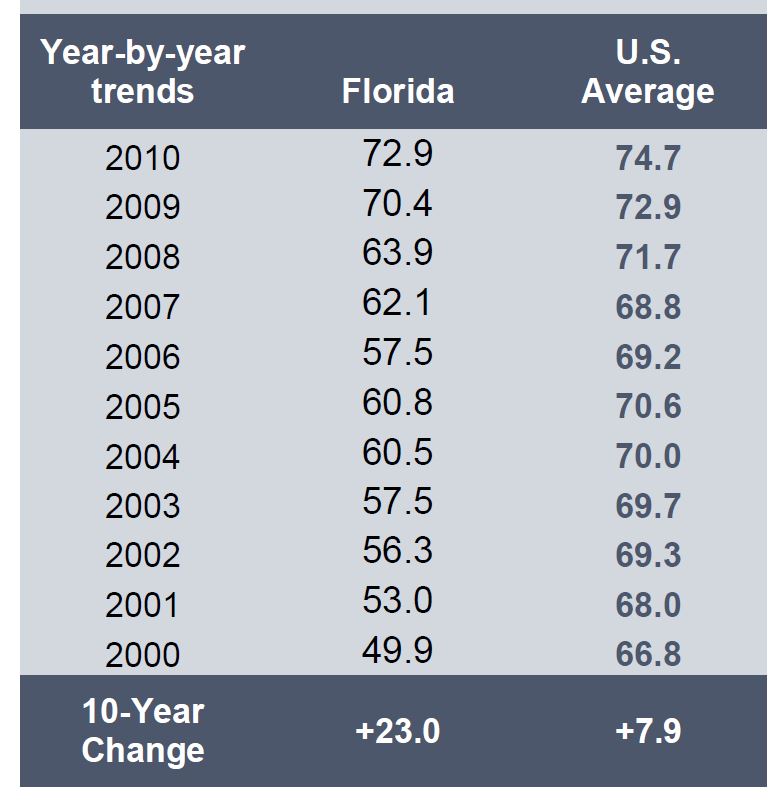
From Education Week
Only Tennessee did better, with a 31.5 percentage point gain, shows the annual Diplomas Count report from Education Week. The national rate was up 7.9 percent, to 74.7 percent.
Education Week, the country’s highly respected paper of record for education news, uses its own formula to calculate graduation rates.
Its findings are the latest in a stack from credible, independent sources that show Florida students and teachers are making some of the biggest academic gains in the country under a model distinguished by a tough, top-down accountability system and expanded parental school choice.
Florida ranks No. 44 in the percentage of students eligible for free- and reduced-price lunch (with the ranking going from lowest rate to highest), according to the latest federal figures. But the Education Week data puts it at No. 34 in graduation rates, ahead of states with less challenging student populations - and arguably better academic reputations - like Washington, North Carolina and Utah.
The gains also come despite tougher standards than other states. Among other things, Florida requires more academic credits to graduate than most states (24 to the national average of 21.1) and the passing of an exit exam (only 23 other states do). (more…)
 I’m kind of glad the ruckus over the parent trigger is over for now. I continue to believe that despite how mercurial it was, there are far more issues that can unite parents, the press and policymakers, if only we can wall off the static and talk.
Perhaps this is one: I think most of us can agree that poor and minority students are getting shortchanged when it comes to getting the best teachers in traditional public schools. I think most of us can agree this is fundamentally unfair to students and teachers alike.
No matter how you define teacher quality – and let’s leave teacher evaluations out of this for now because, sheesh, that is a mess – poor and minority students get less of what is ideal and more of what isn’t. There are far more rookie teachers in high poverty schools, far more teachers who needed multiple attempts to pass certification exams, far fewer board certified. In many urban districts, the teacher transfer pipeline is one-way from inner city to leafy burbs. Given what we know about great teachers – that they are the biggest in-school variable in student achievement, that they can and do change lives – this is unconscionable.
The latest evidence is from a Stanford University study published last month. It’s based on data from the Miami-Dade School District. And it finds that even within schools, lower-performing students are more likely to be taught by the less-than-ideal teachers.
I wish issues like this got more media attention, especially in Florida. As far as I can tell, the only major news outlets that wrote about the Stanford study were Education Week and BET. I know reporters are under more stress than ever, and the timing – near the end of the Florida legislative session – couldn’t have been worse. But this isn’t a fleeting issue. (more…)

Image from www.privateschoolreview.com
As the fight to restore the ability of families to choose the school that best meets their children’s needs proceeds across the country, the future of urban faith-based schools that have served communities for decades remains in serious doubt. Often these schools have been the only choice available to families in tough neighborhoods, but because of changing economics and demographics they have been closing at alarming rates for decades. U.S. Supreme Court Justice Sonia Sotomayor described them “as a road of opportunity for kids with no other alternative.”
Unless this downward trend is reversed, the battle for parental choice may eventually be won, only to find the actual choices available have been substantially and possibly irreversibly diminished. On June 6 in Austin, Texas the national Commission on Faith-based Schools of the American Center for School Choice will host its first conference, “Religious Schools in America: A Proud History and Perilous Future,” to bring together an ecumenical group of leaders interested in preserving faith-based schools, as well as policymakers and media.
At the conference, the commission will release a report on its view of the state of faith-based schools in the U.S., the important role they continue to have in American education, and how they can serve all families that wish to choose them in the future. It will unveil a new web site that will have state-by-state data on faith-based schools and the students they serve. And most important, the commission will lead attendees as they strategize and plan on how to build on recent promising progress in several states and the courts to create momentum for sustaining and growing these schools.
Conference sessions will be highly interactive and encourage dialogue among all attendees. They will discuss progress on tax credit scholarship and voucher programs, and in the courts, and what actions made that possible. The intent is to help attendees understand in more depth how these programs work to benefit schools, as well as how they can be enacted and expanded in their communities.
This is a unique opportunity to build support for these schools on a broad interfaith basis. (more…)
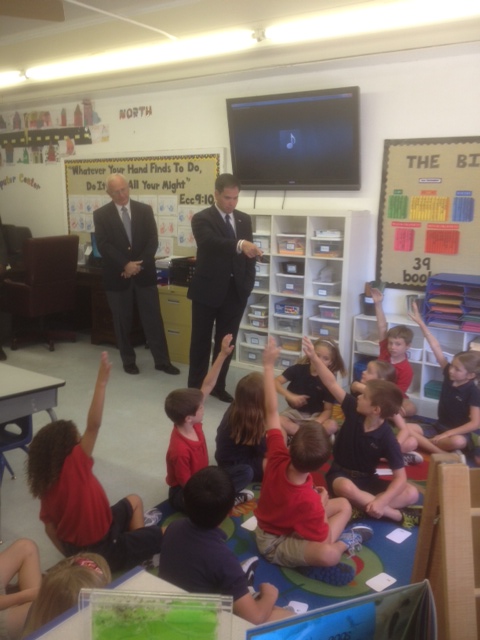
Sen. Rubio visited several classrooms at Florida College Academy, including this second-grade class. The students were in the midst of a social studies lesson on goods and services.
U.S. Sen. Marco Rubio, R-Fla., used a Tampa-area private school as a backdrop Tuesday to highlight his proposal for a federal school choice program that resembles Florida’s tax credit scholarships.
Under the bill he filed in February, low-income parents anywhere in the country would be able to defray private school tuition with scholarships funded by individuals and corporations who make donations in return for federal tax credits.“I think school choice means that every parent in America, irrespective of how much money you make or don’t make, should be allowed to put their kids in any educational environment they deem fit," Rubio said during an hour-long visit to Florida College Academy in Temple Terrace. "And I think what’s sad about the current status across most of our country is that the only people who don’t have school choice are the people who need it the most."
Rubio’s bill isn’t the first school choice bill considered at the federal level, but it may be the most sweeping. It would make private schools an option for low-income families in states that don’t currently have vouchers or tax credit scholarships, essentially bypassing resistance from teachers unions and school boards and, in some cases, state constitutions.
Individuals could give up to $4,500 a year to “scholarship granting organizations” in return for dollar-for-dollar tax credits. Corporations could give up to $100,000. The SGOs would award scholarships to students whose household incomes do not exceed 250 percent of the federal poverty level. For a family of four, that's $58,875 this year.
It's not clear what the per-scholarship amount would be. In Florida, a tax credit scholarship this year is valued at $4,335. (more…)

