In another blow to national efforts to expand children's educational rights through the courts, a Massachusetts superior court judge rejected a lawsuit brought by five children denied access to charter schools.
The children had entered charter lotteries but did not win spots in their desired schools. Their lawyers argued they were trapped in low-performing schools, due in part to state laws that limit the number of charters.
The Massachusetts constitution obligates the state to "cherish" its public schools and ensure that all children are educated, Associate Justice Heidi E. Brieger ruled on Tuesday, but "[t]his obligation does not mean that Plaintiffs have the constitutional right to choose a particular flavor of education, whether it be a trade school, a sports academy, an arts school, or a charter school."
The Boston Globe profiled the plaintiffs last fall, when the suit, backed by a trio of prominent attorneys, was first filed. (more…)
There's a good deal of evidence that Massachusetts students would be better off if their state's urban charter schools were allowed to expand.
That was reinforced yesterday by a new report from Harvard University's Center for Education Policy Research.
But the ballot initiative that would lift the cap on the number of charters in the Bay State may succeed or fail regardless of what the evidence says.
This week, during a forum at Harvard, parents weighed in on both sides of the debate. These excerpts from their comments, lightly edited for length and clarity, illustrate the political divide over what is known as "Question 2" — and the national debate over school choice.
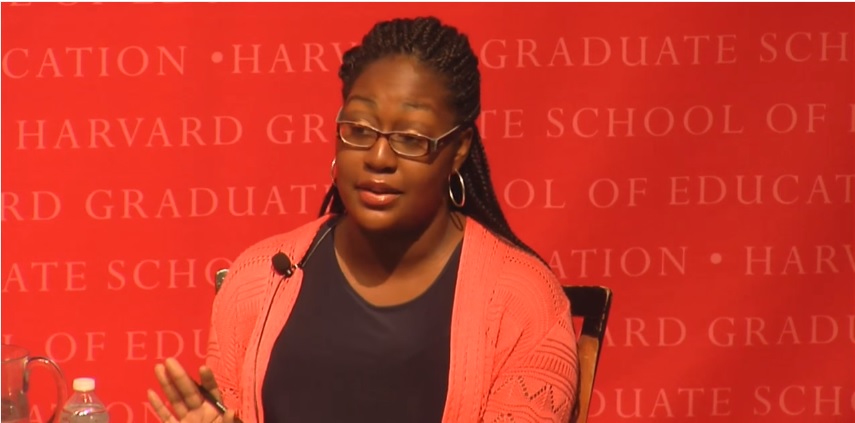
Sarpy
First, LaTasha Sarpy, a charter school parent and associate professor at Bunker Hill Community College:
I am a product of two great district schools. I have the privilege of teaching at the largest and most diverse community college in Massachusetts.
Every day, I realize the obstacles that my students have faced just to walk through the door. Each semester, I reassure them that they made the right decision to enroll in college.
I tell them this because the only guaranteed way I know to change a person's social mobility in life is through education.
However, as my students begin to develop their sociological imagination, they become angry.
They begin to realize that education, like other social institutions, is stratified based on race, income, gender and ZIP codes.
My students become angry when they realize that their educational experiences are based on their social locations. They become angry when they realize they didn't have a choice.
I'm angry as well. I'm angry at the fact that 90 percent of my students enter college testing into developmental math. At the lowest level, students are currently learning long division.
The reality is that many of these students have graduated from high school with the assumption that they are college-ready, only to waste time and money taking classes that do not count toward their degree.
Question 2 asks whether charter schools should be able to create 12 new schools a year, or to expand enrollment in current charters in Massachusetts.
I am in full support, because I am tired of being angry.
You may have heard both sides of the argument about the number of students being served that represent special subgroups, the comparable disciplinary rates, and of course, the funding.
But this debate is not about any of those things. This debate is about choice.
We can argue back and forth, but both charter and district schools have strengths and challenges. But we also know that some districts have had a long history of dealing with — and not being able to fix — those challenges.
In fact, 20 years ago, my mother faced these problems that we're discussing today. She had to make tough decisions about which educational environment would be best for me.
I am so grateful for those tough and demanding conditions, the long bus rides, and sometimes, tearful nights that I spent in another district because of the disparity between my ZIP code and another town's.
But then I become angry again, thinking about how, two decades later, I am still in the fight, but now, as a parent.
Will the evidence on school choice ever change the politics? Right now, Massachusetts is putting that question to the test.
Nationally and in Florida, the evidence on charter schools is mostly mixed. Studies show they generally raise student's test scores at about the same rates as traditional public schools, though they do it with less money. Research looking at how well charter school graduates do later in life is also hardly clear-cut.
But in Massachusetts, it's a different story. Studies have found Boston charters are more effective than traditional schools at raising student test scores by a wide margin. A new study published by Brookings Institution shows charter school students in Boston do better than their peers in traditional schools by a wide range of measures, and are more likely to make it to college.
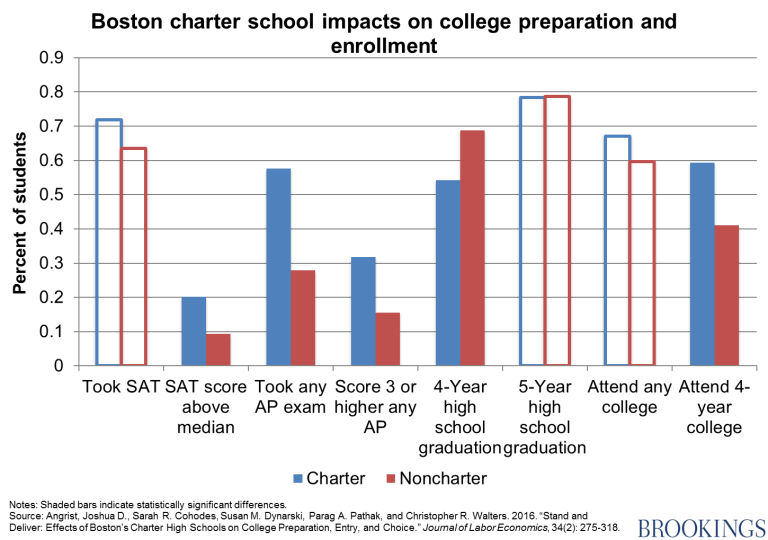
The urban results don't carry into the suburbs and rural areas of Massachusetts, where charter schools don't perform as well. But right now, voters are considering a referendum to raise a cap on the number of charter schools in the state. And the Brookings authors (Sarah Cohodes of Columbia Teachers College and Susan Dynarski of the University of Michigan) note that the cap does not currently limit charter growth in rural and suburban areas. In other words:
Massachusetts’ charter cap currently prevents expansion in precisely the urban areas where charter schools are doing their best work. Lifting the cap will allow more students to benefit from charter schools that are improving test scores, college preparation, and college attendance.
The Boston Globe gives us a look at the growing number of Massachusetts districts embracing a concept designed to compete with charter schools. These "innovation schools" serve as the bedrock of Gov. Deval Patrick overhaul of public education, and they are meant to operate with more autonomy than traditional public schools.
"We are valuing the individual child," one innovation school principal told the Globe. But while the schools are meant to address the individual needs of students, they are unlike charter schools in that they must negotiate their freedom with their district's superintendent and they are still bound by most provisions of the district's teachers union contracts.

