“Pacific Rim” is without a doubt the greatest “giant robots smashing giant monsters” movie in the long and storied history of cinema. Okay, so the only real competition was the wretched “Pacific Rim 2” and maybe a few Japanese movies with people wearing rubber suits stomping on model buildings. Honest Trailers described “Pacific Rim” as either “The Most Awesome Dumb Movie of All Time” or “the Dumbest Awesome Movie of All Time.” “Pacific Rim” did indeed have everything your inner 9-year-old craves, including the above “Today we are cancelling the Apocalypse!” speech from the great Idris Elba.
So anyhoo – when do we get to cancel the apocalypse talk with regards to Florida schools?
I first started following the K-12 debate in Florida back in the late 1990s. Then, sadly as now, the air was filled with claims about the “destruction of the Florida public school system.” Among the many problems with this fevered story is the fact that the Florida Constitution guarantees public school funding and the public supports that guarantee. A quick perusal of the National Assessment of Educational Progress (NAEP) – the most highly respected source of apples-to-apples K-12 data available, shows consistent improvement in outcomes over time. The below chart shows the percentage of Florida students scoring “Basic or Better” (top four lines) and “Proficient or Better” (bottom four lines) from the earliest available results (1990) to the most recent (2017). Note that all the lines are trending up – which in this case is what you want.
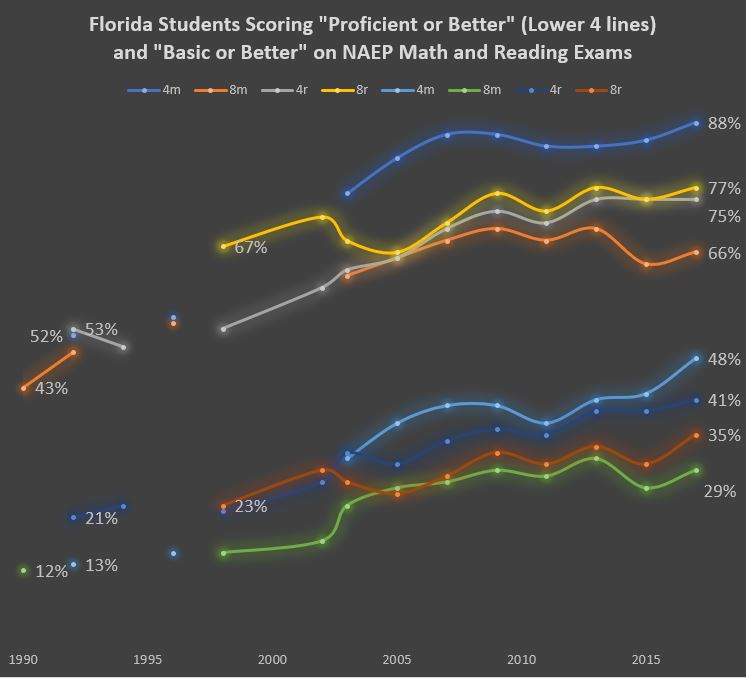
The trend in Florida students scoring “Below Basic” is easier to follow. “Below Basic” is the lowest achievement level on NAEP, so what you want to see in this next graph is the numbers trending down. Sure enough:
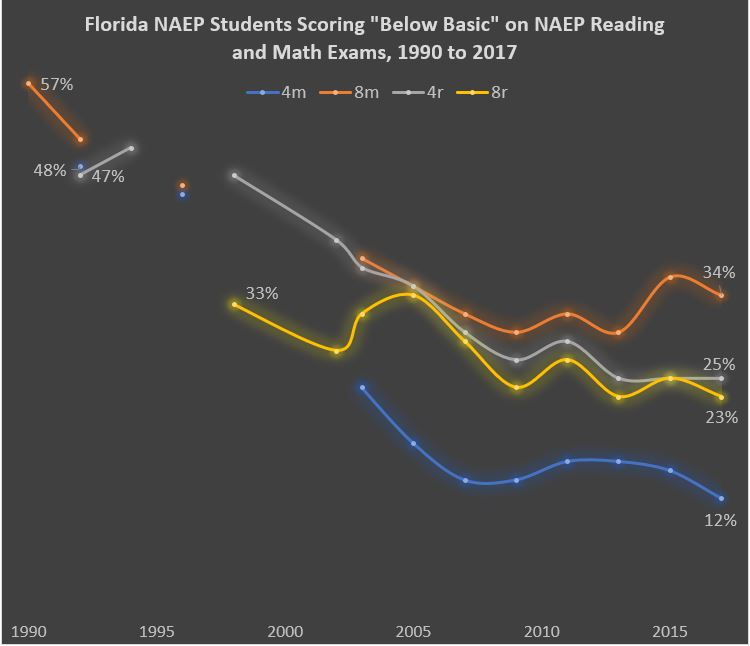 There are of course things to disagree over and debate, but for those liberally pushing Florida K-12 apocalypse narratives, I simply want to pose the following questions: How do you square this obvious evidence of academic improvement among Florida students with impending predictions of doom? Is there a nefarious plot to improve public schools to death? The comment section awaits. I’ll hang up and listen.

Florida is adding hundreds of thousands more retirees AND students in the coming decades.
This is the state of things. Now, make your plans.
-Sophocles Antigone
Florida is getting it from both barrels of the age demographic gun – a rise in the elderly, super-elderly and youth all at the same time. On average, 10,000 Baby Boomers per day will reach the age of 65 until 2030, whereupon all surviving Boomers have reached retirement age. For the Florida economy, retirees are a way of life and benefit the state’s economy as they come in and buy condos. But the pain to the state budget hits later, when they near the end and draw upon state health care resources. This isn’t something that is going to happen, but rather something that is already well under way:
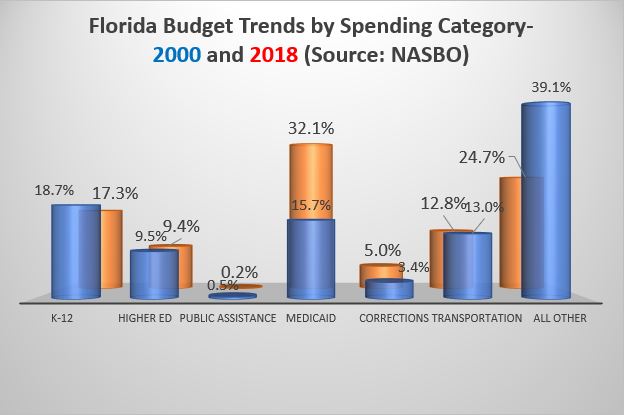
Okay so I won’t go into the gory details here. But what ought to be jumping off the chart and into your cerebral cortex is the Medicaid doubling as a percentage of the budget between 2000 and 2018, and the rest of the budget getting either flattened or reduced. That’s in no small part due to the fact that the elderly draw heavily upon Medicaid – especially the aged 85+ community, which is set to substantially increase.
Did I mention the part where EDR projects that Florida will continue to have a growing school-age population during this period as well? Well, yeah, that too.
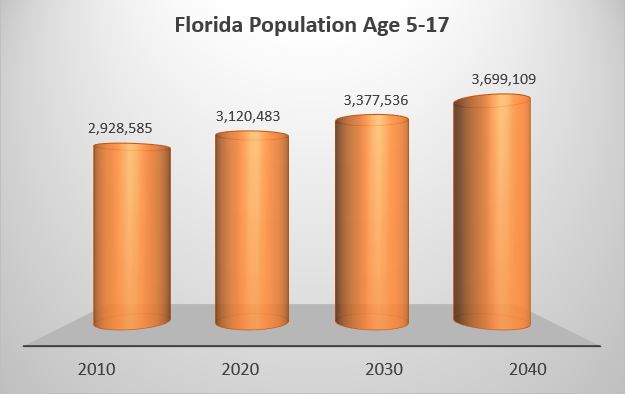
This youth chart underestimates the scale of the challenge because Florida pays for preschool for 4-year-olds (not included above), and many 18-year-olds are still in high school. But, you get the point – Florida has hundreds of thousands of new students on the way.
According to figures provided by the Florida Department of Education, in 2016 Florida school districts spent nearly $393 million to create 14,552 new seats in district schools. EDR, however, projects a 257,053 increase in 5- to 17-year-olds between 2020 and 2030. The new seats built in 2016 will accommodate 5 percent of the 2020-2030 increase. Florida is going to need new school seats and plenty of them. But if the plan is just to spend ~$400m for 14,500 seats when you need hundreds of thousands of them, you might need a new plan.
Does Florida have a plan for recruiting the teachers it will take to accommodate 257,000 new students and replacing the retiring Boomers? The first Baby Boomer to draw a Social Security check was in 2007, but the first Baby Boomer to draw a teacher pension came earlier than that. Baby Boomer teachers are retiring, and enrollment in traditional teacher prep programs is in decline nationwide. Perhaps it would be a highly productive idea to give educators more autonomy in a context where families choose their own educational experiences. If the plan is to recruit a gigantic legion of new recruits into the teaching profession to march through curriculum scripts, you might need a new plan.
The Florida education system of 2018 was demonstrably superior to the one of 2000 across a variety of measures, including NAEP, graduation rates, K-12 students earning college credit and industrial certifications by exam, and higher education success. Hundreds of thousands of additional students enrolled in Florida schools during this period, the student body became increasingly majority minority, and academic achievement improved. Not only did you accomplish all of this, you did it with a slightly smaller share of the state’s budget (see first chart). It wasn’t easy, but you pulled it off.
Baby Boom retirement will create a whole new set of policy challenges – most prominently in health care and state pensions, but in other ways as well. Education policy alone cannot meet these challenges, nor can you meet this trial without it. Florida needs a system of education which is continually improving both academic and cost effectiveness. I’m inclined to think the only plausible path to achieving this is a decentralized process where educators are free to innovate, and families are free to reward and reject innovation.
You don’t know how to create a continually improving education system, nor do I, nor does any other individual or clique. Continual improvements in quality and cost effectiveness will require a social effort at a societal scale where educators try new things – and families try them out, keep the innovations they value and discard those they dislike. Florida needs a plan, but not of the central type. As Matthew Ridley explained:
The elite gets things wrong, says Douglas Carswell in The End of Politics and the Birth of iDemocracy, ‘because they endlessly seek to govern by design in a world that is best organized spontaneously from below.’ Public policy failures stem from planner’s excessive faith in deliberate design. ‘They constantly underrate the merits of spontaneous, organic arrangement, and fail to recognize that the best plan is often not to have one.’
We can’t be sure what schools should look like now, much less decades from now. A partnership of educators and families, however, can create the needed discovery process to improve and update education. The status quo isn’t an option. But the best plan, in my opinion, is to set educators free in a system with proper incentives – and with parents playing the primary role of holding them accountable through the tried-and-true mechanisms of voluntary association and exchange.
This is the state of things: Florida has hundreds of thousands more students and super-elderly residents on the way at the same time. Now, make your plans.
A few years back I visited these pages to discuss Florida’s age demographic change, and the challenges it will pose to policymakers, especially with regards to health care and education. Here’s the abridged version: Florida has lots of elderly people, and lots of young people, and relatively few working-age people paying for health care for the elderly and education for the young. This should not be terribly shocking if you have walked around a bit in Florida. The problem: demographers project Florida is growing large additional populations of elderly and young people. When you use Census projections to plot out all 50 states, it looks like: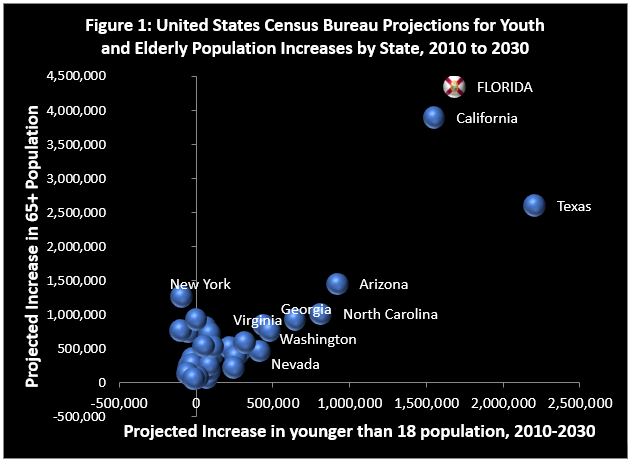 The Census Bureau made these projections some time ago and decided to leave the task of updating projections to the state. Fortunately, Florida’s Office of Economic and Demographic Research (EDR) has created updated age demography projections for the state. There’s good news and there’s bad news in the updated EDR projections. The good news: They aren’t as scary as the Census projections. The bad news: It’s not by much.
Demographers calculate an “age dependency ratio” as a measure of societal strain. To create an age dependency ratio, you take the under-18 population, add in the 65-and-older population, and then divide that sum by the number of 18- to 64-year-old people. Basically, what you are looking at is the ratio of people less likely to be in the workforce and more likely to be drawing on state services like K-12 education and Medicaid to those more likely to be in the workforce (and thus carrying the bulk of the burden for paying for things like education and health care services).
Here are the age dependency ratios for Florida in 2010, 2020, 2030 and 2040 based on EDR projections. Think of it this way: For every 100 working-age people pushing the cart of Florida’s social welfare state, how many elderly and young people do you have riding in the cart?
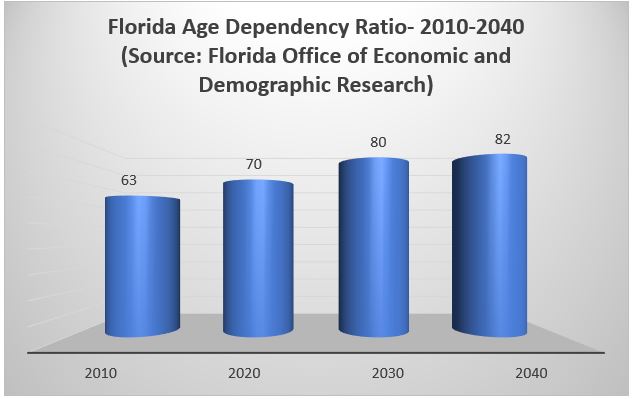 Four years from the time of this writing will mark the half-way mark for the massive Baby Boom generation reaching the age of 65. By 2030, all surviving Baby Boomers will have reached the age of 65. From a state budget perspective this is challenging on multiple fronts: retirees live on fixed incomes and have left their peak earning and taxpaying years behind. They also draw upon state health care benefits at a rate far above average.
States like Florida and Arizona have an added wrinkle as retirement destinations. Incoming retirees provide a short-term economic boon to a state economy as they make some major purchases (like condos) but then they often live frugally. The state budgetary gain turns to pain with the “super elderly” aged 85+ who tend to draw mightily on state health care spending late in life. Below are the EDR projections for Florida residents age 85 and over.
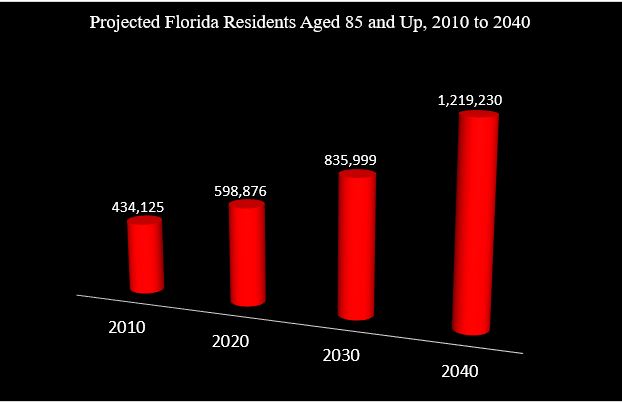 Using 2010 as the baseline for comparison, that looks like an almost doubling by 2030 and a getting close to tripling by 2040. A fierce battle over limited state resources may loom: a generational battle between the old and the young, education spending versus health care spending.
We should all – left, right and center – seek to avoid such a clash. By far the best solution involves Florida developing a far more productive and innovative workforce to accompany far-reaching policy and medical innovations. Florida K-12 spending is enshrined in the state constitution and won’t be going anywhere, but the need to develop methods to better educate student at the same or lower costs will grow increasingly acute.
Absent substantial productivity/policy/medical innovation:

Many of the Florida taxpayers who will be tasked with paying for the pensions and health care expenses of the Baby Boom retirees of 2020, 2030 and 2040 sit in Florida’s classrooms right about now. Fortunately, there has been an enormous amount of progress made over the last two decades in Florida education, the subject of a forthcoming post.
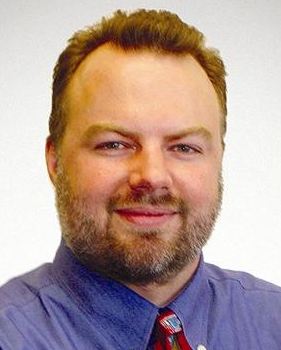
Matthew Ladner
Note: This is part of a three-part series of podcasts on Nevada's new education savings account program. See our conversation with Seth Rau of Nevada Succeeds here. In Part 3, we will talk with Howard Fuller.
Nevada's first-of-its-kind education savings account program has highlighted a philosophical difference among some within the school choice movement, which has previously aired on this blog and elsewhere.
Should private school programs be open to all students, or should eligibility be limited to the disadvantaged — such those with lower incomes, or those with special needs?
In a recent piece published by the Thomas B. Fordham Institute, Howard Fuller, long a leading champion of the movement, said he did not want to join the parade celebrating Nevada's program, which will be open to nearly all students, including the wealthy.
Other school choice backers favor universal programs, and responded that they prefer other mechanisms, like weighted funding, to meet the needs of disadvantaged students.
Some of the most detailed responses came from Matthew Ladner, a senior adviser to the Foundation for Excellence in Education.
In this podcast, we dig a little deeper into areas where he and Fuller have common ground, where they differ, and the potential of education savings accounts to create new possibilities for students and educators. 
Ladner says it can make sense to means-test some programs, like tax credit scholarships that have caps on the amount of funding available, to ensure their limited resources serve the students with the greatest needs.
Nevada's program is different, he says, because there is no limit on the number of students it can serve. Any student can participate, as long as they've been enrolled in public schools for more than 100 days.
Ladner
Call them Vouchers 2.0. In the age of customization, researcher Matthew Ladner sees education savings accounts as the tool for the times. Unlike vouchers or tax credit scholarships, ESAs would allow parents to use state funds to pay for a blend of K-12 educational options – schools, tutors, online programs, etc., in whatever combo works - and perhaps squirrel away some of those funds for college.
“We we like to say that ESAs are sort of school choice and parental control over education down to the last penny,” Ladner said in a podcast interview with redefinED. “What we really want to do is allow parents to customize the education for their child. Education shouldn’t be necessarily an all or nothing proposition - you’re either attending this school or that school. In fact, the whole definition of what a school is is being fairly rapidly changed by technology.”
Ladner is senior advisor of policy and research at the Foundation for Excellence in Education. He’s one of the creators of the ESA concept and its most diligent Johnny Appleseed. In October, the Friedman Foundation for Educational Choice published a report he authored about ESAs called, “The Way of the Future.” Ladner also was instrumental in creating the ESA program in Arizona, which to date is the only one in the country but was recently expanded.
A key feature of ESAs, Ladner said, is that it requires parents to make choices based on quality and price. That in turn will spur innovation and, at the same time, reign in costs that have risen steeply for decades with little improvement in academic outcomes. “If you want to reverse that, you have to do something that’s going to seem a little radical at first,” Ladner said. “But by giving parents complete control over the money and requiring them to consider possible alternative uses for that money, it really sets them up to be discriminating consumers.“
Florida lawmakers flirted with ESAs in 2011, with critics panning the idea as “universal vouchers” and “vouchers for all.” But Ladner said even if a state went “whole hog” with the idea, the vast majority of kids would remain in public schools, as the Florida experience has shown with McKay vouchers and tax credit scholarships. In his view, ESAs should also be designed for equity - with greater funding for students with greater needs.
Are people ready for ESAs? Maybe not just yet, Ladner said. But it took a while for people to catch on to Palm Pilots, too. “As a movement we always need to be taking a strong interest in the development of our product. And our product in this case is our methods to increasing the freedom and the effectiveness of parents the parents within the schooling system,” Ladner said. “I think there is work to be done. But I do think that when this work is done we will have a product that is clearly superior to the ones we have today.”

