 School funding suit rejected: The First District Court of Appeal rejects a challenge to the state's public school funding, saying the issue raises political questions that can't be answered by judges. Several education groups and some parents contend that the state discriminates against minorities and low-income students, which they call a violation of the state's constitutional duty to provide a "high quality system of free public schools." The argument was rejected by a circuit court judge last year, leading to this appeal. The groups suing the state say they don't know if they'll take the issue to the Florida Supreme Court. The appeal court also ruled that the McKay scholarship, which provides state money to about 30,000 disabled children, is constitutional. Associated Press. News Service of Florida. Orlando Sentinel. Gradebook. Sunshine State News. Politico Florida. redefinED.
Charters are public: The Florida Commission on Ethics has decided that charter schools are public agencies, not private ones. In October, the commission deadlocked on an opinion in a conflict of interest case. The opinion concluded that charter schools are not public agencies, but it was not adopted because of the tie vote. Last week, commissioner Matthew Carson cast the deciding vote and said, “Charter schools are public schools in operation, in function and by statute. Seems to me that what would be good for any other public agency under this statute would also be good for a charter school.” Politico Florida.
Charter school accused: A former Broward County charter school once accused of falsifying enrollment numbers to get more money from the state now faces allegations of fraud. New Horizons, now a private school that used to be the Pathway Academy charter school, allegedly falsified records when applying for tax credit scholarship money, and an administrative judge says the school should be cut off from scholarship funds. School officials deny the charges, and plan to file a response to the Department of Education. Step Up For Students, which hosts this blog, helps administer the tax credit scholarship program. Sun-Sentinel.
A call for reform: Legislators and local school officials are calling for better oversight of private schools that get millions of dollars from the state's three scholarship programs. A series in the Orlando Sentinel last week detailed how some of those schools hired uncertified teachers with criminal backgrounds and submitted falsified fire reports for years without the state taking action against them. State Sen. David Simmons, R-Altamonte Springs, remains a supporter of the tax credit, Gardiner and McKay scholarships, but agrees that "there's some place between no regulation and over-regulation.” Step Up For Students, which hosts this blog, helps administer the tax credit and Gardiner scholarship programs. Orlando Sentinel.
Teacher pay: Gov. Rick Scott has pushed for higher teacher pay in the past, but now is saying that the decision is out of his hands. "The way our system is set up in our state those decisions are made at the local level," Scott said during a discussion with teachers. "What I tell everybody is, 'You have to be active with your school board members, your superintendents.' " Associated Press. Scott did say that his budget proposal will include $63 million for teachers to help buy classroom supplies, an increase of $18 million over last year. That would bump the $250 a year teachers receive for supplies to $350. WTLV.
'Schools of hope': The Knowledge is Power Program (KIPP) charter school network is working on establishing a "school of hope" in the Liberty City area of Miami. The tentative agreement calls for the Miami-Dade County School Board to provide KIPP Miami with a facility, and KIPP would receive a state grant to help disadvantaged students and share its training programs with the district. The "schools of hope" program was set up by the Legislature to offer financial incentives so charter companies could move into neighborhoods with persistently struggling schools. KIPP is the nation’s largest nonprofit charter school network. redefinED.
Construction funds: Gov. Rick Scott and the Cabinet approve issuing up to $233 million in education construction bonds. Now legislators have to reconcile their differences on the amount they'll commit to the Public Education Capital Outlay (PECO) program. The Senate bill uses bonding and calls for $617 million for PECO, including $75 million each for public and charter schools. The House bill does not use bonding and allocates lower overall PECO spending, including $100 million for charter schools and $20 million for public schools. News Service of Florida. The Volusia County School Board considers ways to catch up on deferred school maintenance. District officials say many of the problems that have been temporarily fixed over the past 10 years now need a permanent solution, but they're not sure they'll have the money needed. Daytona Beach News-Journal.
Title I spending: An amendment recently added to a bill that revises charter schools regulations would limit the amount of Title I funding school districts can spend on administrative overhead and required services for specific groups of students. Rep. Manny Diaz, R-Hialeah, says the change aligns the bill with others that push more authority to school principals and away from centralized administrations. “We need to figure out how to get those dollars down to the school site, where the student is,” he said. redefinED.
Vouchers' hidden costs: Many parents who accept state vouchers to help their special-needs children attend private schools are unaware that by doing so, they lose lose some or most of the protections of the federal Individuals with Disabilities Education Act (IDEA). One of them, Tamiko Walker of Port St. Lucie County, whose son has a speech and language disability, found this out after accepting money from Florida's McKay scholarship, the largest of 10 disability scholarship programs in the United States. “Once you take those McKay funds and you go to a private school, you’re no longer covered under IDEA — and I don’t understand why,” Walker said. New York Times.
ELL success story: English language learners (ELL) at High Point Elementary School are bucking the national trends by equaling or surpassing their peers at other struggling schools in Pinellas County on tests that are considered predictors of how students will perform on the Florida Standards Assessments. ELL students make up about a third of High Point's enrollment, and about 80 percent of them are Hispanic. "They're defying some national trends, which is pretty exciting," said Joyce Nutta, a world languages professor at the University of Central Florida who has been developing teacher training methods at High Point. Tampa Bay Times. (more…)
Florida is home to one in six of the nation's students using a voucher to attend a private school, more than a third of those using tax credit scholarships, and just shy of 70 percent of all students using education savings accounts.
Those stats come from The ABCs of School Choice, the most comprehensive rundown of private educational options in the country.
EdChoice released the latest version of its annual report Tuesday, and it shows Florida remains one of the national leaders in private school —choice especially for low-income and economically disadvantaged students.
Serving more than 30,000 students with special needs, McKay Scholarships are the nation's second-largest voucher program. They were recently overtaken by Indiana's means-tested voucher program.
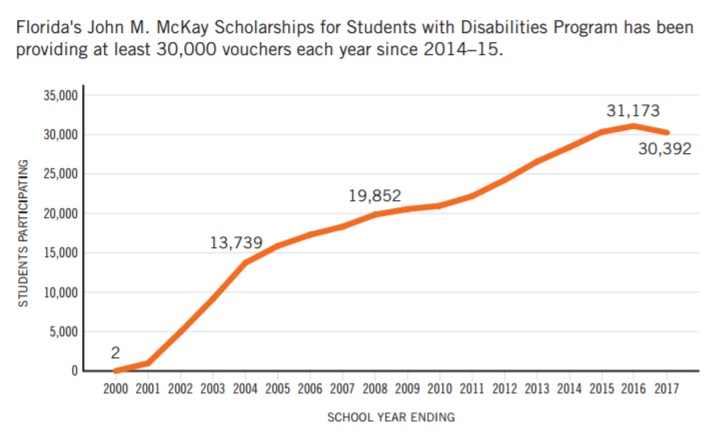
Graph via EdChoice
Florida's Gardiner Scholarships*, also for students with special needs, comprise the nation's largest education savings account program. A potent rival — Nevada's ESAs, which could soon be available to nearly all students — was sidelined by a court challenge and remains in legislative limbo. (more…)
Older students with special needs could use Florida's McKay Scholarships to pay for transition programs intended to prepare them for jobs, under legislation backed unanimously by a state House panel on Tuesday.
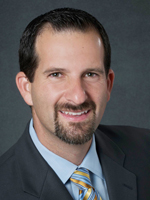
Bileca
HB 837, by Rep. Michael Bileca, R-Miami, would allow children between the ages of 17 and 22 to use the vouchers for "transition-to-work" programs.
A growing number of private schools that accept McKay scholarships have started post-graduate programs designed to prepare recent graduates for the workforce.
This year, lawmakers have filed multiple bills, including some expected to pass this week, aimed at expanding college and job-training programs for special needs students who finish high school. (more…)
One recent morning, Tana Norris walked into the small building that houses the makeshift dance studio at her North Florida private school.
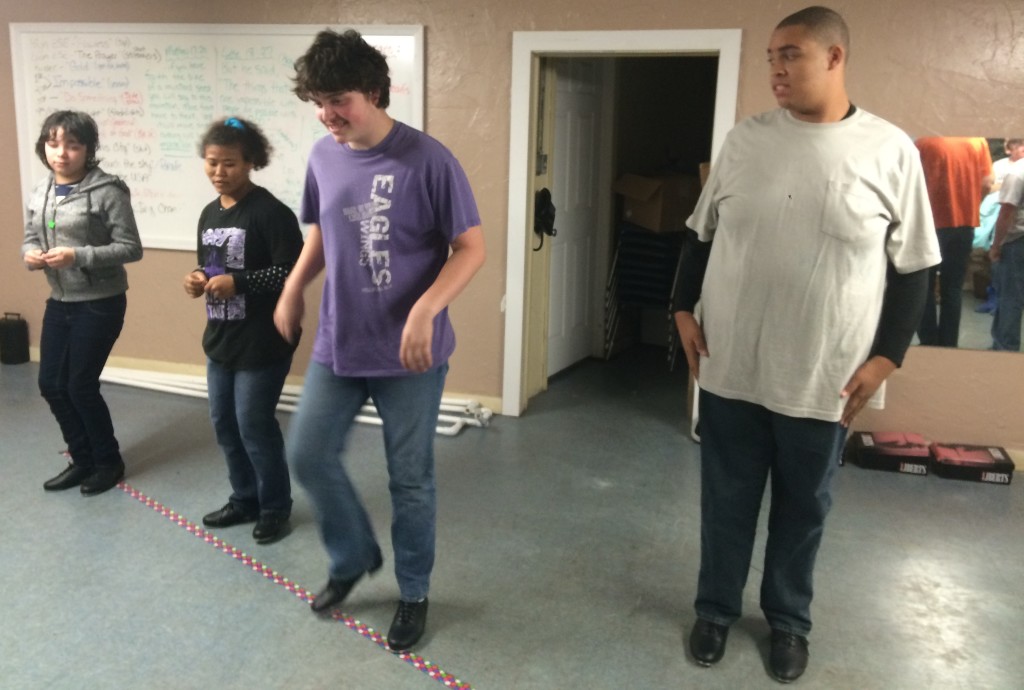
Students tap dance at Lake City Christian Academy.
"I hear there are some amazing dancers in here," she intoned.
"I'm a dancer!" Stephen, an 11th-grader, responded. He and some classmates launched into a routine set to the contemporary Christian sounds of MercyMe, twirling, tapping and finishing with a confident bow.
Stephen, it turns out, is more than a dancer. He's also prize-winning Special Olympics athlete (his finishes in local competitions include second place in the broad jump and first place in bowling) and a testament to the approach Norris said has guided Lake City Christian Academy since she founded it more than 20 years ago: "If a child feels good about themselves, and feels safe, they can learn."
The non-denominational private school has found ways to cater to a diverse group of children, the majority of whom either have special needs, or didn't quite fit in at other schools. Nearly half of its 194 students rely on McKay scholarships, the state's voucher program for special needs students. Others use tax-credit scholarships for low-income students or the state's newest option, Personal Learning Scholarship Accounts. Step Up For Students, which hosts this blog, helps administer the latter two programs.
Crystal Hair, the school's dance instructor, said movement and music can have benefits for all kinds of students. For some, dance can even help with reading instruction.
"It's operating their whole brain," she said. "It's amazing to see how much dance helps in their academics." (more…)
School choice supporters won a legal victory in Florida Monday, as they knocked down some of the arguments in a wide-ranging lawsuit challenging the constitutionality of the state's education system.
In a bench ruling, Leon County Circuit Judge George Reynolds rebuffed a constitutional challenge of the state's tax credit scholarship program, according to two Institute for Justice lawyers present for the hearing and a report from the Associated Press.
The ruling, however, does not mean the scholarship program, which serves 77,000 low-income students, is in the clear. The "adequacy" lawsuit is separate from another suit that is focused exclusively on the scholarship program. That suit, filed last year by the statewide teachers union, is still pending before the First District Court of Appeal.
The broader adequacy suit argues, among other things, that state lawmakers have violated the state constitution by under-funding public schools, using student test scores in teacher evaluations and enacting various school choice programs.
Reynolds is holding a series of case management hearings to decide how to deal with those issues during a trial set for early next year. According to the AP, he decided the groups behind the lawsuit did not have standing to challenge the school choice programs.
The Institute for Justice lawyers represent parents whose children use tax credit scholarships and McKay scholarships to attend private schools. They are helping the state defend its policies.
The education advocacy groups supporting the adequacy suit had argued in court papers that school choice programs "divert public funds to a parallel non-uniform private school system." They also argued private schools "teach religious doctrine" and are not required to administer the same tests as public schools. (more…)
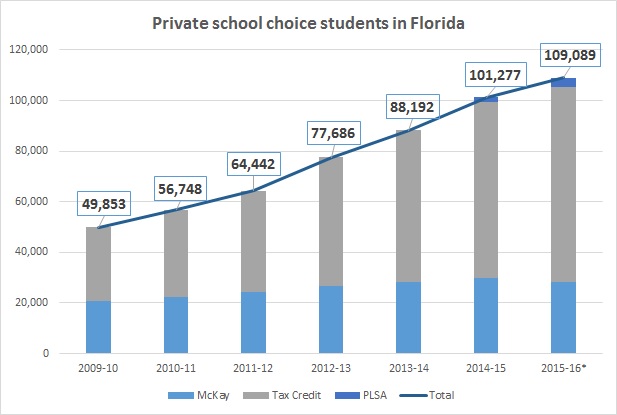
Private school choice growth keeps growing. Source: Florida Department of Education. *Numbers for 2015-16 based on September data. Other years based on data from the end of the school year.
The number of students in Florida's three K-12 private school choice programs continues to grow.
Last school year, the state became the first in the country to serve more than 100,000 students with special needs vouchers, tax credit scholarships, and its new education savings account program for special needs students.
The first numbers for the 2015-16 school year, released this week by the Florida Department of Education, show thousands more students are participating.
More than 77,000 low-income students are receiving tax credit scholarships, a roughly 10 percent increase from last school year. More than 28,000 special-needs students are using McKay scholarships to attend private schools. Nearly 3,900 students have Personal Learning Scholarship Accounts (PLSAs). (more…)
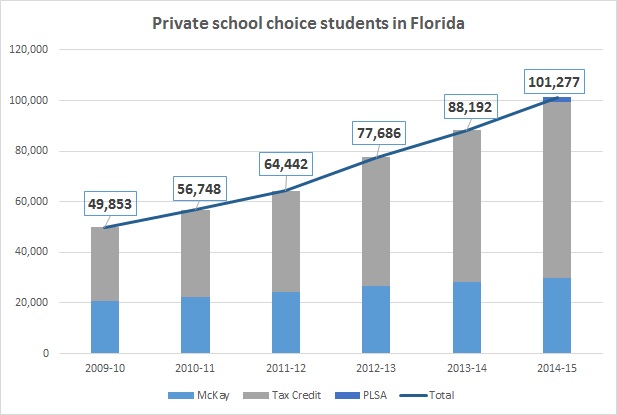
Florida's three private school choice programs are growing, and as the state begins a new fiscal year, they have passed a milestone.
During the 2014-15 school year, Florida became the first state with more than 100,000 students enrolled in private school choice programs.
The tax credit scholarship program grew to help 69,846 low-income students afford private school tuition. The McKay scholarship program grew to serve 29,776 special needs students. In the first year of a new program, the parents of 1,655 special needs children signed them up for Personal Learning Scholarship Accounts (PLSAs).
Charter schools: The Pasco County school board will consider charter applications, including one aimed for low-income elementary students at risk for dropping out. Tampa Bay Times.
Private schools: A Tampa Islamic school simulates the hajj to teach children about the rite. Tampa Bay Times. The McKay Scholarship helps more than 27,000 children with disabilities attend private school. Tallahassee Democrat.
Virtual schools: Florida Virtual School leaders tell lawmakers that a shift in funding has hurt enrollment in the online learning program, especially in rural districts. Florida Current.
Teacher raises: Only 13 districts have negotiated pay increases with their unions, with the average raise ranging from $1,500 to $2,900. The Buzz. More from the Palm Beach Post and Naples Daily News.
School security: The Broward County school district agrees to spend $555,000 for 12 officers to patrol elementary schools in six cities. Sun Sentinel. Instead of hiring armed security officers all at once for 144 elementary schools, Hillsborough's latest plan would phase them in over four years. Tampa Bay Times.
Safety net: The State Board of Education will vote again on a "safety net" for school grades that would extend the controversial measure through 2014. Orlando Sentinel.
Outsourcing: The Miami-Dade school district may look to privatize its vast fleet of school buses and transportation employees. Miami Herald. The Polk County School District is looking into outsourcing the management of its substitute teachers. The Ledger.
Board view: Clay County school board members say their superintendent didn't tell them he was authorizing $2,037 to reserve a meeting room and amenities for an “American exceptionalism” conference. Florida Times-Union. (more…)

