 Students from Puerto Rico: The Hillsborough County School District is throwing out the welcome mat for students displaced from Puerto Rico by Hurricane Maria. While school officials do not know how many students will arrive, or when, where they will live and where they will attend school, the district is well-equipped to handle the influx. There are 27,000 empty seats in the county's schools, and about 35 percent of the district's students are Hispanic. "We know these students have been through a tragedy and we want these students to feel welcome and safe in our schools," Superintendent Jeff Eakins wrote in a memo to all principals. Tampa Bay Times. Puerto Rican refugees have begun enrolling in some state schools. WUSF.
Testing changes request: Lee and Collier county school districts are asking the state to delay the standardized testing schedule, to suspend assigning letter grades to schools, and to not automatically retain 3rd-graders who fail the state's ready test. Both districts missed 11 days before and after Hurricane Irma moved through the state. Fort Myers News-Press.
H.B. 7069 lawsuit: The Martin County School Board decides not to join 14 other school districts in a lawsuit against the state's new education law, H.B. 7069. The vote was 3-2, and board members say the suit would be counterproductive and waste money. They say they hope to find another way to influence legislators. The districts saying the state say the bill is unconstitutional because it favors charter schools and strips power from local school boards. TCPalm.
Legislation. Senate President Joe Negron says education funding is among the most difficult spending issues lawmakers will try to resolve this session. Tallahassee Democrat. Budget talks between the House and Senate appear to be at an impasse. The Buzz.
Schools of Hope. Florida House members say attracting charter school operators remains an important part of their plan to transform persistently struggling schools. redefinED. Tampa Bay Times columnist John Romano blasts the plan as a "gimmick." District officials criticize it. Pensacola News-Journal. Activists decry an alleged conspiracy. Tallahassee Democrat.
Failure factories. A principal at a struggling Pinellas County school is caught saying by email that white students should be grouped in classes together, then fails to provide a complete explanation. Tampa Bay Times.
Superintendents. A Duval school board member wants to try to keep district schools chief Nikolai Vitti around. Florida Times-Union. Vitti was hired to make changes. Were they enough? Times-Union. A legal battle over transparency stalls his talks for a new job in Detroit. Detroit Free Press.
McKay scrutiny. Orlando Sentinel columnist Lauren Ritchie argues there's a lack of oversight in Florida's McKay scholarship program, which provides vouchers to children with special needs.
Charter school conversion. The Polk County Schol Board is set to discuss a plan in which the Lake Wales charter school system would take over a struggling middle school. Lakeland Ledger.
K-12 funding: The Senate Budget Committee proposes a boost of $790 million in spending in the next school year for Florida's K-12 public schools. Almost 68 percent of that would come through higher property taxes for local districts. Gov. Rick Scott has proposed an $815 million increase for K-12 schools, also with 68 percent of the boost coming from local property taxes. House leaders, who have said they won't accept any tax increase, propose an increase of $251.3 million. The House budget's chief priority is $200 million to attract charter school networks into areas where traditional public schools have struggled. News Service of Florida. Politico Florida. Politico Florida. Florida Politics.
Recess bill: The Florida House K-12 Innovation Subcommittee makes significant changes to the mandatory recess bill, then passes it. The original bill called for at least 20 minutes of unstructured but supervised recess every day for the state's elementary school students. The amended bill changes the daily requirement to at least twice a week, lets schools count recess time toward physical education requirements, and removes the recess requirement for fourth- and fifth-graders. Miami Herald. Sunshine State News.
School choice: The House Education Appropriations Subcommittee approves a bill that would increase the money students can receive through the state's tax credit scholarship program. But removed from the bill was an expansion of eligibility and triple the money for Gardiner scholarships for students with disabilities. Step Up For Students, which publishes this blog, helps administer both programs. The subcommittee also stripped the bill of a provision that would have allowed McKay scholarships for students with special needs even if they hadn't attended a public school for an entire school year. redefinED. News Service of Florida.
Charter schools: The House PreK-12 Innovation Subcommittee approves a bill that could make it easier for high-performing charter schools to expand, give charter networks the ability to received federal funding directly, allow school districts an extra 30 days to review charter applications, and make public schools accountable for the academic performance of students who transfer to private or alternative charter schools. Ralph Arza of the Florida Charter School Alliance says his group supports nearly all the bill, but said alternative charters should be held responsible for students who transfer from traditional schools. redefinED. The committee also approves a bill that would require school districts to proportionately split local property tax revenues with charter schools after the money districts set aside for construction debts is deducted. The state’s 556 charter schools would receive about $148 million, or nearly double what they now get. redefinED. (more…)
Opt-out ruling overturned: An appeals court overturns a ruling that some state school districts improperly retained third-graders who had opted out of the Florida Standards Assessment language arts test. The appeals court concluded that lawsuits against the state over the retention policy should have been heard in local courts instead of a circuit court in Tallahassee. In August, the Leon County judge ruled largely in favor of 14 parents from several districts who refused to let their children take the tests, then sued districts that held back those students. “The test can only achieve that laudable purpose (assessing reading skills to determine promotions) if the student meaningfully takes part in the test by attempting to answer all of its questions to the best of the student’s ability," the appeals judges wrote in their opinion. "Anything less is a disservice to the student — and the public.” Orlando Sentinel. Tampa Bay Times. News Service of Florida. WUSF. Associated Press.
State of the state: In his State of the State address to open the 2017 legislative session, Gov. Rick Scott urges lawmakers to approve his increase in education funding for K-12 schools and colleges and universities while also cutting taxes. Sunshine State News. Florida Politics. Associated Press. The transcript of the speech. News Service of Florida.
Leaders' priorities: Senate President Joe Negron, R-Stuart, expands his priorities for the Legislature's session to include the bill that protects students' religious expression in schools. “I think it’s very important that students of any faith or no faith” have a right to free speech, Negron said in his speech on the opening day of the 60-day legislative session. Miami Herald. Negron also says charter schools should get a fair share of state funding for construction and maintenance. Politico Florida. House Speaker Richard Corcoran, R-Land O'Lakes, says his top budget priority for the legislative session is to put an end to the state's so-called "failure factories," or underperforming public schools. While Corcoran has not detailed how he'd do that, he's hinted that adding charter schools is part of the solution. Politico Florida.
Scholarships expansion: A Florida House education subcommittee approves a bill that expands scholarship programs for low-income and disabled students. The amount available for disabled students under the Gardiner and McKay scholarships would jump from $73 million to $200 million, and the number of disabilities covered would be expanded. The bill also increases the per-pupil amount for low-income students who qualify for the tax credit scholarship program. Step Up For Students, which hosts this blog, helps administer the Gardiner and tax credit scholarship programs. Orlando Sentinel. redefinED. (more…)
When people learn Robert Breske is the father of a teenager with Down syndrome, they sometimes tell him they're sorry. That isn't what he wants to hear. He'll tell them children like his soon-to-be-15-year-old son, Bobby, have changed his life — and the world — for the better.
"They are closest things to God," he said during an event earlier this month at Orlando's Morning Star Catholic School, a faith-based special education center Bobby attends. "They are that way all through their whole lives."
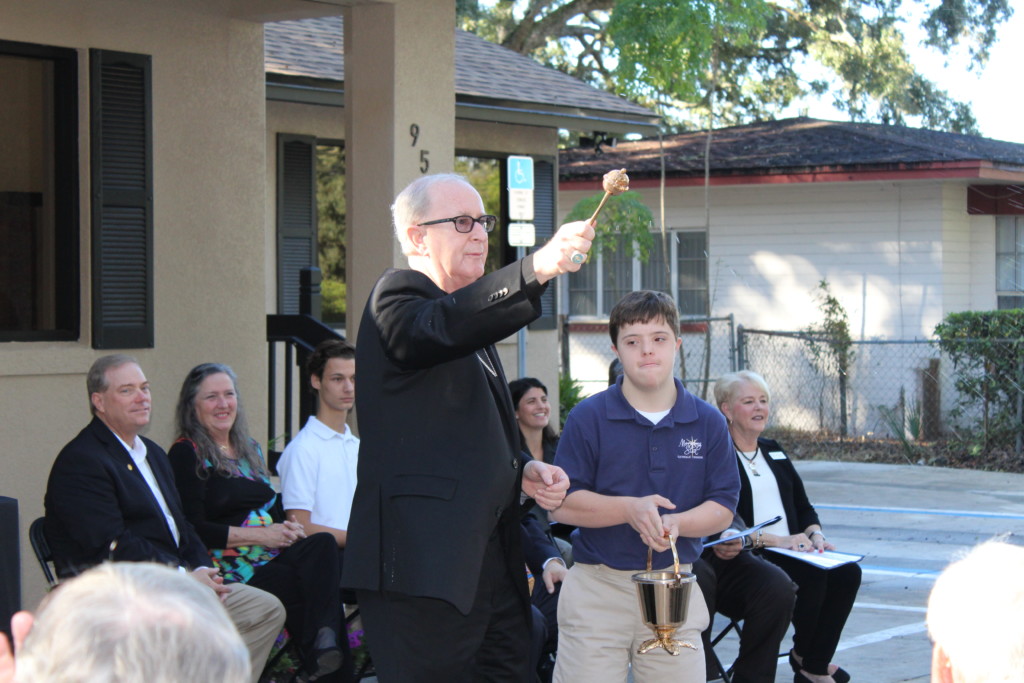
Bishop John Noonan blesses a new transition facility for young adults with special needs at Morning Star Catholic School in Orlando.
In recent decades, advances in medicine and early intervention programs have made their lives richer and longer than ever. And that has created a new set of questions for parents like Breske, whose special-needs children will need to prepare for life as adults.
Public policy is starting to adapt. Recent federal legislation created savings accounts that can help adults with special needs pay their living expenses. New Florida laws promote college and career-training programs. And schools, both public and private, have expanded programs aimed at preparing students like Bobby to get part-time jobs and care for themselves.
The elder Breske was helping unveil a renovated house at Morning Star. The structure once housed nuns on the 56-year-old school site, but it's been converted to help students in its young-adult transition program learn how to cook, clean and live independently. Recent changes to Florida educational choice programs mean similar programs could soon be growing at private schools around the state.
"We all know we're going to away one day," Breske said, describing the anxiety many parents feel as their special needs children grow older. "And what's going to happen to them?"
Camille Gardiner, who also has a son with Down syndrome, said parents like her were less likely to face that question a generation ago. In the 1970s, children born with Down syndrome were only expected to live into their 20s. Now, their life expectancy is about 60. As a devout Catholic, she said, "I have come to realize that being pro-life does not end at the birth of a child. In many ways, that's where it starts."
Members of both chambers of the Florida Legislature voted unanimously this afternoon for a bill that would expand several educational options for children with special needs and improve private school students' access to college courses.
Among other things, the measure, which advanced without controversy, would broaden the possible uses for the state's popular school voucher program for special needs students.
If Gov. Rick Scott approves the revised HB 837, among other things: (more…)
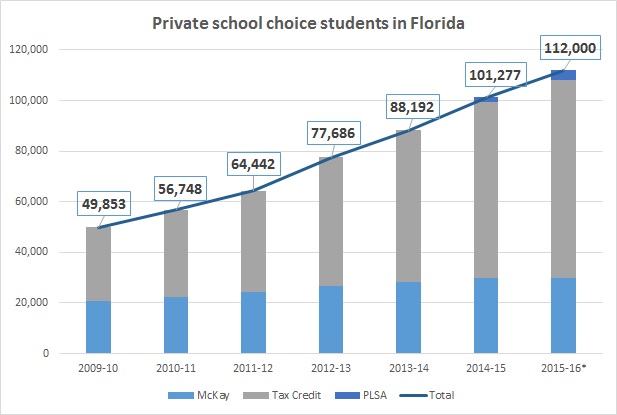
Florida's three private-school choice programs serve roughly 112,000 students this year. *2015-16 totals are rounded and preliminary. Numbers could change before the school year ends.
Florida may be home to the largest private-school choice program in the nation, but its level of participation ranks no. 3 in the country, according to new data from the Friedman Foundation for Educational Choice.
The no. 1 state (Arizona) should come as no surprise. The no. 2 state (Vermont) might, though it's home to one of the oldest school choice traditions in the United States.
The Friedman Foundation added up the number of private-school choice students in each state. In Florida, that's about 30,000 on McKay Scholarships, more than 78,000 on tax credit scholarships, and roughly 4,000 using Gardiner Scholarships during the 2015-16 school year. It then divided the total by the number of "taxpayer-supported" students, including the nearly 2.8 million attending public schools. Florida's private school choice participation rate came to about 4.1 percent. (Tax credit scholarships are supported with private, tax-credited donations, while the other two programs receive direct state funding). (more…)
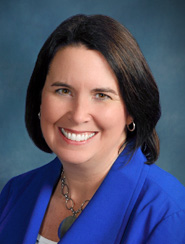
Sen. Stargel
SB 1062 by Sen. Kelli Stargel, R-Lakeland, cleared the Education Pre-K-12 Committee on a 9-1 vote on Tuesday. It would make it easier for students to receive John M. McKay Scholarships for Students with Disabilities, a popular voucher program.
Right now, with few exceptions, students with special needs are required to have enrolled in public schools or received specialized services under the state's Voluntary Prekindergarten program before they can apply for the scholarships, which serve more than 30,000 students this school year.
The lone committee member voting against the plan was Sen. Dwight Bullard, D-Miami, who noted parents can apply for Gardiner Scholarships, the state's newer education savings account program for special needs students, without first attending public schools. (Step Up For Students, which publishes this blog, helps administer the Gardiner program.)
Bullard said the requirement that students attend public schools before qualifying for McKay Scholarships was intended, in part, to ensure parents "understood the width and breadth of the programs at the public-school level that were available."
(more…)
Cierra Penson starts the week with her schedule planned out. Monday, she works at Publix. On Tuesday, she helps out at the Jacksonville Zoo. On Wednesdays, she'll join some classmates working on one of her school's business ventures: Barkin' Biscuits, a brand of dog treats now shipped around the country. The 19-going-on-20-year-old also juggles after-school guitar lessons, sessions with job coaches, and coursework aimed at teaching skills for adult life.
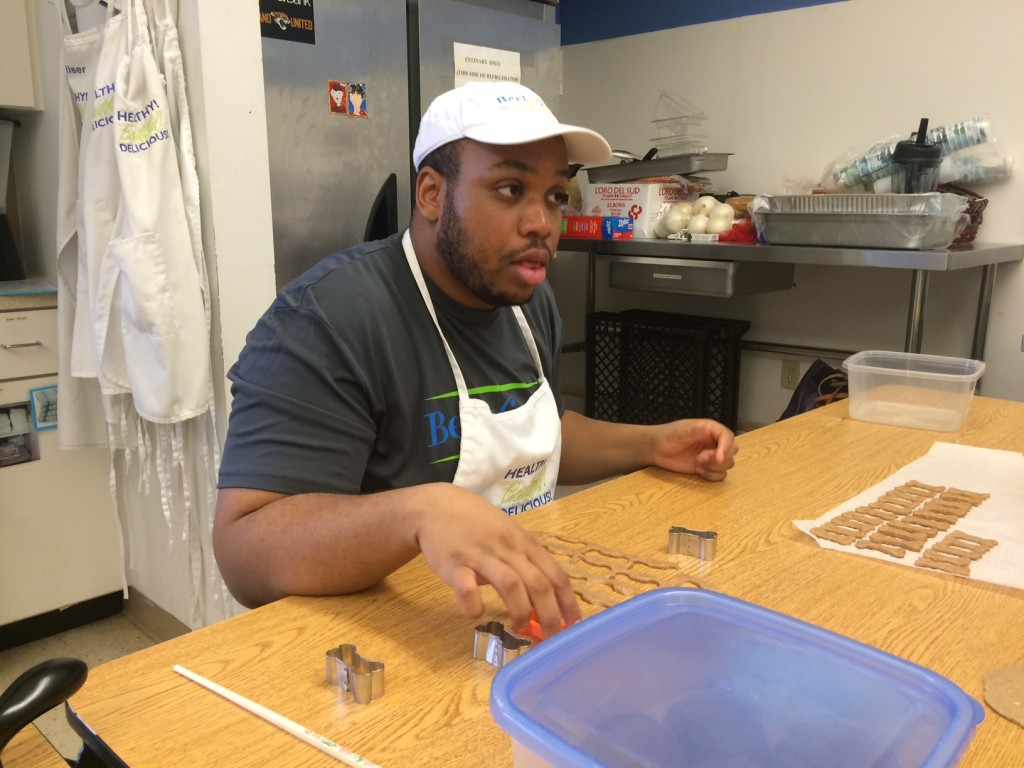
London Hurley works on Barkin' Biscuits, one of the in-house enterprises at the North Florida School of Special Education.
Sally Hazelip, the school's executive director, said teenagers and young adults with special needs "need to be as busy as we are." But holding down a full-time job can be stressful. So after students graduate — which for special needs students tends to happen between the ages of 18 and 23 — the school teaches skills, from time management to grocery shopping, that will help them thrive as adults.
In recent years, Florida lawmakers who saw the benefits of early-intervention programs and a proliferation of K-12 options for special-needs students began to focus on what would happen when those children got older. When the Legislature convenes this week, bills near the top of the agenda are aimed at expanding college and job opportunities for people with special needs.
The quest to help them achieve their potential doesn't end with a diploma. As Hazelip put it: "Our kids with special needs should have every opportunity that everyone else does." (more…)
Florida's private schools added more than 5,500 students during the recently completed school year, according to new statistics from the state Department of Education.
The 1.7 percent enrollment increase in 2015 marks the fourth-straight year of small but significant growth for private schools, and the latest sign they are slowly recovering from the Great Recession.
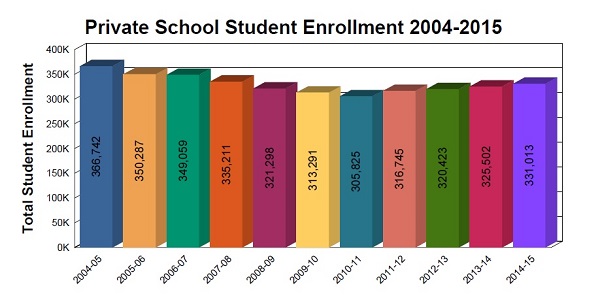
Graph by Florida Department of Education

