In a new twist on the legislative funding changes crimping Florida Virtual School, private schools that accept state-funded McKay Scholarships for special needs students may now lose money when McKay students take FLVS classes.
Rennick
Private schools learned last week about the possible fallout, which could result in students dropping Florida Virtual School courses or parents paying for what traditionally has been offered for free.
Many of the 1,200 private schools that accept the scholarships, which on average range between $3,977 and $7,019, don’t charge parents more for tuition, said Robyn Rennick of The Coalition of McKay Scholarship Schools. So they likely will withdraw students from FLVS courses or ask parents to make up the difference.
“Was this really what the Legislature intended when they changed this statute – hurting the parents of kids with disabilities?’’ the coalition asked in a notice to school operators Monday.
Of the roughly 27,000 students who receive McKay Scholarships, 790 are enrolled in FLVS classes. At many of the high schools that accept the scholarships, students are taking driver’s education and health courses offered by FLVS, Rennick said.
FLVS officials, who have watched enrollment plummet since the funding change, said they’ve already heard from private school administrators who say the proposed cuts will cause financial hardships and lead to withdrawal of students currently enrolled in FLVS.
“This is yet another unintended consequence of the new funding model – denied choice for children with disabilities working hard to get the best education they can possibly get,’’ Florida Virtual School spokeswoman Tania Clow said.
Department of Education officials plan to discuss the issue Friday morning during a regularly scheduled internal meeting. They declined comment Thursday. (more…)
Private schools. The principal of Seminole High in Pinellas is leaving to take the top job at Indian Rocks Christian. Gradebook.
Charter schools. Funding for charters, vouchers and tax credit scholarships figure into Duval's budget considerations. First Coast News.
 Kiera Wilmot. Mom: "We've been a living a nightmare." Orlando Sentinel.
Teacher unions. FEA files a motion for rehearing on dismissed SB 736 suit, reports Gradebook. Fedrick Ingram, the new president of the Miami-Dade teacher union, is sworn in, reports the Miami Herald.
Teacher conduct. The Broward County school district should have stopped a middle school teacher from having sex with one of her students, the victim's family alleges in a lawsuit. Miami Herald.
Teacher pay. The Tallahassee Democrat follows the email trail between the FEA and Gov. Rick Scott's office over the shape of teacher pay raises in the waning days of the legislative session. (more…)
by Allison Hertog
Hertog
I have dedicated my life to helping disabled students – first as a special education teacher and, for the last many years, as an attorney for parents of disabled children. As strongly as I support the rights of disabled students to be educated on an equal playing field with their typical peers, I do not completely agree with the kind of heavy governmental oversight of private schools that the U.S. Department of Justice mandated last month in its much-publicized letter to the Wisconsin superintendent of public schools.
In that letter, the DOJ finds the State of Wisconsin is obligated to “eliminate discrimination” against students with disabilities in its private school voucher program, regardless of whether the private schools accept federal funds.
Because they take federal funds, states are of course charged with meeting certain federal civil rights mandates in their administration of public schools. I am not an expert in school choice law, or the Americans with Disabilities Act for that matter. But what appears to be new here is that because Wisconsin administers a school choice program, it must “ensure” that participating private schools, regardless of whether they take federal funds, adhere to some of the most important mandates of the ADA.
The private and religious status of the individual voucher schools does not absolve DPI of its obligation to assure that Wisconsin’s school choice programs do not discriminate against persons with disabilities as required under Title II [of the Americans with Disabilities Act.]
The letter was precipitated by a complaint filed in June 2011 by the American Civil Liberties Union and Disability Rights Wisconsin. It alleged the Milwaukee voucher program discriminates against kids with disabilities and segregates them in public schools. It claimed that of the 21,000 students enrolled in private voucher schools, 1.6 percent had plans that specified special needs services, compared to about 20 percent of students in the Milwaukee public school system. Voucher advocates such as Patrick Wolf, who completed a study in 2012, have found less discrepant rates of disability in the Milwaukee program.
An important note: Wisconsin’s voucher programs are not designed specifically to serve children with special needs, such as Florida’s John M. McKay Scholarship for Students with Disabilities. They are designed to serve all students with family incomes up to 300 percent above the poverty level.
Nonetheless, the result of the DOJ letter is the state must seriously ramp up its oversight of the private secular and religious schools participating in its voucher programs, including the Milwaukee Parental Choice Program, the oldest voucher program in the country.
Some oversight is, of course, warranted. In our country, private schools can’t discriminate against students based on their race for instance, regardless of whether the schools take government funds. And private schools which don’t take federal funds shouldn’t discriminate in their admissions and suspensions process against students who can meet the demands of the school if provided with reasonable accommodations and supports.
However, not all private entities in our society have a public purpose. Some private schools choose to forego the benefits of federal monies because they want to provide a certain type of education to a certain type of student population - be it a nunnery or a secular feeder high school to the Ivies. In the later case, even a private school which takes federal funds is totally within the confines of the ADA to discriminate against a child applicant with intellectual disabilities who cannot meet its academic demands. When a private school foregoes government money, it should not be subject to the same government oversight as a school which reaps the benefits of it. (more…)
 My recent post about the importance of including parental choice in our definition of public education accountability drew a thoughtful response from Melissa Webber, the parent of a special needs child.
She writes, “I’m not sure I agree with the writer’s explanation of accountability. While I support parental choice and have in the past taken advantage of the McKay Scholarship, I think choice is a separate issue not to be confused with accountability unless parent empowerment actually affects positive change of a program to bring it up to regulation standards. One of the private schools I visited had no certified teacher, made no attempt to comply with sunshine standards and they weren’t bound to provide services spelled out in Blake’s IEP. Basically, it served as a disorganized daycare for middle school ESE kids. It was an easy choice for me to opt for another public school program. However, my choice to do so did not make the school more accountable. There should be much more oversight to insure at least minimal standards are met so the children of less informed parents do not suffer in the name of choice.”
The public good is best served when public education operates with maximum effectiveness and efficiency. Highly effective and efficient schools are best possible through a combination of regulations and consumer choice. Regulations provide the floor below which no school should operate, but regulations alone can’t produce excellence. Excellence requires consumer choice.
Ron Matus’ recent story about one of Florida’s top charter schools included this quote from the school’s founder and principal, Yalcin Akin: “If they like us, they come to our school. If they don’t like us, they don’t come. We have to have a high level of customer service and a high level of performance – or we will not survive.”
This necessity to meet parents’ needs or go out of business is part of accountability, and helps fuel the drive for excellence. Last year, Akin’s school had a waiting list of about 1,500 students.
Now consider Melrose Elementary in St. Petersburg. Only one student chose to attend Melrose’s magnet program this year. All the other Melrose students were assigned there by the school board and, if they don’t show up, their parents can be sent to jail.
Melrose is more highly regulated than Akin’s charter school, but it is not more accountable. As long as students are forced by law to attend Melrose, it won’t go out of business, regardless of its effectiveness. (more…)
 Accountability in public education derives from a combination of government regulations and consumer choice. Historically, because we’ve had so little consumer choice in public education, regulations have been the dominant component of accountability. But now that school choice is becoming more ubiquitous, consumer choice is assuming a more prominent role.
Unfortunately, some of our most important public education policy wonks are devaluing the importance of consumer choice by using the term accountability as a synonym for regulations.
My friend and former colleague here at Step Up For Students, Adam Emerson, in criticizing the lack of required state assessments in Florida’s McKay Scholarship program, recently wrote on his Fordham Institute blog that:
“Virtually no accountability measures, however, exist in most of the nation’s special-education voucher programs, including the largest such program in the United States, Florida’s McKay Scholarship for Students with Disabilities.”
Parents choose to apply for and use a McKay Scholarship. If their needs are not being met at one of the more than 1,100 Florida private schools accepting the McKay Scholarships, they can vote with their feet and go to another school. To suggest this level of consumer choice equates with “virtually no accountability measures” is wrong.
Adam’s gifted colleague at Fordham, Mike Petrilli, made a similar error a few days later. He wrote that “Indiana’s voucher program has accountability in spades,” then ignored consumer choice and equated accountability only with required student testing and school grades. (more…)

Emerson
The Fordham Institute took Florida’s McKay Coalition to task Monday for a survey the institute says "stoked emotions" about state tests at private schools that serve disabled students on state vouchers. In a post by parental choice program director Adam Emerson, the Institute chided the coalition for resisting academic assessment for the McKay Scholarship, which this year serves more than 26,000 students with learning disabilities and physical limitations.
“Virtually no accountability measures … exist in most of the nation’s special-education voucher programs, including the largest such program in the United States, Florida’s McKay Scholarship for Students with Disabilities,” Emerson wrote. “And the coalition of schools that oversees the McKay program appears to want to keep it that way — and it’s wrong to do so.”
Fordham remains a strong national supporter of parental choice, including charter schools, school vouchers and tax credit scholarships. But the institute also has called on the learning options to be held to account for the achievement of their students.
In its recent report, “Red Tape or Red Herring,” Fordham looked at the participation rate of private schools in voucher and tax credit scholarship programs in 11 states and surveys from 241 private schools that do and don’t participate, and found that testing requirements are not a significant deterrent. Only a quarter of the schools ranked state-required testing as a “very” or “extremely” important factor. The response rate among participating schools was 73 percent.
McKay countered with its own yes-or-no survey of Florida private schools participating in the state scholarship for disabled students. Its response rate was 40 percent. (more…)
Charter schools. The Tampa Tribune suggests a compromise is in the works on bills dealing with charter schools funding, facilities and accountability. Senate education leaders want a broader discussion about a proposal to give charter schools dibs on unused school buildings, reports Gradebook. Tampa Bay Times columnist John Romano lists support for "for profit charter schools" as another example of the Legislature not caring about popular opinion. A St. Lucie County School Board member raises the idea of converting a soon-to-be-shuttered school into a charter, reports TCPalm.com.
 Private schools. The ones in Marion County are hurt by the recession, but the pain is mitigated by McKay and tax credit scholarships, reports the Ocala Star Banner. Unpaid volunteer teachers come to the rescue of a Brandon private school that experienced an enrollment dip. Tampa Bay Times.
Magnet schools. The Miami-Dade school district is looking to create a new MAST magnet school on one of the FIU campuses, but it hinges on funding from local communities. Miami Herald.
Parent trigger. The Panama City News Herald writes up Friday's vote in the House Education Committee.
The Florida model. Education Commissioner Tony Bennett and Patricia Levesque, executive director of the Foundation for Excellence in Education, are among those participating in Maine Gov. Paul LePage's education summit, reports the Kennebec Journal. More from WABI TV. (more…)
Editor’s note: This post was submitted by the Coalition of McKay Scholarship Schools.
 In a recent “Florida Roundup” post, redefinED reported that a new study from the Fordham Institute “finds that mandated testing – and even public reporting of test results – isn’t that big a concern for private schools worried about government regs tied to vouchers and tax credit scholarships.”
The Coalition of McKay Scholarship Schools, a volunteer organization of private schools participating in the McKay Scholarship Program, decided to take a survey and determine whether this research finding held true for Florida private schools. The findings in Florida were polar opposite from the Fordham Institute, which did not survey schools in Florida but concentrated on schools in Indiana, Ohio, and Wisconsin.
The Coalition sent a survey to the 1,155 participating McKay Scholarship schools in February. It received 474 responses, representing approximately 40 percent of the McKay schools. Results indicate that 1) nearly all of the schools are conducting norm-referenced assessments of their students; 2) these education professionals do not believe the FCAT is an appropriate measure for their students with disabilities; and 3) 61 percent of the schools responding reported they would no longer participate in the McKay Scholarship Program (a type of school voucher program) if required to give the FCAT to their students.
The McKay Scholarship Program was designed so parents of children with disabilities would be able to identify and participate in programs that would meet the needs of their children. Many parents choose to participate in the McKay program because they do not believe the FCAT and a one-size-fits-all approach to education are in the best interest of their children who have disabilities and do not fit the “norms.” The McKay Scholarship Program has been very successful and popular with parents because it provides them with the ability to choose a school that best meets the unique needs of their children.
Contrary to the findings of the Fordham survey, Florida private schools participating in the McKay Scholarship Program are very concerned with mandated testing and will leave the program if required to do so, thus limiting the access to educational options that parents of children with disabilities now have.
The survey questions and statistics may be found at www.mckaycoalition.com. The following is a summary of the findings: (more…)
Backers of a bill that would give Florida students with disabilities quicker access to state-funded vouchers for private schools say they need another year to work on the proposal.
Senate Bill 172, filed by Sen. Miguel Diaz de la Portilla, R-Miami, was withdrawn from consideration last week.
The bill called for removing the rule that students spend a year in a Florida public school immediately prior to becoming eligible for the McKay Scholarship. Advocates support that provision whole-heartedly, but some feared potential complications between parents and school districts.
“We want to go back and rework it a little,’’ said Steve Hicks, president of the Coalition of McKay Scholarship Schools, which presents private schools that accept the vouchers.
The plan is to gather stakeholders and meet during the year before presenting a new bill for the next legislative session, he said.
Sen. Diaz de la Portilla could not be reached for comment.
Florida’s new education commissioner is known for his zealous support of charter schools and vouchers and other learning options that some critics see as anti-public school.
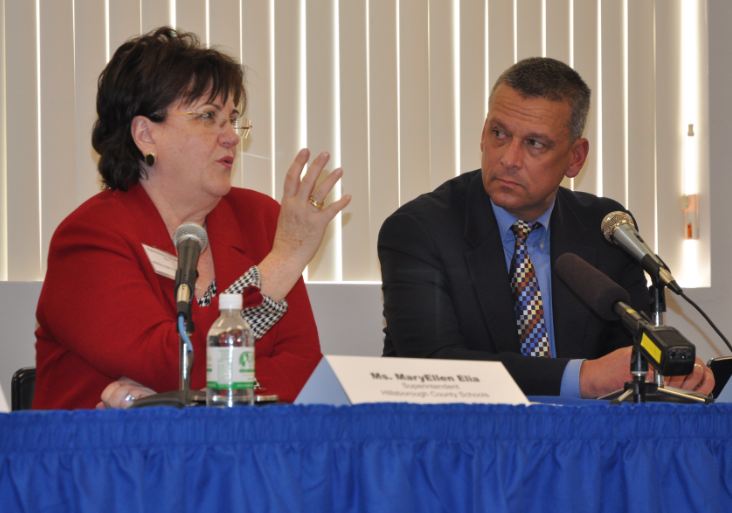
Florida Education Commissioner Tony Bennett and Hillsborough Superintendent MaryEllen Elia were among the panelists at a National School Choice Week event in Tampa. (Photo by Lisa A. Davis/Step Up For Students)
But on Tuesday afternoon, Tony Bennett sat next to Hillsborough County Public Schools Superintendent MaryEllen Elia inside a Tampa magnet school for boys, and praised the growth of choice in district schools across the state.
Florida is transcending the first round of conversations on choice that pit private and charter schools against public schools and virtual schools against “brick and mortar’’ ones, Bennett said during an event marking National School Choice Week. The new conversation, he suggested, isn’t either-or; it’s whatever works to ensure all kids have access to quality choices.
“So we’re now talking about choice – not just private schools and charter schools and virtual schools – we’re talking about public school choice,” he told an audience of about 100 people gathered at the Boys Preparatory Academy. “We’re talking about creative leaders like MaryEllen, like the team here, creating educational opportunities for children within the district - and really going to what we all heard was the purpose of choice to begin with, to provide incubation for innovation for our public schools.”
Tuesday’s event was sponsored by the Florida Alliance for Choices in Education, a coalition that includes a wide swath of school choice groups. Bennett and Elia sat on a panel with representatives from home-schooling, virtual education, magnet schools, career academies, Florida tax credit scholarships and McKay scholarships.
Most were parents who had lived and breathed school choice, starting with their own children. As they shared stories of searching for schools that practiced their faith or fit their child’s academic needs, they offered numbers that shed light on the choice movement’s impact. (more…)

