Backers of a bill that would give Florida students with disabilities quicker access to state-funded vouchers for private schools say they need another year to work on the proposal.
Senate Bill 172, filed by Sen. Miguel Diaz de la Portilla, R-Miami, was withdrawn from consideration last week.
The bill called for removing the rule that students spend a year in a Florida public school immediately prior to becoming eligible for the McKay Scholarship. Advocates support that provision whole-heartedly, but some feared potential complications between parents and school districts.
“We want to go back and rework it a little,’’ said Steve Hicks, president of the Coalition of McKay Scholarship Schools, which presents private schools that accept the vouchers.
The plan is to gather stakeholders and meet during the year before presenting a new bill for the next legislative session, he said.
Sen. Diaz de la Portilla could not be reached for comment.
Florida’s new education commissioner is known for his zealous support of charter schools and vouchers and other learning options that some critics see as anti-public school.
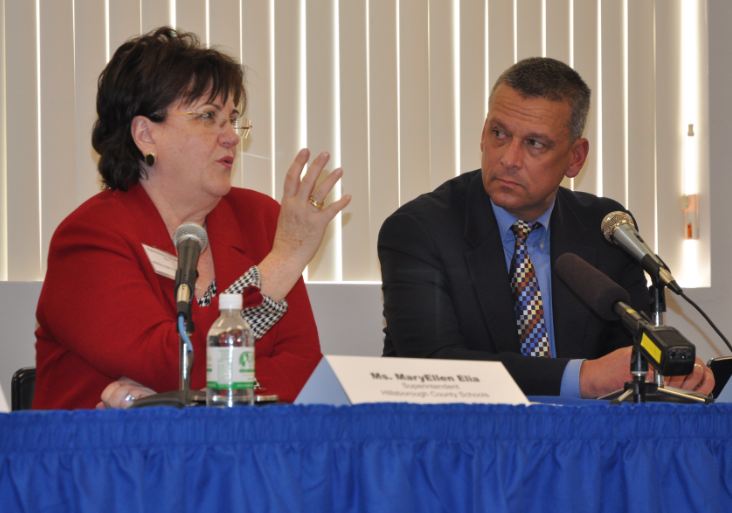
Florida Education Commissioner Tony Bennett and Hillsborough Superintendent MaryEllen Elia were among the panelists at a National School Choice Week event in Tampa. (Photo by Lisa A. Davis/Step Up For Students)
But on Tuesday afternoon, Tony Bennett sat next to Hillsborough County Public Schools Superintendent MaryEllen Elia inside a Tampa magnet school for boys, and praised the growth of choice in district schools across the state.
Florida is transcending the first round of conversations on choice that pit private and charter schools against public schools and virtual schools against “brick and mortar’’ ones, Bennett said during an event marking National School Choice Week. The new conversation, he suggested, isn’t either-or; it’s whatever works to ensure all kids have access to quality choices.
“So we’re now talking about choice – not just private schools and charter schools and virtual schools – we’re talking about public school choice,” he told an audience of about 100 people gathered at the Boys Preparatory Academy. “We’re talking about creative leaders like MaryEllen, like the team here, creating educational opportunities for children within the district - and really going to what we all heard was the purpose of choice to begin with, to provide incubation for innovation for our public schools.”
Tuesday’s event was sponsored by the Florida Alliance for Choices in Education, a coalition that includes a wide swath of school choice groups. Bennett and Elia sat on a panel with representatives from home-schooling, virtual education, magnet schools, career academies, Florida tax credit scholarships and McKay scholarships.
Most were parents who had lived and breathed school choice, starting with their own children. As they shared stories of searching for schools that practiced their faith or fit their child’s academic needs, they offered numbers that shed light on the choice movement’s impact. (more…)
Florida Catholic schools are embracing Common Core academic standards and seriously considering whether to take the coming state tests aligned to them. In the meantime, their leaders say, 30 to 40 Catholic schools want to administer the FCAT in 2014, in what would be a trial run for potential transition to Common Core testing.
“Our mission is the same, public or Catholic school, to create productive citizens in our world that actually have the skills in life they need,” Alberto Vazquez-Matos, schools superintendent for the Diocese of St. Petersburg, told redefinED. “We’ll all be raising the standards and talking the same academic language.”
The push by Catholic schools towards common standards - and perhaps common tests - is an interesting counterpoint to the debate that followed last week’s comments by Gov. Rick Scott. Scott re-opened the door to a long-running conversation about voucher and tax-credit scholarship programs by saying he wants to see students in those programs take the same tests as their public school peers.
Right now, the state does not require tax credit scholarship students to take the FCAT, but they are mandated to take another comparable, state-approved test such as the Stanford Achievement Test or Iowa Tests of Basic Skills. Disabled students who use McKay vouchers to attend private schools are not required by the state to take any such tests.
This year, Catholic schools in Florida enroll 7,673 tax credit scholarship students. (The scholarship program is administered by Step Up for Students, which co-hosts this blog.)
Scott’s comments sparked suggestions from some school choice critics that private schools were dodging comparisons to public schools. But Florida’s Catholic schools have been quietly moving towards Common Core for more than year. In fact, all 237 Catholic schools in Florida will be rolling out a “blended’’ version of the language arts standards, right along with public schools, in 2014. (more…)
A new Florida House subcommittee devoted to all things school choice does not necessarily signal major reforms in the upcoming legislative session, says incoming House Speaker Will Weatherford. The point, rather, is to keep choice in the debate.
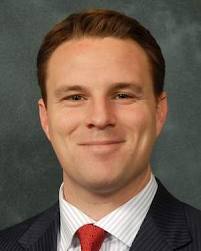
Weatherford
“I think choice has always been in the conversation,’’ Weatherford, who is scheduled to be voted in as speaker today, told redefinED.
Creating the Choice & Innovation Subcommittee is really more about helping the Education Committee make sure parental empowerment, technology and other school choice issues don’t get lost in the general discussion, he said. Education is “such a huge policy area,’’ Weatherford said. “There are a lot of bills that get filed.’’
Expect those bills to include many that have more to do with overall education policies and red tape than turning classrooms into a “21st learning experience,’’ he said. “There’s a lot of reform and a lot of innovating taking place across the country and across the world,’’ Weatherford said. “I want the Legislature to lead this debate.’’
The subcommittee has sparked interest across party lines. (more…)
 In the next five years, Florida aims to double the number of students attending charter schools, to 360,000, and more than double the number attending private schools with tax credit scholarships, to 100,000, according to the state Board of Education’s draft strategic plan.
It’s no secret that expanding school choice is central to the board’s vision of education reform. But the draft plan, which the board is scheduled to vote on Tuesday, shows just how sweeping that vision continues to be, even for a state that’s already recognized as a national leader in learning options.
Charter schools: Last year, Florida had 518 schools and 179,940 students enrolled in charter schools. The BOE’s draft goal for 2017-18: 829 schools and 359,880 students.
McKay scholarships: Last year, 24,194 students with disabilities used these vouchers to attend private schools. The draft goal for 2017-18: 31,441.
Tax credit scholarships: Last year, 40,248 low-income students attended private schools with them. The draft goal for 2017-18: 100,620.
Virtual education: Last year, 3.84 percent of Florida students were enrolled in online programs part time and 0.24 percent were enrolled full time. For 2017-18, the BOE is shooting for 5 percent part-time and 1 percent full-time. (more…)
 Editor's note: This op-ed appeared in today's Tampa Bay Times.
Few public issues are as absorbing as the balance between religion and government, so a ballot initiative that aims to change the boundary is worthy of rigorous debate. Instead, Florida's Amendment 8 is being treated to a proxy campaign on school vouchers.
A new radio ad by the Florida Education Association: "Amendment 8 allows the government to give our tax dollars to any group claiming to be a religious organization, so any religious group or sect can use our money to fund their own religious schools."
FEA president Andy Ford: "This is designed to open the state treasury to voucher schools."
Alachua School Board member Eileen Roy: "It's the very death of public schools. That's not overstating it, in my opinion."
These are provocative arguments, to be sure, but they are basically irrelevant. The amendment was placed on the ballot by two legislators — Sen. Thad Altman, R-Viera, and Rep. Scott Plakon, R-Longwood — who have said repeatedly they want to protect religiously based social services. Their interest was piqued by a lawsuit, Council for Secular Humanism vs. McNeil, that challenges a prison ministries program, and by the fact that the New York-based council has called it "a springboard to mounting other challenges."
In turn, the pro-Amendment 8 campaign is being led by a coalition of community-service providers and religious leaders who have raised less than $100,000 to date. They believe that if the secular humanists will sue over prison ministries, they might one day challenge the Catholic Charities or Catholic hospitals or the YMCA. After all, the current constitutional language is explicit: "No revenue of the state or any political subdivision or agency thereof shall ever be taken from the public treasury directly or indirectly in aid of any church, sect, or religious denomination or in aid of any sectarian institution."
Now it is certainly true that voucher advocates have previously pushed to alter the no-aid clause. But it is just as clear that they played no role in getting this amendment on the ballot and, most telling, have raised not a penny for the campaign. Their reasons are pragmatic, not philosophical: Federal and state court decisions in recent years have rendered the no-aid clause all but moot as it relates to school choice. Read full editorial here.
Editor's note: The debate over school choice might be less tense if we heard more from the parents, teachers and principals who have decided an alternative setting is best. Nadia Hionides, who recently penned a heartfelt letter to The Beaches Leader newspaper in Jacksonville Beach, Fla., offers a good example. Hionides runs The Foundation Academy private school in Jacksonville, where about 90 of 280 students benefit from tax credit scholarships for low-income students. As her letter shows, her goals aren't privatization and profits; they're justice, equity and diversity. She credits Florida's two K-12 private-option programs - tax credit scholarships (administered by Step Up For Students) and McKay scholarships for disabled students - with helping her school reach those schools. Below is her letter. Hat tip to Elizabeth Watson, Step Up's director of operations support services, for sending the letter our way.
 I am an educator for 35 years, a school owner and principal for 25 years.
I came into the profession to help promote equity and justice in America.
We are all unique and creative beings. There is no one size fits all way of learning and growing into successful, compassionate, well-adjusted people.
I cannot think of a better way to promote equity and justice in education than through the Step Up/McKay scholarships.
These scholarships not only equalize the playing field economically but allows those in poverty to enhance the lives of the economically privileged by being in the same private schools.
We all gain in a diverse environment. We all lose in segregated settings.
Myself, my students, my teachers and my community are all blessed through this amazing scholarship.
No child left behind can be accomplished if all private schools participate.
Only in the diversity of private school choices, along with public school, can we meet the diversity in children and achieve successful, well-educated, globally competitive students.
I am privileged to be part of something that changes lives.
by Allison Hertog
Mississippi recently became the first state in the nation to adopt a public and private school choice program in which state and federal monies are provided directly to schools which parents choose. Aimed at students with dyslexia, it's also the second special needs school choice program in the country designed for children with a single type of disability. (Ohio’s Autism Scholarship Program enacted in 2003 was the first.)
What makes this new program interesting is that it may be a starting point for other state legislatures where special needs voucher bills have failed due to concerns about parent accountability – Wisconsin comes to mind – or where special needs voucher laws have come under increased scrutiny due to reports of private school abuse of public money – Florida comes to mind.
Mississippi’s program morphed from a dyslexia screening and treatment bill (supported by a governor who struggled with the learning disorder) into a school choice measure during the proverbial sausage-making legislative process. It’s not as carefully or as broadly designed as it could have been. It also appears there’s currently only one school in the state which is specialized enough to meet the exceedingly specific criteria to participate. But nonetheless, it succeeds in incentivizing the growth of more highly-accountable school options for parents. (more…)
Step Up For Students (SUFS) is a nonprofit organization whose mission is to help low-income parents access the schools that best meet their children’s needs. We do this, in part, by providing tax-credit funded scholarships to low-income families to help them pay the tuition and fees at qualified private schools.
While our scholarships help disadvantaged families afford private schools, our mission is not to promote private schools over homeschooling, charter schools, virtual schools, neighborhood schools or magnet schools. We just want parents to have a full array of educational choices to them, and having access to private schools — especially faith-based private schools – is important to many low-income families. So we want this option to remain viable. Unfortunately, if we don’t reverse recent trends, this private school choice is threatened.
Enrollment in Florida private schools has declined 20 percent in the past seven years, from 381,346 students in 2003-4 to 305,825 in 2010-11. And as the demand for private schools has declined, so has the supply. From 2004-5 to 2010-11, the number of private schools in Florida went from 2,304 to 2055, a decrease of 11 percent.
We know from Economics 101 that supply and demand are interdependent. A growth cycle occurs when increased demand leads to greater supply, which in turn drives more demand, which in turn generates more supply. And a death cycle happens when the opposite occurs: less demand leads to less supply, which further reduces demand, which causes even less supply. Florida’s private schools today are in a pronounced downward spiral that cannot be explained fully by current economic conditions. If we cannot reverse this trend, private school choice for low-income families will be diminished. I don’t believe demand has decreased - I believe the demand is as great as ever - it’s just that parents can’t afford to make this choice.
One solution is to make private schools more affordable for working-class families. (more…)
Editor’s note: The McKay Scholarship Program for students with disabilities has on occasion been criticized because it does not require that student progress be measured with a standardized test. Robyn Rennick with the Coalition of McKay Scholarship Schools argues that such a policy would be ineffective and counterproductive.
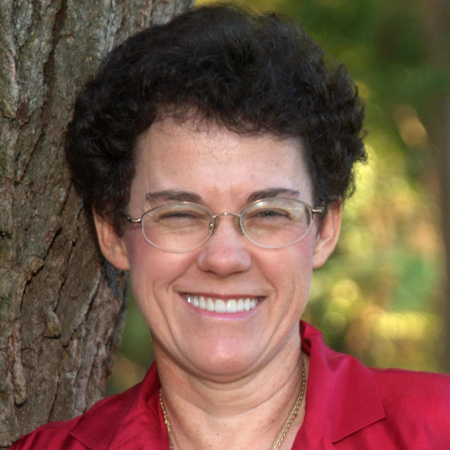
Rennick
The McKay Scholarship is quite different from tax credit scholarships in Florida or other programs that are working with the general student population. All recipients of McKay Scholarships have diagnosed disabilities and had either an Individual Education Plan or 504 Plan in the public school. Therefore, by definition, they are a unique group of students with all types of disabilities from low cognitive functioning, to autism, to learning disabilities.
The issue of requiring standardized testing was thoroughly investigated and discussed prior to crafting the initial legislation to create the McKay Scholarship. Legislators determined it was an inappropriate measure of accountability. The testing issue was brought up again between 2004 and 2006 when the accountability bill for scholarship programs was being crafted. Legislators again saw the inappropriateness of this type of testing and did not place it the legislation. They recognized that the “one size fits all” approach to testing is wrong for this population of students.
How do you test such a diverse population? What standardized test measures the growth of a severely non-verbal autistic child whose progress may be measured in gaining 40 words in a year and in being able to sit appropriately for five minutes? What standardized test measures the progress of a developmentally disabled child who is learning proper hygiene? Placing these children in a standardized test format would never show the immense progress they may have made that year, compared to where they were. It would also be a cruel exercise to make the children follow.
What of the learning disabled students? Shouldn’t standardized testing be used to show their progress? When the Coalition of McKay Scholarship Schools surveyed its members, we found more than 50 percent of the schools did use a standardized test, especially those serving the learning disabled population. However, what is also typical is these students often enter the private schools three or four years behind their peers on standardized test scores. If a student only “gains” a year on the standardized test, they are still behind. Has the school failed?
We have seen the controversy in our public system as to whether “experts” agree that standardized tests really show whether a school is working. From a research basis, for scores to be compared, the population has to be similar. As we have already noted, the McKay population is extremely diverse. Also, the population has to be large enough to develop an aggregate score. Forty-five percent of schools with McKay students have 10 or fewer students. No researcher would validate aggregate scores from such a small group of subjects. Even in a school with 100 students, the diversity of the groups would not allow for a true picture. So to require standardized testing which is reported to DOE, and then to craft a “research report” from that, would be the most flawed research and a tremendous waste of everyone’s effort, time and money.
This is a parent choice program. Parents are the consumers. They can leave if their children’s needs are not being met. (more…)

