 Editor’s note: This commentary from Gwen Samuel, president and founder of the Connecticut Parents Union and a reimaginED guest blogger, written in the form of a letter to U.S. Education Secretary Miguel Cardona, appeared recently on Samuel's blog.
When the Biden Administration announced that it was creating an “unprecedented” advisory council to elevate the role of parents and families in schools, I became full of mixed emotions.
Why? Because our parent group and similar groups across the nation have been engaged in that work for years— some for decades – with minimal parent right protections from the U.S. Department of Education.
God knows I try so hard to stay optimistic, but when I dug into the details, all I saw was an effort that looks a lot like window dressing covering up many issues parents and families are actually concerned about right now during this unprecedented time in the lives of our children.
Summer is here. Many schools are closing for summer break while many parents from rural, suburban, and urban America are scrambling to find activities and resources that help keep their kids occupied safely all while seeking additional academic and youth mental health supports critically needed due to massive learning loss and isolation that occurred because of school closures over the last two years related to the COVID-19 pandemic.
Research during and after the pandemic has identified spikes in juvenile delinquency and violent crime and massive learning loss. No longer are we talking about achievement gaps; we are talking achievement gulfs. Marginalized communities are still dealing with our country’s ongoing literacy crisis.
The CDC has emphasized the need to support the youth mental health crises from long-term isolation. Safety remains a number one concern for parents, families and many communities. In addition, many families, from all backgrounds, are worried about what is being taught in their kids’ classrooms when it comes to sexuality and sex.
Parents and families from all parts of our country are dealing with many of these major educational and life challenges all while our country is still reeling from the recent aftermath of mass shootings involving children and educators.
As a result, and in my opinion, parents and guardians and the community do not have time for a partisan government-run solution that clearly will value some parent and family voices while alienating others. I base some of my conclusions on the precedent set by this administration in recent months. All of which brings me to wonder why the Biden administration has characterized its new parent council as “unprecedented”.
Solutions to bring together parents, families and the school community is not new. Sustainable parent and family relationship building with educators is always a best practice. Making sure all our voices are represented at this government table, for the betterment of all children, is something I thought we might be able to help with.
That is why I gathered input from some diverse parent perspectives who already are doing the work engaging other parents across the country, in their respective communities, regarding K-12 education. Here is what they had to say:
Kelley Williams-Bolar, parent and youth advocate (Ohio): Mental health takes precedence over academics. We must take care of our children’s anxiety, depression, PTSD, and any other emotion in addition to applying learning in our classrooms. The Parent council is a great step, but we must include our children’s input when discussing them all while keeping mental health a priority.
Maria Cordero, grandmother of 10 (Connecticut): Dr. Cardona, recuerde que los abuelos también están criando estudiantes, asegúrese de que nuestras voces sean parte del Consejo de padres y familias. Maria Cordero’s quote translation: Dr. Cardona, remember that grandparents are raising students too, make sure our voices are part of the Council of Parents and Families.
Charles Harris, dad of six (Georgia): As the father of six children who have gone through the public school system, I have noticed a void in the area of inclusion for fathers. There is a great amount of data that highlights the importance of father involvement in the lives of children. Although there are a great many households in which the father does not reside, the schools need to do a better job of treating both custodial and non-custodial parents equally.
Tremayne Haymer, Nashville parent education advocate (Tennessee): Unfortunately when it comes to “unprecedented” changes and “innovative” programs to help disadvantaged and marginalized communities, the people in said communities often are not a part of the conversation or have a seat at the table when it comes to planning. I am curious to know even if canvassing or consulting with REAL parents was a part of the body of this new council. Because honestly speaking, this sounds like yet another placebo being administered to satisfy votes.
Najimah Roberson of Harrisburg Families United (Pennsylvania): As an urban parent leader the only way to support my voice would be to give all children educational freedom. Lack of education = Violence = The same old prison pipeline! Biden can do better!
Mama Bear Gwen Samuel, president, and founder CT Parents Union (Connecticut): Every day there is a new flavor of the month solution in public education. As a result, I teach parents/guardians not to blindly trust any system. Parents, regardless of race or zip code, must always fight to ensure the safety, education, and overall wellbeing of their child and all children. I support any entity that values ALL parent and family voices – keyword ALL – even if we have different points of view on an issue.
Erika Sanzi of Parents Defending Education (Rhode Island): If the goal of this parent council is to quell parent concerns, it will backfire quickly since it excludes groups that stand up for parental rights and groups that are on the ground in local communities listening to parents and working to bring about meaningful change. It is also strange that people who defended the letter calling parents “domestic terrorists” are on the council. Good luck with that, Mr. President.
Asia Taylor of Harrisburg Families United (Pennsylvania): At the end of the day the key to a successful education for a child is parent involvement! The government needs to knock down this invisible but ever so evident wall and allow us parents to choose for our children!
Lin Yang, mom, and board member of Chinese American Heritage Association (Connecticut): I believe the American Dream is founded upon the premise of equal opportunity, not equal outcomes, that we are not judged by the color of our skin but the content of our characters. However, the recent trend in our educational institutions towards the assignment of victim groups among our children by their race, ethnicity, or sexual orientation is extremely deleterious to our society’s meritocratic foundations. In particular, we strongly oppose the ethnic subgroup registry of Asian-American students. Please treat all our children as equals instead of victims.
 Editor’s note: This article appeared Tuesday on The 74.
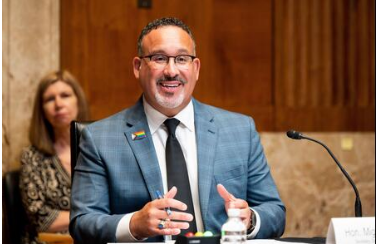
Recognizing a growing movement for parent rights in education, Education Secretary Miguel Cardona on Tuesday announced the creation of a new “Parents and Families Engagement Council.”
The council will include representatives from 14 organizations that advocate for giving parents a voice in their children’s education — including families involved in charters, homeschooling and private schools.
In preparation for the 2022-23 school year, the council’s “listening sessions” are slated to explore what schools can do to help students recover from the pandemic, according to the department’s announcement. The meetings will emphasize finding “constructive ways to help families engage at the local level.”
“Would I have liked to see it happen a year ago? Of course,” said Keri Rodrigues, president of the National Parents Union, one of the groups involved. She began advocating for such an initiative during the Trump administration, but added, “It’s the first time where we’re really getting … a group of folks representing parents and families at the table. It’s unprecedented.”
Other participating groups include the Council of Parent Attorneys and Advocates, which supports families who have children with disabilities; Mocha Moms, a network of Black moms’ groups; and the National PTA.
In public comments, Cardona, the father of two teenagers, frequently notes that he’s a “parent first” and has made “roundtable” discussions with parents part of his visits to schools across the country. But his department has also faced criticism from parent leaders who say he’s been more vocal about the pandemic’s strain on educators than on parents who had to endure months of remote learning and are still asking for tutoring to help their children catch up.
Meanwhile, parents have gained new political power. Those who felt overlooked by unions and Democratic leaders who were slow to reopen schools helped tilt the 2021 Virginia governor’s race in favor of Republican Glenn Youngkin.
To continue reading, click here.
 Around the state: Changes in district quarantine policies in Polk, students awarded for being courageous in Sarasota, new civics curriculum for Florida students and the state Legislature's restraint ban. Here are details about those stories and other developments from the state's districts, private schools, and colleges and universities:
Miami-Dade: Graduation dates are set for seniors from 66 public schools, who will have the chance to walk across the stage to receive their diploma. Miami Herald.
Broward: A report released last week by state auditors found multiple violations of safety protocols in Broward schools. The findings show that complying with school security standards remains a challenge for the district, four years after the shooting at Marjory Stoneman Douglas High. WLRN.
Polk: Schools officials here announced a change in the district's quarantine policy, cutting in half the amount of time students and staff will have to stay at home if they have symptoms of COVID-19 or a positive test result. Lakeland Ledger.
Volusia: The Volusia County School Board has canceled the Tuesday workshop designated to discuss the extension of Superintendent Scott Fritz's contract, per the district's website. The extension of Fritz's contract has been a controversial issue, where teachers, district staff and parents have spoken out against the contract extension while area groups have sent letters of support for Fritz to the board. Daytona Beach News-Journal.
Sarasota: Several North Port students were honored for their courage recently at an awards ceremony called Do the Right Thing. Students from Imagine School of North Port upper middle and high school campus and North Port High helped others since the school year began. Some turned in money, while others told an adult when they heard about a student struggling with mental health issues. Your Sun.
Alachua: A ninth-grade PK Yonge Developmental and Research student named Marin Best has been selected to be a "youth trekker" for the Florida Wildlife Corridor Foundation. Best will be part of a documentary called "Home Waters" coming out later this year. Gainesville Sun.
Citrus: Citrus High School made an announcement via Facebook on Friday that current principal Laura Lindeman will be leaving for a district job on June 1. Citrus County Chronicle.
Learning losses: Gov. Ron DeSantis recently announced a batch of new funding to address student learning losses. The money comes from federal COVID-19 relief funds, and it will be used for after-school programs, reading intervention and creating regional mental health teams. One chunk of funding will support reading intervention and professional development for reading coaches, since DeSantis says it's crucial to have children reading at grade level by the time they reach 3rd grade. WUSF. Florida Politics.
Civics curriculum: A new civics curriculum is available for Florida fourth graders, and all Florida residents will be able to access it online for free. The state Department of Education approved a curriculum created by the state House. Florida House Speaker Chris Sprowls said the curriculum can assist in improving Florida's third place ranking in K-12 achievement. Citrus County Chronicle.
Pandemic update: The disruption and isolation of the coronavirus pandemic on students has been unlike anything they have ever experienced, with one counselor saying the impact on their mental health remains significant. Kids were already facing a mental health crisis before COVID-19, according to the U.S. Surgeon General, but the pandemic has only made it worse. WFSU.
Understaffing woes: The return to classrooms for schoolchildren nationwide doesn't equate to a return to work for many of their parents are finding needed after-school programs in short supply. Hiring and retaining staff are the biggest reasons school-based providers have not fully rebounded from pandemic shutdowns. Miami Herald. Meanwhile, students are stepping up to become employees at schools due to staff shortages. NPR.
Restraint ban: The state Legislature has banned teachers and other school staff from using zip-ties and handcuffs on students. The House and Senate approved legislation to prohibit those methods, which often target children with disabilities. HB 235 provides that only school resource officers, school safety officers, school guardians or school security guards can use mechanical restraints on students in grades 6 through 12. The next step? Approval of the bill by Gov. DeSantis. Florida Phoenix.
Legislative confusion: Two pieces of major legislation pushed by Gov. DeSantis and approved by the state Legislature have created confusion, critics say, over what public school teachers can teach in class. Orlando Sentinel.
Bill support: U.S. Education Secretary Miguel Cardona spoke with LBGTQ students to say the federal government supports them even if their governor does not in regards to the controversial parental rights in education bill. Fox 13.
Spelling bee champs: Twenty-four spellers in south Florida competed to become the champ and represent their county in the national bee, which will take place the week of Memorial Day in Maryland. The finals will be broadcast live on June 2. Miami Herald.
University and college news: University of South Florida is working to close learning gaps for male students through a mentorship program. USF officials hope such mentorship relationships will move students one step closer to addressing a longstanding issue: The growing gap in college completion rates between male and female students. Across the country, men are falling behind women not only in college enrollment, but in college graduation rates, with the gap widening in recent decades. Tampa Bay Times. The University of Florida launched the Artificial Intelligence Academic Initiative Center in March. The initiative, known as AI Squared, is designed to promote the use of AI and data science research. WUFT. University of Florida officials have selected a presidential search firm used by University of South Florida and Florida State University. The UF Board of Trustees voted during a meeting on Friday to select SP&A Executive Search from among four search firms interviewed. Tampa Bay Times. As educational institutions return to a level of normalcy, Florida Gulf Coast University students are calling for the school to honor graduating seniors with a commencement ceremony as in years prior. Instead, university leaders announced they are keeping their Grad Walk to honor graduates, with the concern being space and not COVID-19. Ft. Myers News-Press. The FAMU-FSU College of Engineering partnered with For Inspiration and Recognition of Science and Technology (FIRST) Robotics to host a regional competition in Tallahassee. The event featured robots built by high school students from across the Southeast, in addition to a team from Hawaii. Tallahassee Democrat.
Opinions on schools: The education budget passed by the state Legislature this year is the largest in the history of Florida. Step up for Students President Doug Tuthill and Legislative Affairs Manager Alexis Laroe discussed changes coming to educational choice programs in the Sunshine State. reimaginED. When Gov. DeSantis announced legislation to end the Florida Standards Assessment (FSA), he said the proposal would reduce school testing by 75%. But it's unclear whether a bill he signed on Tuesday will achieve that reduction. Miami Herald. The 2022 Legislative session was about waging cultural wars in the name of "transparency" and parental involvement in public education. South Florida Sun-Sentinel.
 A few weeks ago, Secretary of Education Miguel Cardona had this to say at a national education conference sponsored by Latinos for Education:
“We’ve often heard and maybe even explained that education is the great equalizer. Well, now’s our chance to prove it. Funding is there. Urgency from the president is there. Are we going to lead through this and come out stronger? I say we can.”
Cardona pointed out that the American Rescue Plan, President Joe Biden's first pandemic relief plan, included $130 billion for K-12 education and $40 billion for higher education. However, none of this funding was allocated to give families direct support when searching for access to school options to non-government schools.
Further, not all the funding meant to help these non-government schools has been received, despite how critically it’s needed.
During the same education conference, Hispanic leaders urged the Biden administration to give Hispanics a seat at the table. Those leaders expressed that Hispanic students make up more than a quarter of the nation's public school students but still are not fairly represented by teachers at public schools, nor are they getting a fair shot at access to education.
This lack of access spans from early learning opportunities to limited support to access to a college, according to this Latinos for Education report.
While the pandemic has had a great impact on all American children, it has affected communities of color and low-income students at a higher rate, especially Hispanic students, and has widened learning gaps even further. These students have faced many challenges, from lack of internet or electronic devices to language and computer literacy barriers as families struggled to help students at home.
It’s fair to say these challenges have been greater for Hispanic students than white students; it is not fair to say that students of color are hurting just because of the pandemic; they have been hurting for a long time. The hurt has been ongoing for generations. Low-income students of color have been continually impacted by the lack of school options in the U.S. and by a ZIP code system that was created to fail them.
Before the pandemic's turmoil and disruption, only around 35% of fourth-graders in the United States scored at the competency level in reading. Broken down by race, 45% of white children scored at competency level compared with 18% of Black students and 23% of Hispanic students overall.
Cardona, who is Hispanic himself, said we have a chance to help Hispanic students now. He can use his voice to truly represent Hispanic communities that are desperately asking for more school options and a shot at a great education.
He has the power to create an education system that empowers every parent and student to be the drivers in choosing what is best for them. Simply allocating funding to public schools is not enough; it’s time to reimagine education in the United States.

