It’s been a month since classes started, and Matthew Ottenwess is settled into his freshman year at Tampa Catholic High School.
He’s made friends and likes his teachers.
His high score on the school’s entrance exam gained him admission to three honors classes and one AP course. He plays linebacker on the junior varsity football team.
This was the educational landing his mother, Maggie, was looking for when she learned the family would move from New Mexico to Florida after her husband Chris, a Chief Master Sergeant in the United States Air Force, received a transfer to MacDill Air Force Base in Tampa.
The Ottenwesses have a Florida education choice scholarship to thank for that.
“It’s a game-changer,” Maggie said.

Maggie, Chris and Matthew visit Yellowstone National Park. (Photos courtesy of Maggie Ottenwess)
While the family was still stationed at Kirtland Air Force Base in Alburquerque, Maggie was able to apply for a Family Empowerment Scholarship for Educational Options (FES-EO), managed by Step Up For Students.
“The scholarship made the (moving) process easier, gave us more choice, allowed us to take a breath and not have to worry about additional stresses, both monetary and interpersonal,” Maggie said. “It eased the PCS (Permanent Change of Station) experience. There are countless other things that change – doctors, dentists, specialists, church, youth group, scouts. This took one of the larger chunks off the list.
“Box checked.”
Matthew had been homeschooled during the past five years. Chris and Maggie decided he would return to a brick-and-mortar school setting for high school. They also wanted that setting to be at a faith-based school, preferably a Catholic school.
They understood that would burden the family’s finances, but it was a sacrifice they would accept.
Chris received his Permanent Change of Station order on Dec. 23, 2024. Soon, Maggie was told of Florida’s private school scholarship program from other moms within the military community.
“I couldn’t believe what I was hearing,” Maggie said. “It was too good to be true.”

Maggie set her alarm for 7 a.m. local time on the first Saturday in February. Families could apply for FES-EO scholarships that day at 9 a.m. EST. Since Albuquerque is two hours behind, Maggie wanted to apply as soon as the session opened.
“In the military, on-time is late,” she joked.
Maggie found the “Scholarships for Military Families” page on the Step Up website and entered her family’s information. The process went smoothly until Maggie came to the screen that required her to enter her Florida address. Since the move wouldn’t happen until June, and since the family would live on the Air Force Base, they had yet to be assigned housing, so no Florida address.
“I was in panic mode,” she said.
Her fear was quickly defused during a live chat with customer service.
“You’re not the first,” Maggie was told. “We get this a lot.”
She just needed to upload Chris’s Permanent Change of Station order in the proof of residency screen on the application.
Once Maggie learned that Matthew was awarded a scholarship, she started researching private faith-based schools in the Tampa area and settled on Tampa Catholic because of its challenging history and science curriculums. He was accepted Feb. 28.
“Our Christian faith is important to our family,” Maggie said. “It is the foundation that makes all the complications, moves, hardships, financial struggles, stress, and the like possible. We incorporated religion into Matt's homeschool curriculum and wanted to keep that moving forward. We were open to both Christian and specifically Catholic options. We believed a faith-centered school would continue to support his character and moral compass.”
The FES-EO scholarship covers more than half of the yearly tuition at Tampa Catholic. Maggie said they can afford to cover the rest without her getting a job, something that is not easy for military spouses. Local businesses are not quick to hire someone who could be moving in two or three years.
This allows Maggie to continue her work as an advocate for younger enlisted Airmen, military families and dependents. She works on various committees, task forces, and councils that deal with medical, special needs, and religious issues.
“So, the scholarship is not only helping my son get a quality education, it's helping the mission of the military by me having the breadth and space and time to do those things,” Maggie said. “The scholarship is allowing a difference to happen.”
Chris, who is the Command Chief of the 6th Air Refueling Wing at MacDill, has been in the Air Force for 28 years. He and Maggie have been married for 18 years. They’ve lived on five bases in four different states.
Matthew, who was born when his parents were stationed in New Jersey, his mom’s home state, has lived in Mississippi, Illinois, New Mexico and now Florida.
When asked about the latest move, he said, “I was super excited, a little nervous for all the changes, but definitely excited to get a whole different experience of school.”
The experience was somewhat of a jolt at first. He said it took him a few weeks to become comfortable with the return to the classroom setting. He had attended Catholic school before being homeschooled.
He said he likes living in Tampa, and being on the football team allowed him to make friends quickly, since fall practice began before the first day of classes.
“It's really good,” he said. “(Tampa Catholic) has a really good curriculum. I like the teachers, and it's fun to hang out with my friends all day.”
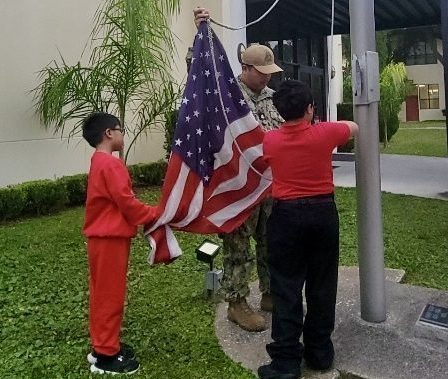
A local veteran helps students at Sacred Heart Catholic School raise the American flag before the school's annual Veterans Day ceremony. The Jacksonville school was one of two Florida Catholic schools that recently earned the state's Purple Star School of Distinction designation for supporting military students and families. Photo courtesy of Sacred Heart Catholic School
It’s tough being the new kid in school. It’s even tougher being the new kid every two to three years.
That’s the norm for 1.2 million United States children born into military families. According to the Military Child Education Coalition, military-connected children move six to nine times between kindergarten and high school graduation.
Florida lawmakers recognized the stress such transitions can create and in 2021 passed HB 439 with bipartisan support to establish a Purple Star Schools of Distinction program in the Sunshine State.
The law grants schools that meet certain criteria to be military-friendly the designation of Purple Star Schools of Distinction. The program is open to public schools as well as private schools that accept state K-12 education choice scholarships. (Step Up For Students, which hosts this blog, is the state’s largest administrator of state education choice scholarships, which allow automatic eligibility for dependents of active-duty military members.) So far, 121 schools across the state have earned the designation, including two private schools: Sacred Heart Catholic School in Jacksonville and St. John the Evangelist Catholic School in Pensacola.
Both schools are located close to military bases; Jacksonville boasts the third-largest military presence in the United States.
“We’ve always had a long history or supporting military families and the students who have been enrolled,” said Sacred Heart Principal Archie Yumul, who earned a medical degree before deciding in 2005 to trade the world of genetic research for a career in teaching, and later, school administration. His school is about three miles from the Naval Air Station in Jacksonville, so “it seemed like a good fit that we would apply for the Purple Star School designation because of our relationship with the military.”
The Purple Star Schools program has been around since 2016 thanks to Pete LuPiba, a Navy veteran and Ohio’s commissioner for Military Children Interstate Compact Commission. He wanted to create another way for schools in the Buckeye State to support military-connected children in addition to following the guidelines of the compact, which were created to replace widely varying policies all 50 states that affect transitioning military students.
However, it wasn’t until the past few years that grassroots efforts really gained momentum. So far, 34 states have passed legislation establishing the programs, while two states, Michigan and Oregon, have introduced bills.
In Florida, the state Department of Education recently established an application process for earning the designation. The requirements include the following:
At Sacred Heart, which enrolls 417 students in 3-year-old kindergarten through eighth grade this year, the school established a chapter of Anchored 4 Life, a peer-to-peer group that helps students through transitions, including those common among military families. The group works to welcome and acclimate new students, as well as provide ongoing support. Members also coordinate recognition events for military members, veterans and first responders and prepare care packages for patients in VA hospitals and nursing homes.
“As a military child, I had to relocate several times and know how challenging that can be for little ones,” said Barbara Ramos, the daughter of an Army veteran and wife of a Marine Corps veteran who now serves as the military liaison and adviser to Anchored 4 Life. Ramos also serves in the Air Force Air National Guard and so brings a parent’s perspective to her role.
“I strive to make Sacred Heart a safe and comforting environment for both the students and the parents,” she said. “I have had to deploy, and knowing my children had a true extended family with the staff and students at Sacred Heart was extremely comforting.”
Yumul said the biggest challenge the school now faces is getting the word out to the community about these military-friendly designations.
To do this, the school is circulating flyers and meeting with military contacts on the bases. They also have a display wall of their credentials and programs, hope to put up outdoor signs, and seek to engage military members as school volunteers at events such as the annual spring carnival.
Yumul said military student enrollment has grown from between 5% and 10% to between 10% and 20%.
“Our office staff, teachers, and students have taken this challenge by the horns, and we’ve just been excited to be part of the process,” he said. “We feel fortunate that we are one of two Catholic schools in the state of Florida to have this honor and distinction.”
 Florida school leaders got their first look on Wednesday at proposed rules for earning a state designation that will earmark them as friendly to military families.
The Purple Star campus program has been created in 28 states as of 2021, with the Florida Legislature approving its version in the form of HB 429, with rulemaking delegated to the Florida Department of Education.
Department staff unveiled the state’s proposed application process, a moment school leaders, especially those at Catholic schools, were eagerly awaiting. Many, especially those whose schools are located close to military bases, already have established programs geared toward being military friendly.
District, charter and private schools are all eligible for the designation if they meet the following criteria:
Schools that choose to participate must apply by Aug. 1 of each school year. Designations must be renewed every three years. Forms are expected to be available in March after final approval by the state Board of Education.
Nationally, the program is the result of a grassroots effort aimed at helping the nation’s 1.2 million military students, who face unique challenges because of the many transitions they and their families must make that can disrupt their education and social and emotional well-being.
 More military families will be able to qualify for state K-12 education choice scholarships due to a rule change approved today by the Florida Board of Education.
The rule was made in response to the passage of HB 7045, which expanded scholarship eligibility to dependents of active duty military families.
The change approved today clarifies that rule to expand eligibility to dependents of military reservists.
Dakeyan Graham, executive director of independent education and parental choice for the Florida Department of Education, told board members the change was proposed at stakeholders’ requests during a series of community meetings held after Gov. Ron DeSantis signed the bill in May.
Following presentation of an overview of the changes included in HB 7045, Graham said Florida “continues to lead the nation in our choice options.”
Billed as the largest expansion of education choice in Florida history, the new law merged the state’s two scholarship programs for students with unique abilities, McKay and Gardiner, and combined them with the Family Empowerment Scholarship program approved in 2019.
One category of the Family Empowerment Scholarship now serves students with unique abilities and special needs, while the other will continue to serve lower-income families.
The law left intact the Florida Tax Credit Scholarship program, which is funded by corporate tax donations, and the Hope Scholarship program for students who have experienced bullying at district schools. More than 160,000 students across Florida participate in K-12 scholarship programs. The law is expected to add as many as 61,000 new students and cost about $200 million, according to a legislative analysis.
The law simplifies eligibility requirements by aligning qualifying income levels of the Florida Tax Credit Scholarship with the Family Empowerment Scholarship. The two programs previously had different income requirements.
The legislation also provides greater convenience for families by placing management of the Family Empowerment program under nonprofit scholarship organizations, which include Step Up For Students, which hosts this blog.
Under the legislation, families currently receiving flexible spending dollars under the Gardiner program will continue to receive their scholarships as education savings accounts, with McKay’s traditional scholarships converting to education savings accounts starting in 2022-23. Families currently participating in each program will receive whichever dollar amounts were higher, whether that was in the previous law or in HB 7045.
One aspect of HB 7045 that has drawn enthusiastic support is elimination of a requirement that students attend a district school the previous year to qualify for the scholarship. That rule resulted in some families whose incomes took a hit during the pandemic from being turned down for scholarships that would have helped them keep their children in private schools.

Schools in the North Canton, Osnaburg and Tuslaw school districts of Ohio are among those in 12 states nationwide that recently have earned Purple Star designation. Roughly 35,000 Ohio students have at least one parent serving in the military.
Military families move every two to three years, which means new homes, new cities, and most important, new schools.
To help make Florida’s education system more hospitable to the children of active duty and former members of the armed forces, state lawmakers recently approved HB 429. The law, which Gov. Ron DeSantis signed at a ceremony June 4, establishes a statewide program for schools to be designated as Purple Star campuses. Any district, charter, or private school that accepts state school choice scholarships is eligible to earn the designation.
Staffers at the Florida Department of Education are still developing an application process and detailed requirements that schools must meet for the designation. However, the law already lists these minimum standards, the first four of which are based on research from the U.S. Army Community and Family Support Center:
· Designate a staff member as a military liaison
· Maintain a page on the school’s website that includes resources for military students and their families
· Maintain a student-led transition program to assist military students entering the school
· Offer professional development training opportunities for staff members on issues related to military students
· Reserve at least 5% of controlled open enrollment seats for military students
Florida’s Catholic school leaders, who supported the bill during the 2021 legislative session, see it as an opportunity to boost declining enrollments, though the drops were less steep in Florida than at Catholic schools nationally, thanks in part to the Sunshine State’s robust support for school choice. Paired with the recent expansion of school choice eligibility to all active-duty military families, the new program could raise awareness and attract new students.
“For years, Catholic schools have successfully served military families throughout Florida,” said Michael Barrett, education associate for the Florida Conference of Catholic Bishops. “This program will help Catholic schools continue to provide a wonderful education, helpful resources, and a welcoming community to those families. We look forward to participating in the Purple Star Campus Program and continuing to support the men and women of Florida who bravely serve our country and protect our freedom.”
The program, which exists in 12 states, is the result of a national grassroots effort aimed at helping the nation’s 1.2 million military students, who face unique challenges because of the many transitions they and their families must make that can disrupt their education and social and emotional well-being.
“Military children face issues such as gaps and overlaps in curriculum, different graduation requirements, and course placement disruption, as well as difficulties related to socially and emotionally connecting with a new school and community,” according to the Department’s Defense State Liaison Office website.
In addition to Florida, New Hampshire also began setting up a program, upon which military families rely heavily as they move to new stations and look for new schools that will provide the most support, according to the Military Child Education Coalition, a national nonprofit that supports the Purple Star initiative and whose mission is to ensure that every military-connected child is prepared for college, work and life.
“The programs are so successful, searching for a Purple Star school is often the first thing service member parents do upon receiving Permanent Change of Station orders,” the organization’s chief executive officer and president Becky Porter wrote in the Boston Herald.
Catholic school leaders say they are eagerly waiting for the Florida Department of Education to issue final rules so they can get started. Some of the schools, especially those near military bases, already have outreach programs to make their campuses military friendly, so designation could be earned quickly.
“The connection between this program and our state scholarship program is a great opportunity for our military families who serve and protect our country every day,” said Deacon Scott Conway, superintendent of schools for the Diocese of St. Augustine. “Our diocese has many military bases around us, including NAS Jax, Mayport, Kings Bay, Camp Blanding, and the many coast guard members living in our boundaries.”
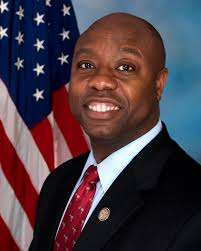
Sen. Tim Scott
His older brother was a command sergeant major in the U.S. Army. His younger brother is a colonel in the Air Force.
Their experiences trying to find schools for their children helped inspire the CHOICE Act. Scott's legislation would create pilot scholarship programs on at least five military bases.
"I know firsthand that a parent doesn't choose the base they go to, and therefore, can only hope and pray that the education is good," the South Carolina Republican tells Denisha Merriweather, a Florida tax credit scholarship alumna, in our latest podcast interview.
April is the month of the military child, and several states are advancing proposals to create new educational options for military families — or help existing school choice programs better meet their needs.
Georgia lawmakers approved a bill creating open enrollment for families on military bases, while Florida is advancing legislation that would allow military parents to apply for tax credit scholarships year-round. (more…)

