 “There are more things in heaven and Earth, Horatio, than are dreamt of in a test score analysis …” Shakespeare by way of Ladner
Learning to read proficiently and to understand math are two jolly important goals for our schools. They are by far, however, not the only goals.
Americans want students equipped with the academic knowledge and training for success, but they also aspire to broader types of success in the formation of character – the ability to exercise citizenship responsibly and to function as productive members of society, for instance.
A new study from Patrick Wolf, a professor of education policy at the University of Arkansas, and Corey DeAngelis of the Reason Foundation, published in the Journal of Private Enterprise, tracks long-term outcomes associated with the Milwaukee Parental Choice Program. The MPCP makes low-income students eligible to receive a voucher to attend a private school.
The authors carefully construct a comparison group and analyze the long-term social welfare effects on students who have been offered a voucher after controlling for a variety of student background characteristics. They found that exposure to the MPCP is associated with a reduction of about 53% in drug convictions, 86% in property damage convictions and 38% in paternity suits. Effects tend to be largest for males and students with lower levels of academic achievement at baseline.
So, in addition to academic benefits of the program, including a higher high school graduation rate, MPCP participants also have lower criminal conviction rates and less time in family court. The average MPCP voucher was worth $7,943 in 2018-19 while the average total spending per pupil in the Milwaukee Public Schools was $15,250 in 2017-18.
Just imagine what Milwaukee students might do if they got equitable funding, and if their families could utilize that funding for educational benefits beyond private school tuition. There would almost be enough money left over to pay for the sort of enrichment activities that the top decile American families pay for things like summer camps and tutors.

A study from the University of Arkansas reveals that students who participated in Milwaukee's voucher program showed a reduced rate of criminal activity
While most studies of private school choice programs have focused on academic outcomes as measured by standardized tests, some recent studies have begun to look at other indicators of success.
The Urban Institute, for example, in a study released earlier this month, found that lower-income, mostly minority students using the Florida Tax Credit Scholarship to attend private schools are up to 43 percent more likely to enroll in four-year colleges than like students in public schools.
Those same students, the study found, are up to 20 percent more likely to earn bachelor’s degrees – and the outcomes are even stronger for students who use the scholarship four or more years.
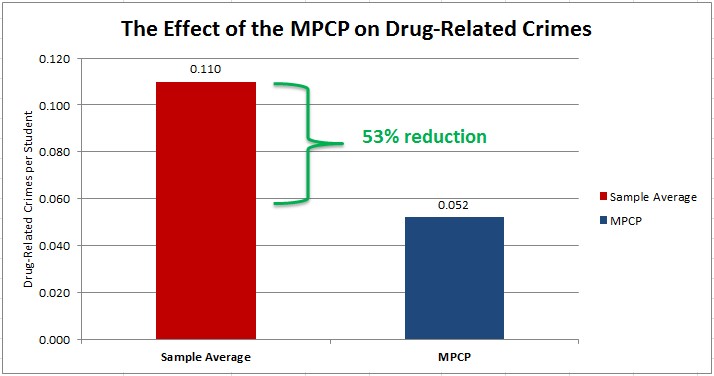
The Effect of the MPCP on Drug-Related Crimes
Now, a new study from the University of Arkansas shows that students who participated in a school voucher program showed a reduced rate of criminal activity as well as lower rates of paternity suits by ages 25 to 28.
The study by Corey A. DeAngelis and Patrick J. Wolf, titled “Private School Choice and
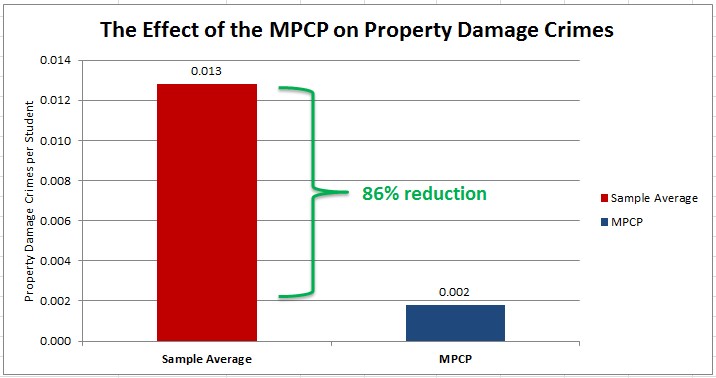
The effect of the MPCP on Property Damage Crimes
Character: More Evidence from Milwaukee,” found that students who were exposed to the Milwaukee Parental Choice Program voucher in grades 8 or 9 experienced an approximately 53 percent reduction in drug convictions, an 86 percent reduction in property damage convictions, and a 38 percent reduction in paternity suits.
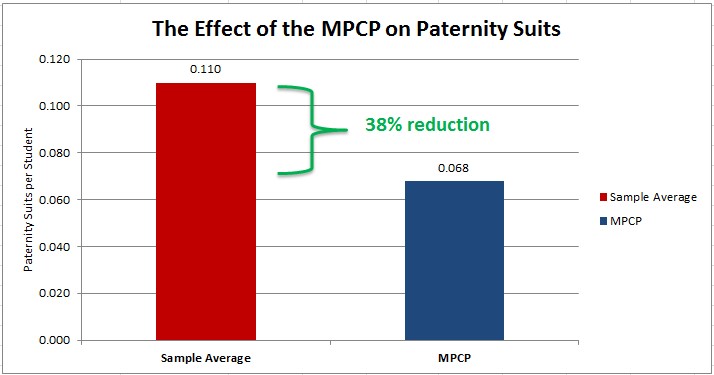
The Effect of the MPCP on Paternity Suits
A reduced rate of drug convictions and property damage convictions tend to be greater for males than females. Across the board, positive outcomes are greater for students with lower levels of academic achievement.
The Milwaukee Parental Choice Program is a voucher program for low-income students living in Milwaukee. The voucher, worth up to $8,400 for high school students, helped 28,917 students attend 129 private schools this academic year. Wisconsin’s second, statewide voucher program, which serves another 7,140 students, was not covered in the report.
School vouchers and tax credit scholarships may not always improve participants' standardized test performance, but a growing crop of studies suggest they are cost-effective when it comes to encouraging economically disadvantaged students to pursue a college education.
Two recent Urban Institute studies, one on Milwaukee and the other on Washington, D.C., continue that trend. The reports follow similar results from a 2017 Urban Institute study of Florida's Tax Credit Scholarship program.
Students in Milwaukee using vouchers to attend private schools were more likely to attend college, while students in Washington were no more or less likely, to attend college than their public-school peers. Past Urban Institute research in Florida showed modest positive college attendance and associate degree gains among school choice participants.
Researchers Patrick Wolf, John Witte and Brian Kisida found Milwaukee voucher students were 6 percentage points more likely to attend a four-year college than their public school peers. Milwaukee choice students were 1-2 percentage points more likely to graduate college, but that difference was not statistically significant.
The researchers conclude, "students in the Milwaukee Parental Choice Program tend to have higher levels of many measures of educational attainment than a carefully matched comparison of Milwaukee Public School students."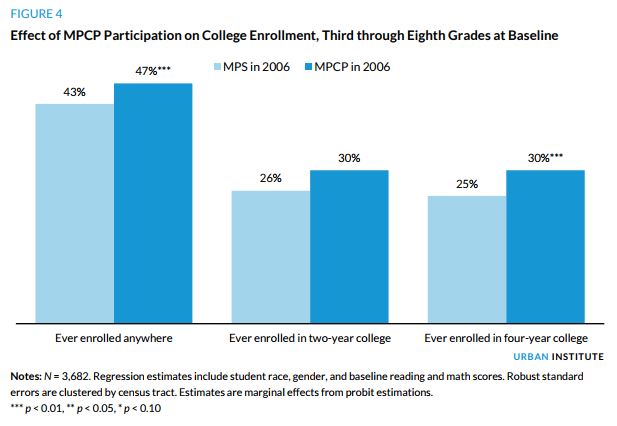
The question of how to hold private schools academically accountable for publicly supported, school voucher students remains contentious and, frankly, unclear. But to oppose tests out of fear the opposition will twist the results is simply untenable.
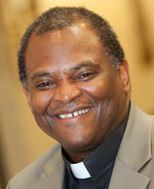
Bob Smith
In one of the latest venues where this debate played out, at the American Federation For Children policy summit this week on the banks of the Potomac River, part of the audience broke into applause when Bob Smith, the former president of Messmer Catholic Schools in Milwaukee, pushed back on testing. Smith and Messmer schools are both highly regarded, and he was not coy about his rationale.
“We have some enemies who have sworn they are going to destroy this program, beginning with two presidents of the United States, and a number of secretaries of education,” Smith said. “Until those people stand up, and with the same fervor, deny that they will use that data against private schools, I will not trust them.”
At least two of the panels during the two-day event revealed the ongoing split over how, or even whether, to test students on school vouchers and tax credit scholarships.
Not surprisingly, Robert Enlow, president of the Friedman Foundation For Educational Choice, made an eloquent and principled case for why the marketplace itself is a powerful force for assuring quality. Parents whose students are on scholarships, just like parents whose students are on private tuition, can and do walk away from schools that aren’t serving their needs – in some case putting schools out of business in the process.
Adam Emerson, director of parental choice for the Fordham Institute, made the principled case for why public is different. Public schools are under enormous pressure to produce results on state tests, with sometimes severe consequences for failure. To expect private schools serving publicly supported students to be immune from that system is unrealistic. It also denies elected policymakers who are paying the bill a test that they view as an important report card.
One slice of the divide that was hard to ignore was the contributions of the only current school administrator to serve on either panel. (more…)

Romero
by Gloria Romero
Diane Ravitch, are you listening?
This is former state Sen. Gloria Romero calling.
I am the author of California’s first Parent Trigger law, the first parent trigger law in the nation. Since I first wrote that law, some 15 other states have seen some version of the law introduced in their states.
I wanted to reach out to you since we have never met, and I look forward to meeting you so we can one day talk directly with each other. Woman to woman.
In one of your recent blog posts on Education Week, you wrote that the parent trigger came from the American Legislative Exchange Council (ALEC). On the blogosphere, I now read many claims that ALEC wrote the law. This is completely false, and I ask you to correct this.
Please, stop saying that some organization I had never met until just this year gave me the idea and somehow, miraculously, turned it into law without me not knowing about it. ALEC happens to like the law and encourages other states to write similar laws. That is true. But that does not mean it developed either the idea or the law. That’s preposterous! Quite frankly, it’s also a bit sexist and ethnocentric to assert my work actually came from someone else - that somehow the Latina senator from East Los Angeles couldn’t think on my own, or figure out how to write a bill and turn it into law.
To be fair, you are not alone in failing to acknowledge my role, or the role of other strong individuals (mostly women of color) in getting the bill passed. I always recognize Ben Austin from Parent Revolution for suggesting the idea. Unfortunately, the materials Parent Revolution distributes make it sound as if parents cascaded on the state Capitol and forced this into law. It seldom concedes in its materials that someone actually had to write a bill and argue and negotiate for its enactment. While it sounds romantic to say parents demanded this and descended on the Capitol to force this into law, that is too much Hollywood. In fact, we did have parents in Sacramento. But many of them were from organizations that were not affiliated with Parent Revolution, and they are seldom acknowledged.
One day I will write the full story of how the Parent Empowerment Act (its official title) became law. In the meantime, let it suffice to say that both you and Parent Revolution and anyone else who writes about the law should know that once the idea was discussed with me, I chose to expand and develop it in a bill. I developed a strategy. I worked with my legislative staff to write language. I assembled a “rag tag” army of civil rights activists who understood that this was our moment to enact the change in which I so strongly believed. And I never saw an ALEC representative. (more…)
School voucher critics generally approach their job reviewing the research on school choice with unfair assumptions, and otherwise insightful commentators risk recycling old canards. This is true with Thomas Toch’s critique of vouchers in the newest edition of Kappan, which concludes that voucher programs haven't shown enough impact to justify their position in a large-scale reform effort. Questions of scale can lead to legitimate debate, but we'll get nowhere until we acknowledge what's in the literature.
Toch grounds what he calls "the underwhelming record of voucher schools" first with an anecdotal report in the Milwaukee Journal Sentinel, which determined that America's first voucher program "is very much like a teenager: heart-warmingly good at times, disturbingly bad at others." The problem is that this newspaper report is nearly seven years old. We've learned so much since then, and at no time has the peer-reviewed science on the subject shown the back-and-forth swing from good to bad that the Journal Sentinel implied in 2005.
John Witte and Patrick Wolf, for instance, gave us a glimpse this year into their evaluation of the Milwaukee Parental Choice Program. Among other findings, they conclude that the competitive pressure from the voucher program produced modest achievement gains in the school district, and that the gains of the low-income choice students were comparable to a low-income sample in the school district. Notably, they also found that high school students in the choice program enroll in four-year colleges at a higher rate than do students in Milwaukee Public Schools, a factor that Toch dispatches with a rhetorical afterthought.
And if "comparable" gains between voucher and public school students are insufficient to Toch, he need only turn to more recent evidence from Northwestern University's David Figlio, who annually studies the academic impact of the Florida Tax Credit Scholarship program and wrote last summer that scholarship students had modestly better gains in reading and math than similar low-income students in public schools. "The estimated effects of program participation on math performance are statistically significantly positive at conventional levels ... and the estimated effects on reading performance are significantly positive in the case of reading," Figlio said. "These differences, while not large in magnitude, are larger and more statistically significant than in the past year's results, suggesting that successive cohorts of participating students may be gaining ground over time."
Critiques like Toch's have been applied carelessly by others to charter schools and other choice initiatives as well, but Toch is correct to point out that public school choice has evolved to grow more accountable to taxpayers in a way that most voucher programs have not. But this, too, ignores more recent developments that would make private school options more transparent. Toch notes that Indiana has established a sweeping new program that will significantly increase the size of the nation's voucher population, but he doesn't mention that voucher students will be subject to the same state testing regimen as public school students. And next summer we'll see the learning gains of Florida Tax Credit Scholarship students according to each participating school in which there are 30 qualifying scholarship student test scores.
The picture is far from perfect, but the lessons we're learning year by year should help inform states to develop well-regulated private school options that help us find common ground on issues of accountability, quality and scale. Toch's commentary may have succeeded in shedding more light on the lingering political divide on parental choice, but it also seems more relevant with debates that took place years ago. Vouchers and tax credit scholarships in Florida, Milwaukee and elsewhere are now well established in systems of public education that defy traditional notions of "public" and "private." Enrollment in the Florida Tax Credit Scholarship has grown by nearly 61 percent in just the last three years, and 95 percent of all scholarship parents rate their school as "good" or "excellent." It's time to graduate to a new conversation about choice where we leave old fears behind.
This week, the Denver-based Legal Center for People with Disabilities and Older People filed a federal complaint alleging that a Colorado school district's pilot voucher plan discriminates against children with special needs. The voucher program would provide "only limited services (if any) for students with disabilities" and violates not only the Americans with Disabilities Act, but also Section 504 of the Rehabilitation Act protecting civil rights law, reads the complaint to the Justice Department. "Parents of students with disabilities do not have the same choice to participate in this program," the center states.
This, of course, comes just a month after the American Civil Liberties Union filed a similar complaint to the Justice Department alleging that the Milwaukee Parental Choice Program, and two schools in particular, also violate both ADA and Section 504 by discriminating against students with disabilities and further segregating Milwaukee students. "Proposed legislation to substantially expand the voucher program, if implemented, will exacerbate the discrimination against and segregation of students with disabilities by permitting more schools to participate in the program," the ACLU states.
The Milwaukee program did indeed expand to Racine, Wis., just as many private school options passed state legislatures during the past several months. Will we be seeing more complaints like these as one strategy to reverse the momentum?
The Wisconsin Assembly passed Gov. Scott Walker's state budget early today, which would expand the City of Milwaukee's school voucher program to schools in Milwaukee County and in Racine. Despite a plan to bring the choice program to Green Bay, The Associated Press reported that Republican leaders failed to generate enough support in the face of strong opposition from Green Bay school leaders.
The budget bill passed along party lines, with no Democrats voting in support. The Senate will take up the measure later today.
The Milwaukee Parental Choice Program, the oldest school voucher program in the nation, currently serves about 21,000 students at 102 private schools in the city.
Civil rights and school choice champion Howard Fuller today released a statement through the American Federation for Children supporting a proposal to expand the Milwaukee Parental Choice Program to other cities in Wisconsin.
In recent weeks, Fuller has reacted strongly against a plan from Gov. Scott Walker to eliminate the income threshold that regulates entry to the voucher program, but he called Walker's plan to expand the program to other cities one that gives poor and working-class families the education options they deserve.
His full statement reads as follows:
I believe that poor and working class families deserve to have options that allow them to seek better educational opportunities for their children. Programs like the Milwaukee Parental Choice Program are one of those options. I would strongly support any efforts by parents, elected representatives and concerned citizens from other cities in Wisconsin such as Green Bay and Racine to establish such a program in their communities. I recognize that both Racine and Green Bay have some good public schools but not every child has access to them. I want every child in these two communities to be able to go to a high quality school that will transform their lives whether that school is public or private.
In today's Wall Street Journal, John O. Norquist, a former Democratic mayor of Milwaukee, defends an effort from Wisconsin Gov. Scott Walker to eliminate the income threshold regulating entry to the Milwaukee voucher program, which currently is open only to low-income students. The threshold has had the effect, Norquist writes, "of isolating low-income students from other more affluent students." By contrast, most Western nations have a much greater enhanced form of parental school choice, and their urban centers are economically and racially diverse as a result.
People with children and money don't cluster outside European or Canadian cities to avoid sending their kids to school with the poor. And the poor who live in cities have the opportunity to attend public, private and parochial schools that are appreciated by a large cross section of parents.
American liberals have been reluctant to embrace school choice, fearing it will drain resources from government-operated schools. Yet isn't it even worse to support a system that rewards concentration of the rich in exclusive suburbs segregated from the poor? Of course there are affluent people (Bill Clinton and Barack Obama come to mind) who enroll their children in urban private schools like D.C.'s Sidwell Friends, which still has some children enrolled from the choice program. Many more, including middle-class parents, would live in economically and racially diverse cities once school choice was universally available.
If expanded, Milwaukee's choice program will demonstrate this to the whole country.
Opposition to Walker's plan to expand the program has come in recent weeks from a stalwart defender of the school choice movement, Howard Fuller. While Fuller has supported raising the income limit of the Milwaukee voucher to include more moderate-income people, he said making the program universally accessible to students in all income levels "essentially provides a subsidy for rich people."

