 EdWeek’s Politics K-12 blog offers an intriguing list of possible education secretaries in a Romney administration, including one prominent Floridian: Jeb Bush. But the otherwise great list overlooked another Floridian: Eric J. Smith, the state's former ed commissioner.
Smith, nudged out last year by Gov. Rick Scott, was hired by the state Board of Education in late 2007 and immediately found himself on a high-wire: Shepherding the state’s proposed new science standards, which for the first time included the teaching of evolution, through public hearings and a divided state board. Ultimately, the board approved them 4-3.
Smith led the way on Florida’s Race to the Top application and was a strong supporter of legislation that changed the way Florida teachers are evaluated and paid. Like Indiana’s Tony Bennett, he was an original member of Chiefs for Change and enjoyed strong backing from Bush’s Foundation for Excellence in Education. One Bush ally, T. Willard Fair, was so upset by Smith's ouster that he resigned from the BOE in protest.
"Dr. Eric Smith would make an outstanding U.S. Secretary of Education,” Roberto Martinez, another board member, told redefinED via email. “When he was Florida's Commissioner of Education he proved himself to be best in the nation. During his tenure he led Florida to the top of the nation in achieving several significant educational benchmarks. He is a successful reformer because as a former hands-on teacher, principal, and superintendent he knows what works in the classroom.”
Smith’s is now a fellow in education policy at the George W. Bush Institute. His successor as commish, Gerard Robinson, is stepping down at the end of this month.

Checker Finn
Mitt Romney’s plan to voucherize (though he doesn’t call it that) Title I and IDEA has considerable merit - but it’s not the only way the federal government could foster school choice and it might not even be the best way.
It’s not a new idea, either. I recall working with Bill Bennett on such a plan - which Ronald Reagan then proposed to a heedless Congress - a quarter century ago.
It had merit then and has even more today. As America nears the half-century mark with Title I, we can fairly conclude that pumping all this money into districts to boost the budgets of schools serving disadvantaged kids hasn't done those kids much good, though it has surely been welcomed by revenue-hungry districts (and states). Evaluation after evaluation of Title I has shown that iconic program to have little or no positive impact, and everybody knows that the No Child Left Behind edition of Title I hasn't done much good either. It has, however, yielded an enormous number of schools that we now know, without doubt, are doing a miserable job, particularly with disadvantaged kids, but we're having a dreadful time "turning around" those schools. One may fairly conclude that Title I in its present form isn't working and probably cannot.
So why not try strapping the money to the backs of needy kids and letting them take it to the schools of their choice? This would help them escape from dreadful schools. It would make them more "affordable" for the schools they move into. It would remove one of the main barriers (the non-portability of federal dollars) that discourages states and districts from moving toward "weighted student funding" with their own money. And it would certainly go a long way to change the balance of power in American education from producers to consumers.
Having said that, a word of caution is needed. Few federal education initiatives work nearly as well as intended. (NCLB is again a large, recent, case in point.) Legitimate questions persist about what, exactly, is the federal role in the K-12 sphere, particularly in reforming it. A good case can be made for Washington to generate sound data, safeguard civil rights, support research, and assist with the costs of educating high-risk kids - but setting the ground rules for schools and operating the system is really the job of states. Moreover, the federal share of the school dollar - a dime - isn’t big enough to yield much leverage over how the system works. That’s why the Romney plan is apt to do some good in states (and districts) that want to extend more school choices to their students - the federal dime can join the state/local 90 cents in the kid’s backpack - but won’t make much difference in places that aren’t willing to put their own resources into this kind of reform.
Similar caveats must be attached to other possible methods by which Uncle Sam could try to foster school choice. Which isn’t to say such possibilities don’t exist. Indeed, I can think of four more opportunities. (more…)

Sec. Spellings
Giving parents and families the opportunity to choose the very best education options available for their children is not only the right thing to do, but it leads to accountability for results.
School choice plus standards, assessments, transparency for results, and consequences for failure has been the recipe our nation’s public schools have been following for the past decade under No Child Left Behind.
This work has not been easy. I didn’t think it would be. In fact, it’s been hard. It’s why a lot of adults in the system have pushed back so hard. They don’t like change. They don’t want to be accountable for results. And some simply don’t want the “feds” telling them what to do, which is something they weren’t shy about telling me!
I know it won’t surprise you to hear I fielded the occasional question during my years in the White House as head of the Domestic Policy Council, and then as a Cabinet secretary, about the legitimacy of the U.S. Department of Education. The questioner would ask where in the Constitution it provided for the establishment of the agency, knowing such language did not exist. The message was simple: the federal government should simply stay out.
Sadly the “stay out” message has been exploited and leveraged by powerful teachers’ unions and other entrenched interests, who, with no principled opposition to a federal role in education, just want more taxpayer dollars with fewer strings attached. This “unholy alliance” between the unions and those who want no role for the federal government in education is propping up the status quo on the backs of our most vulnerable children. It’s shameful beyond words.
Here’s why there’s a legitimate role for the federal government in education.
When the Elementary and Secondary Education Act was signed into law in 1965, by any measure, poor and minority students were overwhelmingly denied meaningful educational opportunities because of the abysmal quality of the schools they attended. Then, and now, education remains a civil rights issue. While the federal role in education has been and remains limited, providing less than 10 percent of the total funding for the nation’s public schools, it is focused on our disadvantaged students, helping them to have a shot at the American Dream. (more…)
Beyond the boos for his vow to undo President Obama's health care overhaul, Republican president Mitt Romney stressed school choice in his speech to the NAACP today, talking up charter schools and suggesting Obama’s ties to teachers unions hampered his efforts to help disadvantaged kids.
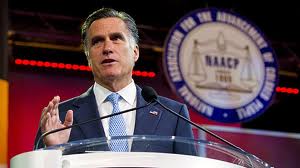 “If equal opportunity in America were an accomplished fact, black families could send their sons and daughters to public schools that truly offer the hope of a better life,” he said, according to his prepared remarks. “Instead, for generations, the African-American community has been waiting and waiting for that promise to be kept. Today, black children are 17 percent of students nationwide – but they are 42 percent of the students in our worst-performing schools.”
“Our society,” he continued, “sends them into mediocre schools and expects them to perform with excellence, and that is not fair. Frederick Douglass observed that, “It is easier to build strong children than to repair broken men.” Yet, instead of preparing these children for life, too many schools set them up for failure. Everyone in this room knows that we owe them better than that.”
Media coverage of today's event in Houston is focusing heavily on the negative reaction Romney received for his plans to scuttle "Obamacare." The Republican candidate got a more polite response to his education positions.
Romney noted his support for charter schools as governor of Massachusetts, despite opposition from teachers unions and Democratic lawmakers.He also pitched his plan to allow federal education funding to follow the student to the school of the parents’ choosing, including private schools “where permitted.”
The dig at Obama's education agenda came without mentioning the president’s name. (more…)
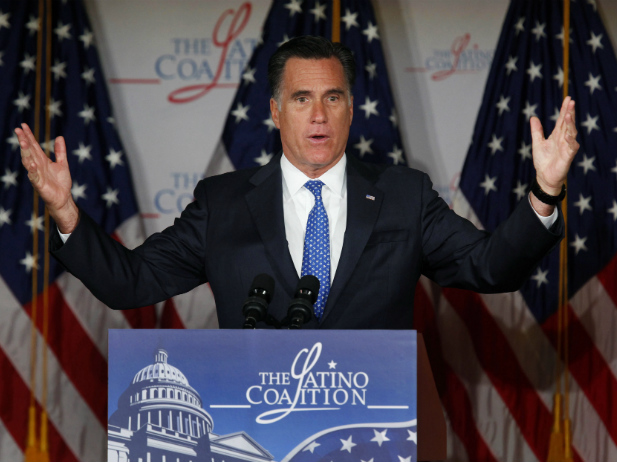 Gov. Romney gave a speech last month to a Hispanic audience calling for more school choice for parents. He promised, if elected president, to provide all children from low-income families and all special needs children with choice in a broad range of public and (where legal) private schools. This is a promise that should very much please school choice supporters.
The likelihood of Congress actually passing such a plan may be small, but a president can provide leadership (although this could turn out to be like many of President Reagan’s pro-family promises during his campaigns that failed to yield actual policy changes).
While Romney’s broad rhetoric was attractive, what was distressing about his talk is the uncertainty as to just how his promise could be delivered. As I will explain, I fear the Romney team has not sufficiently thought through the details.
For public school choices that families would make, things are clear enough. Today, federal funding for low-income and special needs students is distributed in a very complicated way. Romney’s plan would simplify things by converting that funding into specific amounts per eligible pupil and, more importantly, that per pupil funding would follow the child to the school he or she actually attended, whether traditional, charter, magnet, out-of-district, or whatever – thereby providing the child’s school with extra money to help pay for extra services the children from low-income families may need in order to achieve at grade level. This is how federal aid to education should be working already and is overdue.
But for those families choosing private schools, the proposal is much murkier. Federal aid to education is a small share of overall school funding, and so a low-income child’s per pupil share of federal aid (say, $2,000 a year) would, in most cases, be far too little to pay the tuition at either a religious or secular private school. Put differently, we are talking about a sum that would be far less than the $7,500 per pupil now provided by the federal government (by way of vouchers) to low-income families in the District of Columbia who send their children to private schools participating in the voucher plan (a successful program that Romney supports continuing). (more…)
 Mitt Romney is all in on school choice, at least according to the speech he delivered today at the Latino Coalition's Annual Economic Summit. Here's a piece of his prepared remarks:
First, I will expand parental choice in an unprecedented way. Too many of our kids are trapped in schools that are failing or simply don’t meet their needs. And for too long, we’ve merely talked about the virtues of school choice.
As President, I will give the parents of every low-income and special needs student the chance to choose where their child goes to school. For the first time in history, federal education funds will be linked to a student, so that parents can send their child to any public or charter school, or to a private school, where permitted. And I will make that choice meaningful by ensuring there are sufficient options to exercise it.
To receive the full complement of federal education dollars, states must provide students with ample school choice. In addition, digital learning options must not be prohibited. And charter schools or similar education choices must be scaled up to meet student demand.
Instead of eliminating the D.C. Opportunity Scholarship Program as President Obama has proposed, I will expand it to offer more students a chance to attend a better school. It will be a model for parental choice programs across the nation.
Romney came back to the D.C. program later in the speech. He used it as one of several examples where teachers unions blocked school choice programs and proposals. (more…)

