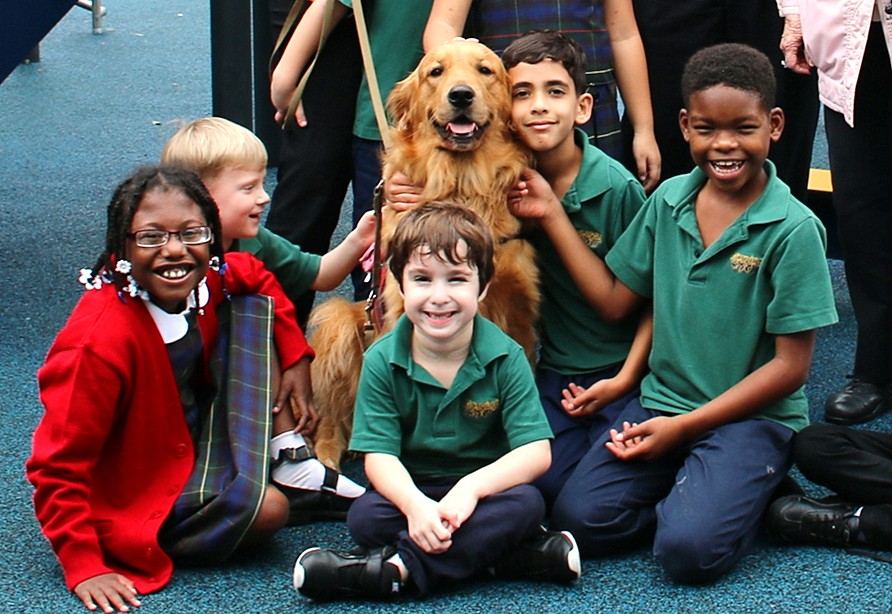
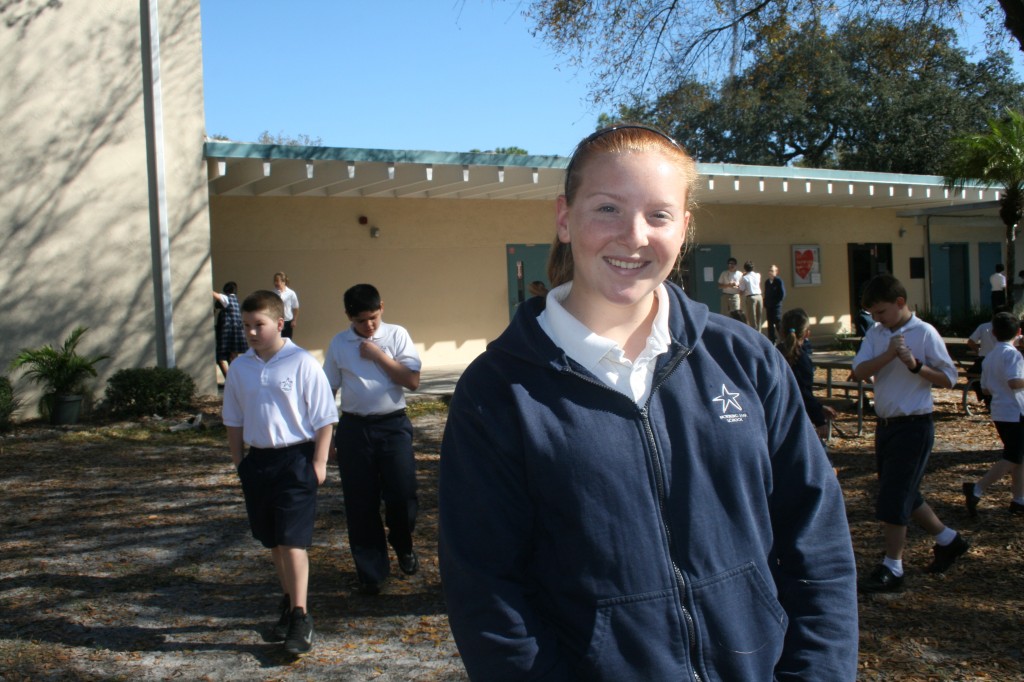
Students at Morning Star Catholic School in Jacksonville pose with their therapy dog, Nova, prior to the coronavirus shutdown.
As COVID-19 sent brick-and-mortar education into a tailspin this spring, students at one North Florida school realized what they missed most was a creature with four legs and a wet nose.
That’s why staff at Morning Star Catholic School in Jacksonville featured Nova, a golden retriever who likes to lean into humans’ legs while being petted, in a video created to help families feel connected during distance learning.
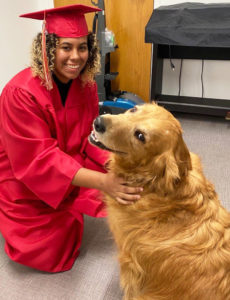 Trained by Project Chance to help students on the autism spectrum, Nova and another service dog, Corbin, have coaxed anxious students out of cars, lunched with students who met behavior goals and served as an audience to beginning readers to build their confidence.
Graduating seniors had a chance to hug Nova goodbye when they came to the school one at a time for cap and gown photos.
“They miss her terribly, and she misses them terribly, too,” said principal Jean Barnes.
The school, one of six Morning Star Catholic schools in Florida that specialize in teaching students with special needs, serves 138 children with learning differences, including 20 who receive Gardiner Scholarships for students with unique abilities. (Gardiner Scholarships are administered by Step Up For Students, which hosts this blog.)
Despite missing out on the usual end-of-year activities, students at other Catholic schools that serve children with learning differences haven’t been deprived of therapies and services traditionally provided.
Fourteen-year-old Hannah Halperin, in her third year at St. Mary Academy in Sarasota, is continuing to receive weekly speech therapy as well as occupational therapy remotely.
“I’m getting to hear her speech therapy, and I can tell it’s very good,” said her father, Gary Halperin.
Occupational therapy has proved a bit more challenging because it relies on hands-on activities. Still, Hannah, who has Down syndrome, was able to take therapy supplies home before the campus shut down in March. Therapists are encouraging her to squeeze a tennis ball and do floor exercises to maintain muscle tone. She also works on fine motor skills by writing and picking up toothpicks, and she attends group therapy sessions via Google Meet.
“They use computers at school, so that made the transition easier,” Halperin said.
St. Mary serves 74 students in grades K-8, nearly a third of whom receive a state scholarship. According to the school website, it’s the only Catholic school providing services for students with special needs in Sarasota, Manatee, Charlotte, Collier, DeSoto, Glades, Hardee, Hendry and Highlands counties. Its slogan is “Where Dreams Are Free.”
In addition to live Zoom classes, teachers are holding "office hours" for student questions, scheduling small group sessions for interventions and conducting assessments.
“Our school counselor meets with me once a week to discuss students' needs (and) both my counselor and I attend meetings with teachers once a week to identify students at risk,” principal Rebecca Reynolds said. “A plan is then made for follow-up interventions and care.”
At Morning Star Catholic School in Orlando, specialists have created service plans for each student based on their individual education plans, which are required by law for qualified students. The plans also are based on current assessments, teacher observations and therapists’ recommendations.
“All the teachers have been using these to help individualize instruction for their students and allow any accommodations or flexibility needed to reach their goals and the mastery of the skills being taught,” said principal Alicia Abbey.
Of the school’s 66 students in grades K-12, 20 percent receive Gardiner Scholarships.
Other ways students are being accommodated include allowing extended time to complete assignments, holding small group instruction via Zoom videoconferencing for reading and math, and one-on-one instruction, with parents present for safety protocol.
Additionally, a guidance counselor has reached out to families to let them know they’re available if needed, and the school’s transition program for students moving from high school to life after school has remained in place.
Abbey said the school has continued to provide speech, language and music therapy as well as occupational and physical therapy through a virtual program.
“Some students have even been able to continue to see their behavior therapist at home,” she said. “It depends on both the comfort level of the therapist and family, as well as their availability.”
When people learn Robert Breske is the father of a teenager with Down syndrome, they sometimes tell him they're sorry. That isn't what he wants to hear. He'll tell them children like his soon-to-be-15-year-old son, Bobby, have changed his life — and the world — for the better.
"They are closest things to God," he said during an event earlier this month at Orlando's Morning Star Catholic School, a faith-based special education center Bobby attends. "They are that way all through their whole lives."
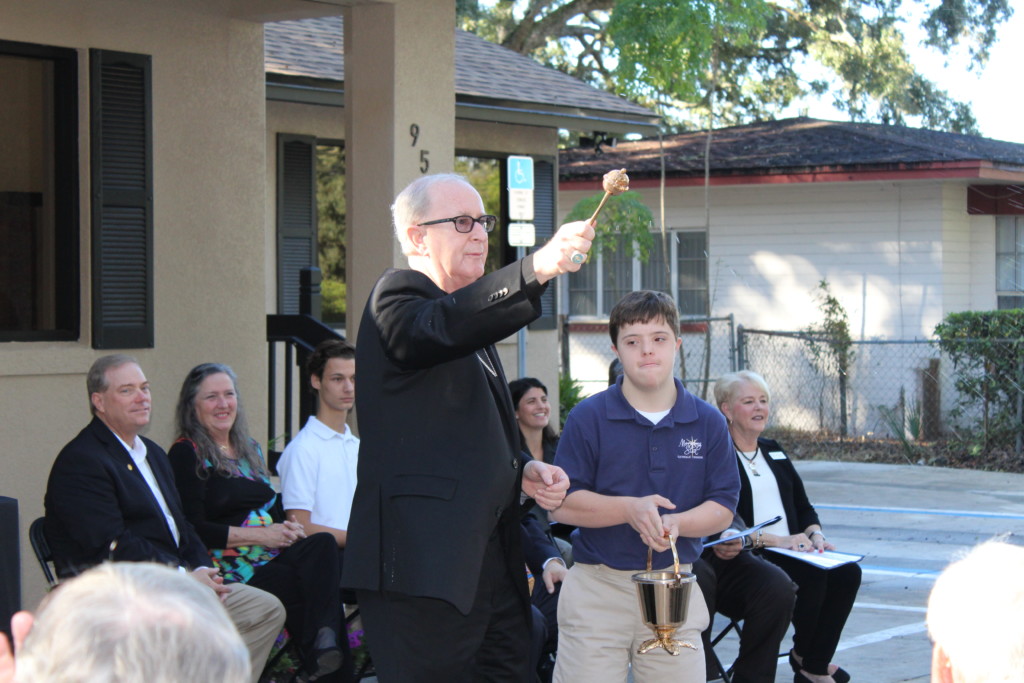
Bishop John Noonan blesses a new transition facility for young adults with special needs at Morning Star Catholic School in Orlando.
In recent decades, advances in medicine and early intervention programs have made their lives richer and longer than ever. And that has created a new set of questions for parents like Breske, whose special-needs children will need to prepare for life as adults.
Public policy is starting to adapt. Recent federal legislation created savings accounts that can help adults with special needs pay their living expenses. New Florida laws promote college and career-training programs. And schools, both public and private, have expanded programs aimed at preparing students like Bobby to get part-time jobs and care for themselves.
The elder Breske was helping unveil a renovated house at Morning Star. The structure once housed nuns on the 56-year-old school site, but it's been converted to help students in its young-adult transition program learn how to cook, clean and live independently. Recent changes to Florida educational choice programs mean similar programs could soon be growing at private schools around the state.
"We all know we're going to away one day," Breske said, describing the anxiety many parents feel as their special needs children grow older. "And what's going to happen to them?"
Camille Gardiner, who also has a son with Down syndrome, said parents like her were less likely to face that question a generation ago. In the 1970s, children born with Down syndrome were only expected to live into their 20s. Now, their life expectancy is about 60. As a devout Catholic, she said, "I have come to realize that being pro-life does not end at the birth of a child. In many ways, that's where it starts."
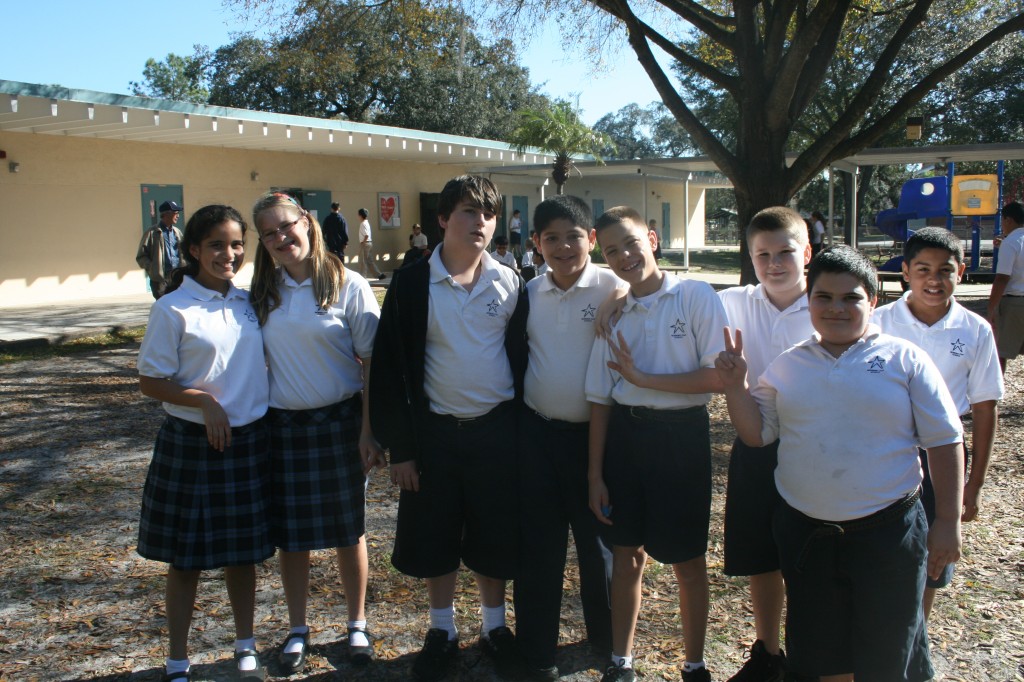
“They’re just children,’’ Principal Eileen Daly says of her students at Morning Star Catholic School in Tampa, Fla. “They come to us to learn what they’re good at and what they can do. … But really we’re teaching them how to do well in school.’’
When Madelyn Tomas was in the third grade, teachers at her public school wanted to retain the speech- impaired student another year. Madelyn’s mom, a school nurse, chose, instead, to move her daughter to Morning Star Catholic School in Tampa, Fla.
Madelyn Tomas says Morning Star helped her fit in at school, and excel.
“It saved my life, to be honest,’’ said Madelyn, now an eighth-grader who earned straight A’s last semester. “The small class sizes helped me focus. I’ve gone from thinking I couldn’t learn anything to knowing I can learn.’’
That’s the goal at Morning Star, one of six private schools and three programs in the Florida Catholic Diocese system that serves 566 children with special needs. The first Morning Star opened in Jacksonville in 1956 to serve boys and girls with physical needs. Through the years, the schools have broadened that focus based on a growing need to provide more educational opportunities for students with learning disabilities.
“They’re just children,’’ said Principal Eileen Daly, who has been with the Tampa school for 23 years, first as a reading teacher. “They come to us to learn what they’re good at and what they can do. … But really we’re teaching them how to do well in school.’’
Morning Star opened in Tampa in 1958 in a small concrete-block building behind Most Holy Redeemer Catholic Church. Most of the school’s 78 students in grades first through eighth have been diagnosed with a speech, language or learning disability. The rest have a combination of physical impairments and developmental disorders, such as autism or Tourette syndrome.
Sixty students receive McKay Scholarships, state dollars that go to families of children with special needs. Another four receive Florida Tax Credit Scholarships for low-income students, which provides $4,880 of the school’s $10,750 annual tuition. (Step Up For Students is the nonprofit that administers the scholarship program and co-hosts this blog).
The school, a nonprofit that receives funding from the diocese as well as the community, also provides its own scholarships. About half of the student body is Catholic, but Morning Star focuses more on academics, said administrative coordinator Paul Reed.
Students are taught in classes with 10 students per teacher. Sometimes, when the school has extra dollars, there’s an aide. There also are SMART boards, laptops and iPad minis in almost every class. Junior high students are allowed to bring their own devices, such as a tablet.
Lessons adhere to the same standards and benchmarks taught at other diocesan schools, but Morning Star students don’t receive grades. Learning gains are measured through the Iowa Test of Basic Skills.
Students also are exposed to classes and clubs found in most any school, like student council, yearbook and show choir – “so they can kind of be top dog, where elsewhere they wouldn’t be,’’ Daly said.

