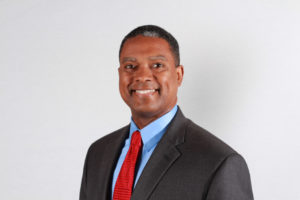
Robinson
Over the past few weeks, the NAACP has faced constant pushback from education reformers and school choice advocates for its proposed stance against charter schools. Some of that pushback has come from Gerard Robinson, a resident fellow at the American Enterprise Institute, who recently wrote a series of blog posts unpacking the proposal
However, on our latest podcast, he says it's important to remember where the civil rights organization is coming from. The organization's advocacy forced many public schools to integrate for the first time, he says, and helped pave the way for him to become a state education chief in Virginia and then in Florida.
"When they say they want to make sure that public schools are open to all kids, they're speaking from a standpoint of knowing it wasn't always that way, and that if they see that kind of spirit cropping back up, they're going to attack it," Robinson tells Denisha Merriweather, a former tax credit scholarship student who's now a family advocate at Step Up For Students, which publishes this blog. "In their world, they see charter schools as part of that. I don't." (more…)
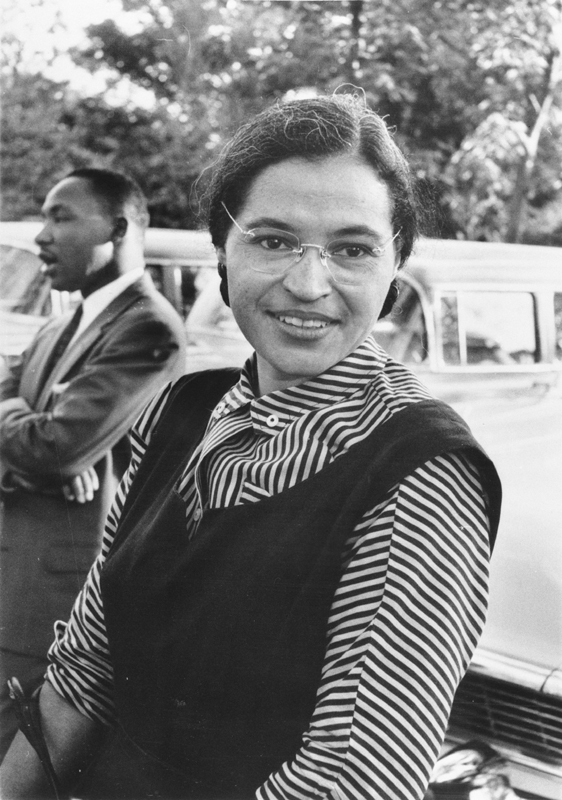
In the late 1990s, Rosa Parks and her foundation applied to start a charter school in inner-city Detroit. She wasn't thinking about privatizing education; she was thinking about ways to lift up the struggling students in her community. The same impulses have guided the African-American drive for educational freedom for centuries. (Image from Wikimedia Commons)
A few weeks ago, an African-American parent in Florida took the NAACP to task in a guest column for one of the state’s leading African-American newspapers.
Wevlyn Graves was upset because the NAACP’s Florida chapter had joined the state teacher union in a lawsuit to kill the state’s tax credit scholarship.* The 15-year-old initiative is now the largest private school choice program in America, and it’s expected to serve more than 90,000 students this fall. That includes more than 20,000 African-American children. That includes Graves’s 10-year-old son.
“You’re telling me the NAACP is fighting against the ability of African American parents to have more options and choices to further their children’s education,” Graves wrote, “when African Americans have been fighting for that since the beginning? Are you serious?”
I thought of Graves’ op-ed when it surfaced last week that delegates to the NAACP’s national convention had passed a resolution calling for a national moratorium on charter schools.
I appreciate her column because it offers the view of a school choice parent. Their views are too often absent from school choice debates, including this ongoing debate over the NAACP and charters.
I also think Ms. Graves makes a particularly powerful point about school choice history.
Before I go on, a disclaimer: I have nothing but respect and admiration for the NAACP. It pains me to not be on the same page, on this issue, with a group that has done so much, for so many, for so long.
At the same time, I think it’s fair to offer a little more context, especially to progressives who may not follow education issues closely, and who may be reflexively swayed by the NAACP position. They should know there is far more to the NAACP story, and they can read and hear some of the pushback from African-American leaders here, here and here.
To add to Ms. Graves’s thread, there are strong currents of educational freedom that course throughout American history, and they are particularly deep in African-American communities. The NAACP and its surrogates say they’re worried about privatization when it comes to both charter schools and state-supported private school scholarships. But African-American communities have not shied from private schools, charter schools or private philanthropy in education, not when it enabled them to access or create better alternatives for their children.
Mary McLeod Bethune wasn’t aiming to privatize education in 1904, when she founded a private school, the Daytona Educational and Industrial Training School for Negro Girls. She created the school because the public schools were so bad.
Privatization wasn’t on Marva Collins’s mind in 1975, when she took $5,000 from her teacher’s retirement fund to start Westside Prep, an acclaimed private school for low-income black kids in Chicago. She was moved to do so because she could not stomach the epidemic of black children being labeled “disabled” in public schools, and doomed by low expectations.
Rosa Parks wasn’t trying to ring up cash registers in the late 1990s, when she and her foundation applied to start a charter school in Detroit. She wanted to lift up the struggling kids in her inner-city neighborhood, and instill in them the traits that made her an American hero: “dignity with pride, courage with perseverance and power with discipline.” (more…)
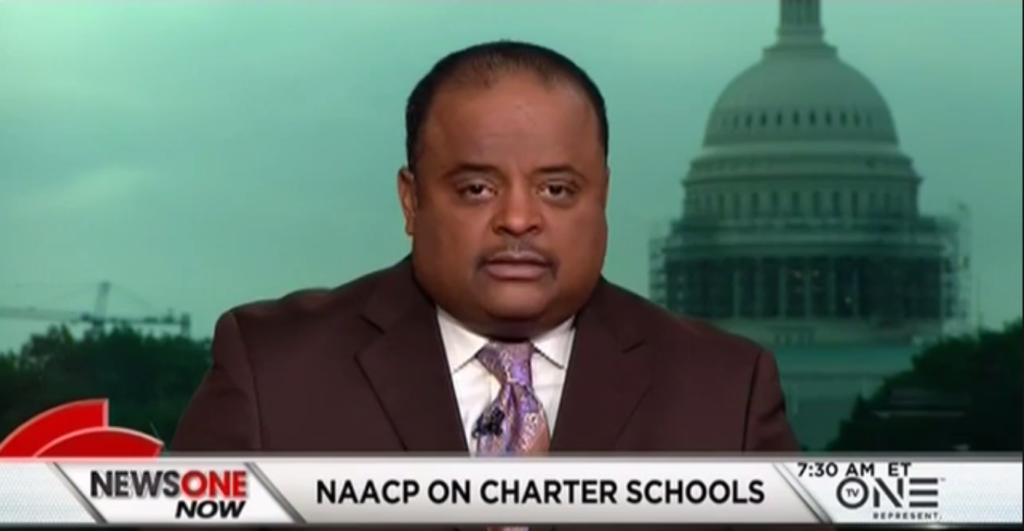
Washington-based TV host Roland Martin hosted a debate on the NAACP's stance against charter schools.
Yesterday, on a morning news broadcast in the nation's capital, host Roland Martin asked the question: "Is the NAACP out of step with black folks?"
He was grilling Hilary Shelton, the director of the NAACP's Washington bureau, about the national civil rights organization's latest stand against school choice.
In mid-July, the organization's members approved a resolution that called for restricting the growth of charter schools. They've passed resolutions critical of charters before, but the new one, which recently started making the rounds on blogs critical of education reform, goes further. It calls for an outright moratorium "on the proliferation of privately managed charter schools."
The ensuing controversy mirrors recent events in Florida, where educators and black clergy members who support the NAACP have taken issue with its role in a lawsuit challenging a private school choice program* for low-income children.
Martin, a prominent journalist at the black-owned D.C. outlet News One, is an unabashed supporter of school choice who speaks at charter school conferences and spars with critics on his Twitter feed. He told Shelton that surveys show African-Americans are more likely to support charters. He wanted to know whether NAACP leaders would get more input before they meet in the fall, when the resolution could become official policy for the organization.
"Are you going to bring in black folks who run charter schools to get their perspective?" he asked, adding: "I can give you a list." (more…)
Charter schools. Why do parents choose charter schools? Why do teachers choose to work in them? The Tampa Bay Times interviews a principal. Hillsborough school board candidates are divided on charter school issues. Tampa Bay Times. The Florida Times-Union looks at Duval charter schools' audits.
Magnet schools. The Miami Herald profiles a principal at Jose Marti MAST 6-12 Academy.
Opt-out. The Sun-Sentinel has the latest on the controversy over whether some third graders, whose parents opted them out of state assessments, may be retained.
STEM. A South Florida science teacher follows in her father's footsteps. Miami Herald. What would happen if former Gov. Jeb Bush took up the cause of STEM excellence? Bridge to Tomorrow.
Testing. Polk teachers examine district end-of-year exams. Lakeland Ledger.
Diversity. Collier County principals don't reflect the diversity of the district's students, the NAACP argues. Naples Daily News. (more…)
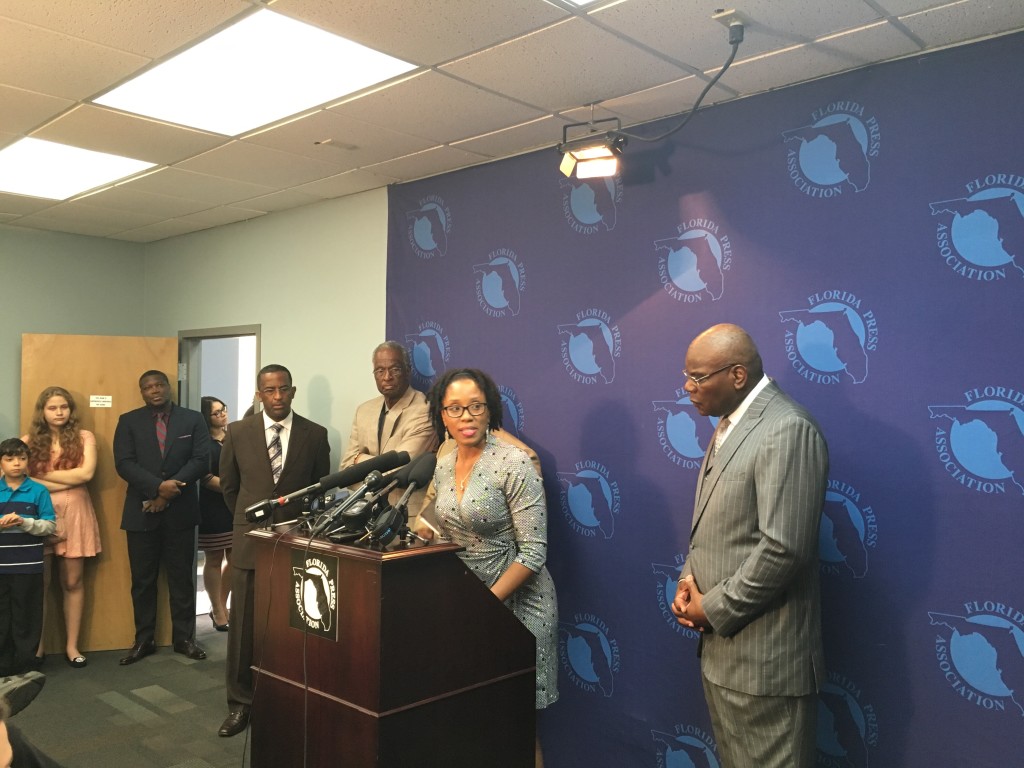
Scholarship parent Cheryl Joseph speaks at a Tallahassee press conference.
A Florida appeals court this afternoon will hear arguments in a lawsuit challenging the state's tax credit scholarship program, which allows more than 78,000 low-income students to attend private schools.
The statewide teachers union, the state chapter of the NAACP, the League of Women voters and other groups challenged the program in August of 2014, but a Leon County circuit court judge dismissed the case in May 2015.
Groups representing school boards and school administrators have since dropped out of the suit, but the remaining plaintiffs are taking the case to the First District Court of Appeal, and Joanne McCall, the lead plaintiff and president of the Florida Education Association, has said she plans to fight the lawsuit all the way to the Florida Supreme Court.
Ahead of the hearing, a group of scholarship parents and African-American ministers called a press conference, where they presented a petition signed by 100 prominent religious leaders and by 5,000 others online, calling on the NAACP to drop out of the suit. Several clergy members who say they generally align with the civil rights organization have criticized its involvement in the case.
"We are friends of the NAACP," Rev. R.B. Holmes, pastor of Tallahassee's Bethel Missionary Baptist Church, said, noting he is a lifelong member. "My great organization is on the wrong side of history on this."
The petition states:
We see no principled reason to fight an education program that is targeted exclusively at low-income children and has a 14-year track record of helping black students succeed. We believe in public education, and believe this scholarship makes it stronger.
According to Politico Florida, Adora Obi Nweze, president of Florida's NAACP chapter, responded that the program has undermined public schools, an argument the plaintiffs have also made in court. (more…)
Construction caps: School officials worry about the effects a construction spending cap bill will have on growing districts. One of the provisions in the House bill limits the amount that can be spent on land, which district officials say is unfair because the price of property varies widely across the state. Another is that construction money collected through property taxes would have to be shared with charter schools. Orlando Sentinel. Fort Myers News-Press.
School recess: Pinellas County School District officials make it official: There will be recess or physical education classes in elementary schools every day for the 2016-2017 school year. Each school will determine its own scheduling. Gradebook.
School pledge bill: Sponsors of the Pledge of Allegiance bill say it's still alive, despite the lack of action in the Senate. The bill would allow schools to post notice of a student's right not to participate in a student handbook instead of having a sign in every classroom. Pensacola News Journal. TCPalm.
NAACP's view: The NAACP says it supports Duval County School Board member Constance Hall's comments about the need to improve school grades. It also discounts Superintendent Nikolai Vitti's claims of being in a hostile work environment. The tiff started when Hall sent text messages to another school staffer that were critical of Vitti. Florida Times-Union.
Charter school rejected: The Lake County School Board rejects a proposed charter school in Minneola that can't open by August as it originally said it would. Officials at the Pinecrest Lakes Academy Charter School will have to resubmit an application when they're ready to open. Daily Commercial. (more…)
Charter school bills: A bill requiring school districts to share capital funding with charter schools is heading to the House floor. The bill also would penalize schools that spend more on construction than is allowed under state law. Politico Florida. Miami Herald. Sun-Sentinel. WFSU. The Florida League of Women Voters says the bill that sets up a state-appointed board controlling charter schools is "an egregious attack on public schools." Miami Herald. News Service of Florida.
Other education bills: Votes on several other education bills are expected today in the House. Among them: making the teacher bonuses program permanent and giving principals more autonomy over struggling schools. Also up for a vote is a bill requiring mandatory recess in elementary schools, but it appears to be dead in the Senate. Politico Florida.
Pledge of Allegiance: Students would be notified in a school handbook about their right to opt out of reciting the Pledge of Allegiance, under a bill approved by a House committee. Excused students would not be forced to stand or place their hand over their hearts. AP, via Palm Beach Post.
School funding formula: A bill that would change the state's formula for funding school districts is not expected to pass, according to the sponsor. Rep. Larry Metz, R-Yalah, says he will try again in the next session. Daily Commercial.
Suspensions questioned: Officials from the Flagler branch of the NAACP want access to school records so they can check complaints about the district's out-of-school suspensions for black students. Daytona Beach News-Journal.
Staff restructuring: Palm Beach County School Superintendent Robert Avossa is cutting 58 jobs from the school's district offices and redirecting the $4.5 million savings to the district's poorest 66 schools. Palm Beach Post. (more…)
This week, a working paper from the National Bureau of Economic Research on Lousisiana vouchers became the first high-quality study to find negative academic results for a private school choice program.
Informed observers have sounded important notes of caution. New Orleans-based researcher Doug Harris notes the results cover only the first year after the program's 2012 expansion. Student achievement might improve as schools adjust. The use of the state test could also explain some of the negative results, since it might not be well-aligned to private-school standards.
Some school choice advocates say they've found an explanation for the dismal findings: Louisiana's heavy regulation of voucher programs, which has kept many private schools — perhaps some high-performing ones — from participating. Regulation, in other words, appears to have backfired, and may prove to be, in the words of Jason Bedrick of the Cato Institute, "folly."
Michael Petrilli and Amber Northern of the Thomas B. Fordham Institute say that explanation doesn't hold much water.
Neerav Kingsland says the anti-regulation argument presents a challenge to school choice supporters:
I understand the risks involved with this type of deregulation, but I think it’s worth trying and seeing what we learn. I don’t know if it would work, but it might, and the potential the upside seems high.
I also think there are things you can do to solve for equity (significantly weighting vouchers for at-risk students), that will lead to higher performing private schools enrolling hard to serve kids.
But, ultimately, I’m not ok with taking the public out of public education.
Lurking the background in Louisiana: Uncertain political support for its voucher program, despite high ratings from parents.
Meanwhile... (more…)
A national organization that fights for the academic needs of black students entered the lawsuit over Florida’s tax credit scholarship today. The group, Black Alliance for Educational Options, filed an amicus brief urging the First District Court of Appeal to reject the state teacher union’s attempt to shut down the scholarship and to affirm a circuit judge’s dismissal of the case.
The brief tracks some of the legal arguments offered by lawyers representing the state and scholarship parents, but its tone is more personal. “BAEO knows from recent history that without high quality educational options such as the FTC scholarships, many of these students would never be in a position to enjoy their full panoply of civil rights – those rights can ring hollow for illiterate black students,” wrote Michael Ufferman, the attorney for BAEO.
The tax credit scholarship, passed into law in 2001, is serving 78,014 low-income schoolchildren this year. Of those, 23,268 are black. Their average household income is $23,551, which is 0.6 percent above poverty. Roughly 54 percent live with only one parent.
The Florida Education Association and other groups filed suit in August 2014, asking the courts to declare the scholarship unconstitutional. Leon Circuit Judge George Reynolds dismissed the case on standing in May, ruling the plaintiffs could not show how they or public schools were harmed. The U.S. Supreme Court in 2011 similarly rejected a challenge to a tax credit scholarship law in Arizona, denying standing, and three other state supreme courts have ruled in favor of the scholarships. None to date has ruled against them.
“If this lawsuit succeeds, the results will be devastating to the nearly 80,000 low-income and working-class, mostly black and Hispanic students who will be kicked out of their schools,” BAEO Policy and Research Director Tiffany Forrester said in a news release. “But it will also be a blow to social justice. Wealthy families have always had choices in education; low-income and working-class families deserve the same.”
BAEO also said in the release it was "very disappointed" the Florida NAACP joined in filing the suit. Two other plaintiffs, the Florida School Boards Association and the Florida Association of School Administrators, have withdrawn since the case was dismissed in circuit court. Meanwhile, a growing number of leading black ministers across the state have joined the cause against the lawsuit, calling themselves the "Florida African-American Ministers Alliance For Parental Choice."
Earlier this month, attorneys for the state and scholarship families filed response briefs in the First District Court of Appeal. They asked to court to schedule oral arguments for the appeal.
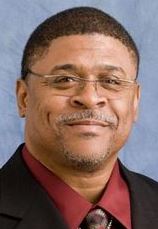
Pastor Sykes
Leading black ministers in Florida are ramping up criticism of the NAACP for supporting a lawsuit that seeks to kill the nation’s largest private school choice program.
The Rev. Dr. Manuel Sykes, pastor of Bethel Community Baptist Church in St. Petersburg, became the latest to do so, suggesting during a “radio rally” in Tampa Bay today that the esteemed civil rights organization was stuck in the past.
“While they’re fighting the old fight of integration versus segregation, our children are falling through the cracks. And in this issue, I believe they’re on the wrong side,” said Sykes, former president of the NAACP branch in St. Petersburg. “So at this point, we’re out here to advocate for and inform our African-American community that this (school choice) is something they need to support. Because while everyone is fighting on the top levels, it’s our children that’s at stake.”
At issue is the lawsuit filed last August by the Florida teachers union, Florida School Boards Association, the Florida branch of the NAACP and other groups. It argues the state’s tax credit scholarship program for low-income students is akin to the state’s first K-12 voucher program, which the Florida Supreme Court declared unconstitutional in 2006. Both sides are awaiting a ruling from Leon County Circuit Judge George Reynolds on whether the plaintiffs have standing to continue.
The scholarship program is administered by non-profits such as Step Up For Students, which co-hosts this blog and employs the author of this post. This year, the program serves 70,000 students statewide, including more than 20,000 black students.
Sykes was president of the local NAACP until last summer, when state NAACP officials forced his ouster after he appeared at a rally opposing the lawsuit. He did not criticize the NAACP or note his ties during that event, but did not hold back today.
“Groups like the NAACP, as sad as it is to say, they fought for desegregation because they believed that the quality of education of black children would be increased. However, the statistics show it’s gone in the opposite direction,” Sykes said. “And now they are struggling with the idea of the same people they fought for having the choice to take their business elsewhere. Any restaurant, any bank, any institution that does not offer you the services that you need, you have the right to move. But they’re telling us, sort of like the Pharaoh said, ‘I’m not going to let your people go.’ ” (more…)

