
Elevate Charter Academy in Caldwell, Idaho, occupies a state-of-the-art, 55,000-square-foot building designed by professionals in the areas of culinary arts, construction, welding, manufacturing, medical arts, criminal justice, firefighting, business, marketing, and graphic design.
As National Charter Schools Week draws to a close, reimaginED presents this first-person essay from Domionique Valenzuela, a charter school graduate and member of the 2023 Future Leaders Fellowship with the American Federation for Children. You can read more about Valenzuela here.

Domionique Valenzuela
If you had told me three years ago that I would be at this point in life – with my diploma, a certificate in culinary arts, and a certificate in business services – all because of a charter school, I wouldn't have believed you.
But that’s exactly what happened, and my experience is why I am so motivated to make sure other students have the chances I did. This year during National Charter Schools Week, I am sharing my experience so that others might know the endless opportunities these choices can bring.
For as long as I can remember, I had a tough time in school. I struggled with reading and writing for years. My family moved around a lot, so I was constantly in and out of different schools. The public schools I went to were good for some students, but they were never able to help me in the way I needed.
Often, what I needed most was just support and encouragement.
As my freshman year approached, because of where I lived, there were no other options for my schooling other than my local public high school. I never felt so diminished in my life as during that year. I was tired of feeling like I didn't know anything.
I couldn't turn to my teachers for support because they had already determined my value and decided my time was better spent in suspension than in the classroom.
I was tired of being told I was so far behind I couldn’t catch up, that I wouldn't even come close to graduating. It was hurtful, but even worse, I had started to believe it, that I wouldn't make it and wasn't going to graduate and build the life I had dreamed of.
Luckily, at the beginning of my sophomore year, Elevate Academy in Caldwell, Idaho, part of the Boise metropolitan area, had opened. When my family found out about this option, I immediately transferred. Elevate is a public charter school that involves trades in its curriculum. I remember my first day; it was hard. I didn't trust my teachers because of experiences at my old high school, and working past that was a challenge.
It took some adjusting and getting to know my teachers until I realized that they cared about me, about all of us. They took so much time and energy and invested it into our success. Most of my classmates came from the same school I had come from. We were tired, and we all felt the same way: dumb. No student deserves to feel that way, but we did. We were all behind, and if we had stayed, most of us would have failed or dropped out.
Elevate provided the hope for us to get another chance to be something in life, not just prove everyone who had shamed us right. At Elevate, we had teachers supporting us, and we were a close-knit group ourselves. We weren't going to let each other fall behind.
Not only did Elevate give me the strength to believe in myself and graduate, but it also gave me the love I didn’t realize I had for learning. It’s a great feeling wanting to come to school because you have a responsibility and know people are counting on you. Elevate was able to make me feel that way with my education, and it changed everything.
During sophomore year, we learned about the different trades to determine what we wanted to pick for the next year, and we got a helpful visual learning experience. In math, we were told we had to design a building on paper, and we decided on a shed. It needed doors, windows, and a roof.
The construction teacher used an app, and we were able to build and sell our building! Later, when we took business, we had to find a real lot on which to place our hypothetical building, make sure it complied with city laws, and have some type of nonprofit or business to occupy it. Experiencing a more hands-on approach to education was like entering a new world, and it was one in which I thrived.
During junior year, I was able to pick two trades to learn and focus on for the next two years. I decided that my primary would be business services, and secondary would be culinary arts. During that time, I was the business manager of the construction trade, and members of the public could use our services.
The construction team built a doghouse, sheds, fences, and so many other creations. I had the experience of calling the customers, talking to them about pricing, billing them, and everything else that goes along with managing businesses. For culinary arts, we managed catering, school coffee shops, bakery fundraisers, teacher lunches, and more. We were the real-life faces of the businesses, and we students had a responsibility to be there – and we wanted to be!
My experience shows just one small part of the endless opportunities that innovative educational options can bring. For me, choosing Elevate was choosing success for my future. I graduated in 2022, and I’m learning the demands of my current job to take ownership of it, along with continuing my education, taking a competitive internship, and more. All of this – for a student who was told she would fail.
The U.S. Congress as well as individual states should support charter schools because every student deserves these chances.

Arizona Autism Charter School in Phoenix is the first and only tuition-free, public charter school in the state focused on the educational needs of children with autism. Serving families on two campuses, the school has been recognized nationally for excellence and innovation, winning the prestigious Yass Prize in 2022.
Editor’s note: This commentary from Nina Rees, president & CEO of the National Alliance for Public Charter Schools, appeared Sunday on the74million.org to mark Teacher Appreciation Week, which coincides this year with National Charter Schools Week.
Remember the teacher who made a difference in your life? For me, that was Mrs. Campbell, my AP French teacher.
As an immigrant for whom English was not a first language, Mrs. Campbell offered me a chance to excel while my other classes were more daunting. Her class was also where I felt most at ease and supported. Mrs. Campbell found ways to shine a positive light on me in this large, rural high school, and when it came time to apply to college, she was the advocate who reached out to the admissions office to ensure my application got serious consideration.
Today, more than 35 years (yikes!) after I sat in her classroom, Mrs. Campbell continues to inspire me. I’ve dedicated my career to improving education policy. I wake up every day working to make public education better, not just for students and families, but for teachers like Mrs. Campbell who know that offering options helps all families.
I’m thrilled that National Charter Schools Week coincides with Teacher Appreciation Week this year, because charter schools are powered by teachers and other visionary educators who make a huge difference in the lives of more than 3.7 million students — two-thirds of whom are from low-income, Black, or Latino communities.
Teacher quality is the single biggest in-school factor in determining student success. There’s lots of fluffy talk about how important teachers are, but most of the time they are treated like identical cogs in a wheel. Charter schools do it differently.
Public charters offer an environment that encourages teachers to flourish, treats them like professionals and rewards their excellence through competitive pay and advancement opportunities. This allows them to chart their own course, whether it’s dedicating themselves to the classroom, moving into leadership roles or opening their own schools.
Charter schools also rely on teachers’ judgment about what works for students and what doesn’t, providing the flexibility to adapt curriculum and instruction as needed.
One of the key reasons charter schools were created was to give educators the freedom to test new ways of teaching. It’s also one of the reasons the late Albert Shanker, leader of the American Federation of Teachers, supported charter schools. Even Randi Weingarten, president of the AFT, is a charter school founder.
Today, the sector boasts more than 206,000 teachers — and the National Alliance of Public Charter Schools is especially proud that these educators reflect the diversity of the students they teach. The most recently available data (2020-21 school year) show that 69.3% of charter school students were children of color, compared with 53.4% of district students.
To continue reading, click here.
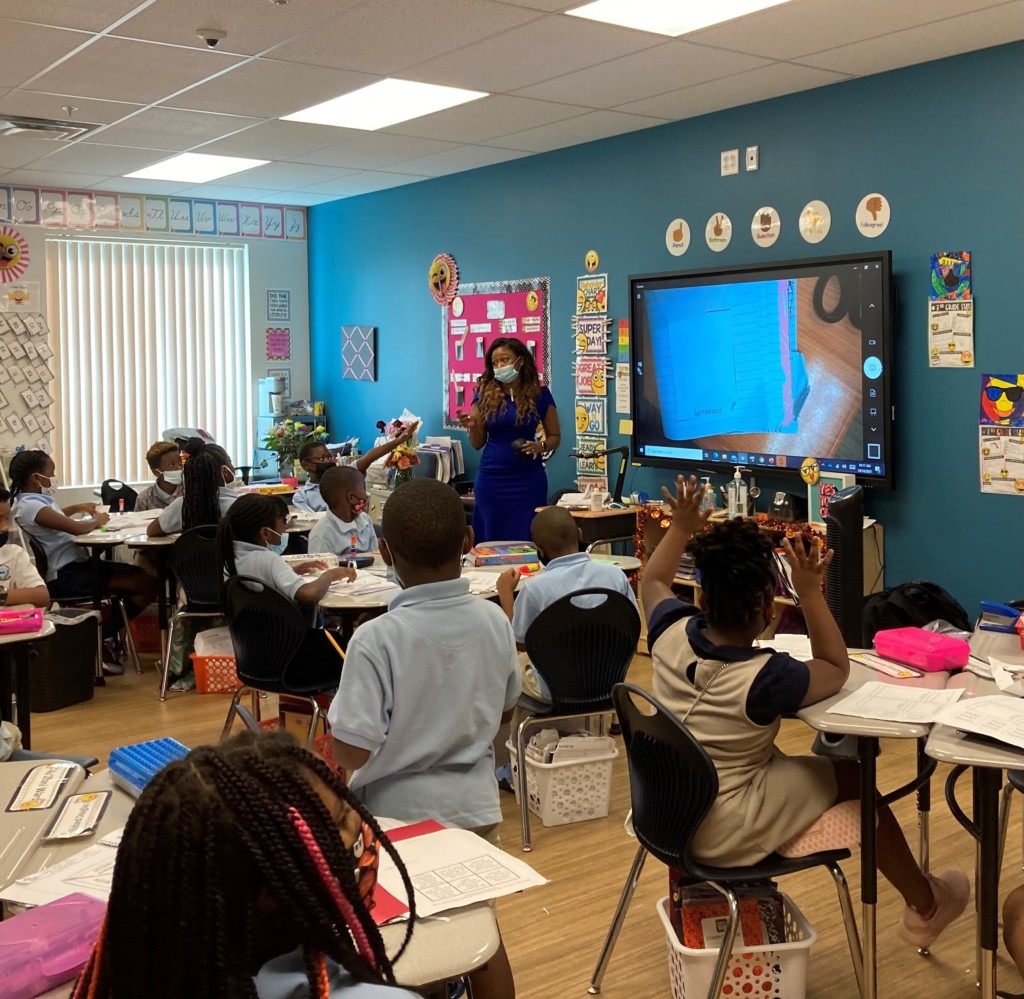
Third-grade teacher Ashley Clarke leads her class at Somerset Academy Eagle Campus in Jacksonville, Florida, which has as its focus academic excellence, leadership development, personal responsibility, community involvement and character.
Editor’s note: This commentary from Nina Rees, president and CEO of the National Alliance for Public Charter Schools, appeared today on the74million.org.
A parent-led rally today in Washington, D.C., is putting the charter school movement’s energy and passion on full display as supporters band together to fight for their schools and for every student’s right to a high-quality education.
The event is happening during National Charter Schools Week, an annual celebration of charter schools and the students, teachers, leaders, families, advocates and supporters who bring power and purpose to the movement.
This year’s National Charter Schools Week theme is Charter Schools Rising, and the evidence for their rise is everywhere. Demand for charter schools has never been higher, and support is strong in all quarters. It’s true that charter schools have faced significant challenges on the federal policy front — from threatened funding cuts to proposed Charter Schools Program rules that would limit educational opportunities — but each challenge offers the opportunity to show how formidable and united the movement is.
We have fended off funding cuts and organized a massive campaign to protect the rule changes. Last week, a bipartisan group of senators added their voices to the chorus calling on the U.S. Department of Education to back off its proposed changes to the Charter School Program. The department has also heard from governors, state school chiefs, educators and parents who know firsthand that charter schools are vital to educational opportunity and equity.
Today’s rally will keep that momentum going.
This week also offers the opportunity to honor and thank the 2022 Charter School Changemakers — some of the most inspiring advocates and community leaders in the movement — and the 2022 Champions for Charter Schools, federal and state policymakers who are blazing a path of opportunity for students across America.
To continue reading, click here.
Charter school critics got a lot of mileage from a U.S. Government Accounting Office report last summer that found charter schools enrolled fewer students with disabilities than traditional public schools. But a new report (hat tip: EdWeek) offers even more reason why we should all take a more careful look before leaping to conclusions.
The Center for Reinventing Public Education found the numbers for middle and high schools in New York state were on par between the two sectors. And while fewer students with disabilities were enrolling in charter elementary schools, that didn't mean discrimination. Wrote the center:
The fact that only charter elementary schools systematically enroll lower proportions of students with disabilities than their district-run counterparts calls into question whether discrimination drives lower enrollment. There is no obvious reason to think that charter elementary leaders would be more likely to discriminate than charter middle and high school leaders. Indeed, the fact that state testing does not begin until the third grade suggests that elementary schools have arguably the weakest incentives to discriminate against students with disabilities. The grade-span differences highlight a need to examine what is different about the policies and practices of special education and the preferences of parents with students with disabilities at the elementary grades versus the upper grades. Many causes other than discrimination could be affecting enrollment.
It may be that charter schools are simply less likely to identify students as having disabilities that qualify them for special education in the first place, or that specialized preschool programs with designated district feeder schools lead parents to opt for the district school over the charter school. Or it may be that federally mandated district counseling for families of kids with disabilities creates opportunities for the district to encourage these families to stay in district-run schools, whereas non–special education students’ families never get such advice. None of these potential contributors to elementary level underenrollment in charter schools have been explored sufficiently, if at all.
The GAO report was written about widely, from the New York Times and Wall Street Journal to outlets in Florida. It'll be interesting to see what kind of coverage the new report gets.
A presidential proclamation is rarely news, but Barack Obama's continued embrace of charter schools is notable for its inclusiveness of alternative forms of public education, as evidenced by this statement proclaiming this week as National Charter Schools Week:
In communities across our country, successful public charter schools help put children on the path to academic excellence by harnessing the power of new ideas, ground breaking strategies, and the collective involvement of students, parents, teachers, and administrators. During National Charter Schools Week, we recognize these institutions of learning and renew our commitment to preparing our children with the knowledge and skills they will need to compete in the 21st century.
The unique flexibility afforded to charter schools places them at the forefront of innovation and in a unique position to spark a dialogue with other public schools on how to organize teaching and learning and enhance curricula. As part of our strategy for strengthening public education, my Administration has supported charter schools and rewarded successful innovation, encouraging States to improve their laws and policies so students can thrive.
Equally important to a world class education system are actions taken by charter school authorizers and the charter community itself to strengthen effectiveness and deliver results that improve educational outcomes. My Administration will continue to encourage meaningful accountability, including closure of low performing charter schools and replication of advances and reforms made at high performing charter schools.
In order to win the global competition for new jobs and industries, we must win the global competition to educate our children. At their best, charter schools provide us with an opportunity to meet this challenge and produce the next generation of great American leaders. (more…)

