Democrats made it through their week-long national convention without talking much about their plans for public education. Like at the Republican convention the week before, most talk of school choice and educational opportunity happened off the main stage. Still, there were some signals about the shape of education politics to come.
Who would hold sway on education in a Hillary Clinton administration?
National Education Association President Lily Eskelsen García says:
"She's going to listen to a lot of people. But we're going to be in her ear first, talking about things like what English-language learners need, what students in special education need, and what a test measures and what it doesn't measure," Eskelsen García told me as she bounced from one event to another here.
Ben LaBolt, former National Press Secretary for Obama for America, replied: "The Clinton campaign has said they're going to have a seat at the table for everyone in the party who works in education. That means reformers will have a seat at the table, that means the unions will have a seat at the table." The important thing, he quipped, is that "the unions don't get all the seats at the table -- just one of the seats."
And what about President Barack Obama's legacy of support for charter schools?
Now, a party’s platform is very different from how that party’s nominee, if elected, would actually govern. But to the extent the platform represents Hillary Clinton’s views — and on the campaign trail, she’s shown some signs that it may — she should think again. Charter school populations mirror the Democrats’ base of low-income and working-class African-Americans and Latinos. Attacks on the schools they send their children to are not what they want or need from the political party they call home.
Regardless what happens in the political arena this year, the education reform agenda remains a powerful force.
School choice is here to stay because families want a say in where their children go to school. We are now arguing about the best ways to offer families choice, not whether empowering families is a good idea.
ESAs in court
State Supreme Court hearings on Nevada's landmark education savings account program fired up people on both sides of the school choice debate.
They rallied both in support of and against Senate Bill 302, a controversial bill that Republicans passed last year to create the state’s new education savings account program, gathering on the courthouse steps as attorneys prepared to deliver oral arguments before the Nevada Supreme Court.
“Our children deserve better than this,” said ESA supporter Jennifer Hainley. She said she wants to use the program to transfer her son from a Clark County school which lacks “the right learning environment.”
Thousands of other parents play the waiting game while the legal battle winds on.
See our coverage of the hearings here, and more from Cato at Liberty, KUNR and the Las Vegas Sun.
Tim Keller of the Institute for Justice, which represents parents in one of the cases, weighs in here. (more…)
In an interview with The American Prospect, Lily Eskelsen García, the president of the National Education Association, says her union's California affiliate represents charter school teachers who voted to unionize after they became disillusioned with management.
The magazine asked whether the NEA could help those teachers. Here's García's response:
Well, you know there are different rules. Technically every charter is public because they get public money. But it is a private system and privately managed. So we would have to reinvent the rules. But when our locals respond to a group of charter educators that want to be unionized, there is nobody that I’ve met who says, you know we really need to grow the charter movement. They’re responding to people who are feeling cheated and exploited, and who worry about their students. Charter teachers are saying we don’t want to give up on our school, but we need a union voice. So they’re coming in and saying we want to look at how we can do this, and we’re helping them explore it. (more…)

Part of the National Education Association's new digital ad campaign (screenshot from Politico.com).
Students' ZIP codes shouldn't be their destiny.
Variations on that line have long been a rhetorical staple of school choice advocates, from parents prosecuted for daring to send their children to schools outside their assigned zone to outfits like the Center for Education Reform, whose statement of beliefs holds that "the quality of a student’s education should not be dictated by their zip code."
Recently it's become an adopted slogan of a different advocacy group: The National Education Association. The country's largest teachers union has recently made the denunciation of ZIP code-based inequality a mainstay of its social media accounts and in its publicity surrounding the reauthorization of the Elementary and Secondary Education Act.
The idea was suggested in an internal communications memo that became public earlier this year, which appears to have informed the union's ongoing campaign for a federal "opportunity dashboard" that would track a variety of indicators on public schools, from class sizes to teacher qualifications.
In fairness, the NEA has taken aim at ZIP codes before. It says it wants equity — meaning, among other things, schools should be funded based on their students' needs, not the wealth of their tax base. That's a worthwhile goal, especially in states that don't even out funding among school districts they way Florida does. There are unconscionable gaps in a lot of places, and students should have access to quality schools, regardless of where they live or what their families can afford. (more…)
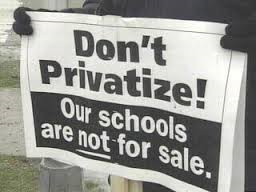
Everyone in the debate over how best to improve public education has private interests. Our collective challenge is to manage these often conflicting interests in ways that best serve the common good.
We all have private interests.
People pursuing their private interests – individually or as a group – is what drives progress and innovation. But our private interests should never trump the common good.
Private interests usurping the public good is privatization. Privatization is bad. It undermines democracy and progress.
Encouraging the pursuit of private interests while avoiding privatization is a core challenge for our economic and political democracy. In pursuing their private interests, individuals and organizations often claim their interests promote the common good, while the interests of those they disagree with don’t. Politics derives, in part, from conflicting claims of whose private interests better align with the common good.
We see this regularly in our debates over how best to improve public education.
As a long-time teacher union leader, I sold financial services, insurance and advocacy services to teachers working for school districts. Therefore, maximizing the number of teachers employed by school districts served my business interests. Our union continuously asserted that more teachers working for school districts served the common good, as did higher teacher salaries and benefits. Our favorite marketing slogan was, “Teachers’ working conditions are students’ learning conditions.”
Our union’s political and marketing strategy was to tie the private interests of district teachers to a greater common good (i.e., the welfare of children). Of course, the private interests of teachers are often – but not always – tied to children’s interest, so this was, and still is, an effective strategy.
Teacher unions use a similar political strategy when attacking school choice programs that empower students and teachers to attend schools not covered by union contracts. The unions accuse these schools of furthering privatization. As the National Education Association recently stated about charter schools not under union contracts: “We oppose the creation of charter schools for the purpose of privatization.”
Teacher unions are often criticized – unfairly in my opinion – for advocating for the private interests of district teachers. (more…)
Tuthill
Editor's note: This is the fourth and final post in a series on the future of teachers unions.
Over the last 20 years, the federal government and state governments have used standards, assessments and regulatory accountability to assert more top-down control over classroom teachers. As state-mandated teacher evaluation and merit pay systems have become ubiquitous, the level of teacher disempowerment and alienation has soared, and teacher unions have hunkered down and become even more defensive and conservative.
School choice is the way out - not only because it is breaking down public education’s 19th Century industrial management model, but because teacher unions are so economically tied to this model they are fighting to preserve it, even though it is bad for teachers and students. Ironically, teacher union dues today are used to perpetuate a dysfunctional management system, and to protect teachers from being abused by this same system. It’s crazy.
I say this as a former teacher union leader.
I started teaching in fall 1977. In January 1978, I sat at a table with other teachers and heard a divorced mother with two young children tearfully tell us she had rejected her boss’ sexual advances and now he was ending her employment contract. At the time, we didn’t have a union or a union contract.
I was 22 years old and became a union organizer while sitting at that table. We organized ourselves, collected cards and successfully petitioned the state to hold a collective bargaining election. We won a court case management had filed to block the election. Then we won the election and bargained and ratified a contract that included protections against arbitrarily firing employees.
In 1984, I joined a more mature union (and the school choice movement) when I moved to St. Petersburg, Fla. to help start one of the state’s first magnet schools. The Pinellas Classroom Teachers Association had been a professional association for several decades before turning into an industrial union in the late 1960s. By 1984, its collective bargaining agreement had been in place for more than a decade, and it had established a collaborative working relationship with management.
After the intensity of building a union from scratch, PCTA felt stagnant. The union was part of district management. It did a great job protecting teachers from the abuses of a politically-managed bureaucracy, but there was no energy or vision for progress. PCTA’s only internal and external message was, “We need more money.”
Pinellas teacher salaries increased by an average of 45 percent from 1981 to 1986, yet teachers were still miserable. More money was great, but they wanted greater job satisfaction. Individuals become teachers because they want to make a meaningful contribution to children’s lives, but that’s difficult - and often impossible - in a mass production bureaucracy that treats teachers like assembly line workers and students like identical widgets.
We attempted reform from within. (more…)
Editor's note: This is the third of four guest posts on the future of teachers unions.
by Gary Beckner
Gary Beckner
We are at a critical crossroads on the path to education reform in America. Stakeholders from all walks of life and political stripes are beginning to understand that in order to compete in a global economy we must focus on choice and technology to prepare our students for the future.
Likewise, we must also recognize that in order to drive needed change in instruction we must also examine how the teacher workforce is represented. Just as a one-size-fits-all system is not working for students, a labor union model solely fixated on protecting the status quo is no longer serving the needs of all educators in a modern workforce.
Choices in education have opened up avenues for advancing the teaching profession like never before. Virtual schools, technology, and non-traditional charter schools allow teachers to set new schedules and adapt their vision for education to a school that meets their specific needs. These innovations have brought new experienced professionals into the profession and have allowed other talented educators the ability to stay on in different capacities.
According to a membership survey by the Association of American Educators, the non-union teacher organization that I lead, teachers support laws that advance choice and promote options. For example, 68 percent of member educators support an Indiana law that provides a tax credit to parents who send their children to a private or parochial school of their choice. Similarly, 74 percent of survey respondents support Arizona's Empowerment Scholarship Accounts, which allow parents of special-needs students to use state education dollars in a school that meets the student's needs.
Despite this groundswell of support from educators themselves, the nation’s largest teacher unions, the National Education Association and the American Federation of Teachers, continue to stand in the way of commonsense education reform for the sake of preserving their own monopoly. Not only is this harmful to America’s students, it degrades the professionalism of one of the most revered career choices. (more…)
Editor's note: This is the latest installment of an ongoing dialogue between Doug Tuthill, president of Step Up For Students, and John Wilson, a former National Education Association official who writes a blog at Education Week.
Doug Tuthill: John, on your John Wilson Unleashed blog, you recently wrote that “there are really two groups of poor children” - a group that benefits from effective parenting and other sources of social capital, and a second group that does not. You said to pigeonhole these high poverty/low social capital children “into a ‘one size fits all’ school model is malpractice.”
 You concluded by saying we need “new policies and new practices that are customized to ensure that this group of children can succeed in our schools.”
I agree with you, and I know you have decades of experience working with these high poverty/low social capital children. Would you elaborate on what you think some of these new policies and customized practices should be?
John Wilson: Thanks, Doug, for giving me the chance to elaborate. First, let me say that equity in our schools gets a lot of rhetoric, but not much action. If there is one thing we should learn from Finland is that they made equity the focus of their transformation and excellence followed. In the United States, we have more challenges to overcome to achieve equity so we have to be bolder and smarter. Here are a few of my thoughts.
1. End segregation by socio-economics. I believe this is the civil rights issue of this century. The few school systems that have done this through creative student assignment plans and choice programs like magnet schools have seen student achievement for all rise, parent engagement increase, and opportunities for their students' future expand.
2. Provide every poor child with little or no social capital an education advocate. If we can provide children/juveniles in the court system with an advocate, would it not be smart to provide this for children in that pipeline as an intervention? I always tell friends don't enter the health care system without an advocate, and I would be remiss not to recognize the same need in education for poor children.
3. Strengthen career and technical education to provide more opportunities for all students. This pathway needs to be as strong as the college pathway so students can switch successfully. We could learn a lot from Finland and other European countries.
4. Provide wraparound services to all schools with the first priority being for the poorest. Health, housing, nutrition, safety and after- school programs affect academic achievement. We have seen the difference that Communities in Schools has made. It is time to replicate them.
I invite you to add to my starter list or challenge my ideas. (more…)
Two years ago, we launched redefinED in an attempt to help opinion leaders, the public and the mainstream media understand how public education is being transformed and redefined. So the following lead in yesterday’s New York Times was, even if by mere coincidence, gratifying to read: “A growing number of lawmakers across the country are taking steps to redefine public education … legislators and some governors are headed toward funneling public money directly to families, who would be free to choose the kind of schooling they believe is best for their children, be it public, charter, private, religious, online or at home.”
We are still early in this transition from a one-size-fits-all assembly-line model of public education to an approach that stresses empowerment, diversity and customization, but this shift to expanded school choice is accelerating and it’s inevitable. And as these changes unfold, redefinED will continue to aspire to be a place where thoughtful people can - with civility and mutual respect - discuss how best to address all the challenges this transformation is producing.
In the 1980s and '90s, when the National Education Association was a leader in trying to improve public education, we use to say change is inevitable but improvement is optional. This is especially true today, which is why the dialogue we’re having at redefinED is so important.
Thanks for staying with us.
My holiday wish is for teacher unions to expand their business model to include all public education teachers, and not just those employed by school districts.
 The industrial model of unionism that teachers borrowed from the auto and steel workers 50 years ago assumes a large number of employees working in a centralized, command-and-control management system. Unions lose money when they apply this industrial unionism to smaller, decentralized employers such as charter and private schools. Consequently, they protect their desired market by opposing all school choice programs that enable students to attend schools not owned and managed by school districts.
But they are losing this fight. Parents like school choice. More than 40 percent of Florida students – 1.3 million - are now attending a choice school, and their numbers are increasing daily. As teachers move with their students and membership losses accelerate, teacher unions will eventually be forced to expand their business model to include services for teachers working for smaller, non-district employers. This expansion might include providing charter, virtual and private school teachers with liability insurance, financial planning, professional development, political advocacy and employee leasing for teachers willing to pay unions for guaranteed employment.
Teacher unions are an important vehicle through which teachers can make their voices heard and impact political decision making, but they have historically been conservative and resistant to change. The National Education Association, the nation’s largest teacher organization, resisted collective bargaining for several years and only relented after losing thousands of members to the AFL-CIO affiliated American Federation of Teachers. Both the NEA and AFT will refuse to embrace a more progressive, inclusive unionism until their membership losses are so severe they have no other choice.
This day is coming. When it arrives, teachers, unions, students and the public will all benefit.
Coming Friday: Two posts. Wishing school choice parents were impossible to ignore. And wishing for more information to help parents make the best choice.
Editor's note: Blog stars is our occasional roundup of compelling, provocative or just downright good stuff from other ed blogs (although sometimes we throw in op-eds from newspapers and magazines, too). Enjoy.
Geoffrey Canada: Death to Education Reform
Canada
To know me is to know that no one feels more strongly than I do about the importance of transforming our current absurd, destructive educational system.
But the way education reform advocates are going about it is wrong. The problem is that you’re never going to get people motivated to be awesome teachers if they’re part of a giant bureaucracy. The only way you’re going to get people to be motivated to be awesome teachers is, yes, if you give them enough money, but also if they are part of a STRUCTURE and a CULTURE that breathes this kind of achievement and rewards it–rewards it not only financially, but also through an environment that encourages it every day. Why do small startups kick the ass of giant technology companies every day? It’s because, yes, these startups have payoffs, but anyone who knows them will tell you that what really makes them tick is the fact that they are small, tight-knit, and everyone is extremely focused. Information loops close really fast. It’s also what made Harlem Children’s Zone a success. It’s what makes neoliberal attempts to “reform” schools centrally via spreadsheet fail.
The only way you’re going to get good schools, in other words, is if you have a system where the people who have the biggest stake in the education, also have a very direct say in how things are run.
To put it another way, you need radical decentralization and a radical shift to power to parents and children in how schools are run. This can be accomplished through vouchers or through other means. (I actually have my misgivings about vouchers, for a bunch of complex reasons, but I’ve come to believe decentralization really is the key.) You could have a 100% public system if it was also structured so as to enable choice and competition. But the crucial thing is to let a thousand flowers bloom. Full post here. (Image from the thebestschools.org)
Andrew J. Coulson: Uh ... the 'Quality Controlled' Schools Are Worse
Sunday’s Washington Post ran a story titled “Quality controls lacking for D.C. schools accepting federal vouchers.” These are the particular failings chosen for the story’s lede:
schools that are unaccredited or are in unconventional settings, such as a family-run K-12 school operating out of a storefront, a Nation of Islam school based in a converted Deanwood residence, and a school built around the philosophy of a Bulgarian psychotherapist.
It is remarkable that more serious transgressions were omitted. Why not mention the schools in which current and former staff brawl in the parking lot, or students start vicious fights at sporting events? Why not discuss the schools spending nearly $30,000 per pupil annually and yet graduating barely half of their students on time?
The reason the WaPo didn’t mention them is that they are not voucher schools. (more…)

