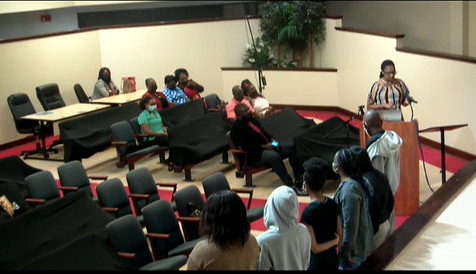
Althea Graham, whose son attends Piney Grove Academy in Lauderdale Lakes with assistance from a state scholarship, thanked the commission for its support of school choice.
National School Choice Week, which this year runs Jan. 23 through 29, shines a spotlight on effective education options for children in grades K-12.
Be it public, charter, private, magnet, virtual, home school, learning pod or micro-school, all are celebrated, as the focus is on choice and parents’ right to determine the best educational fit for their children.
Every January, participants plan tens of thousands of events and activities – such as school fairs, open houses, and student showcases – to raise awareness about school choice across all 50 states.
Many state and local governments also recognize National School Choice Week by approving resolutions or issuing proclamations. Among them was the Lauderdale Lakes City Commission, which approved a proclamation and recognized several school choice families during its Dec. 28 meeting.
The proclamation, signed by Mayor Hazelle P. Rogers, reads that “all children in Lauderdale Lakes should have access to the highest-quality possible education; and recognized that “Lauderdale Lakes is home to a multitude of high quality public and non-public schools from which parents can choose for their children, in addition to families who educate their children in the home.”
The document also urges all residents to join the commission to “raise awareness of the importance of opportunity in education.”
Parent Althea Graham thanked the commission for its support of school choice and said her decision to send her fifth-grade son to Piney Grove Academy in Lauderdale Lakes was one of the best she’s ever made.
“I see him asserting himself as a leader, and I feel such pride in seeing his growth,” she said.
You can watch a video of the presentation here. To learn more about National School Choice Week, click here.
 Editor’s note: This commentary from Jude Schwallbach, research associate and project coordinator at The Heritage Foundation, originally appeared in The Daily Signal.
 National School Choice Week has taken on renewed importance this year, as too many families are approaching the one-year mark of crisis online learning provided by their public school district.
Last March, the coronavirus pandemic shuttered schools nationwide, forcing teachers, parents, and students to transition to virtual classrooms and grapple with the various effects of lockdowns. Ten months later, parents report that 53% of K-12 students are still learning in their virtual classrooms.
Public schools have remained largely closed to in-person instruction.
Recent research by the Centers for Disease Control and Prevention indicated that in-person learning is rarely a source of large outbreak. Even though in-person learning is one of the safest activities for children, proposals to reopen district schools for face-to-face learning have met with staunch opposition from teachers’ unions.
Inexplicably, teachers unions have also rejected measures which would require teachers to be more available to students throughout the day via live video.
The Center on Reinventing Public Education’s director, Robin Lake, told the New York Times that the teachers unions’ vacillating responses feel “like we are treating kids as pawns in this game.”
Adding to parents’ frustrations, teachers unions have also taken the opportunity to push for a whole host of concessions that have nothing to do with health safety.
For instance, the American Federation of Teachers has a long list of demands, including: additional food programs, guidance counselors, smaller classes, tutors to assist teachers, and “culturally responsive practices.”
Similarly, The United Teachers of Los Angeles has demanded a moratorium on charter schools, higher taxes for the wealthy, and “Medicare for All.”
The blatant, non-pandemic-related demands of many teachers unions have illustrated what Stanford University professor Terry Moe noted a decade ago: “This is a school system organized for the benefit of the people who work in it, not for the kids they are expected to teach.”
The inflexibility of teachers unions has increasingly become a source of escalating tension with local officials. For example, Chicago Public Schools, the third largest school district in the nation, locked teachers out of their virtual classrooms after they refused to return to in-person instruction with classrooms at less than 20% capacity.
Such unbending posture has provoked the ire of parents and left many children frustrated, both academically and socially. As Tim Carne wrote in the Washington Examiner, “The very people who have most loudly declared the importance of public schools now are deliberately destroying public schools.”
Many parents are tired of being strong-armed by teachers unions and have pursued alternative education options for their children.
For instance, the learning pod phenomenon, wherein parents work together to pool resources and hire their own tutors and materials is popular. This allows students to return to in-person lessons, even if school districts refuse to reopen.
Last September, a national poll by the pro-school choice nonprofit EdChoice indicated that 18% of surveyed parents were looking to join one. At the same time, 70% of surveyed teachers reported interest in teaching in a pod.
A recent report by education scholars Michael B. Henderson, Paul Peterson, and Martin West found that approximately 3 million students—nearly 6% of K-12 students—currently participate in a learning pod.
Notably, pod participants are more likely to be “from families in the bottom quartile of the income distribution.” The authors wrote, “Parent reports suggest that 9% of all students from low-income families and 5% of all students from high-income families are participating in pods.”
Families have embraced private school options, too. A survey last November of 160 schools in 15 states and Washington, D.C., showed that half of the surveyed private schools experienced higher enrollment this academic year than they had the previous year pre-pandemic.
Moreover, more than 75% of surveyed private schools were open for in-person instruction. The remaining schools offered hybrid education, which is a combination of in-person and virtual learning.
Children could have greater access to private education if more states made education dollars student-centered. For instance, parent controlled education savings accounts allow parents to spend their funds on approved education costs, like private tutoring, books, or tuition. These accounts already exist in five states.
National School Choice Week is an important reminder that “public education” means education available to the public, regardless of the type of school it takes place in. It is the perfect time to remember that parents, not teachers unions, are best positioned to determine the education needs of children.
School choice options like education savings accounts can bring education consistency to families across the country during a most uncertain time. National School Choice Week is an important reminder of that.
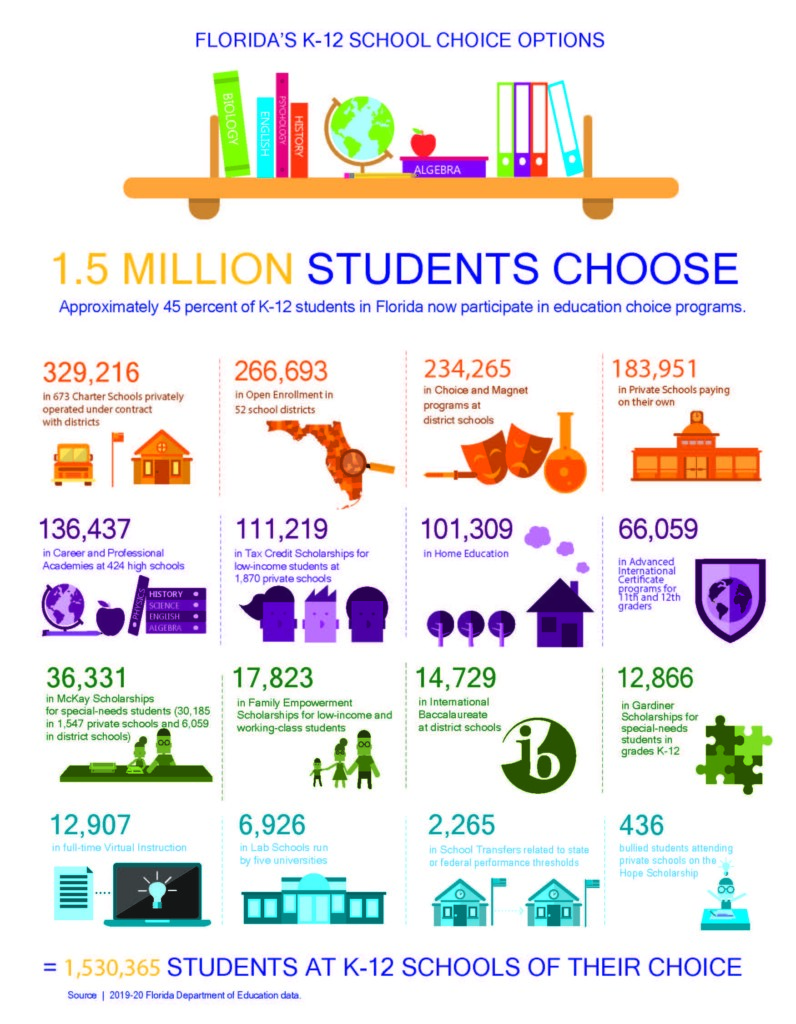 The 11th National School Choice Week celebration kicked off Monday as various organizations, schools, parents and students celebrate educational opportunities in their own unique way. RedefinED celebrates School Choice Week by releasing its 12th annual Florida Changing Landscapes document.
This most recent document, created from Florida Department of Education data, reveals that more than 1.5 million K-12 Florida students participated in school choice during the 2019-20 school year.
This year’s Changing Landscape is a little different than past years. Last year, we saw nearly 1.7 million PK-12 students participating in some form of school choice in the Sunshine State. A detailed breakdown of Florida’s VPK program enrollment, the state’s largest voucher program with around 171,000 students, wasn’t available at the time of publication.
This year, we examined only K-12 school choice programs. Where applicable, such as with private school-private pay or the Gardiner Scholarship, pre-K students have been removed from the count. Likewise, Gardiner Scholarship students who are enrolled in home education programs have been removed from the home education count.
As was the case last year, charter schools dominate the top spot with 329,216 students enrolled. Various public school options, such as magnet schools, career and professional academies and open enrollment continue to dominate the landscape. School choice programs offered by public school districts enrolled more than 717,000 students last year, which means there are more students enrolled in public school choice programs than there are public school students in 24 other states.
Overall, growth in school choice was modest in the 2019-20 school year, adding just 25,000 students for 0.9% growth over the prior year.
The Gardiner Scholarship program, administered by Step Up for Students, the nonprofit that hosts this blog, grew by 17%. Virtual education grew by 15% and Advanced International Certificate of Education programs grew by 14%.
Home education proved to be another popular option, exceeding 101,000 students, a growth of nearly 11% over the prior year.
Career and Professional Academies and Choice and Magnet Programs saw enrollment decline by 6% and 5%, respectively. Private pay students attending private schools shrunk by 3.5%. But thanks in large measure to Florida’s scholarship programs, total K-12 enrollment in Florida’s private schools grew by 5%.
The 2019-20 school year ended amidst a global pandemic that shook public education well into the new year. Nationally, both charter school and private school enrollment grew by 3% while home education grew by 2%.
You can view last year’s Florida Changing Landscapes document here.
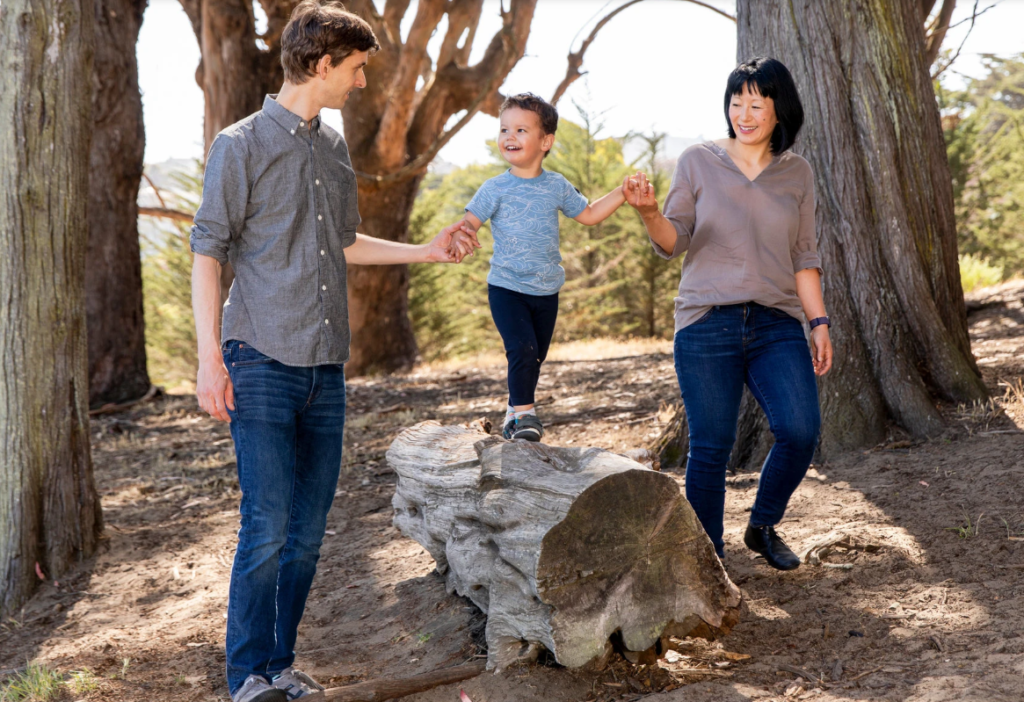
Lian Chikako Chang, right, of South Florida, pictured with her husband, Drew Harry, and their son, Jay, created a pandemic pods Facebook page at the start of the shutdown to connect families looking for education options.
Moviegoers learned in “Star Trek II: The Wrath of Khan” that Capt. James T. Kirk was the only cadet in Starfleet history to beat the training exercise Kobayashi Maru, created as a no-win scenario to test leadership and decision-making.
Born with a rebellious streak that gained him the reputation as Starfleet’s resident troublemaker, Kirk reprogrammed the simulation so he could win. In effect, he changed the rules.
That sounds a lot like what some parents did last summer when the coronavirus pandemic handed them what seemed like a no-win scenario: Keep their kids online and risk having them fall behind academically or send them to brick-and-mortar campuses struggling to meet federal safety guidelines, putting them at risk for contracting a potentially deadly virus. In some parts of the country, campuses remained shuttered, leaving even fewer choices.
Instead, those parents changed the rules. Social media groups sprang up to support pandemic pods, a form of homeschooling in which small groups of students meet together under adult supervision to learn, explore and socialize.
Many families began rotating pod duty or paying teachers to provide in-person instruction in homes or in rented spaces. That led to criticism that the pods, also referred to as co-ops or micro-schools, with critics charging that pods favored families of privilege and shut out those without the means to engage.
One veteran principal of a Northern Virginia elementary school called the sudden push for pod learning “shocking” and likened it to the development of charter schools, only at a faster pace. Some bureaucrats attempted to shut things down by trying to regulate the pods, while some school districts barred their teachers from participating even though those teachers were participating on their own time.
But some cities, like Orlando, responded by setting up their own pod arrangements at community centers for lower-income students to access their district’s online classes and while receiving in-person support from adult staff and volunteers. Also on the plus side: teachers, some of whom were frustrated with traditional learning models or wanted the chance to be more creative in their instructional delivery, saw opportunities.
Some educators even saw a chance to earn more than they were earning in traditional schools in the process.
Despite the challenges, pods and other innovative learning arrangements have thrived as the pandemic drags on. The question is, are they the final frontier? Many experts predict innovation will continue into the future as more families come to expect choice.
In at least one state, legislators are responding to the demand for flexibility and innovation. Florida lawmakers during this year’s legislative session will consider a bill that would give parents greater control by expanding educational savings accounts.
If the bill passes, Florida parents will have the opportunity to boldly go where no one has gone before.
 Editor’s note: This commentary from Andrew Campanella, president of National School Choice Week, appeared today on The 74.
In the midst of sudden school closures and a wild election season, many families heard about school choice for the first time this past year, though it’s been around for decades. I ardently wish the circumstances had been different, but I do believe that heightened national awareness about educational choice is good news.
This Jan. 24 to 30 marks the 11th annual National School Choice Week celebration, though it’s the first time we focus exclusively on virtual, drive-in and at-home events. But this much hasn’t changed: As a public awareness effort, our goal each year is to reach new people with our message that every child deserves a great education to match his or her unique needs, talents and interests.
We invite and welcome everyone into the fold. Last school year, for instance, we reached out to every school in the U.S. through emails, faxes, mailings, and phone calls, and nearly 26,000 schools of all types participated. That’s about 16 percent of all schools in the U.S., all celebrating National School Choice Week.
Over the last 11 years, we have learned a lot about what helps families understand school choice and be empowered to choose schools that make their children’s lives better. Our participants remind us that there is room in our communities and, in fact, within families, for different types of schools, depending on individual students.
Traditional public schools, public charter schools, public magnet schools, online schools, private schools and homeschooling all contribute to the diversity, variety and opportunity in K-12 education today.
Parents do not view school choice as a zero-sum game. They know that different types of learning environments can and should coexist in a community because one type of school will never work for every child.
Moms and dads also do not use school choice as a catchall term for specific policies, legislation or proposals. It is how they describe the incredibly personal decisions they make for their children’s well-being. It is this definition that National School Choice Week embraces.
Unfortunately, it’s sometimes hard to hear parents’ perspectives over the louder voices in the broader debates over K-12 education. Families often say the jargon, political rhetoric and judgments about others’ choices are deeply unhelpful when they just want what is best for their kids and care little about political squabbles and arcane policies.
That is one reason why, for example, I cringe whenever I hear a supporter of school choice paint our education system with a ridiculously broad brush and portray all traditional public schools as “failing.” This caricature is not only factually inaccurate, but it ignores the incredible work done by so many public school students, parents and teachers.
I am equally disturbed, however, when opponents of school choice portray the concept as wildly controversial or somehow ruinous to anyone. These disingenuous skeptics make these arguments only because nobody — especially parents — seriously believes that all children learn in exactly the same way and will succeed equitably in just one type of school.
We all want children to succeed, teachers to be rewarded and schools to be safe and strong. In these challenging times, let’s get out of parents’ way, provide them with the information they need and respect the decisions they make for their families.
We can do that best by celebrating great schools, regardless of their type, which is exactly what happens during National School Choice Week.
 Editor’s note: As National School Choice Week winds down, Step Up For Students’ manager of charter school initiatives Keith Jacobs considers the challenge of achieving educational equity for all and the danger inherent in embracing the status quo.
 WASHINGTON, D.C. – Sitting in his Birmingham jail cell in 1963, the Rev. Dr. Martin Luther King Jr. wrote of the progress for equality from post-reconstruction to the 1960s.
He concluded that “the Negro’s greatest stumbling block in his strike toward freedom is the white moderate who is more devoted to ‘order’ than to justice.”
That hits home for me.
Dr. King’s focus was to appeal to the moral compass of white leaders, urging them to promote justice, equality and fairness for blacks in the south. Let’s remember: Progress was not only hindered by hate groups, whose members threatened the lives and safety of blacks, but by average white citizens more concerned with maintaining peace and the status quo.
Civil rights were the social justice issue of the 60s. Today, as we bring National School Choice Week to a close, we face a new one: educational equity for all.
Education, often thought of as the foundation of civilization, has been slow to change and evolve. As we fight to improve it, our greatest stumbling block is still the “white moderate” – liberals or progressives with privilege in our present-day society.
Too often, their opposition (at worst) toward education choice or their silence (at best) has left our most vulnerable populations – mostly minorities, lower-income families, and students with disabilities – forced to rely on luck for better options rather than access. When children are prevented from realizing their true potential, it sometimes yields deadly consequences.
Dr. King’s comments suggest that neighbors, clergy and politicians who think of themselves as friendly to progress but refuse to get involved are a big part of the problem. Those who would make excuses or say change is impossible because “it’s always been like this.”
Today, these same individuals complain about shortcomings in the education system at family gatherings and church functions but refuse to support options. Their lack of support suggests the attitude that “this is happening to ‘them,’ but my child is fine.”
This type of privilege is a stain on the fabric of our social conscience.
At the trisection of MLK Day, National School Choice Week and the annual convening of the Diverse Charter Schools Coalition in Washington D.C., where I am a participant, we must take an introspective approach and determine next steps.
There has been tremendous growth in the number of lower-income families and students of color, who also are culturally and linguistically diverse, in school districts across the nation. Why are they still so far behind?
Why are people still opposed to the D.C. Opportunity Scholarship Program that has helped so many students of color?
Why are children with disabilities locked out of the American dream?
How can charter schools serving predominately minority students still be denied equal funding to expand successful programs, especially in the STEM field?
These are the questions we are grappling with today.
If you turn your back on these kids, or would rather discuss district funding than the fight for equity for all, then you are reminiscent of the white moderate who stood aside while blacks were lynched, denied basic human rights, and restricted from voting.
You are the reason why, 50 years after the march in Birmingham for civil rights, we needed a rally of over 10,000 advocates a few years ago in Florida to fight for education choice.
Your endorsement of the status quo is the reason hundreds rallied in Tallahassee the day after Dr. Martin Luther King Jr. Day this month to support better educational opportunities for students with disabilities.
Forget parties and parades.
Let’s finally give our marginalized communities what they need: equity and fairness.
It’s time for any who would think otherwise to get off their lofty post and support a cause that values students over a system. All students.
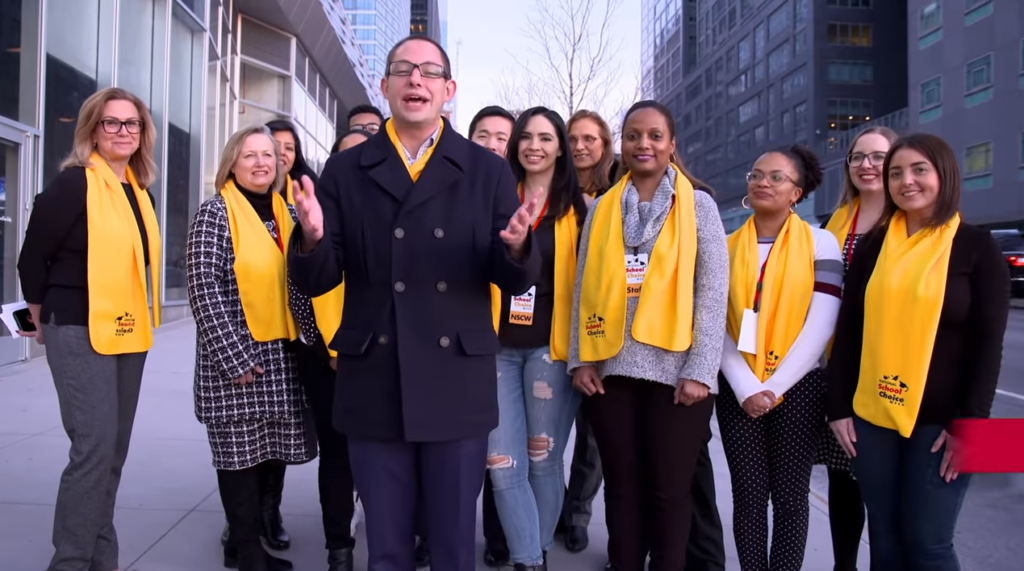
National School Choice Week president Andrew Campanella at an education choice event earlier this month in New York City held as a precursor to the annual celebration
Editor’s note: National School Choice Week, held every January, shines a spotlight on effective education options for children including traditional public schools, public charter schools, public magnet schools, private schools, online academies and homeschooling. NSCW president Andrew Campanella, whose latest book, “The School Choice Roadmap: 7 Steps to Finding the Right School for Your Child” published Jan. 21, shares his thoughts on how school choice cannot and should not be contained within a political ideology.
If you watch how cable news talks about education – in the rare case that it does so – you likely think school choice is a hot-button political issue. This has more to do with the way the media cover stories than with school choice itself.
School choice isn’t a predictable, one-sided political statement; it’s a prudential decision people make every single day.
This year, during National School Choice Week, let’s remember that parents are making educational choices for their kids every day. Those choices aren’t based on political premeditation or activism; they are based on work schedules, life goals and personal needs. These choices aren’t easily clumped together under the category of vouchers or charter schools. They span every iteration of family situation.
Imagine the Smith family moves to Miami, Florida, evaluates the different schools available to them, and chooses to enroll their daughter in the nearest neighborhood public school. That is, quite literally, a school choice, and it may be the perfect choice for the Smiths.
Now maybe the Owens family moves into the same neighborhood in Miami and chooses to use intra-district open enrollment so their son can attend a nearby public school known for its engineering program. Again, that is a school choice.
Perhaps the Delgado family moves in one door down from the Smith family and uses their district’s magnet option for their kids to attend a school focused on the performing arts. That, too, is a school choice.
These three different school choices, all in the realm of free, public education, could each be prompted by unique, personal circumstances. Maybe it’s a medical need, a safety concern, or a learning style that is not being met. Whatever it is, at heart, parents are motivated by the personal needs of their learner and the health of their family unit.
That’s not politics, that’s personal.
Traditional public schools. Private schools. Public magnet schools. Public charter schools. Homeschooling. Online schools. These are all school choices, and the result is that there are more choices and options available for families today than at any other time in history, with most of those choices being completely free for families to access.
The point is, school choice is practiced in so many ways. Of course, like all personal decisions, school choice intersects with the public sphere and cannot be thought of in total isolation. But it remains first and foremost a personal decision that every family makes for itself. Recognizing that is the best and most respectful way to enter the dialogue.
Politicizing a personal decision isn’t going to improve discussions on school funding, quality schools, and what the future of education should look like. Clickbait is fun, cancel culture gripping, and it’s all too easy to wade into reductionist attitudes about school choice and a sea of other issues. But we can do better.
Families are choosing schools all the time. And the more intentional and invested they are in doing so the better. During National School Choice Week, let’s acknowledge the diverse ways that school choice is really practiced rather than dismissing the words to just one or two segments.
Let’s not politicize the personal decisions parents make in pursuit of their children’s happiness.
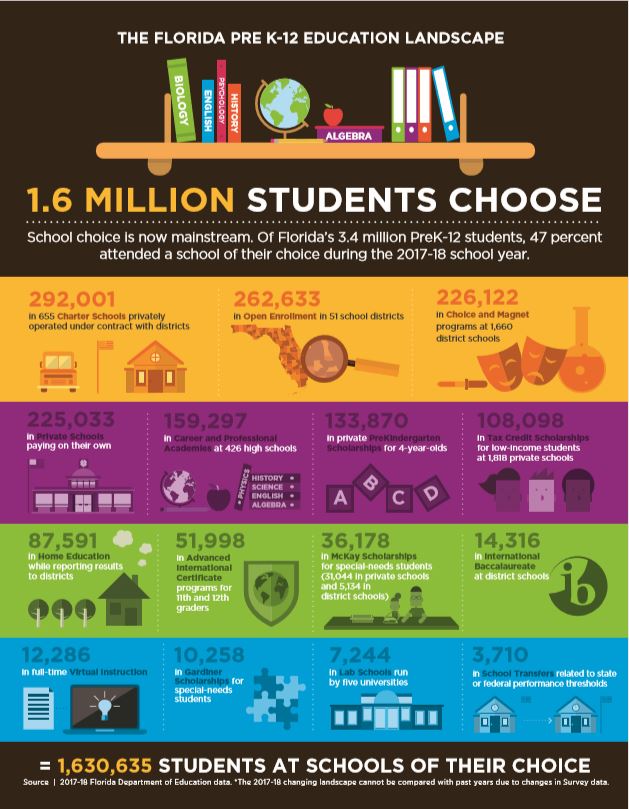
Charter schools overtook “Choice and Magnet programs” and “Open Enrollment” to become the most popular school of choice for Florida parents in 2017-18. The annual Changing Landscapes document above shows 1.63 million preK-12 students, or 47.1 percent of the 3.46 million students statewide, opted for schools outside their zoned neighborhood school.
Charters took the No. 1 spot thanks in part to an increase of 12,081 students, but also because of a 58,499 student decline in “Choice and Magnet” programs.
Polk County accounted for the decline, and then some, in the “Choice and Magnet” programs category with a decrease of 61,036 students. It is unclear what happened with this enrollment figure in Polk. A spokesman from Polk County Public Schools stated that Magnet School enrollment increased from 9,809 in 206-17 to 10,912 in 2017-18 and did not experience a 60,000 student decline in enrollment as statewide survey data initially suggested. The spokesman was unable to confirm whether the initial results were due to a clerical error or a reclassification of students since the individual who previously reported Polk enrollment figures to the Florida Department of Education has retired.*
In addition to charter school growth, the Florida Tax Credit Scholarship grew by 9,162 students, or 9 percent, and the Gardiner Scholarship grew by 2,202 students, or 27 percent.
Several public-school offerings grew significantly, too. Students in an Advanced International Certificate of Education (AICE) program grew by 8,379 students, or 19 percent. Career and Professional Academies grew by 19,540 students, or 14 percent. Even students using the McKay Scholarship to attend other public schools grew by 812 students, or 19 percent growth over the prior year.
This year’s Changing Landscape saw several major revisions.
The FLDOE reported data through “Survey 2,” which is conducted earlier in the school year. According to a department spokesman, using “Survey 2” instead of the end-of-year “Survey 5” reduces the number of duplicated students in choice options. For example, “Survey 5” might count a student enrolled in both a charter school and an open-enrollment public school if the student transferred schools during the year.
Additionally, thanks to better data collection methods, Step Up For Students (which cohosts this blog and administers the Florida Tax Credit Scholarship and Gardiner Scholarship programs) is now better able to track whether Gardiner Students enroll full time as private school students or homeschool students. This enabled us to remove duplicates from both categories this year.
The comparisons narrated above, along with the key findings below, were done by adjusting the 2016-17 school year using earlier “Survey 2” data. As a result, we removed as many as 174,696 duplicated students for the prior 2016-17 school year. The revised data shows that 1.64 million, or 47.5 percent, of the 3.45 million preK-12 students in Florida attended schools of choice in 2016-17, compared to 47.1 percent in 2017-18.
The Changing Landscapes document is in its ninth year. Data for this report is gathered by the FLDOE and includes statistics provided by local school districts.
KEY FINDINGS:
• 47.1 percent of preK-12 students in Florida attend a school of choice, a decline from 47.5 percent last year
• Charter schools are now the most popular school choice option in Florida thanks to steady increase in enrollment and a sharp decline in Choice and Magnet School enrollment in Polk County
• Largest growth rates: Gardiner Scholarship (27 percent), Advanced Certificate of Education (19 percent), McKay Scholarship public school (19 percent), Career and Professional Academies (14 percent)
• Largest declines: Choice and Magnets (minus-21 percent), full-time Florida Virtual School (minus-5 percent), private school private pay (minus-5 percent)
*Editor's Note: Updated to note the Polk County response. A spokesman for the Florida Department of education also speculated the discrepancy could be due to a clerical error or a reclassification of students from one educational option to another within Polk County.
by Darla Romfo
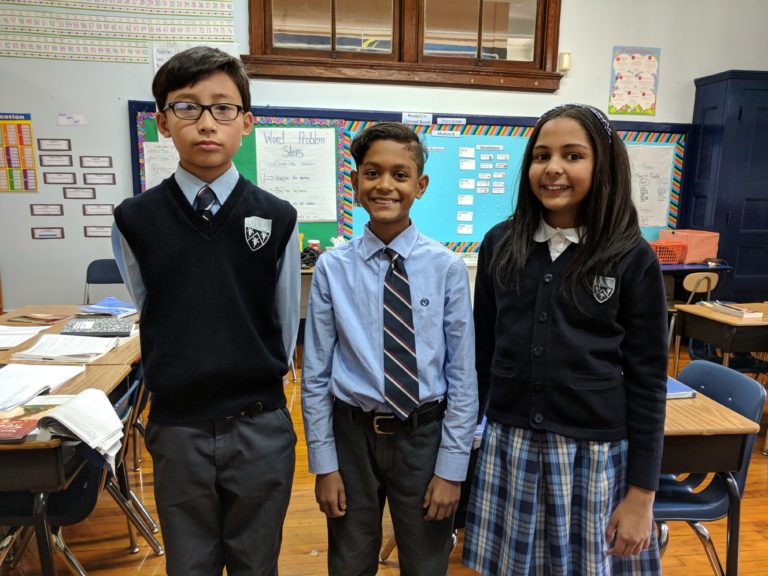 For those of us who follow school choice discussions, the past two weeks have given ample material for conversation, given National School Choice Week, followed by Catholic Schools Week, and the news of the imminent closing of nine Jubilee Catholic Schools with their unique history and mission in Memphis, Tennessee.
During School Choice Week, CSF’s New Hampshire program was part of a happy gathering with 350 people showing up in the middle of an ice storm to celebrate what can happen when parents are empowered with real educational choices for their children. The New Hampshire tax credit program is growing and there is a possibility of education savings accounts (ESAs) in the future. This has uncovered parental demand for more options, and in response, the Catholic Superintendent announced they will actually be opening four new schools. The size of the tax credit program to date does not support four new schools, but the change in culture and expectations does. It has become an environment of hope and excitement about what’s possible. (more…)

