Washington: The new Charter School Commission is attracting candidates from across the state and beyond, including Liz Finne, a lawyer and director of the Center for Education Reform at the Washington Policy Center. The governor and other leaders expect to choose nine volunteers by March 6 (Associated Press). A coalition of educators and community groups filed a legal challenge that questions the constitutionality of Washington's new charter schools law (Associated Press). More from Education Week.
Colorado: With more than 80,000 students enrolled in 190 charter schools, charter leaders try to clear up misconceptions about the school choice option (Reporter-Herald). Douglas County's Choice Scholarship Program does not violate the state Constitution, rules an appeals court. The outcome could have wide-ranging implications for whether vouchers can be used statewide (Associated Press).
 Alabama: Legislators approve tax credit scholarships for students attending failing public schools (Associated Press). More about the "legislative bombshell'' that Republicans called historic and Democrats said was a sleazy "bait and switch,'' at AL.com. And the site offers a primer on the Alabama Accountability Act.
Idaho: Khan Academy will provide math, physics and history classes in 47 public, private and charter schools this fall, making Idaho the nation's first proving ground for statewide implementation of the free online educational content and teaching model (Associated Press).
Michigan: A report measuring charter school performance statewide calls the Eastern Michigan University-authorized schools the second worst system in the state. EMU says the report doesn't take into account that the schools serve some of the state's toughest communities (Ann Arbor.com)
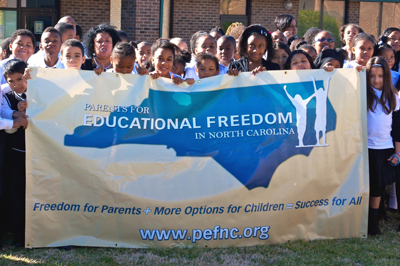 An attempt to bring a tax credit scholarship to low-income children in North Carolina succumbed to a short session and broader tax and education politics as the General Assembly adjourned on Tuesday. But the effort is worth noting in part because of the group pushing it.
Parents for Educational Freedom in North Carolina is a diverse, progressive organization with a membership of 60,000 and is led by a home-grown talent, Darrell Allison, who has a legal and civic mind and has worked in the White House and the U.S. Department of Justice. Allison and his team bring both a zeal to help struggling low-income children and a concern for getting the policy right and making the program accountable. (Disclosure to readers: I worked with PEFNC in preparations for the bill.)
The bill that ultimately was filed, HB 1104, fell short of the type of academic testing requirements the group was seeking. But overall the language kept faith with the 1,200 people who rallied at the Capitol in May, the 4,000 calls and emails that urged lawmakers to act, and the Democrats who signed on as co-sponsors. Importantly, at a time when some tax credit scholarship programs are coming under scrutiny for laws that lack genuine accountability and transparency, Allison and his team were trying to make sure their program had plenty of both.
The “Equal Opportunity Scholarship” was to be funded by contributions from companies that in turn received a dollar-for-dollar tax credit, and the scholarships were to be restricted to students with genuine economic disadvantage – those with household incomes not exceeding 225 percent of poverty. Scholarship organizations could not be tied to any school and could not allow donors to designate that their money go toward any particular student or school. The scholarship itself was to be $4,000, or just under half the amount the state and local governments spend on each public school student. Early fiscal evaluations showed that some versions of the bill saved money even when factoring only the state portion. (more…)
 New Hampshire: The state legislature overrides Gov. John Lynch's veto of a tax credit scholarship bill. (Manchester Union-Leader)
North Carolina: School choice leaders throw in the towel on a legislative proposal for tax credit scholarships. (Associated Press) A judge rules that a virtual charter school cannot open, siding with the state board of education, which had refused to consider the proposed school's application. (Raleigh News & Observer)
New Jersey: Gov. Chris Christie says it's unlikely that a school voucher bill will move in the state legislature this year. (NJ Spotlight)
Florida: Faced with declining enrollment and increased competition from school choice, the Broward County School Board wants to open its own charter schools. (South Florida Sun Sentinel) Meanwhile, the state Charter School Appeal Commission sides with four of five charter school applications rejected by the Palm Beach County School Board. (Palm Beach Post)
Pennsylvania: A well-funded political action committee and the Philadelphia Archdiocese are pushing hard to expand the state's tax credit scholarship program. (Philadelphia Inquirer)
Texas: The state's main charter school group filed suit against the state, charging it with short-changing charters on facilities funding and arbitrarily capping the number of charters that can open. (Houston Chronicle) (more…)
Washington D.C.: The Obama administration relents on funding for the D.C. voucher program and okays a deal that will allow a small expansion. (Washington Post)
New Hampshire: Gov. John Lynch (pictured here) vetoes a legislative proposal for tax credit scholarships, but some expect an override. (Concord Monitor)
Florida: Former Gov. Jeb Bush stresses school choice, accountability and common ground in a speech to Latino officials. (Associated Press)
North Carolina: A legislative proposal for tax credits scholarships has been rolled into a broader education reform bill in the state House. (Associated Press)
Pennsylvania: A proposed state budget would expand the tax credit scholarship program from $75 million to $150 million a year at the same time public school funding levels are kept the same. (Associated Press) The state senate passes a bill that would make it easier for traditional public schools to be converted into charter schools in financially troubled districts. (Bloomberg)
Colorado: Debate arises over the validity of a survey that finds a lack of support for the Douglas County School District's voucher program. (Education News Colorado) (more…)
Editor's note: Due to technical difficulties with the blog, many redefinED readers were unable to read this post when it was originally published Friday. Thanks to those of you who notified us. Thanks to all for your patience.
 It’s old news that many religious schools teach creationism and intelligent design – and that some of those schools accept students with vouchers and tax credit scholarships. But the recent New York Times piece on tax credit scholarships gave school choice critics fresh excuse to pick up and hurl. Teachers union president Randi Weingarten immediately tweeted, “Public money being funneled to creationist, anti-science religious schools.” A few days later, a left-of-center think tank in North Carolina, out to stop a legislative proposal for tax credit scholarships in that state, described the Times story as concluding that “redirected public money” is being used to “spread fundamentalist religious theology like creationism.”
I’m in the science tribe. The evolution-is-fact tribe. But I don’t share their outrage. During my own evolution on school choice, I’ve had to grapple with the fact that many private schools are at odds with what the vast majority of scientists consider good science.
I’ve come to this conclusion: Even if we disagree about creationism, we shouldn’t be so blinded that we forget all the other lessons these children receive in all the other classes they take, in all the years they attend school. We should not overlook whether these children are learning to read and write and succeed in life. I'm hoping that people who do value scientific literacy would be more likely to look at the issue with a sober analytical eye. I’m hoping they might even be willing to place scientific learning in a broader societal context, where many public school students are suffering in part because they lack the foundational learning skills that also handicap them in the arena of science.
The fact is, not many traditional public school students are doing well right now in science. It pains me to say this, because I had amazing biology, chemistry and physics teachers in my public high school. What I learned from them has benefited me personally and professionally. But the facts are informative. In 2009, 21 percent of high school seniors scored at proficient or above on the National Assessment of Educational Progress in science. Break those numbers down into subgroups, and depressing morphs into apocalyptic. Only 8 percent of low-income and Hispanic students reached that bar. Only 4 percent of black students did.
In Florida, the state I know best, only 27 percent of low-income students scored at grade level or above on the state’s high school science test in 2011. To be fair, that’s up from 19 percent in 2006 – and many talented people worked hard to move the needle even that much. But it’s nowhere near high enough or fast enough. (more…)
 North Carolina: The legislative push is on to start a statewide tax credit scholarship program. (Associated Press)
Florida: A former state board of education chair defends the state's decision to offer free tutoring services to low-income families. (Miami Herald)
California: Expanded school choice is at the heart of an increasingly tense feud within the Democratic Party between the teachers unions and supporters of education reform. (Reuters)
Washington: Charter school supporters hope the fourth time is the charm in finally bringing charters to one of the last states left without any. (Seattle Times) (more…)

