
The Missouri State Board of Education took steps this week to curtail public school transfers between school districts. State law currently allows students in failing public school districts (read unaccredited districts) to transfer to higher-performing districts. Receiving districts were required to accept all students, and sending districts were required to pay whatever was required.
In the first year, the Normandy School District outside St. Louis saw more than 900 students – about a quarter of all students – flee its borders to neighboring districts. That resulted in the district falling into financial insolvency before finally being taken over by the state.
 Now that the state is in charge, it is trying to curtail transfers. The state will now limit payments to $7,200 per student; receiving districts may refuse transfers; and students must have attended a Normandy school for at least one semester during the 2012-13 school year. That last rule guarantees 131 students will be forced back into schools they just escaped. And that is a big problem considering some were willing to travel three hours a day to attend the school they wanted.
Worse still, the state is “resetting” the district’s accreditation status for three years to prevent any future students from leaving the district.
For students in Normandy Public Schools, school choice is limited to other public schools outside the district. School choice opponents can’t muddy the debate by claiming profit motives, or arguing that choice schools operate under a different set of rules, or lack accountability. With public school choice the issue boils down to its pure essence: finding the right school for that individual child. Any excuse to limit or eliminate that kind of choice can’t be focused on the students.
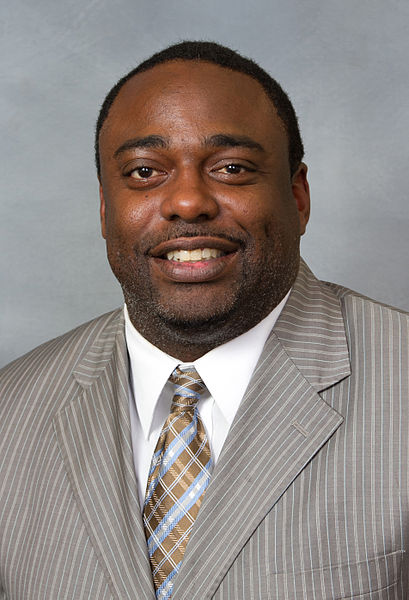
Marcus Brandon D-NC
Late last week, Democrats in North Carolina attempted to kill the state’s new voucher program by axing the $10 million appropriation in a budget amendment. Republicans mounted a defense, but according to Ann Doss Helms, a journalist at the Charlotte Observer, the most vigorous support for vouchers came from two Democrats.
Rep. Marcus Brandon argued public schools in his district weren’t enough to meet student needs. He didn’t blame public school teachers or principals, but a “bad system.” Brandon was troubled by his party’s unwillingness to support learning options for low-income students. “There is nothing unconstitutional about giving poor and minority children the same opportunity as other children,” he argued.
Rep. Edward Hanes Jr., meanwhile, called out members of his caucus. He noted several of his party’s members send their own kids to private schools, but want to deny the same options for low-income parents who need help paying tuition.
The amendment to kill the program failed 43-71.
 Alabama: Judge Gene Reese issues a stay on his own injunction against the Alabama Accountability Act school choice program (AL.com, Montgomery Advertiser, redefinED, American Federation for Children). The decision to lift the injunction takes uncertainty away from low-income families (AL.com). Jeff Reed, public relations director for the Friedman Foundation, says school choice thrives in the state even with the lawsuit (One News Now).
Arizona: Eileen Sigmund, president of the Arizona Charter Schools Association, and Glenn Hamer, the association's vice chairman, say charter schools provide some of the best education in the state and are still looking to improve (Arizona Republic).
Connecticut: Education leaders in Bridgeport drop the idea of suing the state over approving six charter schools in the area after the city attorney says the district has no basis for a lawsuit (Stamford Advocate).
Delaware: Lawmakers debate education savings accounts (JayPGreene.com, Choice Media, Education Week). The News Journal editorial board supports school choice if parents pick charter schools but not if parents want vouchers or education savings accounts to choose private schools.
Florida: The Florida PTA, state teachers union and Florida NAACP urge the governor to veto a school choice bill that includes expansion of tax credit scholarships (the scholarship program is administered by Step Up For Students, which co-hosts this blog). (Tampa Bay Times, Orlando Sentinel).
Idaho: Terry Ryan, president of the Idaho Charter School Association, says over 19,000 children attend charter schools in the state, making support for it a winning proposition for elected Republicans (Idaho Education News). (more…)

