Want to see that charter school’s budget or who sits on its governing board? How about its financial audits? Or whether it is owned by a management company?
Under a bill passed by lawmakers last week, every Florida charter school must maintain a website where it posts that information and then some, beginning in the 2013-14 school year.

Sen. John Legg
“That’s so parents, the media and the community can see how much money the charter is spending on administration, facilities, fees … and compare that with other schools,’’ said Sen. John Legg, R-Lutz. “If there’s something wrong, people can see that online.’’
The provision is one of the less publicized pieces of House Bill 7009, which is now awaiting Gov. Rick Scott’s signature.
Most of the attention on the bill has been focused on its calls for better financial oversight of charter schools. Among other changes, the legislation requires charter operators to file uniform monthly financial reports to school districts that will include balance sheets, revenue statements, expenditures and, new this session, changes in the fund balance.
“This is incredibly important,’’ said Legg, who filed an amendment detailing the procedure during the final week of session. The reports “are critical to bringing transparency to the process.’’
The bill also requires charter schools to get prior written approval from their district sponsors before spending more than $10,000, unless the expenditure was included in the school’s annual budget.
The tougher controls follow last year’s headlines surrounding a struggling Orlando charter school that paid its principal more than $800,000 before shutting down. The payment totaled twice as much as the school spent on its educational program that year, according to the Orlando Sentinel. (more…)
A Florida House subcommittee devoted to school choice has drafted a bill that, if approved, could make life a little easier for the state’s charter school operators - especially when it comes to facilities.
The bill, proposed by the the Choice & Innovation Subcommittee, would give charters free use of certain unused district facilities - and require the district to pay for upkeep.
If a district-owned facility that previously has been used for K-12 educational purposes is no longer being used, the bill says, “it shall be made available for a charter school at no cost.’’
The district may give academically successful charters priority for such facilities, and may require charters to enroll students previously assigned to the school if it was open the year before as a public school.
The district would have to maintain the charter school facility “at the same standard and level it would maintain any other district-operated school similar in age and condition.’’
That suggestion might prove popular among charter advocates, including the Florida Consortium of Public Charter Schools, which represents more than 400 charter schools.
Access to unused district facilities is No. 2 on the consortium’s list of legislative priorities this year. No. 1 is creating a charter school facilities assistance fund to help with new construction, maintenance and furniture and equipment purchases.
“Charter schools are public schools and deserve the same level of financial support and opportunities afforded to district public schools,’’ said Robert Haag, the consortium’s president. “Charter schools should have … equal access to school buildings that are sitting empty and are not being used for their original educational purpose.’’ (more…)
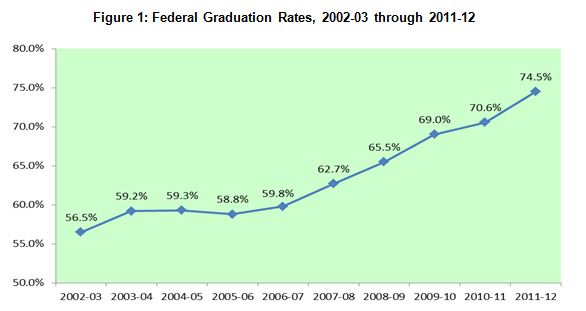
Grad rates rising: Florida’s grad rate jumped nearly 4 percentage points in 2012, to 74.5 percent, the biggest one-year jump since 2003, the Orlando Sentinel reports. Full DOE report for districts and individual schools here. The DOE press release announcing the news was sent out at 5:42 p.m. Friday and that, unfortunately, may have limited coverage. Coverage from Gradebook here and here. Sherman Dorn’s take here.
College remediation rates still too high. StateImpact Florida, first in a series.
That charter school again. NorthStar High School, the same failing Orange County charter school that gave its principal more than $500,000 as it was closing its doors, also paid her husband more than $460,000 over a five-year period, the Orlando Sentinel reports.
Praise for Florida’s reforms. And bipartisanship. Julia Johnson, a former state Board of Education member, writes on both in USA Today.
Zoning woes in Palm Beach. One parent upset about proposed boundary changes for a popular elementary schools tells the Palm Beach Post: “We moved specifically to put our daughter into a better school.” A school board member who represents the school, meanwhile, says dozens of parents are “faking” their addresses so their children can attend.
 Oldest African-American school in Florida. St. Peter Claver Catholic School in Tampa is profiled by Fox 13 in Tampa. Many students attend with tax-credit scholarships.
A different take on charter school payout controversy. Red flags should have prompted more oversight from the Orange County school district, writes Adam Emerson at the Choice Words blog after doing some independent reporting.
Informing or advocating? Some question whether Volusia Superintendent Margaret Smith crossed the line in “informing” voters with automated phone calls about an upcoming tax referendum, reports the Daytona Beach New Journal.
Task force looking at tax hike. From The Florida Current: “A task force looking at construction needs of public schools is finalizing a proposal for a half mill property tax increase with the money split between traditional schools and charter schools.”
Virtual settlement. From the News Service of Florida (subscription required): “Days before an appeals court was set to hear arguments, the Duval County School Board and backers of a proposed virtual charter school have agreed to settle a legal dispute about approval of the school, an attorney said Thursday."
The half-million-dollar payout to the principal of a failing charter school in Orlando has sparked far-ranging criticism of Florida charter schools and the laws that govern them. But over at the Fordham Institute's Choice Words blog today, Adam Emerson offers a different take. After doing some independent reporting, Emerson (the founding editor at redefinED before moving on to Fordham) says the Orange County School District should have responded earlier to obvious warning signs, including information contained in independent audits.
"It’s true that the charter school’s own board seemed absent in its required oversight of NorthStar, and it behaved (at best) irresponsibly in signing off on the outsize compensation for its principal," he wrote. "But the school district is responsible for overseeing the charters it authorizes, and that responsibility became more critical when audits highlighted conflicts of interest and other red flags." Read his full post here.

