 Aaron Churchill, Ohio research director for the Thomas B. Fordham Institute, has released a new report on charter schools in his state for the institute.
Broadly speaking Churchill praises an effort that began in 2015 to tighten up accountability for authorizers, advocates for funding and other efforts to expand “quality” charters, and calls for funding equalization between brick-and-mortar district and charter schools.
Churchill writes: "Ohio can’t afford to slip back into the dark ages of lax accountability and anything-goes in the charter sector. Lawmakers need to maintain the commitment to accountability for sponsors and schools to ensure that student achievement remains a priority and that the performance of the sector continues its upward trend."
This bit of text in the study got your humble author’s attention: "Through much-needed reforms, state lawmakers have reinvented Ohio’s charter school sector. The Buckeye State is no longer the “wild west” of charter schools, as dozens of low-performing schools have closed, and more than forty sponsors have departed."
Out in Arizona, we take the “wild west” term as a badge of honor, given our remarkable results and the unfortunate stagnation of much of the rest of the charter movement. I don’t live in Ohio, and thus will offer no opinion on any of Chu’s recommendations. I will however offer a different perspective.
Let’s start with exhibit A, the Brookings charter school access map from 2014-15.
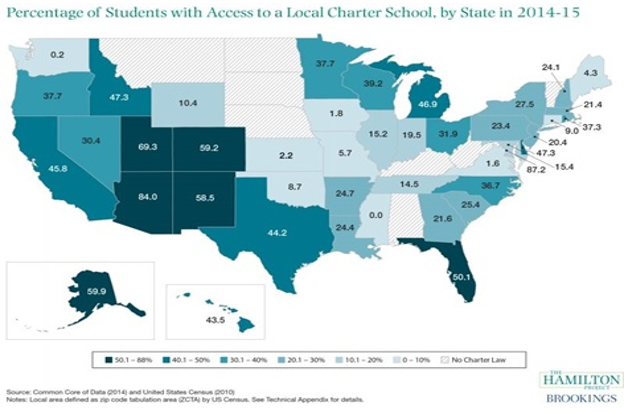
The map shows the percentage of students in each state with one or more charter schools operating in their ZIP code. Even before the 2015 reforms that Chu noted led to 100 Ohio charter schools eventually closing, the state’s charter school sector operated in fewer than one-third of all Ohio ZIP codes.
This was according to the initial design of the Ohio charter statute. Until a recent change in statute supported by both Fordham and yours truly effectively prevented charter schools outside urban areas.
The Stanford Educational Opportunity Project has compiled academic achievement data on schools from around the nation by linking state exams. This chart shows the average rate of academic growth by school for Ohio charter schools, 2008-2018.
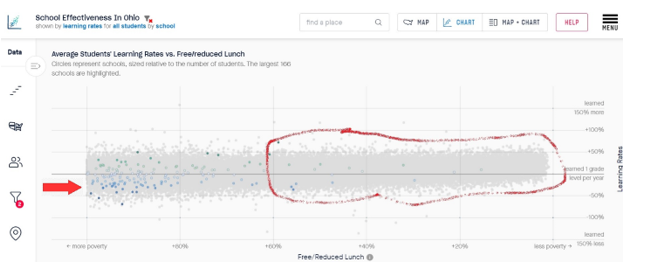 Figure 1: Average Academic Growth Rates for Ohio Charter Schools, 2008-2018 (Source: Stanford Educational Opportunity Project)
Two things to note: First, the circle. Ohio has very few charter schools with either median or low levels of student poverty. The lack of schools in the red circle constitutes further confirmation of the heavily geographically segregated nature of Ohio’s charter school sector seen in the Brookings map.
Second, note the red arrow. Ohio had a large number of high-poverty charter schools with low levels of average academic growth (blue dots below the “learned 1 grade level per year” line. This is disturbing. It means the already large achievement gaps grew in these schools over time.
Finally, take note of the blue-to-green dot ratio: High grow schools do not outnumber schools with low levels of growth.
Now, let’s compare Ohio’s geographically segregated charter sector to the nation’s most geographically inclusive charter sector in Arizona. As shown in the Brookings map, 84% of Arizona students had one or more charter schools operating in their ZIP code.
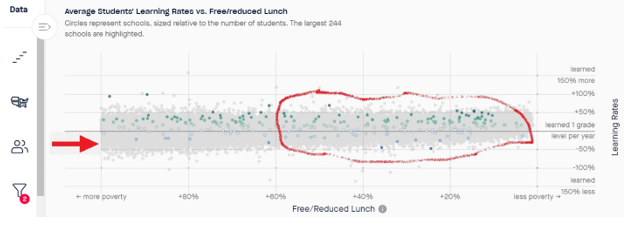
Figure 2: Average Academic Growth Rates for Arizona Charter Schools, 2008-2018 (Source: Stanford Educational Opportunity Project)
Look again in the red circle. Lots of charter schools and lots of charter schools with high levels of academic growth.
Next, let’s examine the high poverty area of the chart near the red arrow: very few low-growth schools.
Finally, notice the total ratio of green-colored schools to blue-colored schools in the entire chart. Arizona has high growth schools across the entire sector, relatively few low-growth schools.
Data from the National Alliance for Public Charter Schools reveal that Arizona has a larger absolute number of urban charter schools than Ohio. How did the state avoid a large number of low-growth schools-urban or otherwise? Closures, but largely not of the administrative variety.
The Arizona State Board for Charter Schools listed 106 charter school closures between 2010 and 2014 and the reasons for the closures, a few more than the 100 closed in Ohio since 2015. The board describes a wide variety of reasons for closures including lack of enrollment, loss of a facility, merger with another charter, etc. The explanations are broad enough to require interpretation, but approximately 16 of the school closures involve a clear administrative action by the board to either close or merge.
Arizona charter schools that closed between 2000 and 2013 had an average tenure of operation of four years and an average of 62 students enrolled in the final year of operation for closed Arizona charters. Arizona law grants 15-year charters, but the competitive environment in Arizona closes charters early and often.
Why does Ohio have so many low-growth charter schools? I believe that this map from the Fordham Institute explains much of the difference between Ohio and Arizona:
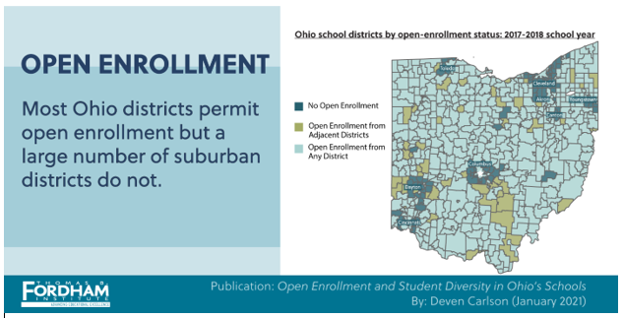
Notice that not every suburban district in Ohio participates in open enrollment. Notice also the sickly, green-colored districts that only participate in open enrollment with adjacent districts. One can’t help but wonder just which students they might be trying to avoid.
My theory is as follows. Low-growth urban charter schools survived in Ohio but quickly closed in Arizona because Arizona students have lots of other options. Nearly all Arizona school districts participate in open enrollment. This includes relatively affluent districts like Scottdale Unified, which brings in over one-quarter of its total enrollment from outside the district’s boundaries.
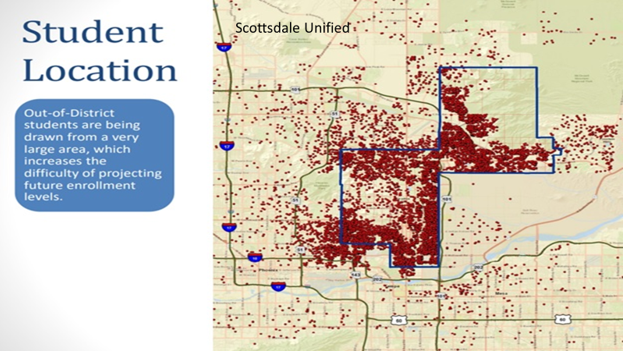
Scottsdale Unified enrolls approximately 20,000 students, with 4,500 students coming to the district through open enrollment. The 9,000 students who live within the boundaries of Scottsdale Unified who attend schools in charters, other districts, private schools, etc., doubtlessly play a large role in making open-enrollment opportunities available. Suburban districts in Arizona prefer to participate in open enrollment rather than close campuses.
Arizona’s suburban charter schools opened suburban districts to open enrollment, leading to closure of low-demand charter schools. This virtuous cycle does not have the chance of occurring in charter sectors constrained exclusively to urban areas.
Wisely, Ohio lawmakers recently expanded choice options by removing geographic restrictions on charters and expanding private choice options. The limitations of Ohio’s charter sector thus seem to owe more to poor central planning than to “wild west” liberality.
Author and podcast host Steven Berlin wrote: “The strange and beautiful truth about the adjacent possible is that its boundaries grow as you explore them. Each new combination opens up the possibility of new combinations.”
Arizona’s experience shows that choice programs, far from being siloed, interact with each other out in the field. Allowing families and teachers to shape the K-12 space is a much better idea than leaving it to state officials and is the best solution to the elimination of low-performing schools of any sort: more options.
Embracing liberality takes humility and wisdom, but without it, choice sectors quickly hit a low ceiling in serving the interests of the poor.
Ohio’s charter failure, by my way of thinking lies in central planning. The goal ought not be to replace bad central planning with better central planning. Rather, the goal should be to create a fully inclusive and demand-driven system of education that allows educators and families to act as the hands of a potter at a wheel, molding the K-12 space over time to create the types of schools educators want to run – and that families want to support.
Indiana: Republican lawmakers scale back a proposal to eliminate a requirement that students attend public schools for one year before becoming eligible for a private school voucher (Associated Press). They pass it mostly along party lines in the House (Associated Press). They're advancing a proposal to switch administration of the voucher program away from newly elected Superintendent Glenda Ritz (Associated Press). They're also considering a Democratic proposal to give school districts with more than 50 percent of their students in charter schools the ability to approve new charters (Post Tribune).
 New Hampshire: The state House votes to repeal the tax credit scholarship program passed into law last year over Gov. John Lynch's vote (New Hampshire Public Radio).
Iowa: The state's Catholic bishops push for vouchers (Iowa Radio).
Texas: Senate Education Committee Chairman Dan Patrick, R-Houston, files legislation to lift the cap on charter schools and create a new body to authorize them (Texas Tribune). More from the Austin American Statesman and the News-Journal. Patrick's proposal for tax credit scholarships isn't getting a warm reception from fellow lawmakers (San Antonio Express News). Thousands of people turn out for a Save Our Schools rally to restore education funding, reduce standardized testing and oppose vouchers and charter schools (KVUE.com)
Alaska: A debate over a proposed constitutional amendment that could open the door to private school vouchers is heating up (Anchorage Daily News). The chair of the Senate Education Committee says his committee will still hold hearings on vouchers even though it will no longer be considering a bill on the proposed amendment (Alaska Public Radio News).
California: The race for three seats on the L0s Angeles Unified School Board has drawn national interest - and financial support - due to three candidates who favor parental choice, charter growth and data-based teacher evaluations (Los Angeles Daily News).
Idaho: Lawmakers propose measures to allot charter schools $1.4 million in facilities funding and allow colleges, universities and nonprofit groups to authorize charter schools (Idaho State Journal). More from Idaho Education News.
Georgia: Amid the debate on parent trigger laws and charter schools, one education advocate ponders: Whose responsibility is it to educate a child — society’s or the parent’s? (Atlanta Journal Constitution). The Georgia Legislature considers an expansion of the tax-credit scholarship program (Rome News Tribune). (more…)
Tennessee: Gov. Bill Haslam proposes a voucher that's limited to low-income students in low-performing schools, with additional state funding for those schools to boot (KnoxNews). More from timesfreepress.com and Nashville Public Radio. Haslam reiterates that his proposal won't affect funding for public schools (Nooga.com). Both supporters and opponents find details to criticize (KnoxNews). Haslam's administration is also backing a bill that would cap enrollment at a virtual charter school run by K12 Inc, reports timesfreepress.com.

Florida: At a National School Choice Week event, new Florida Education Commissioner Tony Bennett gives some school districts credit for expanding public options such as magnet schools and career academies (redefinED).
Louisiana: The teachers union in New Orleans asks for the names of teachers in the city's charter schools in the hopes of organizing them (The Lens).
Arkansas: Former Florida Gov. Jeb Bush makes an appearance during National School Choice Week, urging lawmakers to expand charter schools and other choice options and calling education reform both the civil rights and economic issue of our time (Associated Press). More from the Arkansas Press-Gazette.
Virginia: Democratic lawmakers kill a charter school bill and snub their party's national platform in the process (Watchdog.org). More from the Associated Press. A bill to allow home-schoolers to play sports in public schools - a so-called "Tebow" bill - passes the House but must still clear the Senate (Associated Press).
Georgia: The state charter schools commission holds its first meeting since being revived by passage of a constitutional amendment (Atlanta Journal Constitution). More than 1,000 charter school supporters gather to celebrate the amendment's passage (Atlanta Journal Constitution).
South Carolina: State Superintendent of Education Mick Zais says at a National School Choice Week event that he supports a legislative proposal for tax credit scholarships (SCNow.com).
North Carolina: An expansion of charter schools brings debate about quality (Durham Herald Sun).
Mississippi: A bill backed by Gov. Phil Bryant to create a tax credit scholarship program clears the Senate education committee (Associated Press).
Texas: A charter school chief executive testifies in a trial about education funding that low state spending is hurting charters too (San Antonio Express News). The Amarillo school district joins others in supporting an anti-voucher resolution (NewsChannel 10). Gov. Rick Perry backs expansion of charter schools and a proposal for tax credit scholarships (Dallas Morning News). (more…)

Gov. LePage
New Hampshire: The ACLU and Americans United for Separation of Church and State file suit against the state's new tax credit scholarship program (New Hampshire Public Radio). More from Associated Press.
Maine: State Education Commissioner Stephen Bowen points to problems in the process after the state charter school commission rejects four of five applicants (Bangor DailyNews). Gov. Paul LePage tees off on the commission and the teachers union after the rejections (Portland Press Herald). Supporters of virtual charter schools are also upset (Portland Press Herald). The teachers union blasts LePage for wanting to lift the cap on charter schools (Portland Press Herald). Public school administrators say charters should have to feel effect of education budget cuts too (Bangor Daily News).
Kansas: Vouchers, tax credit scholarships and an expansion of charter schools are all expected to be part of the legislative discussion this year (Wichita Eagle.)
Kentucky: A bill is filed to allow a limited number of charter schools to open in the state for the first time (Kentucky Public Radio).
California: Parents at Desert Trails Elementary School finally succeed in using the parent trigger law to get a charter school to take over their school (Los Angeles Times). More from Hechinger Report and Education Week.
Georgia: A state representative is planning to file a parent trigger bill for the session that begins today (Associated Press).
Mississippi: Business leaders are backing the legislative push for charter schools (Associated Press). Racial divisions and mistrust are at play in debate over charter schools (Hechinger Report). (more…)
 Florida: Incoming Florida Education Commissioner Tony Bennett talks about the idea of voucher students being required to take the same standardized tests as their public school peers (Tampa Bay Times' Gradebook blog).
Texas: Lt. Gov. David Dewhurst sees expanded school choice as part of a legislative agenda that aims to make Texas the most conservative state in the country (Associated Press). The pending fight over vouchers highlights a difference over the best way to fund schools (Dallas Morning News).
Tennessee: A possible school voucher program will be a top issue for Gov. Bill Haslam and state lawmakers next year (The Tennessean).
New Hampshire: The state's new tax credit scholarship program will again be the subject of debate - and potential legislative action - next year (New Hampshire Public Radio.)
Indiana: The state's school districts turned to marketing efforts in 2012 to compete with private school vouchers (Evansville Courier & Press). Charter school administrators say they have the flexibility to quickly respond to make improvements (Evansville Courier & Press).
Massachusetts: A new Pioneer Institute report opens a debate over the value of school choice options, specifically tax credit scholarships and education savings accounts, for Jewish day schools (Masslive.com)
Louisiana: Education reform,including creation of a statewide voucher program, ranks as one of the year's biggest stories (Houma Comet). Gov. Bobby Jindal's education reforms have reliable backing from the state education board, including its elected members (Baton Rouge Advocate).
Ohio: A long-troubled charter school moves again (Cincinnati Inquirer).
Washington D.C.: Fewer than half of the city's charter schools employ nurses (Associated Press).
Pennsylvania: Charter schools aren't just small, independent operations any more (Pittsburg Post Gazette). The western part of the state is seeing a rapid increase in charter school enrollment (Trib Live).
Delaware: Three charter schools delay opening next year, citing start-up costs and problems securing locations (Delaware Online).
 Texas: State lawmakers propose an ambitious school choice expansion plan that includes a tax credit scholarship for low-income students and the lifting of a cap on charter schools (Dallas Morning News). More from the Austin American Statesman and San Antonio Express-News.
Tennessee: A key state lawmaker, House Speaker Beth Harwell, says the legislature will consider a statewide charter school authorizer (The Tennessean). Area businesses help push growth of charters in the Nashville area (The Tennessean). Gov. Bill Haslam gives mixed signals on the possibility of voucher legislation next year (Knoxville News-Sentinel). More from the Memphis Commercial Appeal.
Louisiana: The Recovery School District in New Orleans is moving towards an all-charter system (New Orleans Times Picayune). The latest enrollment counts show families who accepted vouchers are sticking with their schools (Alexandria Town Talk).
North Carolina: Charlotte-Mecklenburg schools superintendent Heath Morrison calls private, charter and traditional public school leaders together to discuss the possibility of partnerships (Charlotte Observer).
Indiana: A new study finds the state's charter schools are among the best in the nation when compared to their traditional public school counterparts (Indianapolis Star). But the poor performance of many charters under one authorizer, Ball State University, drags down the overall results (Indianapolis Star).
Illinois: Members of the Chicago teachers union march to protest a wealthy charter school supporter and ally of Mayor Rahm Emanuel (Chicago Sun Times).
Ohio: Federal education officials are investigating whether charter schools in Ohio and three other states - Texas, Pennsylvania and Wisconsin - are discriminating against students with disabilities (StateImpact Ohio).
Wisconsin: Possible expansion of vouchers, extra pay for low-performing schools with improvement plans, and more education funding are all on tap for the next legislative session, Gov. Scott Walker says (Milwaukee Journal Sentinel).
Georgia: A judge rules that the Atlanta school district must stop withholding money from the city's charter schools to help pay for the district's pension program (Atlanta Journal Constitution).
 Florida: Tony Bennett is selected the state's new education commissioner (redefinED). He tells reporters afterwards that he champions school choice first and foremost because of the social justice component (redefinED). A new group headed by T. Willard Fair, co-founder of the state's first charter school, aims to create a pipeline of black executives and entrepreneurs to help lead private and charter schools (redefinED). The Miami-Dade school district ranks No. 10 in the country for school choice, according to a new report from Brookings (redefinED). A Catholic school in Tampa is at the heart of a University of Notre Dame project to revitalize Catholic schools, particularly for Hispanic students. (redefinED).
Louisiana: Voucher parents are worried in the wake of the legal ruling that puts the program in limbo (advertiser.com). Gov. Bobby Jindal makes a pitch for vouchers at a Brookings Institution event in Washington D.C. (Huffington Post).
Washington: More than 150 teachers, parents and administrators attend a charter school conference in the wake of the successful passage of a charter school ballot initiative (Tacoma News Tribune). (Full disclosure: The conference was sponsored by the Washington Charter School Research Center, which was founded by Jim and Fawn Spady. Fawn Spady chairs the board of directors at the American Center for School Choice, which co-hosts this blog.)
Michigan: The education adviser to Gov. Rick Snyder presents the governor's sweeping public school choice proposal to business and education leaders (Grand Rapids Business Journal). (more…)
 Arizona: Gov. Jan Brewer signs into law a bill that makes students in D and F schools eligible for education savings accounts. (Arizona Republic) An estimated 100,000 students could be eligible. (Arizona Daily Star)
Florida: U.S. Education Secretary Arne Duncan questions why the Florida Legislature decided to continue a program that allows low-income parents to choose private tutoring providers. (Associated Press) Tutoring providers fire back, saying Florida's law is a model. (Tampa Bay Times' Gradebook blog)
New Hampshire: Both houses of the Legislature have now passed a tax credit scholarship bill by margins big enough to override an expected veto from Gov. John Lynch. (Concord Monitor)
South Carolina: Gov. Nikki Haley signs into law a bill that will allow expansion of charter schools, including creation of boys-only and girls-only charter schools. (Associated Press)
Louisiana: State teachers union president says opponents will try to undo the sweeping education changes led by Gov. Bobby Jindal, including the statewide voucher program. (Baton Rouge Advocate) (more…)

