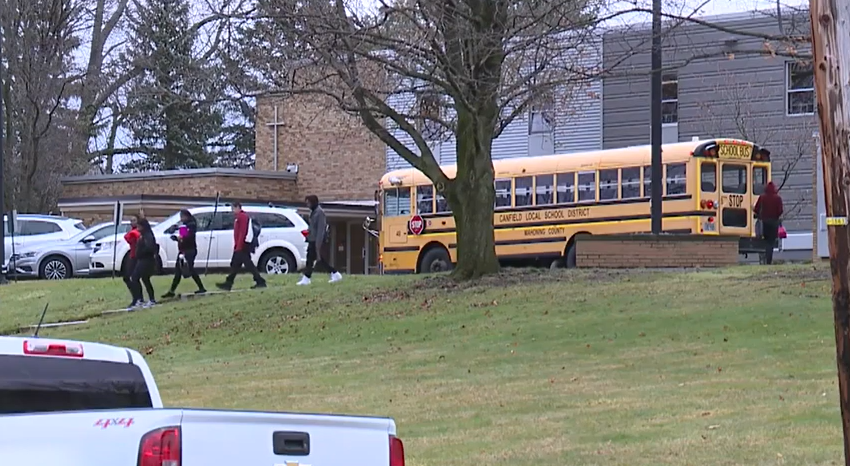
 A coalition of about 70 Ohio public school districts is threatening a lawsuit challenging legislation enacted this year to provide a broader range of educational opportunities for families.
Included in HB 110 was removal of caps on the number of EdChoice Scholarships allowing children from low- and middle-income households to attend private schools of their choice, ensuring that any eligible student applying for an EdChoice scholarship would receive one.
The bill also called for an increase in funding amounts for both the EdChoice and Cleveland scholarships, which had fallen behind public school spending. Perhaps more important, it ensured scholarship amounts would automatically rise in future budgets in proportion to any increase in public school base funding.
Bill Phillis, executive director of the Ohio Coalition for Equity and Adequacy of School Funding, the group bringing the suit, says his organization ultimately is calling for the end of the EdChoice program.
“The bottom line of all this is these alternatives, including vouchers, is diminishing the state’s ability to meet its obligations,” said Phillis, who said the state has removed around $25 billion from K-12 public education in favor of vouchers or other private school options.
For most of Ohio’s legislative session, education debates focused on technical issues with the state’s school funding formula and overall spending levels. That changed in mid-June, when lawmakers unveiled the Senate’s education plan for the state budget for 2022–23 (HB 110).
School-choice proponents such as the Buckeye Institute, a Columbus-based think tank, called the additions bold and significant.
“Gov. Mike DeWine has signed a budget that expands existing school choice options and creates Ohio’s first-ever education savings account program helping parents afford desperately-needed resources and giving them the flexibility necessary to improve their children’s educational outcomes,” said Rea Hederman Jr., executive director of the Economic Research Center at the Buckeye Institute and vice president of policy. “These bold reforms are some of the most significant that Ohio’s families have seen in a decade.”
 Ohio lawmakers may have saved the best for last in a remarkable year for parental choice programs. School Choice Ohio ran down all the private school provisions here but briefly Ohio lawmakers created an afterschool enrichment Education Savings Account. They also created a new private choice scholarship tax credit, and expanded the funding and eligibility of existing voucher programs.
The new Ohio budget also created a small tax credit for home-schooling expenses, eliminated a statewide cap on the number of EdChoice scholarships, and phased out prior public attendance requirements for EdChoice scholarships. Also charter schools, which had been limited to certain challenged districts, can now operate in any Ohio district.
Florida, Indiana, New Hampshire, Ohio and West Virginia enacted school choice reforms that in any “normal” legislative season likely would have been the biggest move of the year. New states like Missouri and Kentucky passed the first programs in their states. Pennsylvania lawmakers increased the cap on their state’s tax credit by $40 million. Lawmakers in Arkansas, Arizona, Georgia, Iowa, Kansas, Montana, South Dakota, Nevada and Oklahoma all either improved existing programs or created new ones.
The 2020-21 school year also saw a large increase in charter school enrollment, a large to gigantic increase in home-schooling (estimates vary) and the emergence of a micro-schooling sector.
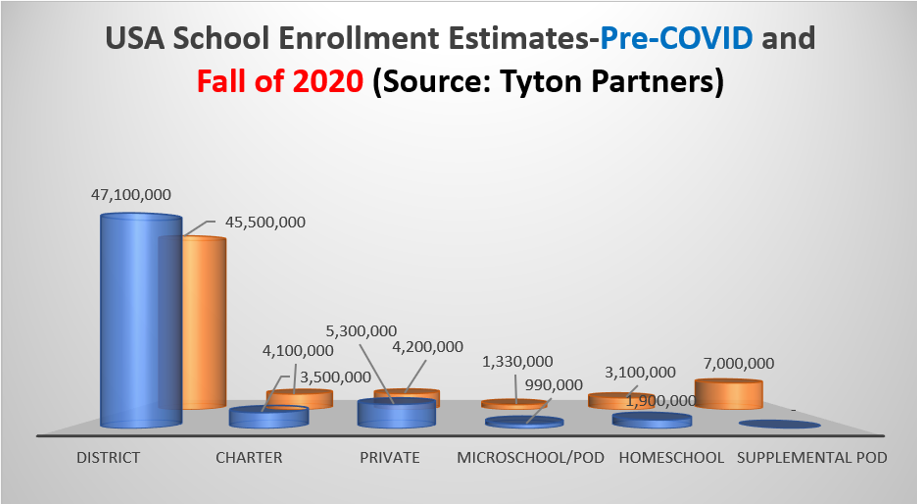
Not everyone however seems to have got the message:

And…
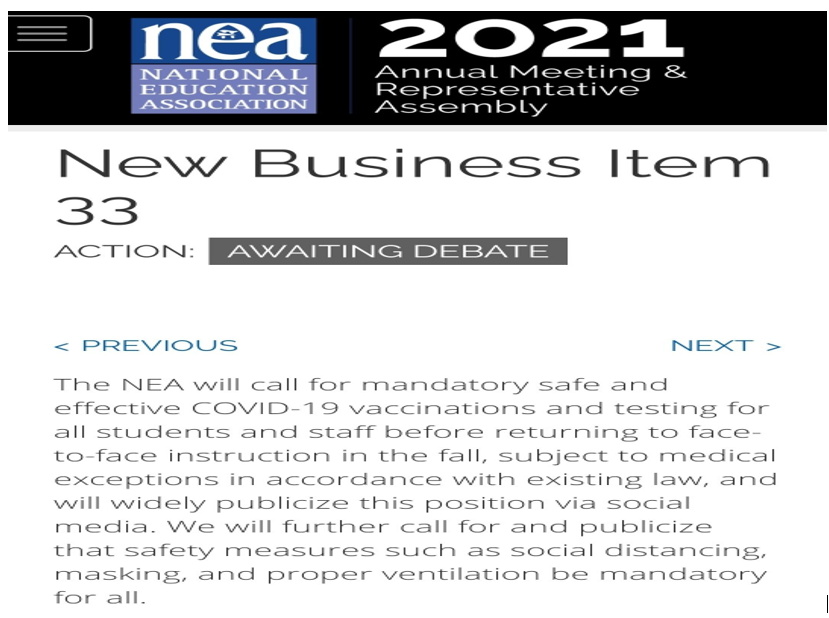
The Centers for Disease Control is allowing COVID-19 vaccines for children the age of 12 and older. While vaccinating children for COVID-19 would contribute to herd-immunity, it is worth recalling that children have been more likely to die from the normal flu than COVID and that school staff were among the first groups to access COVID-19 vaccines. The mere suggestion of disrupting another school year on such spurious grounds is a vulgar display of entitlement.
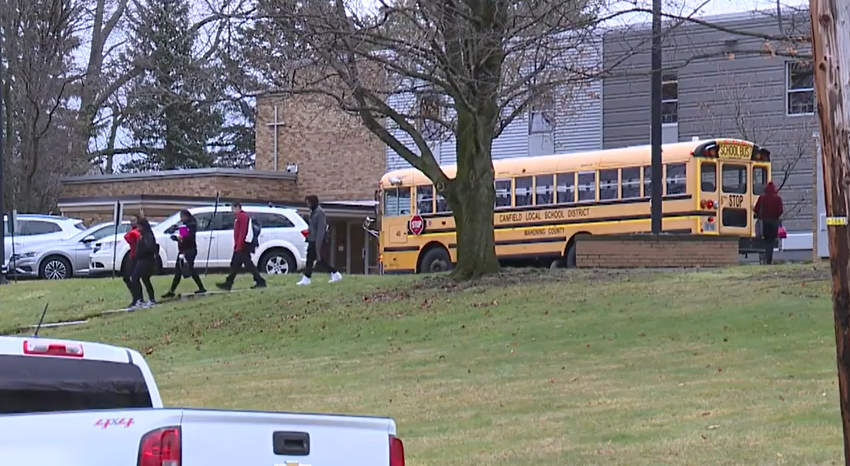
The Ohio Senate’s education plan for the state budget for 2022–23 would prioritize families’ needs and wants.
Editor’s note: this commentary from Aaron Churchill, the Ohio director for the Thomas B. Fordham Institute, appeared recently on the Institute’s website.
Across the nation, state lawmakers have been heeding the call for parents to have more control over their children’s education.
Recognizing that there is no “one-size-fits-all” model that meets every kid’s need, legislators have been actively strengthening school-choice policies and expanding options for families. Florida, for instance, recently expanded its nation-leading private school scholarship programs. Iowa just significantly improved its charter school law. West Virginia and Kentucky created brand-new educational savings account (ESA) programs that offer parents flexibility in how they meet (and pay for) their kids’ educational needs.
So far this year, Ohio’s education debates have paid scant attention to choice. Lawmakers have focused on technical issues with the school funding formula and overall spending levels. But that changed last week with the unveiling of the Senate’s education plan for the state budget for the fiscal years 2022–23 (HB 110). If enacted, its proposals would be a huge step forward in putting families’ needs and wants at the center of education policy. Here are highlights of the Senate approach:
Removes caps on the number of EdChoice scholarships available. EdChoice, the largest of Ohio’s scholarship programs, allows children from low- and middle-income households to attend private schools of their choice. The program has grown significantly over the past decade, but legislators have limited the number of available scholarships, which in the past has left some children in the lurch. The Senate plan would ensure that any eligible student applying for an EdChoice scholarship receives one.
Increases the EdChoice and Cleveland scholarship amounts. The EdChoice and Cleveland scholarship amounts have fallen well behind public school spending. Today, they’re worth just $4,650 in grades K–8 and $6,000 in grades 9–12, even as Ohio’s public schools spend on average $14,000 per pupil. The Senate plan narrows that gap somewhat by lifting these scholarship amounts to $5,500 and $7,500 in grades K–8 and 9–12, respectively. Importantly, it also ensures that in future budgets, scholarship amounts will automatically rise in proportion to any increase in public schools’ base funding. This provision would create more predictability and fairness for families that rely on these programs.
To continue reading, click here.
Founded in 1989, The Buckeye Institute is a non-partisan, non-profit research and educational institution that provides Ohio legislators and executive branch policymakers with ideas, research and data.
On Wednesday, Greg R. Lawson, a research fellow at The Buckeye Institute, an independent research and educational institution whose mission is to advance free-market public policy in the states, testified before the Ohio Senate Primary and Secondary Education Committee on a state spending bill.
In his testimony, Lawson outlined areas where the Senate can improve a proposed school funding formula to give families the resources they need to help their children succeed through adoption of education savings accounts to help students at every income level.
Here is an excerpt of Lawson’s testimony:
Speaker Bob Cupp and others have worked hard to meet that need, improve Ohio’s rickety school funding system, and lay a foundation for more education reform. Under the current school funding protocols, the state practically guesses at the per-pupil amounts needed to educate each child, with almost no reference to known inputs.
The new school spending plan proposed by the House uses a more transparent calculation of the actual costs to educate a student, and it moves away from the caps and guarantees for school districts that plague the current system. The House’s effort takes a solid first step in the right direction, but the Senate should address several concerns before declaring the House plan a success.
First, the new school funding plan ensures that the state’s K-12 education costs—already one of the largest budget line items—will continue to rise as the plan is implemented. But these rising costs are not fully funded by the budget, implicitly assuming that future general assemblies will act according to the plan. That assumption is dubious, leaving the state vulnerable to litigation if a future general assembly fails to fund the system, and casting doubt on the plan’s sustainability.
Second, the House underestimates the plan’s base costs by using three-year old teacher salary data from Fiscal Year 2018. Teacher salaries are sure to rise over time, making the plan’s true costs higher than advertised.
Third, the plan does not distinguish between base costs paid by the state and those paid locally. Without that distinction, local decisions to increase teacher salaries with locally raised dollars may then increase the state’s costs, too, because the per-pupil base cost formula uses the total cost of teacher salaries to determine the state’s share.
To continue reading, click here.
 Alabama: The Institute for Justice, a national civil rights law firm, says vouchers are constitutional in the state (Al.com).
Alaska: School choice opponents voice their concerns at a public hearing over a constitutional amendment to allow public funding of private schools (Anchorage Daily News, Nonprofit Quarterly). The proposed constitutional change passes the House Education Committee but the amendment faces a tough road ahead (Anchorage Daily News). There are 27 charter schools in the state with no cap on how many schools may operate (Alaska Dispatch).
Arizona: The state has many school choice programs (Camp Verde Bugle). A state court rules the Department of Education cannot recoup $5.9 million in over-payments to charter schools due to a change in teacher performance pay because it didn't notify the schools of the rule change (Arizona Republic). Charter school operators plan to open 25 new charter schools in Phoenix (Arizona Republic).
California: Parent trigger elicits emotions from parents on both sides (Hechinger Report). The superintendent of LA Unified says every "student has the right to a choice of a highly effective school" (Reason Magazine). San Diego school board members are attempting to exclude some charter schools from receiving bond money approved by city voters (Fox 5 San Diego).
D.C.: A new study reveals area charter schools are being shortchanged on student funding compared with district schools (Washington Post).
Florida: School choice is growing by leaps and bounds (Sunshine State News). The Palm Beach Post editorial board says giving students public school choice could reduce the disadvantages faced by low-income students. After 17 years as president and CEO of Florida Virtual School, Julie Young announces her retirement (redefinED, Orlando Business Journal). Gov. Rick Scott proposes allowing charter schools access to construction funds if they serve students within attendance zones of low-performing public schools (Tallahassee Democrat).
Georgia: A lawmaker wishes to expand the tax credit scholarship program with a $100 million cap (GPB News).
Illinois: Nobel charter schools name thee schools after donors who give $1 million or more, but the donors do not decide curriculum or which teachers to hire (Chicago Sun Times).
Indiana: The Lafayette Journal & Courier editorial board argues that private schools should continue to take the state test in order to create a fair comparison with public schools. Since vouchers can be worth no more than 90 percent of per-pupil state funding to local school districts, vouchers save the state money (Indianapolis Daily Star). Five voucher schools in the state say they teach intelligent design or creationism (Journal-Gazette). The Star Press editorial board worries that allowing students to use vouchers without ever attending public school creates two classes of education. (more…)

