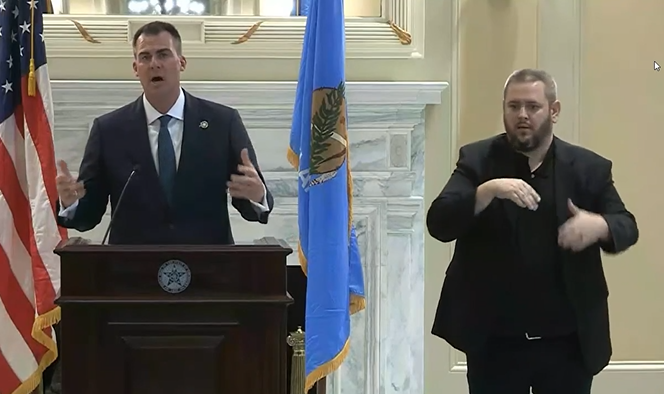
Oklahoma Gov. Kevin Stitt thanked Senate president pro tempore Greg Treat for his efforts to gain more school choice for families, adding that “it is deeply concerning” that so many of his colleagues voted against the proposed legislation.
Editor’s note: This article appeared Thursday on oklahoman.com.
A polarizing Oklahoma bill that would dedicate $128.5 million in taxpayer dollars for private school costs failed in a late-night vote on the Senate floor last week.
In a 24-22 vote, a majority of senators nixed Senate Bill 1647, called the Oklahoma Empowerment Act, effectively defeating the bill for this legislative session.
One of the most high-profile pieces of legislation this year, the bill stalled after two hours of debate and two more hours of waiting as Senate president pro tempore Greg Treat, the bill’s author, tried to flip a few Republican holdouts in a last-ditch effort to advance the measure.
Although the bill is dead, Treat told reporters Thursday he hopes to keep the concept alive in the coming weeks of negotiations.
“I don't know if I'll be successful this session or not,” Treat said. “The deck is stacked against me obviously right now. But the kids deserve it, and I'm going to use everything in my power to try to get it done.”
The defeat deals a blow to Gov. Kevin Stitt’s legislative agenda. The governor pledged to sign the bill and any others that would expand school choice.
To continue reading, click here.
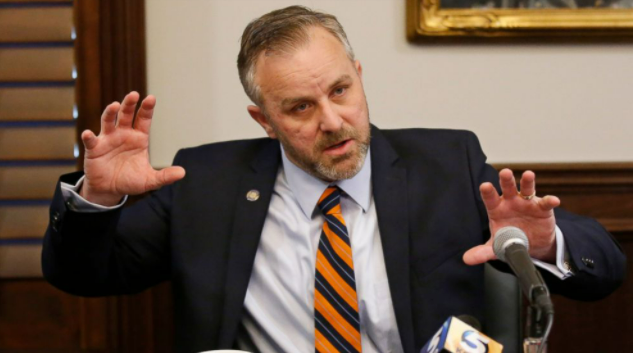
Oklahoma Sen. Greg Treat has introduced the Oklahoma Empowerment Act, which will allow parents to use their child’s state education dollars to pursue private school or cover enrichment expenses for homeschoolers.
Editor’s note: This article first appeared on the Oklahoma Council of Public Affairs’ website.
Senate President Pro Tempore Greg Treat has filed legislation that would provide school-choice opportunities to all Oklahoma families, allowing parents to use state funds to pay for their children to attend any school, including private schools.
If signed into law, the program would be one of the most robust school-choice programs in the nation and make Oklahoma a national leader in educational opportunity.
“Every child deserves the chance for a quality education that fits their unique needs, regardless of their ZIP code,” said Treat, R-Oklahoma City. “We’ve already empowered the parents of children with disabilities with this opportunity through the very successful Lindsey Nicole Henry Scholarship program. It’s time we give all parents and all students in Oklahoma that same opportunity for success.”
Senate Bill 1647, by Treat, declares, “It is the intent of the Legislature that parents, legal guardians, and others with legal authority over children in this state be able to seek educational services that meet the needs of their individual children by directing education dollars to follow each child. The Legislature affirms that parents and legal guardians are best suited to make decisions to help children in this state reach their full potential and achieve a brighter future.”
SB 1647 would create the Oklahoma Empowerment Account (OEA) Program. Under the program, any student eligible to enroll in a public school would be eligible for an OEA, which could be used to pay for a range of education services, including private-school tuition.
To continue reading, click here.
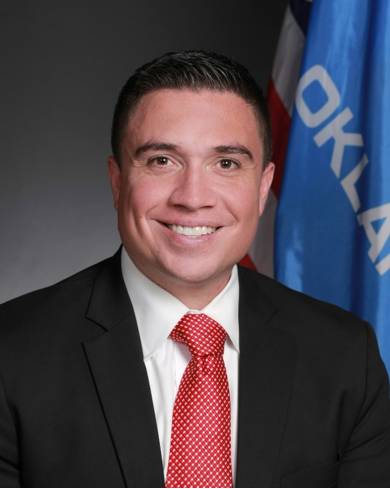
 On this episode, Tuthill talks to the District 39 representative from Edmond, Oklahoma, about education choice in that state and the recent legislative expansion that will allow thousands of additional families access to an Equal Opportunity Education Scholarship.
Martinez’s support of choice is personal. He believes it helped save his life and enabled him to be the first member of his family to graduate from college.
He discusses with Tuthill how Oklahoma’s education choice system benefits public and private schools alike and shares plans for future choice expansion, including the potential for an education savings account program.
"There's an adversarial relationship that if you're for education choice then you hate public schools. That's not the case at all ... I want to do everything I can to make sure we have a robust public education system ... This is good for public and private education."
EPISODE DETAILS:
 The Oklahoma House of Representatives on Thursday gave final approval to a bill which will expand the Oklahoma Equal Opportunity Education Scholarship Act in a 63-36 vote. The scholarship program offers tax credits to businesses and individuals that donate to scholarship-granting organizations and to public school districts that include charter schools.
Senate Bill 1080 would increase the amount of tax credits available for scholarship program donations from $3.5 million to $25 million per year. The amount available for donations to public schools would rises from $1.5 million to $25 million annually.
Jonathan Small, president of the Oklahoma Council of Public Affairs, praised Oklahoma policymakers for the expansion.
“Decades from now, when today’s children are adults, thousands of them will look back and know they were able to achieve great things thanks to the education made possible by lawmakers with this vote today,” Small said. “A quality education opens the door to a better life for all children, but especially those whose current circumstances are mired in challenges few of us can comprehend.”
Supported by the Oklahoma State School Board Association, SB 1080 further allows public schools with fewer than 4,500 students to apply for funds for “innovative educational programs.” Examples include robotics and STEM programs that prepare students for careers in science, technology, engineering and mathematics-related fields.
Two-thirds of the 2,500 students who currently benefit from Opportunity Scholarships are from low-income families.
Oklahoma Gov. Kevin Stitt said he is "thrilled" the bill awaits his signature.
“I will always fight for parents to be able to choose a school that best fits their child’s needs, regardless of ZIP code or income level,” Stitt said in a statement. “I look forward to signing SB 1080 into law.”

College Bound Academy, an Oklahoma charter school, prepares students in grades K-4 to graduate from college and access the career of their choice.
Editor’s note: This commentary is an exclusive to redefinED from Sean-Michael Pigeon, a student majoring in political science at Yale University. He works as a journalism mentor at a magnet school in New Haven, Conn. His writing has appeared in USA Today, the Washington Examiner and the Washington Times.
K-12 schooling is one of many things that has been dramatically impacted by the COVID-19 pandemic. Many traditional public schools across the country opted to teach virtually and some are still grappling with how to reopen. Many parents have turned to charter schools for more flexibility during this time of uncertainty.
Oklahoma families are among them. However, despite the fact that charter schools have provided a service equal to traditional public schools, public school officials are trying to strip them of equal funding.
For years, Oklahoma charter schools have been denied access to funding from property taxes, which puts them at a significant financial disadvantage. Epic Charter Schools, a self-paced, individualized program accredited by the state of Oklahoma, has been fighting for equal funding within the state board of appeals.
A 4-3 decision by the Oklahoma State Board of Education ended a lawsuit after four years of litigation, finally allowing public charters access to the same funding public schools have.
Oklahoma parents should welcome more competition and more choices for them to take control over their child’s education. In one decision, Oklahoma rejected the onerous one-size-fits-all policy for charter schools which, to this point, has been called “a damn mess.”
A bill introduced in the Oklahoma Legislature seeks to overturn this decision. The bill would restrict property taxes to only public schools while tying charter school funding to medical marijuana funds. Furthermore, in response to the Oklahoma State Board of Education’s decision, the Oklahoma City Public School Board of Education is taking legal action against the state.
In other words, Oklahoma’s public school apparatus wants to provide unequal funding to public charter schools, despite equal work.
Not only is this proposed policy unequitable in theory; it will harm students in practice. Property taxes have been used historically to fund schools because they are stable sources of income, and because they help tie a community around the local school. Revoking charter school’s access to stable sources of taxpayer money will limit the options for parents by treating charter schools like second-class educators.
But charter schools are not second-class educational institutions. In fact, they have responded admirably to the difficulties of remote learning. Oklahoma should follow South Carolina, which is increasing its contributions to well-run charter schools.
Others, like Travis Hutson of Florida’s seventh district, have introduced legislation which would help solidify charter school funding. His bill adds language ensuring that charter schools sponsored by a public university will be compensated “as if they are in a basic program or a special program in the school district.” Furthermore, the bill stipulates that this compensation must be appropriated from state funds.
Oklahoma lawmakers should look to the work being done in South Carolina and Florida as an exemplar for their own situation. Across the country, parents are rejecting the public school system and its administrative rigidity. This is a good, healthy, process that helps to cater to the unique needs of students.
The government should not play favorites, especially when it comes to children’s education. Upholding charter schools’ access to funding will help state leaders better serve the 105,000 school-aged children in Oklahoma. Rather than penalizing parents who opt for a more flexible teaching experience, they should uphold the legitimacy of their local schools.
Charter schools provide an equal education to public schools; they should be given equal resources.
 Alabama: The Institute for Justice, a national civil rights law firm, says vouchers are constitutional in the state (Al.com).
Alaska: School choice opponents voice their concerns at a public hearing over a constitutional amendment to allow public funding of private schools (Anchorage Daily News, Nonprofit Quarterly). The proposed constitutional change passes the House Education Committee but the amendment faces a tough road ahead (Anchorage Daily News). There are 27 charter schools in the state with no cap on how many schools may operate (Alaska Dispatch).
Arizona: The state has many school choice programs (Camp Verde Bugle). A state court rules the Department of Education cannot recoup $5.9 million in over-payments to charter schools due to a change in teacher performance pay because it didn't notify the schools of the rule change (Arizona Republic). Charter school operators plan to open 25 new charter schools in Phoenix (Arizona Republic).
California: Parent trigger elicits emotions from parents on both sides (Hechinger Report). The superintendent of LA Unified says every "student has the right to a choice of a highly effective school" (Reason Magazine). San Diego school board members are attempting to exclude some charter schools from receiving bond money approved by city voters (Fox 5 San Diego).
D.C.: A new study reveals area charter schools are being shortchanged on student funding compared with district schools (Washington Post).
Florida: School choice is growing by leaps and bounds (Sunshine State News). The Palm Beach Post editorial board says giving students public school choice could reduce the disadvantages faced by low-income students. After 17 years as president and CEO of Florida Virtual School, Julie Young announces her retirement (redefinED, Orlando Business Journal). Gov. Rick Scott proposes allowing charter schools access to construction funds if they serve students within attendance zones of low-performing public schools (Tallahassee Democrat).
Georgia: A lawmaker wishes to expand the tax credit scholarship program with a $100 million cap (GPB News).
Illinois: Nobel charter schools name thee schools after donors who give $1 million or more, but the donors do not decide curriculum or which teachers to hire (Chicago Sun Times).
Indiana: The Lafayette Journal & Courier editorial board argues that private schools should continue to take the state test in order to create a fair comparison with public schools. Since vouchers can be worth no more than 90 percent of per-pupil state funding to local school districts, vouchers save the state money (Indianapolis Daily Star). Five voucher schools in the state say they teach intelligent design or creationism (Journal-Gazette). The Star Press editorial board worries that allowing students to use vouchers without ever attending public school creates two classes of education. (more…)
Alabama: The Alabama Education Association sued to stop the state's education tax-credit program but a parent steps forward to try and block the suit with the help of the Institute for Justice (Associated Press).
Arizona: The Friedman Foundation for Educational Choice surveys parents using education savings accounts and finds they're happy with the program (Friedman Foundation).
Colorado: Two internet radio talk show hosts speak in Douglas County against school vouchers and "corporate" education reform (Lone Tree News).
D.C.: The government shutdown threatens the funding of the District's public school system including charter schools (Washington Times).
Florida: Tampa Bay area private schools are seeing enrollment growth thanks to a rebounding economy and school choice (Tampa Bay Times). GEICO donates $2 million to Step Up For Students, the non-profit that operates Florida's education tax-credit scholarship program for low-income students (PR Web). The McKay scholarship program serves 27,000 special needs students in Florida (Tallahassee.com). A group is suing the state to get more money for public schools, saying it is unfair to devote resources to charter and virtual schools (Miami Herald). Florida Virtual School wins the first round of court battles against K12 Inc. over trademark violations (EdWeek).
Georgia: Atlanta area KIPP charter schools received a group charter allowing them to pool resources (Atlanta Journal-Constitution).
Indiana: The state could be the No. 1 state for school vouchers if the growth continues (Indianapolis Star). Gov. Mike Pence talks education reform and school choice at the Education Nation summit (WNDU.com). A state report says voucher schools outperform the public schools but it is still unclear if the voucher schools are creating a bigger impact per student (Associated Press).
Iowa: A new survey by the Friedman Foundation shows a majority of parents in Iowa support having a school voucher program (Quad City Times, Waterloo Cedar Falls Courier). One local newspaper columnist calls school choice "insidiously popular" (Daily Iowan).
Louisiana: The state's voucher program actually promotes desegregation (National Review). A Ruston area private school that was kicked off the voucher program sues, claiming discrimination (The Advocate). Parents in Lafayette protest two charter school operators seeking authorizing in the parish (KATC.com). (more…)

