 District boundaries are not racially neutral, nor are the decisions made by districts on whether to participate in open enrollment. American housing patterns are quite segregated by income and race, so ZIP code assignment to schools will naturally reflect those patterns.
An important way to improve education outcomes and potentially school integration is to allow students to attend public schools without regard to their ZIP codes.
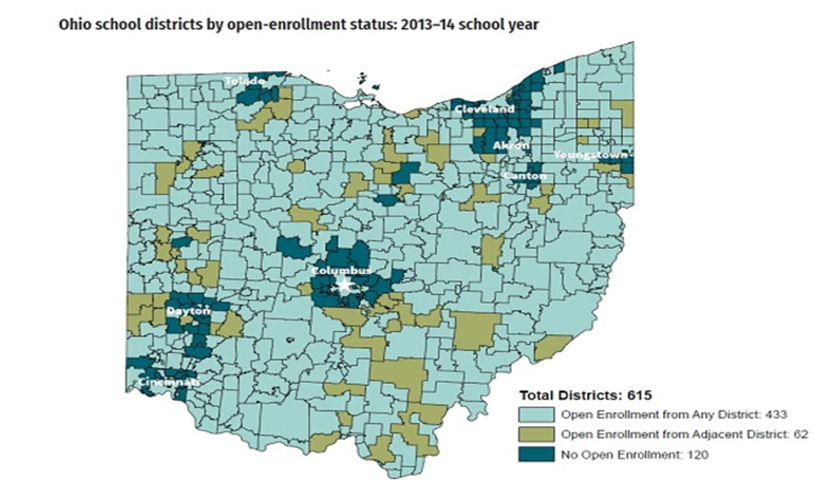
The Fordham Institute has created a school district map of Ohio, coloring districts according to whether they participate in open enrollment.
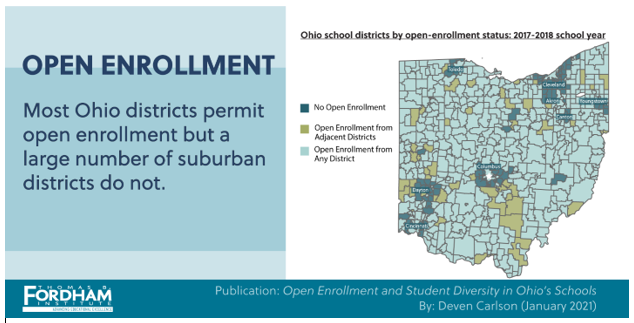
Districts colored dark blue have chosen not to participate in open enrollment, allowing no students from outside the district to attend. Districts colored green allow open enrollment but only for students who reside in adjacent districts. Districts colored pale blue allow open enrollment from any Ohio district.
All of Ohio’s large urban districts find themselves either entirely surrounded by suburban districts that choose not to participate in open enrollment, or nearly so. Notice as well that some of the exurban districts choosing to allow only adjacent district students to enroll sometimes look more than a bit calculated to keep out the urban kids.
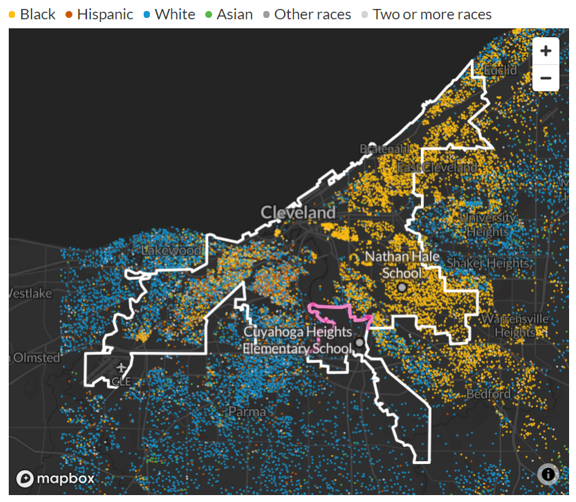
Suburban open enrollment policies have profound implications for the segregation of schools. Cleveland, for instance, is surrounded by districts not choosing to participate in open enrollment. The Urban Institute created a tool reveal the race of the under 17 population across metro areas.
Here is the map for the Cleveland region, which shows Black students in yellow and white students in blue. Rarely the twain shall meet.
Ohio suburban districts have offered up the claim that rapid population growth precludes them from participating in open enrollment. While this is doubtlessly true in some cases, those districts really should avoid making broad claims that can so easily be refuted.
Parma, for instance, is one of the districts shown on the map with a predominantly Anglo student body. It enrolled 13,197 students during the 2000-01 school year and 9,711 in 2019-20. Lakewood, the other predominantly Anglo suburban district, enrolled 7,538 students in 2000-01 and 4,814 in 2019-20. Neither district participates in open enrollment.
A spokesperson for the Alliance for High Quality Education, a group composed primarily of suburban Ohio school districts, was interviewed on Columbus National Public Radio and speculated (implausibly) that suburban Cleveland districts did not participate in open enrollment because they were “land-locked.”
If you feel like wincing, knowing that the interview was recorded in 2021, you can listen here. The Fordham Institute’s Chad Aldis relates that Black students gain the most from open enrollment but find themselves largely locked out. The Alliance spokesperson then make a series of lame arguments, noting among other things that 80% of districts participate. What you need to know is that “participate” does not always mean “take kids from urban areas,” and the urban areas are surrounded by non-participants).
Additionally, the Alliance spokesperson claims that districts will have trouble estimating capacity to take open enrollment, yet plenty of districts in other states mastered it long ago, along with 80% of Ohio districts currently.
He also claims that the non-participating districts have trouble estimating demand for future seats for students returning from parochial schools, but again, other Ohio districts participate and have parochial schools.
All of this reminds me of Jake Blues explaining why he left his former fiancé at the altar.
Luckily, the Ohio Legislature opened up private and charter choice last session, and hopefully it will encourage Ohio suburban districts to participate. So, let’s not pick exclusively on Ohio, as this is a widespread problem.
If you squint at the Urban Institute-colored Cleveland map long enough, you can see some blue dots within Cleveland-integration! But not so fast my friend; within district boundaries, you can segregate just as much as those between districts.
Consider this map included in a recent Education Next story.
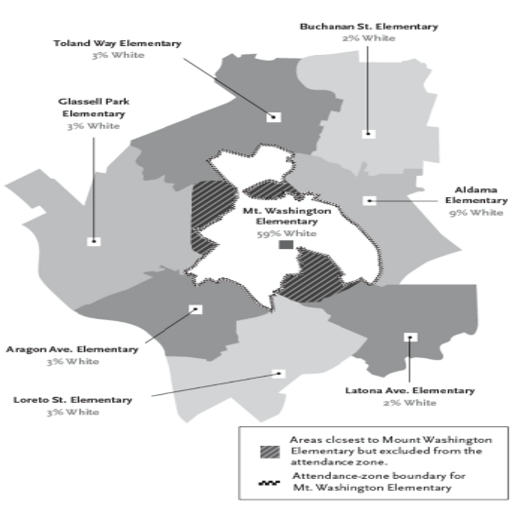
Those are some very carefully drawn school attendance boundary lines.
Oregon nativists made it illegal for parents to send their children to private schools in the early 1920s, but the U.S. Supreme Court struck the measure down as unconstitutional, saying, “The child is not the mere creature of the state; those who nurture him and direct his destiny have the right, coupled with the high duty, to recognize and prepare him for additional obligations.”
Children are not the mere creatures of school districts either, and they should have as many options as possible in schooling.

Buckeye Central Schools, a school district in Crawford County, Ohio, that serves more than 600 students in prekindergarten through twelfth grade, is among districts in that state that participate on open enrollment.
Jay Greene and James D. Paul gathered data for a new study for the American Enterprise Institute released Sept. 22 demonstrating that Democrats in state legislative chambers have only rarely made the difference in passing original private choice legislation nationwide.
The authors make the case that choice supporters have erred in seeking constrained and overly regulated programs in search of Democratic support which failed to meaningfully materialize. While they note that the choice movement needs all the support it can get, they fear Republican votes are being taken for granted. Ultimately, Greene and Paul call for private choice bills with universal eligibility and moderate levels of regulation.
My preferences also run toward universal programs with moderate levels of regulation. I think the Greene-Paul case deserves consideration, debate and reflection.
Whether or not one agrees with Greene and Paul’s conclusions, I believe there is an alternate case to make: Constrained and overly regulated private choice programs have only a limited ability to achieve policy goals that liberals, libertarians and conservatives tend to share.
Americans want public schools to teach necessary academic knowledge and to prepare students to exercise the responsibilities of citizenship as adults. Americans also want public schools to serve as engines of social mobility. They’ve been getting too little of any of that for decades. The unions want to max out the number of district employees to expand their membership, money, influence and power. There has been plenty of that going on for decades and too little to show for it.
K-12 choice is a tool which can give the public more of what they want from the education system. It also is respectful of pluralism. Once you get past the broad academic and civic goals, agreement about education quickly falls apart in the abstract. Individual children vary wildly in their interests and needs and thus can benefit from access to a diverse and specialized set of schools.
Ohio Republicans have passed multiple choice programs since 1995 and focused their efforts on the areas of greatest academic need: Cleveland students, students in failing schools, students with special needs, charter schools with geographic limits. Each of these were entirely worthy efforts.
This year, however, they embraced a number of more inclusive measures, in part, I believe, because the Fordham Institute found and documented the fact that students in every major urban district in Ohio find themselves surrounded, or nearly surrounded, by suburban districts that will not accept open enrollment transfers.
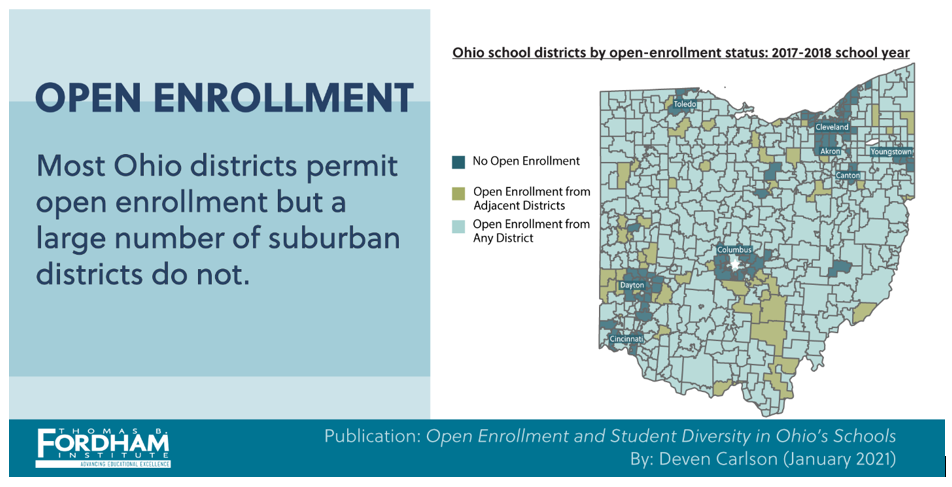
Whether you are a conservative, a liberal, a libertarian or a vegetarian, this map should disgust you as an American.
It apparently disgusted Ohio lawmakers, who took away geographic limits on charter schools, passed a new universal choice program, and improved existing choice programs. If suburban districts want to continue to deny open enrollment opportunities, they will have to do it with fewer students in the future.
K-12 choice deserves bipartisan support, and as Greene and Paul demonstrate, has received too little of it. We should include suburban and rural students in choice programs. They pay their taxes, they have unmet needs.
Our egalitarian desire to give advantage to the poor should be reflected in funding levels rather than in eligibility. No one would ever dream of denying a student access to a university because his or her parents paid too much in taxes. Levels of financial aid routinely vary, however. We should be worried about the sustainability of Republican support if our programs do not include their communities. Those communities pay for the programs; they should have the opportunity to participate.
We should most of all seek inclusive and diverse programs because (ironically) those are the programs that can best serve the interests of the poor. If you want to serve the interests of poor and urban students, yes, give them charter schools. Yes, give them education savings accounts, vouchers and/or education tax credits. It ultimately is untenable to ask suburban and rural voters to pay for such programs and then have them find themselves excluded from participation.
You also, however, want to create incentives necessary to give them access to suburban public schools. Limited, targeted programs won’t be equal to such a task.
The school choice programs that have passed to date usually did not need bipartisan support. A much stronger, impactful, inclusive movement can, however, achieve this and much more.
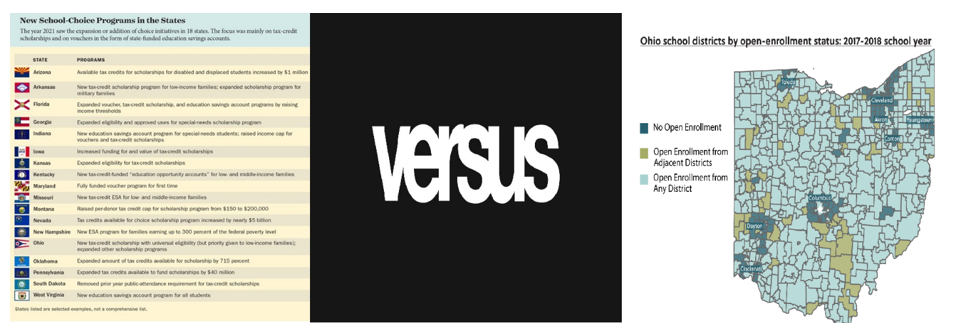 A few years ago, the Thomas B. Fordham Institute documented that the vast majority of Ohio suburban districts did not allow open enrollment transfers from urban districts. Pity the poor children of Cincinnati, Columbus, Cleveland and Dayton as depicted above on the left-hand side of the map, who are surrounded by districts choosing not to participate in open enrollment.
The Ohio legislature, however, took steps in 2021 to set them free.
Ohio stands in stark contrast to Arizona, where almost all school districts allow open enrollment transfers. Ohio had restricted charter schools to urban areas, whereas Arizona’s charter school sector is inclusive and diverse across communities including urban, suburban and rural areas, creating a powerful incentive for districts to put the “open” in “open enrollment.”
Likewise, Ohio’s private choice programs have been focused on urban schools, whereas Arizona’s private choice programs included both targeted and universal eligibility. Almost all Arizona districts participate in open enrollment.
This year, the Ohio legislature took notice and removed geographic restrictions on charter schools and created new and improved existing choice program. The Fordham Institute summarized the change in charters:
Families deserve the opportunity to find a school that’s the best fit for their child, regardless of where they live. And that’s not just pie-in-the-sky, wishful thinking, either. It’s possible. In Arizona, charter schools have long been available to every family regardless of geography, including those who live in affluent, high-performing suburban districts. This open environment has fostered some of the highest-performing charter schools in the country, and has produced high levels of academic growth for both district and charter schools. By eliminating geographic boundaries for new charters, Ohio lawmakers have removed a critical barrier to access and have brought the state one step closer to models like Arizona.
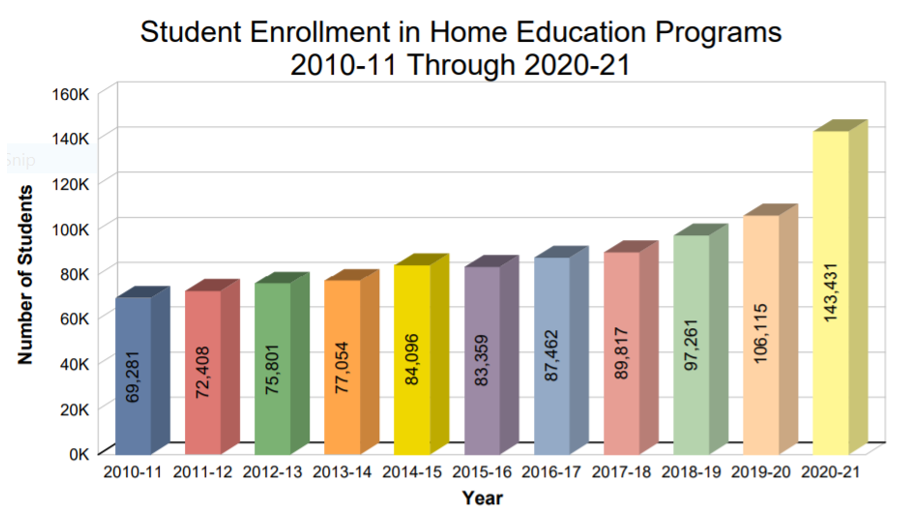
Ohio lawmakers were not alone. Policymakers in Florida, Indiana, New Hampshire and West Virginia also took very strong action on private choice. Private choice programs, however, may play only a supportive role in getting suburban district schools to get more interested in open enrollment. Consider, for instance, the 35% increase in Florida home-schooling in 2020-21.
A 35% increase is impressive, but Tyton Partners forecast a 50% increase in micro-school attendance in the fall 2021, from 1 million to 1.5 million. Note for the record that it took the national charter school movement approximately 17 years to reach 1.5 million students.
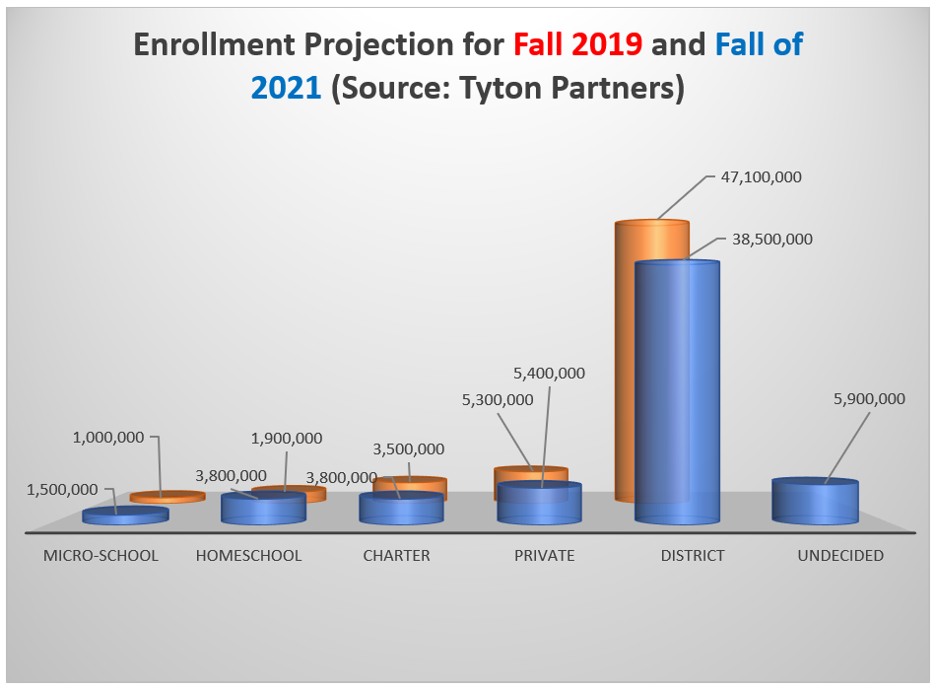
Finally, the United States has had a baby bust going since 2007, and if you guessed that a global pandemic wouldn’t help matters, give yourself a gold star.
But take heart. None of this means public education is doomed. Far from it, in fact.
The federal money printing presses will take the sting off in the short run. In the long run, suburban district schools becoming choice players will have a very positive impact on academic growth. The economic segregation underlying what the map of Ohio shows cannot be defended. An over-built and underperforming school system faces a rough go of things once COVID dollars expire.
A more effective future awaits after families decide which schools to favor and which to avoid. A more humane system of K-12 education beckons, but it will be a rough ride getting there.
Fasten your seat belts.

The Irving (Texas) Independent School District in the Dallas-Fort Worth area, which serves approximately 33,000 students across 37 schools, is one of several districts in the state that offer open enrollment.
While public school systems nationwide have had difficulties dealing with COVID-19, specifically around reopening classes to in-person activities, it’s clear the pandemic has opened many avenues for innovation. One example has come out of Colorado, where school administrators have opened public school enrollment to great success.
A recent Chalkbeat report found that Colorado has embraced public school open enrollment to great effect, with more students taking advantage of the opportunity to cross zoning lines than ever before, resulting in a 9% increase in students moving across districts.
The distribution of students attending schools outside their districts is not evenly distributed. In fact, the districts most likely to lose students to competing schools saw even greater decreases in enrollment. Unsurprisingly, a generally reciprocal increase in more desirable schools was found, too. Chalkbeat reports:
Where students went didn’t change much, though. The districts that already had high numbers of out-of-district students had even more this school year, and those districts that typically lost a lot of students to other districts continued to see that.
Colorado is not alone in pushing for open enrollment. States that have made similar pushes have found similar results. In Texas, the Reason Foundation found that parents sent their children to higher-performing districts when open enrollment was expanded:
Our analysis finds that three percent of Texas students transferred to a traditional public school outside of their assigned school district in the 2018-2019 school year.
These students tended to transfer to higher-performing school districts as measured by state accountability grades. In 2018-2019, roughly 45,000 Texas students transferred to a higher-performing school district at least a letter grade above their residentially assigned district.
The fact that open enrollment accelerated the trend of parents sending children to higher-performing districts indicates two things.
First, it shows that parents know their child’s district is underperforming. Parents must be able to identify good schools for open enrollment to fully flourish, and so this is a positive sign. Furthermore, it provides evidence that many parents had sent their children to local schools in previous years because zoning laws forced them to do so. It’s unlikely that open enrollment districts would return to stringent zoning laws.
Second, the fact that parents continued to send their children to districts that already were accepting more out-of-district students shows that higher-performing districts can maintain high academic rigor. If this were not the case, the trend would either start decreasing or reversing. But neither is happening. This is important because research suggests a school’s academic quality is the primary driving factor in open enrollment flows.
While Texas and Colorado are taking the right steps toward accommodating open enrollment, there is still much work to do. The good news is that 47 states allow some type of open enrollment. Unfortunately, the specifics and ease of these transfers vary greatly between states and districts. The variety is so great that a table provided by the Education Commission of the States is shockingly byzantine.
Some states have specific desegregation criteria that affect enrollment ability while others charge for moving across district lines. In other cases, the distance one must travel between schools is taken into account. Some states have mandatory inter-district open enrollment, while others allow only intra-district movement.
While these concerns may seem important to public school administrators, for parents, such regulations are unwieldy. Asking parents to go through arduous protocols to send their child to a school they know is better creates an adversarial relationship between parents and administrators. Students get caught in the middle.
Colorado has done the right thing by expanding criteria for public school enrollment. The move toward open enrollment has been beneficial for many Texas parents as well. More districts in the Lone Star state are following suit, and the number of children enrolling in schools of their choice is growing across the country.
Expanding open enrollment opportunities is a critical victory for students and parents alike. For students, it paves the way for higher educational achievement. For parents, it provides flexibility and peace of mind that their child is succeeding. While it may put pressure on administrators to deal with fluctuations in enrollment numbers, it is a worthwhile sacrifice if it benefits the student body.
We owe it to our kids to give parents the opportunity to enroll in the school of their choice through the vehicle of open enrollment.
 They say a picture speaks a thousand words, so get ready to read fast!
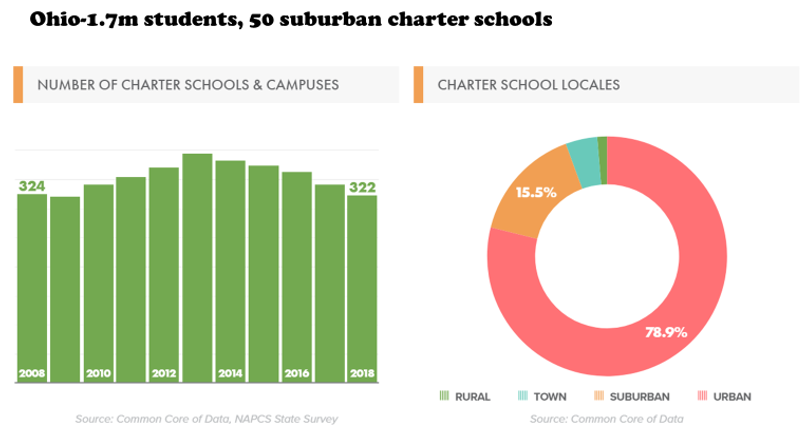
First, this from the National Alliance for Public Charter Schools Dashboard on Ohio:
 Now, the Fordham Foundation’s map of Ohio open enrollment (non)-participation by district:
 And next, the National Alliance for Public Charter Schools dashboard on Arizona:
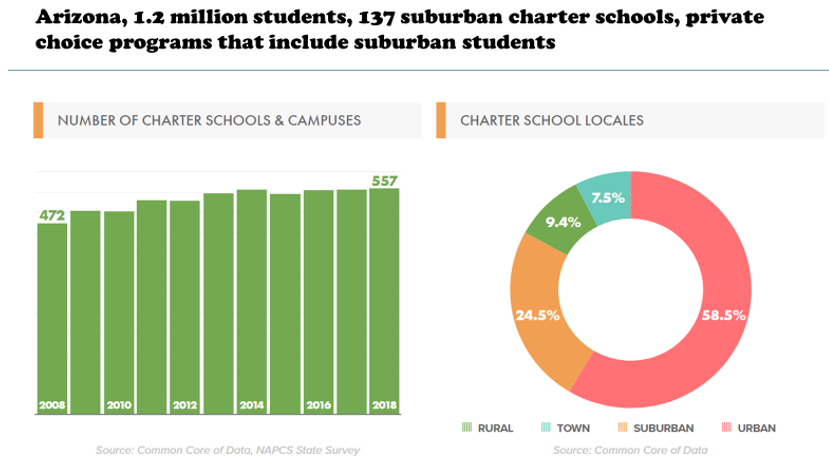 Okay, following the story so far? Fifty suburban charters are way too few to create the incentive for Ohio’s suburban districts to participate in open enrollment. Arizona has a far larger number as well as private choice programs with broader geographic reach.
Now, here is an open enrollment district map of Arizona with non-participating districts indicated in dark blue, as they are on the Ohio map above:
 Okay, that was a slight exaggeration, but only slight. Right about now, 4,000 students in the Scottsdale Unified School District are there through open enrollment, and there are approximately zero, not only in Lakewood, Ohio, but pretty close to every suburban Ohio district.
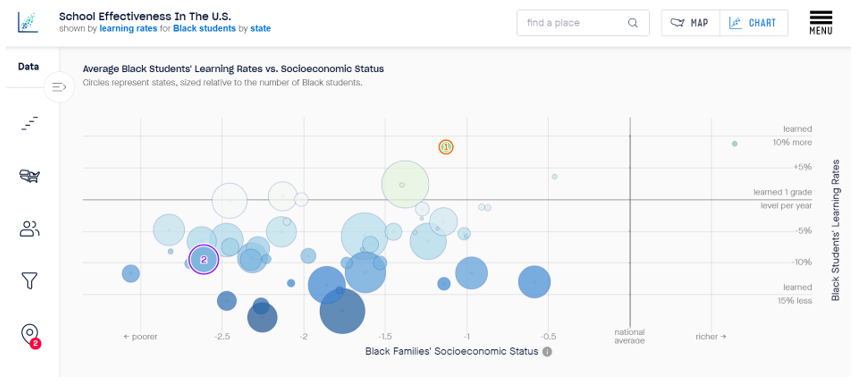
Ohio followed the strategy of focusing choice programs on urban areas for the opening decades of the choice movement. Arizona, meanwhile, created a more inclusive and diverse movement that included suburban and rural communities. How did this work out for disadvantaged students in each state? The Educational Opportunity Project at Stanford University details growth rates for Black students (Arizona = 1, Ohio =2) between 2008 and 2018:
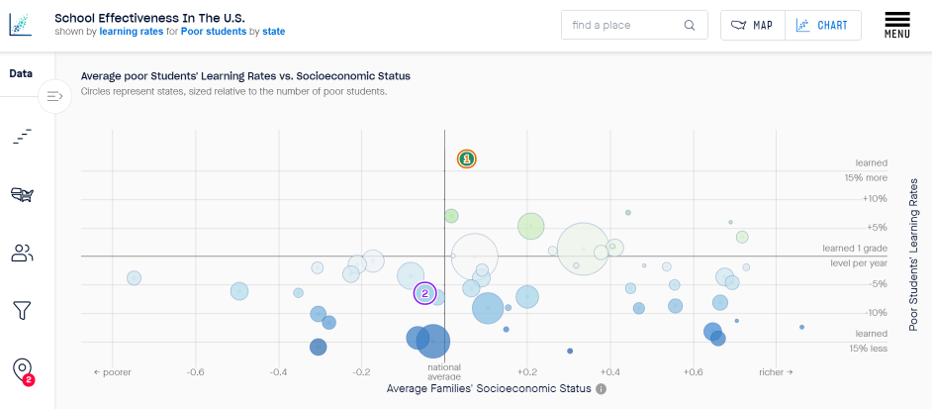
 Still skeptical? Here is the same chart for low-income students:
 I think I still detect a slight hint of doubt in your mind, which just earned Ohio another beating, this time with Hispanic students:
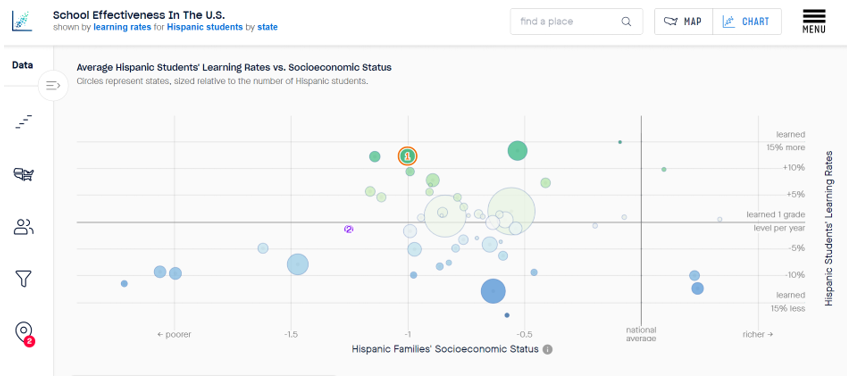 Don’t giggle too much watching Arizona put a whooping on Ohio, because regardless of where you live, Arizona probably could do something as bad or worse compared to your state during this period. We’ll have to see what happens going forward. I’m only picking on Ohio because the Fordham map documents what is broadly the case elsewhere: economic segregation in schooling is a problem.
I made this mistake like everyone else. For many years I repeated the phrase, “the suburbs already have choice.” I was wrong about that.
I’ve learned my lesson: Inclusive choice programs create open enrollment opportunities that turn the choice knob to 11, and the main beneficiaries are disadvantaged students.

Long-time education choice advocate Karla Phillips-Krivickas and her daughter, Vanessa
For 25 years, Arizona’s open enrollment law has allowed families to send their children to any public school they choose, even those outside their local school district. Yet open enrollment has remained out of reach for many students with disabilities.
That’s because while the state’s open enrollment law allows districts to establish and implement necessary policies, many of which guide efforts to determine capacity, these policies and capacity determinations are frustratingly limiting and opaque for the families of students with special needs.
Arizona Gov. Doug Ducey acknowledged this shortcoming in his 2021 Policy Book, saying, “The way we do open enrollment at school districts across the state is overdue for reform. It’s time to make it truly open for all.”
Lawmakers responded this year by introducing comprehensive legislation to remove obstacles families can face when seeking open enrollment and improving transparency in how districts determine capacity and approve applications.
The bill also specifically prohibits schools from limiting admission based on ethnicity or race, national origin, sex, income level, disability, English language proficiency or athletic ability. Correspondingly, schools will be prohibited from requiring the submission of any documentation other than that which demonstrates a pupil's age and residency. This includes any special education documentation.
Parents can — and will — select the best school for their child
Opponents of the bill argue that districts should be able to determine the services a student with a disability would need prior to admission. They claim the districts’ inability to preview all special education documentation is somehow a disservice to the child and family.
Unfortunately, evidence shows the disclosure of these materials has led to high rates of rejection for students with disabilities. It also furthers the idea that only the school administrators will know if a school is a good fit for a child, not the parents who requested enrollment at the school in the first place.
This idea presumes parent incompetence, something I personally find a bit insulting.
Parents know their children best. And since parents of students with disabilities have spent years advocating for their kids (often since birth), we are quite adept at researching and locating the services our students need. Moreover, the law is very clear that it is not the school that determines a student’s needs but rather an Individualized Education Program Team—which includes the parents.
The bill still allows school districts to establish a timeline for their open enrollment process with deadlines that allow sufficient time to determine all incoming student needs.
The bill’s opponents have voiced concerns of already diminished resources and shortages of critical personnel, but these problems are statewide, indeed nationwide, and the movement of students doesn’t change that. In fact, if a student moves into a district, the same dilemma exists, regardless of the student’s needs or how much advance notice the schools are given.
While there are shortages of many critical positions in education, it’s not — quite honestly — a family's problem to solve; nor is it specific to special education. And the parents of students with disabilities shouldn’t be the only ones asked to shoulder that burden.
Prioritize students, not programs
The bill specifies that enrollment capacity should be determined primarily by grade level. Though districts can calculate capacity for “specialized programs,” the legislation clarifies that these do not include special education programs.
This is important because districts are using “program” enrollment caps to reject the enrollment of special education students even when those students’ parents are requesting enrollment in a regular classroom and not a special program. The word “program” has never been questioned until now.
The “quality specialized special education programs” that experience limited capacity are segregated, self-contained classrooms. But most special education students spend the majority of their day in general education classrooms.
At the core of federal special education law is the priority of “least restrictive environment.” Under this policy, school districts are required to educate students with disabilities in regular classrooms with their nondisabled peers in the school they would attend if not disabled, to the maximum extent appropriate. Consequently, it is discriminatory for any school to presume placement in any type of program simply by a disability diagnosis.
And, at the risk of going too far into the weeds, I must point out that in special education, the term “program” commonly refers to the Individualized Education Program, not district-created, aggregated programs. As a result, it is impossible to determine capacity outside of anything but grade level.
All families deserve choice
Federal law is clear that special education is a service, not a place, and that programs are to be individualized. If Arizona is going to offer public school open enrollment, then it must be a real option for all students.
All we are asking for is equal opportunity under the law for our children.
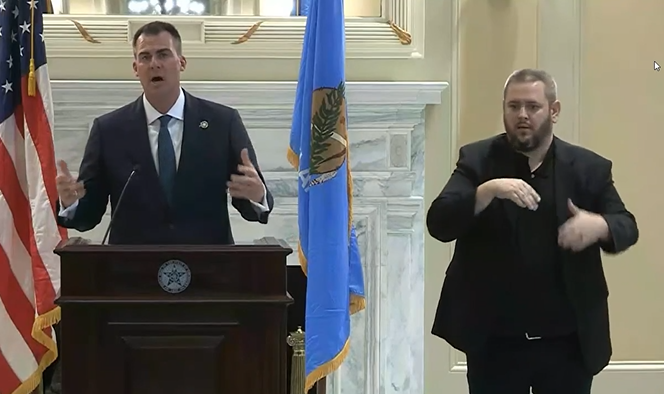
Oklahoma Gov. Kevin Stitt, left, speaking in favor of expanding education choice opportunities for families.
Oklahoma has become the latest state to adopt education choice legislation following Gov. Kevin Stitt’s signature Wednesday on two reform measures.
House Bill 2078, which passed the Senate 27-19, changes the formula for distributing state aid to Oklahoma’s public schools. Senate Bill 783, which passed the House 65-30, removes most barriers to student transfers among districts at any time during the school year as long as those students meet discipline and attendance standards and the receiving school has room for them.
Stitt called Wednesday “a monumental day for education reform in Oklahoma,” noting that education is not one-size-fits-all.
“These bills allow parents and students to have the freedom to attend the best public school for them regardless of their ZIP code,” Stitt said. “Additionally, modernizing the funding formula ensures funding follows the student, not the school. These reforms are vital to getting Oklahoma to be a Top 10 state in education, and I am proud of this Republican legislature for its dedication to putting students first.”
Oklahoma Secretary of Education Ryan Walters called the bill signing “historic.”
“We have transformed funding for every single student in the state and empowered them to choose a school that best fits their needs,” Walters said. “These two bills will work seamlessly together to have an immediate impact on the way we educate Oklahoma’s students and I commend our state leaders for getting this across the finish line.”
The state’s major education associations opposed both bills. One critic charged that the true intent of the bills is to allow Stitt and legislative leaders to claim education reform victories without putting any money into the system.
 Editor’s note: Jude Schwalbach, a research associate in the Institute for Family, Community and Opportunity at The Heritage Foundation, wrote this commentary expressly for redefinED.
For a century, public schools have been billed as the center of a community, with Friday night football games, clubs, theater, and arts activities. But not all students have access to these “community” schools.
Within school districts, most public schools have attendance zones determined by district officials. These “lines within districts,” as author Tim DeRoche describes them, mean all families that reside within the geographic boundaries of the attendance zone are assigned to the public school in that zone. These zones, however, often divide communities by race, socio-economic divisions, and social capital.
In his book, A Fine Line, DeRoche illustrates how much school zones can affect the make-up of a school’s community. For instance, students attending Mount Washington in Los Angeles during 2019 lived in a zip code with a median home value of $847,522. Mount Washington Elementary is ranked a B+ school on Niche.com – a school rating website – with nearly 68% and 75% of students meeting or exceeding state standards in math and reading, respectively.
Meanwhile, just a little more than a mile away, Aldama Elementary School’s student body lives in a zip code where the typical home value is $47,000 less than in Mt. Washington’s zip code. Niche ranked the school a C school, with only 33% of students meeting or exceeding state standards in both math and reading.
At the same time, each school’s number of eligible students for the Free Lunch and Reduced-Price Lunch Programs — historical poverty proxies—illustrate a marked difference in student body. More than 70% of Aldama Elementary students — nearly seven times the number of eligible students at Mt. Washington — are eligible for the Free and Reduced-Price Lunch program.
Depending on which side of the boundary line a student lives on, she will be assigned to either Mount Washington or Aldama — likely having a significant impact on the educational opportunities available to her.
Even though students who attend Aldama and Mount Washington are in the same school district, paying the same property taxes to support all public schools within the district, government officials draw lines around which “public” schools they may attend. This hardly seems fair.
The school zone boundaries sharply divide families that live literally next door to each other. Which side of the street a family lives on can determine the educational opportunities fostered by their “free” public school.
Unfortunately, this phenomenon is all too common; families in cities across America, such as New York, Los Angeles, Dallas, Philadelphia, and Chicago, to name a few, find themselves in similar situations.
For example, in 2019 the Senate’s Joint Economic Committee reported that enrollment in a high-performing public school and greater educational opportunities is often associated with purchasing a more expensive home.
The committee’s report found that “The average U.S. zip code associated with the highest quality (A+) public elementary school has a 4-fold ($486,104) higher median home price than the average neighborhood associated with the lowest quality (D or less) public elementary schools ($122,061).”
At the same time, the gerrymandered nature of school zones means that in many cases some children assigned to a poorly performing school actually live closer to a higher performing school.
For instance, children living between San Adreas Ave and Oneonta Dr. in Los Angeles are closer to the high-performing Mt. Washington Elementary — just a 15-minute walk — but are assigned to the lower-performing and more distant Aldama Elementary.
“No matter the goal, an attendance zone always creates sharp inequalities of opportunity for families who live in the same neighborhood. Some children will be allowed to enroll in the best public schools, and their playmates across the street will be excluded because of where they live,” writes DeRoche.
School zones can divide communities, shepherding children from different social and economic backgrounds into different schools. Such divisions are antithetical to the free and voluntary collaboration essential to American institutions.
Instead of assigning students to schools based on attendance zone boundaries, school districts should stop drawing attendance zone boundaries and instead adopt open enrollment policies, which would allow students to enroll in any school within their school district. Open enrollment, Heritage’s Lindsey Burke and Jonathan Butcher write, “effectively separates housing from schooling.”
However, Burke and Butcher note that even though 47 states in addition to the District of Columbia already allow some type of open enrollment policy, many school districts choose to not participate.
For instance, Alaska only requires that school districts provide open enrollment to students in persistently dangerous schools. By contrast, families in Florida can enroll their children in any school operating in the state’s 67 districts that is not at full capacity.
Expanding open enrollment to benefit all children would mean all children within a district have equal opportunities to attend public schools that are the right fit for them.
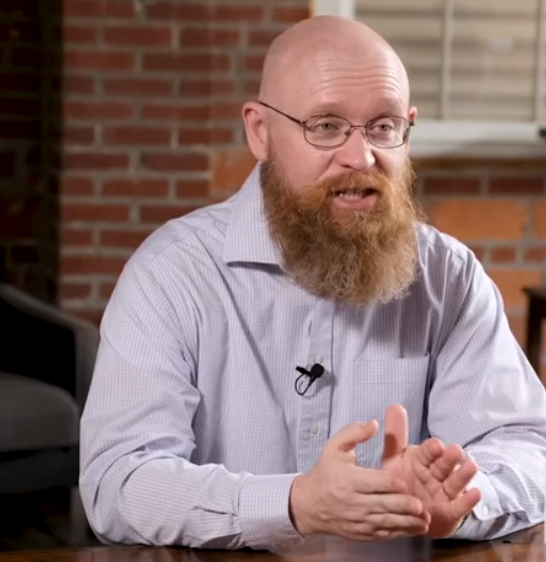 In this podcast video, redefinED’s executive editor speaks with longtime education choice advocate Chad Aldis, vice president for Ohio policy and advocacy at Fordham, wo previously served as executive director of School Choice Ohio and was Ohio State director for StudentsFirst.
Ladner and Aldis discuss a recent Fordham study that mapped out open enrollment policies across Ohio after some media outlets questioned whether open enrollment education choice policies exacerbated school segregation. The study concluded they do not, it brought to light something more alarming.
Under state law, districts choose whether to accept nonresident students. Most suburban districts in Ohio have kept their doors shut. Despite being public agencies – often boasting of being "open to all" – these school systems deny children access just because they don’t have the right address.
“Let’s be real about this … no, you’re not to open to everybody. You’re open to everyone who can pay the price of admission … The price of admission is property taxes.”
EPISODE DETAILS:
· Aldis’s critique of the current system, which results in high-wealth suburban school districts “walling out” poorer students from urban centers, who have been shown to benefit the most from education choice
· How Ohio’s open enrollment system is different in rural counties
· How rules restricting charter schools to urban areas further restricts choices for minority and low-income families
· Comparisons with another education choice state, Arizona
· What can be done to correct the inequities caused by Ohio’s open enrollment choice system
LINKS MENTIONED:
https://fordhaminstitute.org/ohio/research/open-enrollment-and-student-diversity-ohios-schools

Ronald Reagan speaking at the Brandenburg Gate on June 12, 1987: Mr. Gorbachev, tear down this wall!
In your author’s humble opinion, this chart from the Thomas B. Fordham Institute is the most revealing K-12 graphic of the last decade.
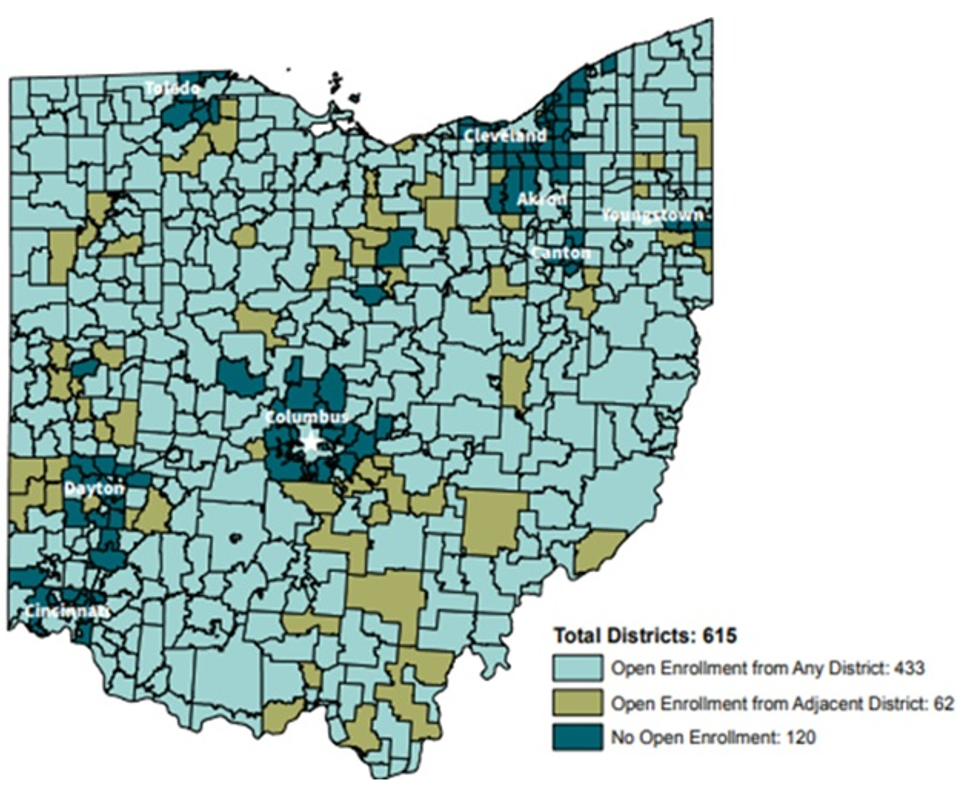
Ohio’s urban areas find themselves surrounded by districts that choose not to participate in open enrollment, featured in dark green. The children of Columbus, for instance, represented by the white star, appear to be surrounded by districts that do not offer open enrollment.
Later this week, this blog will offer a podcast interview with Chad Aldis, vice president for Ohio Policy and Advocacy at Fordham, whose research produced this map. Before criticizing the Ohio suburbs that deny open enrollment, let’s just put it on the table that a map of your state, if one existed, might look eerily similar to this one.
Unless, that is, you live in Arizona.
In Arizona, nearly all districts participate in open enrollment. Open enrollment students outnumber charter students nearly two to one in the Phoenix area despite its distinction as the nation’s largest charter sector.
Arizona has the largest state charter sector in the country, with nearly 20% of students attending charter schools. Ohio not only has fewer charter schools than Arizona; the schools are more geographically concentrated in urban areas. Ohio has a larger student population – 1.7 million students compared to 1.2 million in Arizona – but has far fewer charter schools overall and especially fewer suburban charter schools.
Data from the National Alliance for Public Charter Schools shows approximately 50 suburban charters in Ohio compared to 136 in Arizona.
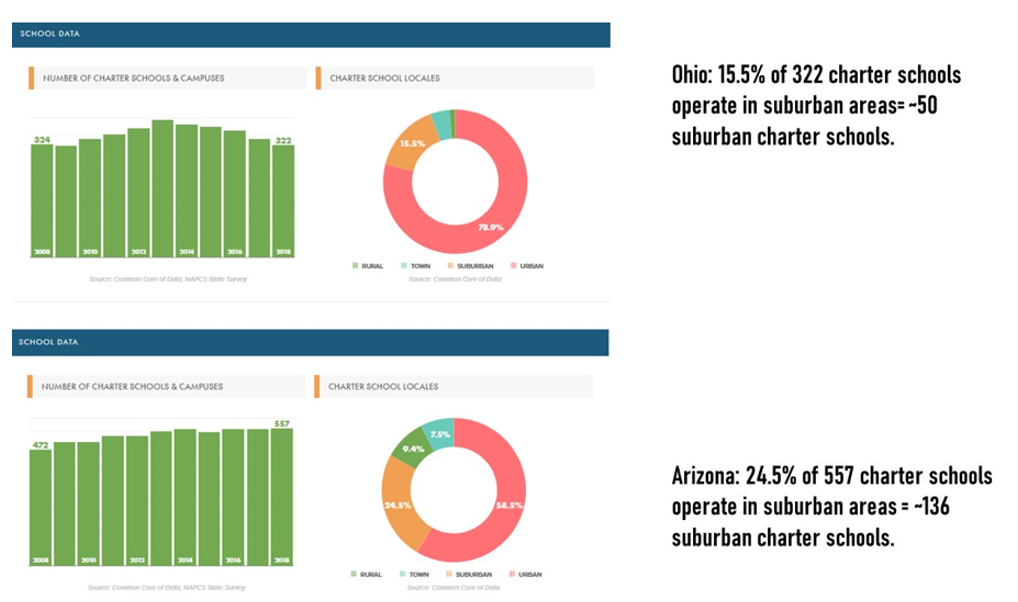 The Brookings Institution measured the availability by the percentage of students with access to one or more charter schools in their ZIP code. Arizona led the nation with 84% of students having one or more charter schools in their ZIP code, whereas Ohio stood at 31.9%.
Your author is going to go way out on a limb at this point.
While it could be that the people running suburban districts in Arizona are unusually interested in stamping out economic and racial segregation because of the dry climate or … something … the level of non-district options held by suburban families has a lot to do with it. Scottsdale Unified, for instance, may accept 4,000 open enrollment transfers because 9,000 students who live within the boundaries of the district go to school elsewhere.
How is this working out for the kids?
Stanford University’s Opportunity Project linked state academic exams across all 50 states to allow comparisons between schools, districts and their associated charters, and counties. The chart shows the comparison for academic gains for poor children in the largest counties in each state: Maricopa County (Phoenix area) in Arizona and Franklin County (Columbus area) in Ohio.
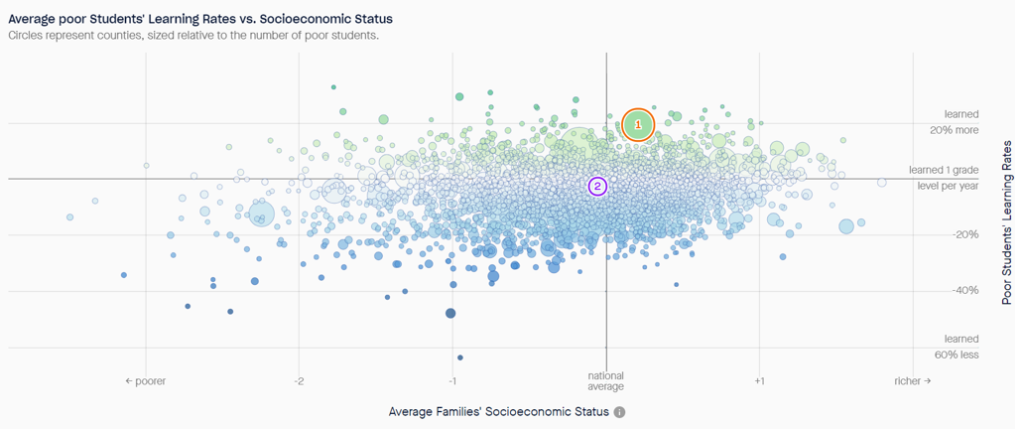
The rate of academic growth for poor students in Maricopa County is 19.3% above the national average for all students. The rate of academic growth for Franklin County students is 2.6% below the national average. Maricopa County outperforms Franklin County across all eight subgroups available in the Stanford data.
What we see in the Fordham map at the start of this post isn’t working, but don’t look for shame alone to open the gates of opportunity for Ohio’s urban students. Only broad choice programs can create the incentives needed to tear down these walls.

