‘When I was arrested, Oceania was at war with Eastasia. With Eastasia. Good. And Oceania has always been at war with Eastasia, has it not?’
Winston drew in his breath. He opened his mouth to speak and then did not speak. He could not take his eyes away from the dial.
‘The truth, please, Winston. YOUR truth. Tell me what you think you remember.’
‘I remember that until only a week before I was arrested, we were not at war with Eastasia at all. We were in alliance with them. The war was against Eurasia. That had lasted for four years. Before that——’
O’Brien stopped him with a movement of the hand.
-George Orwell, 1984
Oceania’s totalitarian government in Orwell’s 1984 relied on a daily “Two Minutes Hate” to whip people into a frenzy against enemies of the state. As Wikipedia helpfully explains:
Within the book, the purpose of the Two Minutes Hate is said to satisfy the citizens’ subdued feelings of angst and hatred from leading such a wretched, controlled existence. By re-directing these subconscious feelings away from the Oceanian government and toward external enemies (which may not even exist), the Party minimizes subversive thought and behaviour.
If you’ve read the newspaper recently you might think you were living in Oceania, but with the new Family Empowerment Scholarship program serving in the role of the hated enemy of the people instead of Emmanuel Goldstein. I could site any number of examples, but the Tampa Bay Times takes the cake for hyperbolic excess with Death Sentence for Florida Public Schools:
They approved the death sentence for public education in Florida at 1:20 p.m. Tuesday. Then they cheered and hugged each other. The legislation approved by the Florida House and sent to the governor will steal $130 million in tax money that could be spent improving public schools next year and spend it on tuition vouchers at private schools. Never mind the Florida Constitution. Never mind the 2.8 million students left in under-funded, overwhelmed public schools.
The Orlando Sentinel, however, reported the following on the 2020 Florida budget:
In the spending outline, K-12 schools funding landed at $21.8 billion, a $782.9 million increase on the current year, or nearly 4 percent.
Thus, Florida lawmakers signed a “death sentence” for Florida public schools by increasing their funding by almost $800 million. First world problem, anyone? According to my Excel spreadsheet, if the Florida Legislature had diverted the entire appropriation to the public school budget, it would have increased spending by 1 percent.
To the Times’ credit, they did provide former Florida Gov. Jeb Bush an opportunity to respond. Bush helpfully noted that Florida does not have a fixed student body but, rather, is rapidly growing:
The Times assumes that because a child chooses to attend a private school of their choice that public schools will somehow be harmed financially. But according to Florida’s Office of Economic Demographic and Research, over the next four years public school enrollment in Florida is projected to grow by an additional 94,000 students — one of the fastest growth rates in the nation.
The Family Empowerment Scholarship program is capped at around 46,000 students during that same time frame. So where exactly is the harm?
Where indeed? The Florida Department of Education provides a spreadsheet that shows Florida school districts spent almost $863 million in 2017 and created spaces for 30,323 students in the process. Call me crazy (it’s been too long since anyone has been good enough to do so) but it appears to me that the new scholarship program will relieve the pressure on Florida districts, whose enrollment will continue to increase. Funds you don’t have to spend on debt service can be used for other purposes – such as paying teachers.
In addition to electronic surveillance, thought police and 2-minute hates, constantly being at war constituted another trick up Oceania’s totalitarian sleeve. Twenty years have passed since the first Florida private choice program passed; Florida’s academic outcomes have improved all the while.
Ignorance of these facts is not strength, and freedom is not slavery. Florida editorial boards are at war with the right of Florida families to exercise autonomy in education. Will Florida editorial boards always be at war with Florida families?
Quick summary:
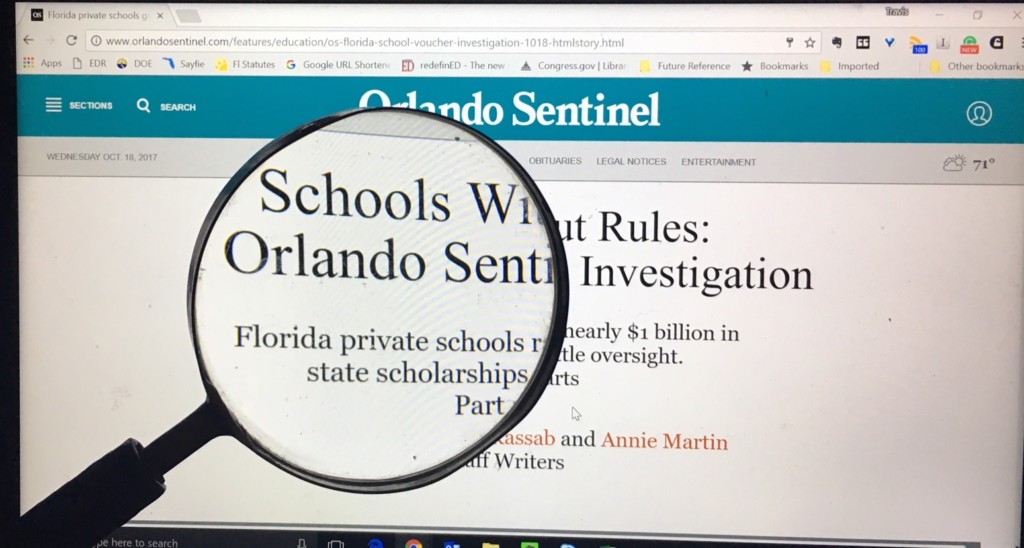 In the city where President Trump visited a Catholic school to declare Florida’s scholarship program for disadvantaged children to be a national model, the Orlando Sentinel offered its response this week. But its own bombastic claim – that the state operates the “most loosely regulated school choice program in the country” – is sensationalized nonsense.
In three lengthy stories, the newspaper spotlighted a handful of problem private schools, and underscored a few legitimate issues that deserve thoughtful remedies. But its work product, described as six months of investigative work and presented by a respected metropolitan newspaper, reads like journalistic guesswork with a grudge. “Schools Without Rules” is every bit as hyperbolic as its headline.
The two leading examples in the Sentinel’s “Schools Without Rules” were both revoked for violating rules. The first was removed from scholarship programs over the summer, while the other, which the state revoked on Tuesday, had a total of 19 students, all on scholarship (11 from Step Up For Students *). That’s 19 out of 140,000 scholarship students statewide. One of the newspaper’s four key investigative findings is the state’s web site directory allows schools to describe themselves to prospective parents, which is certainly less than ideal but also tagged with a bold “DISCLAIMER” note at the top of the web page. Is that truly a scandal?
The reporting lacks precision and calibration.
The state’s oversight, the Sentinel writes, is “limited.” A curriculum called “Accelerated Christian Education” is delivered at “some” schools. The state Department of Education (DOE) gives unwarranted second chances to schools “often.” One Orlando school has “some” teachers without degrees. The state allows “many” schools to enroll scholarship students when they first open. “Many” private schools lack amenities at public schools. The list of regulatory requirements is “short,” the barrier to entry is “low.” (more…)
Note: See a detailed response to the Orlando Sentinel from Step Up For Students here and a quick summary here. Step Up helps administer Florida's Gardiner and Tax Credit Scholarship programs, and publishes this blog.
One of the schools singled out by the Orlando Sentinel’s investigation of private school scholarship programs was founded by a couple who grew frustrated when their son, burdened with severe medical issues since birth, continued to struggle in public school.
Five years later, its standardized test scores show students tested in each of the last two years are, on average, making double-digit academic gains.
The Sentinel didn’t mention this in its description of TDR Learning Academy, a K-12 school in Orlando that enrolls about 90 students who use tax credit scholarships for low-income students, McKay scholarships for students with disabilities, and Gardiner scholarships for students with special needs such as autism and Down syndrome. Instead, in both its story and accompanying video, it portrayed the predominantly Hispanic school as a poster child for a regulatory accountability system it suggests is far too lax.
“These schools operate without state rules when it comes to teacher credentials, academics and facilities,” says the narrator in the Sentinel’s video. “TDR Academy in Orlando is one of them.”
 Jeb Bush's Foundation for Excellence in Education now has a blog.
The EdFly Blog. launched last week, is written by Mike Thomas, a former Orlando Sentinel columnist. For years, Thomas was one of the few journalists in Florida to report the positive impact of the big ed changes here. Here's an excerpt from his introductory post today:
The more I learned, the more I understood that reform was not a plot to destroy public schools.
It was a plot to ensure that children who had long been neglected by education bureaucracies finally got a fair shake.
I saw schools I never knew existed on the front page because they received F’s from the state. And then I saw district officials react accordingly, pouring resources into them. A few years later the same schools appeared on the front page again, this time with beaming teachers and students celebrating A’s.
I saw the reading scores of low-income kids trending up and the achievement gap trending down.
From that point on, I could not write enough about the reform movement.
Media coverage of education reform in Florida never ceases to amaze. What you should be hearing today are the sputtering responses of critics who have drawn widespread media attention in recent weeks with reckless claims that Florida’s ed reforms are an “unmitigated disaster.” Instead ...
The easy prompt for fair and obvious questions was yesterday’s release of the annual “Diplomas Count” report from Education Week. The independent analysis found that between 1999 and 2009, Florida’s graduation rate climbed 18 percentage points – more than all but two states. It also found that Florida’s black and Hispanic students are graduating at rates higher than the national average for like students, which is of no small import for a majority-minority state like Florida. The 2009 rate for Florida’s Hispanic students, in fact, put them at No. 2 among Hispanic students in all 50 states.
So how did the Florida media cover this compelling news? For the most part, it didn’t. (more…)

