Competition with other education options is nothing new for Florida school districts, though some of the rhetoric surrounding new legislation might make it seem that way.
The Palm Beach Post recently covered the deliberations of its local school board. Members worried that with this year's passage of HB 1, which expanded eligibility for Florida's educational choice scholarship programs, they would find themselves competing with private schools for the first time, and that they needed to launch a new marketing campaign in response.
Superintendent Mike Burke announced an idea in the spring to market public schools to families weighing their options. The district launched a kindergarten registration campaign to get Palm Beach County's youngest students in public school classrooms. Their thinking was that if students start in public school, they're more likely to stay.
Among the first orders of business for the district's new chief communications strategist will be expanding its marketing campaign to try to prove to parents considering education choice savings accounts that public schools are their best choice.
"I think we're going to have to dedicate real resources to this beyond our website," Burke said. "We’ve been competing with charter schools for 20 years. We've never competed with private schools."
The reality is that Florida school districts have been competing with private schools, including those supported by state-backed scholarship programs, for more than two decades, as the district's enrollment presentation shows.

The available evidence suggests that, on average, this competition is good for students, including those who remain in district schools. Studies of the expansion of private school scholarship programs and the introduction of new charter schools have both tended to find small but measurable performance improvements in surrounding public schools.
Most of these studies were done by economists who framed their analysis in terms of competition. But it might not be competition per se driving these improvements. It could be that "fit" matters a lot in education. When students gain access to new options, all students become more likely to find schools that fit their needs. As a result, students on average wind up slightly better off, even if they remain in the same school they attended before.
This year's new law has the potential to accelerate that virtuous cycle, in which students gain access to new options, public schools diversify their offerings, and everyone winds up better off.
Here's how: The law broadens options for students, allowing them to use scholarships beyond private schools. More families can now use the scholarships to purchase a mix of education-related goods and services that meet their child's needs, without enrolling full-time in any one school, public or private.
This option will start small. Most families are used to using the scholarship program primarily to pay tuition for full-time enrollment private schools. But it could grow in the coming years. If it does, it will heighten the competition all existing schools face, public and private. It would also create a new opportunity for school districts: They can design programs for students who use this option. Let them sign up for single courses, half-day programs, or one-day-a-week sessions.
These flexible options can help the district attract students who might otherwise leave for private schools or home education—and retain some revenue in the process. Last year, more than 180,000 students used these scholarships, and that number will likely continue growing.
While many people in public education recoil at the language of markets and competition, the broadening of authorized uses for these scholarships creates an opportunity—a new market—for public schools to offer new services to families.
A separate provision in HB 1 allows students to enroll in public schools part-time, allowing districts to serve these students and receive funding proportionate to the hours they attend. This gives districts a second potential avenue to serve families who value the district's offerings but want something more flexible than a conventional full-time school.
This might sound farfetched, but data suggests there is demand for this kind of option. The latest state statistics show homeschooling has doubled in Florida over the past decade. How many of these new homeschooling families would gladly take advantage of a part-time district program if it were available? And surveys by the advocacy group EdChoice have found most families would prefer to keep their children at home at least one day during the workweek.
Districts could attract more families (or convince more families to continue enrolling children in their schools) if they found new ways to cater to these needs.
Competition isn't just a marketing and communications challenge for school districts. It's an opportunity to create new options that work better for all students.
Jim Saunders / News Service of Florida
TALLAHASSEE --- In a decision that could have statewide implications, an administrative law judge Tuesday ruled that the Palm Beach County School Board is required to assign safety officers to charter schools under a law passed last year.
Judge John Van Laningham sided with Renaissance Charter School Inc., which operates six schools in Palm Beach County and wanted the School Board to provide “safe school” officers. The School Board refused, leading to the legal battle.
Van Laningham, in a 43-page order, pointed to a law passed after the February 2018 mass shooting at Parkland’s Marjory Stoneman Douglas High School that included a requirement for safe-school officers.
“In sum, after a thorough study of the statute's plain language, including a review of related statutes at the board's request to determine whether some latent ambiguity exists, the undersigned concludes that (the law) clearly and unambiguously requires school boards and superintendents --- not charter school operators --- to ‘establish or assign’ SSOs (safe-school officers), with the assistance of local law enforcement agencies, to every public school within their respective jurisdictions, including charter schools,” Van Laningham wrote.
The judge indicated the ruling was the first of its kind, describing the dispute as a “first-impression question of statewide interest,” as schools and districts try to comply with the post-Parkland requirements.
Charter schools are public schools that often are operated by private entities. The dispute about safe-school officers comes amid broader clashes across the state about the interplay between school boards and charter schools.
The 2018 law required placing safe-school officers at all public schools. That can include using law-enforcement officers or “guardians,” who are trained school personnel allowed to carry guns. Palm Beach County does not use guardians, according to Van Laningham’s ruling.
Renaissance requested in March 2018 that the School Board provide a full-time safety officer at each of Renaissance’s charter schools, but the board denied the request. The board also later declined a request to mediate the issue, which ultimately led to the dispute going before Van Laningham, the ruling said.
“There is no dispute in this case that, under the safety act, one or more SSOs must be assigned to each charter school facility in the district, including RCS's (Renaissance’s) six schools,” the judge wrote. “The question is, whose duty is it to assign SSOs to charter schools? The board's answer, clearly expressed in word and deed, is this: It's not our job; rather, the obligation falls to each charter school to arrange police protection for its own campus, as though each charter school were a school district unto itself.”
Van Laningham said he was not deciding issues such as who is required to pay for the officers.
“While disputes concerning this financial obligation might someday be ripe for adjudication, the narrower question of law … is, simply, who must satisfy the duty to ‘establish or assign’ SSOs at charter schools,” he wrote. “The plain and obvious answer to this pivotal question is: the district school board and district superintendent.”
The Florida Supreme Court today declined to hear a local school board's attempt to overturn the state's charter school appeals system.
The move comes school districts across the state prepare to challenge a wide-ranging charter school law.
The case may bolster the idea that lawmakers and the state Board of Education can check local boards' authority to oversee public schools — including charters.
The wide-ranging legal battle surrounds the Florida Charter Education Foundation's attempt to open a school in Palm Beach County.
The high court's decision means the school will have to make its case anew to the state's Charter School Appeal Commission.
But it also staves off the local school board's attempt to have the high court declare Florida's charter school appeals system unconstitutional.
That constitutional dispute drew a host of statewide and national groups into the case.
In a statement, Rod Jurado, chair of the Florida Charter Educational Foundation, said the school board was stymied in yet another "attempt to limit parental choice in education." (more…)
A charter school won another victory in a multifaceted legal battle with a South Florida school board.
But even if a ruling issued by the state's Division of Administrative Hearings stands, the fight isn't over.
The Palm Beach County School Board created a rule in 2014 that required charters, among other things, to prove they were "innovative" when they applied to open new schools.
Charter school backers argued the rule was intended to stifle competition. Renaissance Charter School Inc. filed a legal challenge, arguing the school board overstepped its legal authority.
An administrative law judge largely agreed in a ruling this week. June McKinney knocked down four specific parts of the school board's rule.
Those included:
However, McKinney dismissed some of the charter school's complaints. For example, the judge rejected arguments the board's rule, in its entirety, ran afoul of Florida law. (more…)
The Florida Board of Education tomorrow will decide appeals from three prospective South Florida charter schools.
In different ways, the cases spotlight a key tension in the Sunshine State, between removing roadblocks to new charter schools, which must be approved by their local school boards, and stopping schools that are unqualified, unlikely to serve students well, or at risk of shutting down soon after they open.
In Broward County, the school district has come under scrutiny for a large number of sudden, unexpected charter school closures, prompting a suggestion that it should screen charter applicants more closely.
In the case set to come before the state board tomorrow, it denied the Phoenix Academy of Excellence's application after finding what a school board attorney described as "a number of areas of weaknesses or concern." When the case reached the state Charter School Appeals Commission, the district prevailed. (more…)
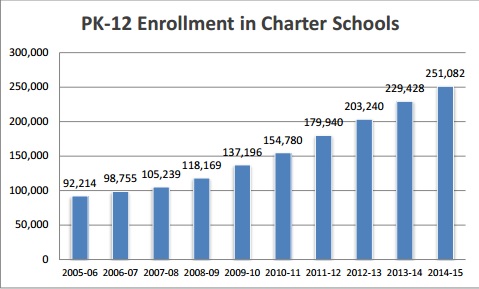
Florida's charter school enrollment has grown nearly three-fold over the past decade. Graph by Florida Department of Education.
Florida largely tracks the national trend.
Since 2006, when the National Alliance for Public Charter Schools released its first report on enrollment trends, the number of charter school students across the country has grown from about one million to nearly three million.
During the same period, Florida's charter enrollment has grown from about 92,000 to more than 251,000 — slightly less than tripling, but close.
Last year's report from the charter alliance showed Florida's urban school districts were home to some of the fastest-growing charter school sectors in the country. This year, they largely held steady in national enrollment rankings. (more…)
Tensions over charter schools may be mounting in Palm Beach County.
Last week, the school district set out to overturn a charter school appeal, telling a state court of appeals that school boards have the right to block charters they don't believe are "innovative." Now, the Palm Beach Post reports it's denying other charter school applications — citing a lack of innovation among other issues — and drawing the attention of statewide charter advocates like former state lawmaker Ralph Arza.
“The law says you have to have clear and convincing evidence to deny [a charter application],” said Arza, now spokesman for Florida Charter School Alliance. “They are finding ways to deny charters and in doing so they are becoming ground-zero for anti-charter school action.”
The district has denied other applications, including 15 this year. In 2013, the district received 33 applications and denied 17. The following year 22 applied and none were approved, said Jim Pegg, the director of the district’s charter school office.
But not until December, when Charter Schools USA asked to build a seventh campus in the county, did the board deny an application based on its lack of offering an innovative program. After the state sided with the company, the district appealed in court. A ruling could take two years, Pegg said.
 Funding. Gov. Rick Scott calls for a "continuation" budget, with potential implications for school funding, while legislative leaders say they intend to assemble a full state spending plan. Times/Herald. The Lee County school board votes unanimously not to ask voters to levy a sales tax for school facilities. Naples Daily News. Fort Myers News-Press.
Charter schools. The Palm Beach school district appeals a state Board of Education decision overturning its denial of a charter school application. Sun-Sentinel. Palm Beach Post. The district and a shuttered charter point fingers over missing records that could cost the district millions in funding. Sun-Sentinel.
Magnet schools. A pair of highly regarded Palm Beach magnet programs land high in national rankings. Palm Beach Post.
Awards. Florida selects its principal of the year. Palm Beach Post.
Lawsuits. Florida Virtual School wins access to its supporting foundation's records in a court case. Orlando Sentinel.
The Florida Board of Education on Wednesday is set to hear appeals on two charter school applications — including one rejected by the Palm Beach County School Board for not being sufficiently "innovative."
A school board member told the Sun-Sentinel the December rejection of the Florida Charter Educational Foundation's proposal was an act of "civil disobedience." The non-profit board is associated with Charter Schools USA, one of the state's largest and fastest-growing charter school management companies.
The commission that reviews state charter appeals has recommended the state Board of Education overrule the district's attempt to block the proposed school, voting unanimously that its application met all the requirements in state law, and that the school board did not show it was unqualified to operate.
Charter school critics in the state Legislature have sought to require charter schools to prove they offer something that districts do not, which was the thrust of Palm Beach board members' objections. (more…)
The South Florida Sun-Sentinel recently reported, the Palm Beach County school board is considering new rules for charter schools.
Some appear to make sense.
The proposed changes, discussed at a workshop Wednesday, include conducting more thorough background checks on charter school applicants and requiring new charter schools to offer an innovative curriculum that fills a niche in the county. Charters also would have to comply with school district investigations, allow district officials access to their records and develop a plan for an orderly closure if they are unsuccessful.
Background checks and orderly closure procedures might help prevent uprooting students, losing taxpayer money, or allowing low-quality charter schools to proliferate. As the results of a recent CREDO study showed, Palm Beach County, and West Palm Beach in particular, don't need more poor-performing charter operators.
It's the requirement that charters be "innovative" — as determined by their main competitors, the school district — that gets a little dicey.
No one's saying charter schools should not be innovative. The issue is who gets to decide what that means. As Rick Hess of the American Enterprise Institute has mused, the term "innovation," as used in education circles, appears to connote "whatever you're not doing at the moment, whatever got profiled recently in Education Week, or anything that involves an iPad."
The Sun-Sentinel notes the Palm Beach school board aims to overcome this problem by consulting with national experts on a definition. It has already used such a requirement to turn down a proposed school by Charter Schools USA.
On Thursday, a Florida Senate panel aired the pitfalls of such a rule, when Sen. Dwight Bullard, D-Miami, proposed adding to state law a requirement that charters "meet a specific instructional need ... which the local school district does not provide." (more…)

