SAFETY HARBOR, Fla. – Edelweiss Szymanski turns 10 on a Friday in December. She will celebrate the milestone by running a 5-kilometer race in Daytona Beach. The next day, she’s scheduled to compete in a triathlon.
No pizza party. No theme park.
How many 10-year-olds want to run three miles on their birthday, then swim, bike, and run some more the day after?
“This one does,” Lacey Szymanski said, pointing to her daughter with both index fingers.
Meet Edelweiss, a young triathlete on the rise who’s as tough as the flower she’s named after. Meet her brother, Spartacus, too, 14 months younger and just as tenacious.
The SkiSibs, as they are known throughout Florida’s triathlon community.

The SkiSibs: Spartacus and Edelweiss. (Photo by Roger Mooney)
Their bedrooms are filled with trophies, medals, and plaques – the spoils of reaching the podiums (finishing in the top three) at triathlons, road and bicycle races. The garage of their Safety Harbor home is packed with bicycles.
“We are an active family,” Lacey said.
Lacey and her husband, Jacek, have participated in triathlon relays.
Some mornings, Jacek and the kids can be found riding the bike trails around Pinellas County, waking as early as 3 a.m. so Jacek can get in a long ride before heading to his job as a sergeant with the Pinellas County Sheriff's Office.
If they time it right, and they usually do, the trio will stop along the overlook on the Courtney Campbell Causeway and snack on peanut butter and jelly sandwiches while they watch the sun rise over Tampa Bay.
“We really like watching the sunrise,” Edelweiss said.
She and Spartacus receive Florida education choice scholarships for students with unique abilities managed by Step Up For Students. Edelweiss is dyslexic. Spartacus has attention deficit hyperactivity disorder (ADHD). They are home educated by Lacey, who taught in a private school for 10 years before the family adopted this educational format.
Edelweiss benefits from one-on-one instruction with her mom, while Spartacus is not required to sit at a desk and complete his assignments, something that was an issue when he attended a brick-and-mortar school.
“The scholarship has been a game-changer. It’s awesome that Florida offers this,” Lacey said. “I have my doctorate in education, so I'm really happy that I'm able to help them in the ways that I can and create a curriculum that is specialized to their individual needs, as well.”
The scholarship covers Spartacus’s occupational therapy, as well as art class and piano lessons for Edelweiss. And learning at home allows for flexible schedules. It’s not unusual for Spartacus, an early riser, to complete his math assignments before the sun is up.

Biking is the favorite part of a triathlon for Edelweiss. (Photo by Roger Mooney)
The family home borders a wetland, which is ideal for interactive science lessons. It also provided the sticks the kids used to carve their own forks, and the twigs Edelweiss used to create a bird’s nest.
“Her art style isn't cut and dry, like paint a picture of this penguin. It's more abstract,” Lacey said. “That’s the way her brain works. Music, art, and athletics are a lot easier for her. When dyslexia held her back from other things, she kind of poured herself into those things.”
Lacey was pregnant with her daughter, and she and Jacek had yet to settle on a name when she came across a music box she bought during a trip to Germany. It played the song “Edelweiss” from the movie “The Sound of Music.” An edelweiss is a stout flower that grows in the rugged high-altitude terrain of the Alps and the Carpathian mountain ranges in Europe and blooms in the winter.
“I thought, ‘That’s what I want to name my daughter,’” Lacey said.
She and her husband believe that people can become the personification of their names. That holds true with Edelweiss.
“She is very hearty, and it aligns with being a triathlete. She can endure a lot and has a high tolerance for the sport,” Lacey said. “And at the same time, it’s a very beautiful flower. It doesn't look like your normal flower. It's very different and unique, which is what she is.”
And Spartacus? Well, he was making a fist in his first ultrasound.
Jacek said he looked like Spartacus, the ex-slave who became a gladiator and led a rebellion against the Roman Republic in 71 BC.
“He said his name is going to be Spartacus, and I said, ‘Yeah, right. There's no way I would name my son Spartacus.’ And here we are,” Lacey said.
“We do get odd looks when we call his name at a triathlon,” Jacek said. “I’m not saying it’s like yelling ‘Fire!’ in a crowd, but almost.”

You will often find Edelweiss on top of the podium on race day. (Photo courtesy of the Szymanski family)
Edelweiss competed in her first triathlon when she was 5. The family belonged to a local YMCA, and Lacey saw a post about the race on the morning of the event. So, she woke Edelweiss and asked her if she wanted to give it a try. Edelweiss said yes.
“It gave me something to do,” she said.
The race consisted of one lap in the 25-meter pool, a half-mile bike ride, and a quarter-mile run. Competing on a bike that had pom-poms and a basket on the handlebars, Edelweiss won her age group.
She had one question for her mom when she finished.
“When can we do this again?”
The answer? As often as possible.
She and Spartacus have moved up to sprint triathlons – 400-yard swim, 8.1-mile bike ride, and a 5K run.
The hardest leg for Edelweiss is the run. The best part, she said, is crossing the finish line.
“Because I don’t have to run anymore,” she said.
She’s been known to finish a race in her socks. Once, when she developed blisters and tossed her shoes halfway through the race, and another time when she was having trouble getting them on during the transition from the bike to the run and didn’t want to waste more time.
Jacek was born in Poland and immigrated to the United States at 19. He was an avid cycler in his native country and passed that love on to his children.
Edelweiss and Spartacus also compete in long-distance cycling races, where they are often the top finishers in their 7-11 age group.
“They goof around when they’re going for a ride with dad,” Jacek said. “But something switches when they are in the competitive world. They put on their game face.”
Before being immersed in the world of triathlons, Edelweiss was all about her ballet lessons.
“She was very into ballet, but now she doesn’t want to go back,” Lacey said. “It’s not the same adrenaline rush.”
Their weekends are loaded with triathlons across the state and cycling races as far north as Virginia. Lacey keeps track of the schedule.
“It’s our lifestyle now,” Lacey said. “We’re always in the water or on bikes, doing something like that. Edelweiss doesn’t feel like she’s actually competing. She’s doing what she loves. Spartacus is a ball of fire, too. Both of them together just constantly amazes me about what they're capable of and the grit that they have to compete.”

Keith Jacobs II, affectionately called "Deuce," with his parents, Keith and Xonjenese Jacobs. Photos courtesy of the Jacobs family
When our son Keith — affectionately known as “Deuce” — was diagnosed with autism spectrum disorder at age 3, we were told he might never speak beyond echolalia (the automatic repetition of words or phrases). Until age 5, echolalia was all we heard.
But Deuce found his voice, and with it, a unique way of seeing the world.
He needed to find the right learning environment, with the assistance of a Florida education choice scholarship.
Deuce spent his early academic years in a district public school, supported by an Individualized Education Plan (IEP). Despite the accommodations, learning remained a challenge. We realized that for some, a student’s success requires more than paperwork. It requires community, compassion, and collaboration with the parents.
Imagine having words in your head but lacking the ability to communicate when you need it most. That was Deuce’s experience in public school. His schools gave him limited exposure to social norms and rigor in the classroom. Additionally, through his IEP, he always needed therapy services throughout the school day, which limited his ability to take electives and courses he enjoyed.
His mother and I instilled the importance of having a strong moral compass and working hard toward his social and academic goals. Although we appreciated his time in public school, we knew a change was needed to prepare him for post-secondary education. We applied and were approved for the Family Empowerment Scholarship for Students with Unique Abilities.
Knowing the potential tradeoffs of leaving public school and the IEP structure behind, we chose to enroll Deuce at Bishop McLaughlin Catholic High School in Spring Hill, about 35 miles north of Tampa. We believed the nurturing, faith-based environment would help him thrive. It was the right decision.
Catholic school provided Deuce with the support he needed to maximize his potential. Despite his autism diagnosis, he was never limited at Bishop. He was accepted into their AP Capstone Program. This was particularly challenging, but Bishop was accommodating. The school provided him with an Exceptional Student Education (ESE) case manager dedicated to his success, and he received a student support plan tailored to his diagnosis and learning style. The school didn’t lower expectations; instead, it empowered him to take rigorous coursework with the right guidance.
Any transition for a child with autism will take time to adjust. On the first day, I received a call: Deuce had walked out of class. This was due to his biology teacher using a voice amplifier. The sound overwhelmed Deuce’s senses, and he began “stimming”— rapidly blinking and tapping his hands. Instead of punishing him or ignoring the issue, the staff immediately reached out.
Together, we crafted a Student Success Plan tailored to Deuce’s needs, drawing from his public school IEP without being bound by it. His plan included preferential seating, frequent breaks, verbal and nonverbal cueing, encouragement, and clear direction repetition. For testing, he was given extended time, one-on-one settings, and help understanding instructions.
These adjustments made all the difference.
Throughout high school, Deuce maintained a grade-point average of over 4.0 while taking honors, AP, and dual enrollment courses. Additionally, he was inducted into the National Honor Society and Mu Alpha Theta Math Honor Society while also playing varsity baseball. Because of his success at Bishop, he will continue his educational journey at Savannah State University, where he will major in accounting and continue to play baseball.

Deuce Jacobs earned an academic scholarship to Savannah State University, where he plans to major in accounting and continue playing baseball.
Catholic schools in Florida increasingly are accommodating students with special needs. The state’s education choice scholarship programs have been instrumental in making Catholic education available to more families. Over the past decade, during a time when Catholic school enrollment has declined across much of the nation and diocesan schools have been forced to close, no state has seen more growth than Florida.
At the same time, the number of students attending a Catholic school on a special-needs scholarship has nearly quadrupled, from 3,004 in 2014-15 to 11,326 in 2024-25. Clearly, many families are choosing the advantages of a private school education without an IEP versus a public school with an IEP.
So, I’m puzzled why federal legislation being considered in Congress, the Educational Choice for Children Act (ECCA), includes a mandate that that all private schools provide accommodations to students with special education needs, including those with IEPs.
Although more and more students with special needs are accessing private schools, not every school can accommodate every student’s unique needs (which is also true of public schools). And, as I learned with Deuce, some schools can accommodate students more effectively if they aren’t bound by rigid legal mandates and have the flexibility to collaborate with parents who choose to entrust them with their children’s education.
If the IEP mandate passes, it would prohibit many schools from accepting funds through a new 50-state scholarship program, undermining the worthy goal of extending educational choice options to more families. The U.S. Conference of Catholic Bishops has called it a “poison pill” that would “debilitate Catholic school participation.”
Bishop McLaughlin’s willingness to partner with me as a parent not only allowed Deuce to succeed academically but also gave him the dignity and respect every child deserves. IEPs work for many. For others, like Deuce, it takes something more like collaboration to build a path forward together.

Public education in the United States is transitioning from its second to third paradigm.
Paradigm shifts in public education occur when larger societal changes force public education to change to meet these new conditions. Current technological advances and the accompanying social changes are pushing public education into a new paradigm and a third era.
To best meet society’s current and future needs, this third paradigm aspires to provide every child with an effective and efficient customized education through an effective and efficient public education market.
A paradigm: The lens through which communities do their work
In his 1962 book, “The Structure of Scientific Revolutions,” Thomas Kuhn described a paradigm as the lens through which a community’s members perceive, understand, implement, and evaluate their work. A paradigm includes a set of assumptions and associated methodologies that guide how communities construct meaning and determine what is true and false and right and wrong.
A paradigm shift occurs when inconsistencies, which Kuhn called anomalies, begin to occur, and some community members begin to question their paradigm’s veracity and effectiveness. As these anomalies accumulate, community members begin proposing new ways of understanding and implementing their work and a prolonged contest emerges between the existing paradigm and proposed new paradigms. If a majority of the community ultimately decides a new paradigm enables them to resolve the anomalies and better understand their discipline, this new paradigm is adopted. In scientific communities, Kuhn calls these paradigm shifts scientific revolutions.
Paradigm shifts are disruptive and revolutionary because they require community members to reinterpret all their previous work and adopt new ways of conducting and evaluating their future work. Senior community members are particularly resistant to changing paradigms because their status comes from applying the existing paradigm over many years. Consequently, paradigm changes are rare and require several decades to complete.
Albert Einstein’s General Theory of Relativity (GTR) was a new physics paradigm that challenged Newtonian mechanics and Newton’s law of universal gravitation (i.e., the dominant physics paradigm at the time). It took over 40 years before GTR gained wide acceptance among physicists. Einstein never won a Nobel Prize for GTR because the Swedish physicists on the Nobel committee refused to accept his new paradigm.
Although Kuhn’s work focused on the role of paradigms in scientific communities, his description of how paradigms function and change is relevant for all communities, including public education. The struggle in U.S. colonial times to transition from a monarchy to a democracy was a paradigm shift. It was a revolutionary change in how government works, was fiercely resisted by those in power, and took decades to complete.
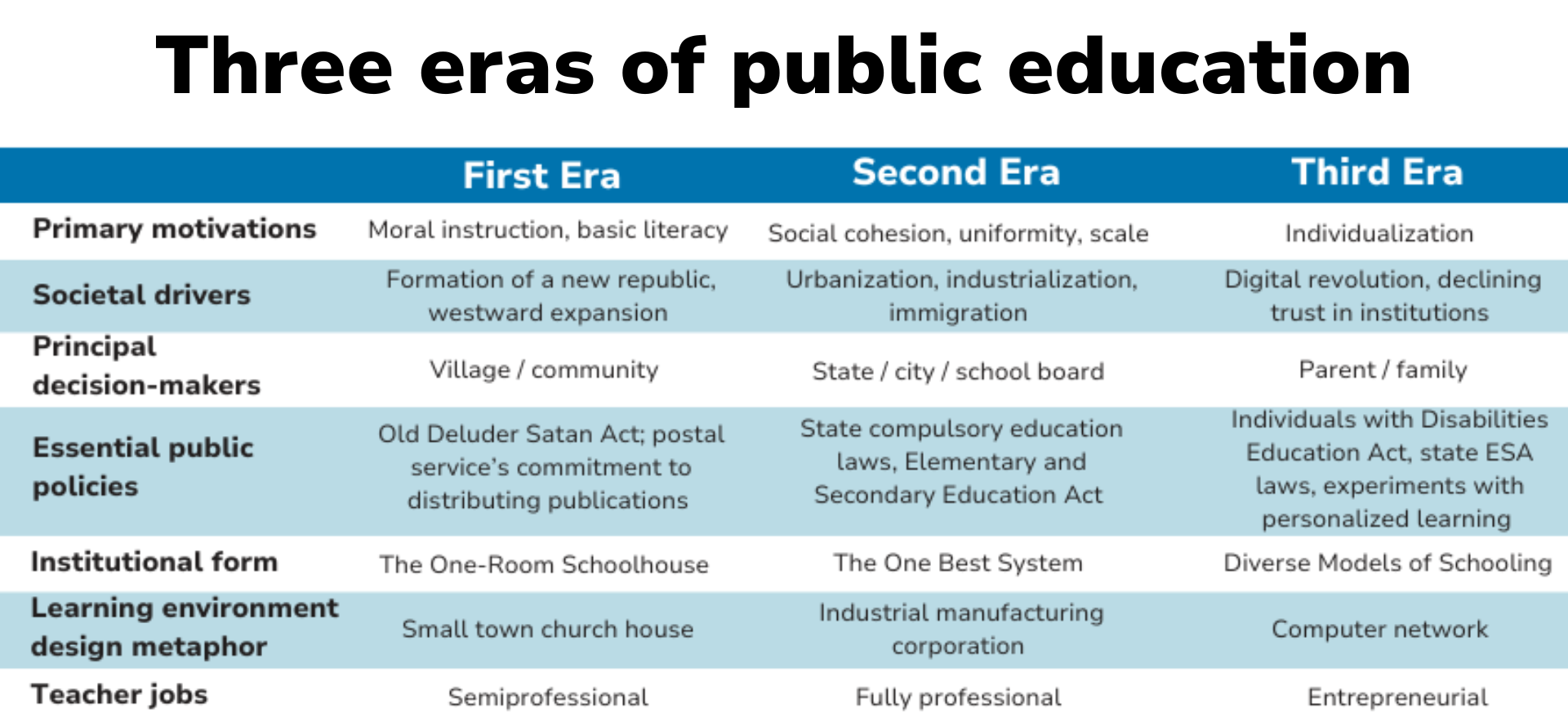
Public education’s first paradigm
Public education’s first paradigm began before the United States was a country, when the Massachusetts Bay Colony enacted the “Old Deluder Satan Act” to ensure the colony’s young people learned scripture. As the name of that early legislation implies, this first era prioritized basic literacy and religious instruction. Most children were homeschooled, and formal instruction tended to be ad hoc, improvised, and organized around the agricultural calendar.
Religious organizations provided most of the structured instruction outside the home in the 1700s and early 1800s. Children and adults attended Sunday schools, and communities organized what today we would call homeschool co-ops, which allowed rural children to receive instruction when their chores permitted.
The federal government supported public education through the U.S. Postal Service by subsidizing the distribution of magazines, pamphlets, books, almanacs, and newspapers, and establishing post offices in rural communities. By 1822, the U.S. had more newspaper readers than any other country.
Public education’s first paradigm started failing in the early 1800s as innovations in transportation and communications began connecting the country and promoting more industrialization and urbanization. About 90% of Americans lived on farms in 1800, 65% in 1850, and 38% in 1900.
This transition from rural to urban created childcare needs. Increased industrialization necessitated a more highly skilled workforce. And concerns about social cohesion grew as the growing country welcomed immigrants from Ireland and later from Southern and Eastern Europe. These were demands the informal, decentralized, and family-driven first public education paradigm was ill-equipped to meet.
Public education’s second paradigm
In 1852, Massachusetts passed the nation’s first mandatory school attendance law. This accelerated public education’s shift from its first to second paradigm.
The massive influx of European immigrants beginning in the 1830s was a primary reason Massachusetts decided to make school attendance mandatory. The U.S. experienced a 600% increase in immigration from 1840 to 1860 compared to the prior 20 years. Most of these immigrants were illiterate, low-income, and Catholic. Massachusetts’ mandatory school attendance law was intended to help turn these new immigrants into “good” Americans, meaning they needed to be literate, financially self-sufficient, and well-versed in Protestant theology.
Protestant hostility toward Catholic education in the U.S. continued deep into the following century and included the infamous Blaine Amendments that many states adopted in the late 1800s to forbid public funding of Catholic schools, and the 1922 constitutional amendment in Oregon that required all students to attend Protestant-controlled government schools.
The U.S. Supreme Court ruled the Oregon amendment unconstitutional in its 1925 decision Pierce v. Society of Sisters, ensuring every American family had the right to choose public or private schools for their children. This ruling would later help make public education’s transition to its third paradigm possible.
By 1900, 31 states had passed mandatory school attendance laws. While these laws were not initially well enforced, they did significantly increase school attendance, which created management challenges.
As David Tyack chronicles in “The One Best System,” a history of how this first paradigm shift unfolded in America's cities, a new class of professional administrators, known as schoolmen, set out to modernize public education practice and infrastructure. One-room schoolhouses serving students were no longer adequate, so public education began adopting the mass production processes that enabled industrial manufacturers to create large numbers of products at lower costs. The most famous example was the assembly line that Henry Ford created to mass produce affordable Model Ts.
This new industrial model of public education replaced multi-age grouped students with age-specific grade levels that functioned like assembly line workstations. Just as Ford’s assembly line workers were taught the skills necessary for their workstations, public school teachers were trained to teach the skills associated with their assigned grade level, and children were moved annually from one grade level to the next en masse.
Mississippi became the last state to pass a mandatory school attendance law in 1918. By then the bulk of multi-aged one-room schools were being replaced with larger schools that reflected the best practices of 19th century industrial management. This was the paradigm through which government, educators, families, and the public were now seeing and understanding public education. This change marked U.S. public education’s second paradigm.
Ford famously told customers they could have any color of Model T they wanted provided it was black. Public education adopted this one-size-fits-all approach to increase efficiency. Car consumers began demanding more diverse options over the next several decades, and so did public education consumers. The auto industry diversified its offerings much quicker than public education because it faced competitive pressures the public education monopoly did not. But in 1975, President Gerald Ford signed the Education for All Handicapped Children Act, which required all school districts to begin adapting instruction to serve special needs students. This was the first instance of government requiring public education to provide a large group of students with customized instruction.
Public education’s third paradigm
This expansion of instructional diversity accelerated in the late 1970s and early 80s as school districts started creating magnet schools to encourage voluntary school desegregation. The school district in Alum Rock, California even experimented with a short-lived voucher program that fostered an ecosystem of small, specialized learning environments that today would be called microschools.
Most of the beneficiaries of early magnet schools were white middle-class and upper middle-class families who were attracted by the additional resources and high-quality specialized instruction. But magnet schools created for desegregation could serve only a limited number of students. In response to political pressure from influential constituents, school districts began creating magnet schools unrelated to desegregation, which expanded and normalized specialization and parental choice within school districts and accelerated the transition to public education’s third era.
Florida added significant momentum to this transition with the passage of its 1996 charter school law, the founding of the Florida Virtual School in 1997, and the 2001 creation of the nation’s largest tax credit scholarship program.
Two decades later, the COVID-19 pandemic further hastened public education’s current paradigm shift. Magnet schools, virtual schools, charter schools, homeschooling, open enrollment, homeschool co-ops, and tax credit scholarship programs were already expanding nationally when COVID arrived in March 2020. The pandemic turbo charged the growth of these options and newer options such as microschools, hybrid schools, and education savings accounts (ESAs).
Just as 19th century innovations in communications, transportation and manufacturing led to public education’s first paradigm shift, the rise of digital networks, mobile computing, and artificial intelligence are transforming all aspects of our lives, including where and how we work, communicate, consume media, and educate our children. These technical and societal changes are driving a decline of trust in institutions that no longer enjoy a monopoly on public information. They are also driving increased demand for flexibility to determine when, where, and with whom teaching and learning happen. Public education has begun to adopt a paradigm more aligned to 21st century demands, which include parents gaining more power to decide how their children learn.
Government’s changing role
Government’s role in public education will be impacted by a new public education paradigm that reflects these ongoing technical and cultural changes. Under the second paradigm, government had a near-monopoly in the public education market. This quasi-monopoly undermined public education’s effectiveness and efficiency because it failed to take full advantage of the knowledge, skills and creativity of students, families and educators.
In public education’s third era, government will regulate health and safety and help facilitate support services for families and educators but will no longer be the dominant provider of publicly-funded instruction. This regulatory and support function is like the role government currently plays in the food, housing, health care, and transportation markets. Most of the responsibility for how children are educated will shift from government to families and the instructional providers families hire with their children’s public education dollars.
Shifting government’s primary role from instructional monopoly to market regulator and supporter will require operational changes. Families will be able to choose from a plethora of instructional options and will need access to information that allows them to make informed decisions, as well as education advisers who can help them evaluate their child’s needs and develop and implement customized education plans to meet these needs. Government will need to ensure data accuracy and truth in labeling – much as it currently ensures food labels accurately describe what’s in the package.
Third paradigm issues
Providing each child with a high-quality customized education through a more effective and efficient public education market will require public education’s stakeholders to rethink all aspects of how it operates. Here are some issues we will need to address.
Public education’s third paradigm has old roots
In 1791, Thomas Paine proposed an ESA-type program for lower-income children in “The Rights of Man.”
“Public schools do not answer the general purpose of the poor. They are chiefly in corporation towns, from which the country towns and villages are excluded; or if admitted, the distance occasions a great loss of time. Education, to be useful to the poor, should be on the spot; and the best method, I believe, to accomplish this, is to enable the parents to pay the [sic] expence themselves.”
Paine’s recommended funding method was, “To allow for each of those children ten shillings a year for the expence of schooling, for six years each, which will give them six months schooling each year, and half a crown a year for paper and spelling books.”
Over 150 years after Paine’s proposal, Milton Friedman proposed a similar but more comprehensive plan in 1955. Many of the third paradigm’s core ideas existed in the 1700s prior to the industrial revolution. But they were not technically or politically feasible.
Thanks to modern technology and a growing acceptance of families’ rights to direct their children’s education, these ideas are viable today. We can now provide every student with an effective and efficient customized public education. While all students will benefit from customized instruction in a more effective and efficient public education market, lower-income students will benefit the most because they have historically been the most underserved by the current government monopoly. Underserved groups always benefit greatly when the markets they rely on for essential goods and services are more effective and efficient.
Public education’s transition to its third paradigm is happening faster in Florida than in other states. Over 500,000 students using ESAs is rapidly improving Florida’s public education market. Floridians are seeing in real time the creation of a virtuous cycle between supply and demand. More families using ESAs is encouraging educators to create more innovative learning options, which in turn is causing even more families to use ESAs, which in turn is causing even more educators to create more learning options. These rapidly expanding options increase the probability that all students, but especially lower-income students, can find and access learning environments that best meet their needs.
Public education’s first paradigm shift took about 100 years to complete (1830-1930). This second transition began around 1975 and will likely also take about 100 years to complete nationally. Like all paradigm changes, this one is proving to be a long slog. But larger societal changes will help ensure this transition’s success.

