
The EdChoice blog recently delivered some good news, specifically that the number of students using private choice programs increased by 25% last year. In fact, if you cobble together some previous years' data from the EdChoice ABCs of School Choice reports, the trend looks like:

Overall, a doubling of private choice participation since Arizona and West Virginia adopted universal policies in 2022 is looking like a good start. It is worth keeping in mind that surveys show that parents prefer private schools at approximately four times the rate that they enroll in them, and there are many miles to go on that front. The new program in Texas and the federal tax credit will provide additional sources of growth in the years ahead.
Meanwhile, over at Charter Folk, the not-so-good news. Jed Wallace has a striking post on the bifurcation of American education. Disadvantaged students have suffered the lion’s share of the decline in achievement since the pandemic struck.
This is your author’s observation rather than Wallace’s, but authorities adopting policies that teens can readily interpret as “attending school is not terribly important” have extremely negative consequences on absenteeism. Moreover, as best your humble author can tell, the “plan” for the public schools to do anything about it involves aging/dropping the academically damaged students out of the system.
In any case, Wallace puts his hammer on the head of an important nail regarding different reactions across red and blue states:
“It comes down to a topic I have written about several times here, which is whether teacher unions think they have overplayed their hands since the pandemic.
“My answer has been that in red states the answer is undoubtedly yes. Teacher union recalcitrance since the pandemic has sparked the Republican party to embrace private school choice, and that is resulting in seismic change happening in those states.
“In blue contexts, though, I have said that it’s a very different story. Thus far, Dems’ calculation has been that their hold on power is so unquestioned in blue states that they don’t really need to pivot on issues. They’ll be able to keep winning without making any adjustment at all.”
Ohio State University political scientist Vladimir Kogan, in his book “No Adult Left Behind,” argues: “We need a public school system that serves students, but we have created one that is governed at the behest of adults. We should not be surprised when it puts the interests of those adults first.”
Wallace is, correctly, I fear, noting that the politics of blue states lend themselves to more of the same on K-12. Wallace notes that this means more of this in Illinois:

If spending $93,787 per student at a high school with 0% proficiency in reading to go along with 0% proficiency in math is not your personal cup of tea, you might want to consider moving out of Illinois. It does not seem likely that you could find such a thing in any of the nearby states, two of which offer their citizens universal access to private choice programs:

Federalism allows people of divergent views to effectuate different policy goals, a healthy design feature of the American Constitution. If your state uses their monopoly on force to require you to pay for the schools like those listed above, opting out sounds like a splendid idea. Finding yourself forced to pay for those schools is far more than anyone should tolerate. Finding oneself forced to pay for them and being required to send your children to them is far, far worse. Illinois policymakers would never inflict this on their own children but seem entirely content to do so on thousands of their fellow citizens.
Depeche Mode once sang about “the grabbing hands grab all they can” but the same song noted “everything counts in large amounts.” For example, within the lifetimes of many reading this post, Illinois will have gone from having twice as many seats in Congress as Florida, to half as many (see below).
 Everything counts in large amounts, indeed. The grabbing hands will be grabbing all they can, but your interests, dear reader, lie in putting yourself beyond their reach.
MELBOURNE, Fla. – When it comes to her son’s education, Denice Santos always thinks about the big picture.
“What can we do to merge his goals?” she said. “Education, and then, of course, becoming a pilot.”
Her son, William, 12, has wanted to fly airplanes for half his life. He took control of a plane for the first time when he was 8. He’s nearly halfway to the required 51 hours of flight time needed to earn a pilot’s license.
A Florida education choice scholarship is helping him reach that goal.
William receives a Personalized Education Program (PEP) scholarship available through the Florida Tax Credit Scholarship Program managed by Step Up For Students. PEP provides parents with flexibility in how they spend their scholarship funds, allowing them to tailor their children’s learning to meet their needs and interests.

William Santos stands in front of a two-engine airplane that he has flown during his training flights.
For his needs, William attends Florida Virtual School, where he is a straight-A student.
For his interests, William heads to Melbourne Flight Training twice a month for flight lessons. Both are paid for with his PEP scholarship, with the flight lessons covered under enrichment courses.
“I’m not just thinking about right now, his education experience right now. I’m thinking long term,” Denice said. “What’s after school? What’s school building to?”
William said he is thinking about attending the United States Air Force Academy. Or maybe a career in law enforcement where he could put his flying skills to use. Border patrol? Possibly.
He’s recently developed an interest in flying helicopters, which could open another career avenue. The family lives in Melbourne Beach, located in Brevard County, and the Brevard County Sheriff's Office has an aviation unit with four helicopters.
He could also become a commercial pilot and fly for an airline or fly charters for a private company.
“The sky is the limit,” said Denice, who chuckled at her choice of words.
***
William was 6 when he attended the Cocoa Beach Air Show with his mother and father, Kevin. There were flying machines everywhere – F-22s and F-35s, F-16s and B-52s. They screamed overhead and rested majestically on the ground.
He was hooked.
When they were leaving, William said, “Mom, when I grow up, I’m going to be a pilot.”
“He’s always been super decisive,” Denice said. “I knew he wasn’t kidding.”
Denice checked for the minimum age requirement needed to begin flying lessons. Turns out, there is none. You do have to be between 8 and 17 to participate in the nationwide Young Eagles program, which offers free introductory rides for youngsters interested in flying. William was in the air as soon as he turned 8.
“They take kids up for 30 minutes with the pilot, and they get a little taste of it to see if they like it. Is this something? Are they afraid, or does it spark something? William did 10 of those, and we said, ‘OK, this is a thing.’”
Soon, Denice and Kevin were searching for a flight school. They settled on Melbourne Flight Training, which is 20 minutes from home.

William poses in front of the wall containing pictures of all the pilots who earned their license after training at Melbourne Flight Training.
“When I was a kid, I always liked planes,” William said. “Even when I would go on flights as a baby, I would never cry. I would love it, every minute. It was the best thing ever. And I was never really afraid of heights. It didn't bother me much.”
That’s good, because his first flight with Young Eagles was in a BushCat Light Sport Aircraft, a small plane that has non-traditional doors – they are clear plastic and can be removed. You can fly with or without them.
“It was kind of ever so slightly scary,” William said. “Since I was young, I was like, ‘Uh, am I sure about this?’ And many, many flights later, I'm here.”
He has flown 25 times with an instructor and has nearly 20 hours of flight time. He will need to turn 17 and have a minimum of 51 hours before he’s licensed. He will also need to be medically certified to fly and pass a written exam that covers weather, navigation, flight regulations, and aerodynamics.
Dr. Tracey Thompson, the student advisor at Melbourne Flight Training, said it’s not uncommon for someone as young as William to take lessons.
“But,” she added, “he’s been up 25 times, and for someone his age to be up that many times, that’s phenomenal. His consistency, his passion, he wants to do this all the time.”
Jonathan Gaume is William’s instructor. He said he’s never worked with a student this young and is impressed by William’s interest and enthusiasm.
While he’s on pace to reach his 51 hours when he’s 17, William would like to accelerate his training and reach those hours when he’s 16.
Why?
“Because I find this fun,” he said.
As for being one of the youngest pilots training at Melbourne Flight Training, “You know, it's been really the only thing I’ve done since I was 8. It’s been the thing I've always looked forward to.”
***
William has trained several times in a four-seat plane, and Denice has accompanied him during those flights. She said she’s noticed a level of peace when William is flying.
Gaume noticed it, too. He said William’s confidence spikes as they climb into the aircraft.
“He has key elements to being a good pilot: calm, confident and in control,” Gaume said.
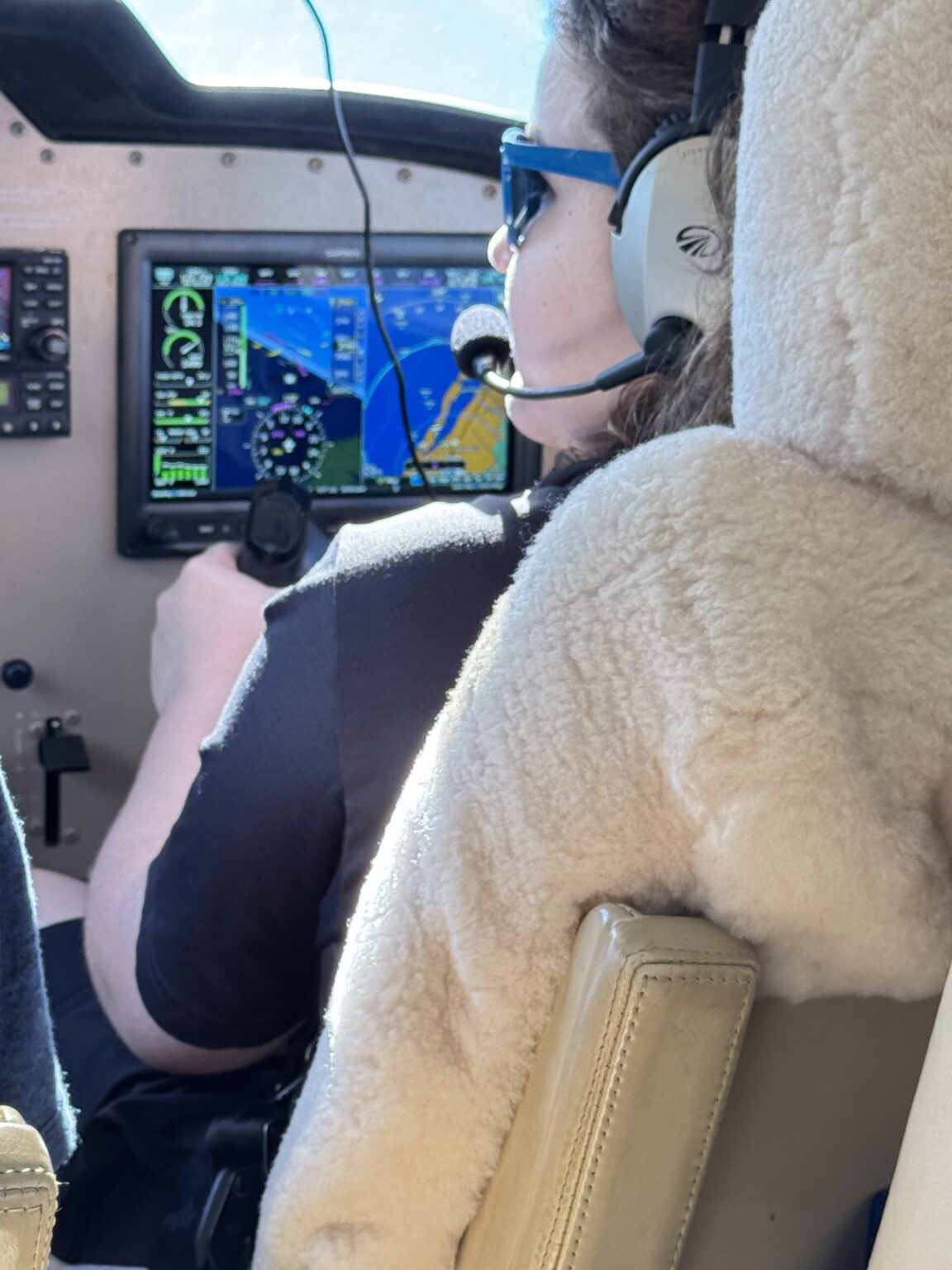
William at the controls. (Photo courtesy of Denice Santos)
The flight path takes William over the Atlantic Ocean, where they sometimes fly around thunderstorms. A recent lesson took place in a twin-engine plane. Gaume killed one of the engines, and William had to keep the plane flying. Confident and in control, William did just that.
“We’re just so thrilled, just so happy to plug him into his dream,” Danica said. “To be in the plane with him, seeing him flying, just seeing him totally locked in, that's all a parent can wish for.”
Flying lessons cost between $300 and $500 depending on airtime, and William averages about two lessons a month. That can strain the family budget for Denice, a teacher at Florida Virtual School, and Kevin, who is retired after 22 years in the U.S. Army.
“It’s not like we’re rolling in the dough,” Denice said. “The scholarship makes this possible. If we didn't have that scholarship, how many flights would he get? Probably not as many as he's getting now.
“I'm thrilled to be in Florida, because there's so much parental choice here. Not only do parents have choices, but then they can branch out and get some financial support from the state for those choices. Amazing. It's awesome.”
Every family in Florida that receives an education choice scholarship uses it in their own, unique way. Denice encourages parents to be as forward-thinking as possible, to merge education and interests and work toward a goal.
“I would like more people to think beyond where their kid is right now, but what are they good at. Really invest in that and tune in and give them the most experience as you can,” she said. “To me, that's what the scholarship money is for, branching out, tap into your kids’ interests because you never know what can happen.”
As Denice said, the sky is the limit.
This is what home education looks like to Vivian McCoy:
Feeding horses in the morning. Mucking stalls, too. Doing the same in the late afternoon, plus whatever else needs to be done at the horse farm where she works part time.
In between, Vivian, who is in the ninth grade, and her sister, Genevieve, second grade, complete their schoolwork on the 15-acre farm where they live with their mom, AnnaMarie, in the Florida Panhandle community of DeFuniak Springs
“I feel I have way more free time to do the things I enjoy,” Vivian said, when asked about the benefits of home education.
That free time includes caring for her own two horses – Blue, a quarter Mustang mix, and Froggy, a Tennessee Walker – and tending to the other animals that live on what AnnaMarie calls a “teaching farm.”

Vivian and Froggy get ready to participate in the Fourth of July parade. (Photo courtesy of AnnaMarie McCoy)
Genevieve looks after the chickens and works in the 2,000-square-foot garden.
There are the core courses, for sure, but there is plenty of hands-on learning for the McCoy sisters in the only educational setting they have known.
Florida education choice scholarships help make it affordable for AnnaMarie, a single mom who works from home part-time as a dietitian consultant.
Genevieve receives the Family Empowerment Scholarship for Students with Unique Abilities (FES-UA). Vivian receives the Personalized Education Program (PEP) scholarship available through the Florida Tax Credit Scholarship Program. Both scholarships are managed by Step Up For Students.
Like FES-UA, PEP is an education savings account (ESA) that gives parents the flexibility to customize their children’s learning to meet their needs. The scholarship, enacted by the Florida Legislature before the 2023-24 school year, has been a financial boon to AnnaMarie.
Until then, she paid out of pocket for the curriculum and supplies needed for Vivian’s home education.
“Pre-scholarship, it was a real struggle meeting all of her goals and being able to present her with things that were going to enhance her interests and her education,” AnnaMarie said. “Although we did it and we got through it, having the scholarship opens up an entire new world for us.
“I can use that money to really enhance what their interests are and what their weaknesses are, or their strengths.”
Like most students who are home educated, Vivian’s and Genevieve’s learning has evolved.
“I’ve gotten a lot more experience over the years to see what works for us,” AnnaMarie said. “These are two very different children, very different students, with very different interests and learning abilities. So, before the scholarship was an option, I definitely did things that were very budget-friendly and utilized anything that was a possible benefit to us that was low-cost, and I still do.”
Vivian is interested in agricultural science and animal husbandry. Hence, Blue and Froggy and her job at the horse farm.
“She's also very artistic,” AnnaMarie said. “She's super, super creative and super artistic.”

Genevieve displays the vegetables she grew in the family's 2000-square-foot garden. (Photo courtesy of AnnaMarie McCoy)
Genevieve, an excellent swimmer, is interested in anything that involves physical activity. She uses part of her ESA for speech-language pathology therapy and the educational tools needed to support that.
While Vivian was “born loving science,” AnnaMarie said, she finds herself trying to find something that will spark that interest in Genevieve. Toward that end, AnnaMarie has “melded” their home into a working farm.
“Everything here presents a teaching opportunity or learning opportunity, and they can see it from beginning to end,” AnnaMarie said.
Genevieve watches the chickens go from egg to chick to chicken – the entire lifecycle. In the garden, she follows the plants from seed to harvest.
“And all the struggles with that,” AnnaMarie said, “the positive outcomes and the negative outcomes and the environmental outcomes.”
AnnaMarie said there are “pros and cons” to every education setting.
“This lifestyle suits them best,” she said. “Having this environment and the flexibility in our schedule really suits their interests and their needs.”
Vivian, 14, is nearing driving age, yet she opted to spend the money she could have put toward a car to buy Froggy.
“She eats, lives, and breathes horse stuff,” AnnaMarie said.
“I’m fascinated by the equine species,” Vivian said. “The power and the majesty they hold. I find it very cool that you can do so many things with them and how they've evolved over the years.”
She was thrilled earlier this summer when she was allowed to ride Froggy in the local Fourth of July parade. It was a big step for both of them, Vivian said. She was able to do something away from the farm with Froggy, and he was able to be around a crowd with all the music and pageantry that comes with a parade.
“I was proud that he didn’t freak out,” she said.
Vivan said she plans to attend college and would like a career in marine biology or one that allows her to work with livestock.
For now, she’s content to work part-time at a local horse farm and care for Blue and Froggy.
And she’s grateful her home education setting allows for that.

During a 1916 football game between Georgia Tech and Cumberland, Georgia Tech coach John Heisman famously urged his players on to victory- “You're doing all right, team, we're ahead. But you just can't tell what those Cumberland players have up their sleeves. They may spring a surprise. Be alert, men! Hit 'em clean, but hit 'em hard!” Cumberland committed 15 turnovers in the game and had one of their players getting tackled for a six-yard loss on an attempt at an offensive rush declared their “play of the game.” Georgia Tech won the game 222 to 0.
This story has repeatedly come to mind repeatedly over the last decade while reading stories about the competition between surging Florida and floundering New York.
The New York Post reports that New York City Schools will spend $42,000 per student this year. Spending $840,000 on a classroom of 20 fourth graders might seem a bit pricey, especially given that judging on their 2024 NAEP performance, nine of them will be reading at “below basic.” New Yorkers must pay sky-high taxes to support the world’s most expensive illiteracy generator/job programs, which is one of the reasons so many New Yorkers keep becoming Floridians. Now, however, it isn’t just people and companies migrating from New York to Florida; New York’s Success Academy schools are also heading south.
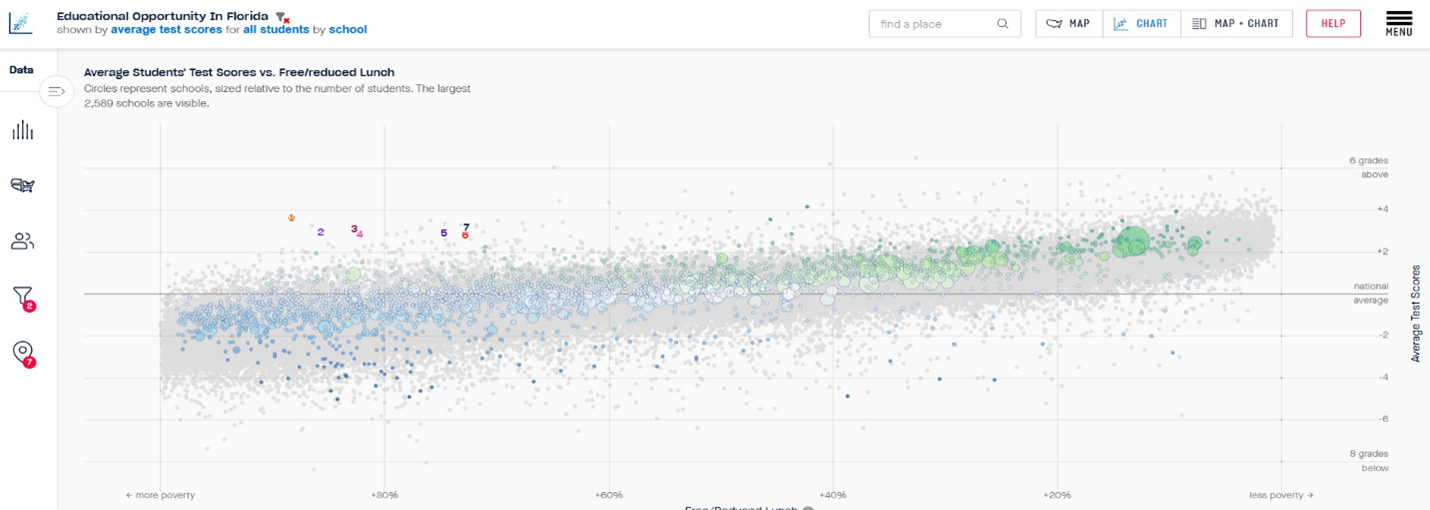
Through the wizardry of Stanford’s Educational Opportunity Project graph generator, I’ve placed New York Success Academies (Marked 1-7) in the graph for the overall state of Florida for academic proficiency. Schools are dots; green dots are higher than average, blue below average, etc.
You don’t see many high-poverty schools (graph runs from low poverty on the right to high poverty on the left) with students scoring 3ish grade levels above average, but that is exactly what Success Academy has consistently delivered in New York.
Being a rational human, you might think that New York policymakers would be falling over themselves to get as many Success Academies operating as possible, but that is just you being silly again. New York lawmakers maintain a statewide cap on the number of charter schools. Apparently, New York lawmakers feel the need to keep safe from, well, learning.
Florida, on the other hand, does not have a cap on charter schools. Rather than treating highly successful schools specializing in educating disadvantaged students as a public menace, Florida is rolling out the red carpet for highly effective school models. Success Academy plans to open 40 schools in Florida over the next 10 years, something which New York law prohibits.
Is it too much? Too much winning? No, Florida, you have to win more! Or to paraphrase Coach Heisman “You're doing all right, Florida; you’re ahead. But you just can't tell what those New Yorkers have up their sleeves. They may spring a surprise. Be alert, men! Hit 'em clean, but hit 'em hard!” Capitalizing on the abject folly of New York policymakers is hitting both clean and hard.

Saltwater Studies in South Florida was founded by education entrepreneur Christa Jewett. It is among the growing number of a la carte providers in Florida made possible by the state's education savings account programs.
Every state’s public education system is a market with supply (i.e., instruction) and demand (i.e., students needing instruction). These markets function as the operating systems for public education. Unfortunately, since the mid-1800s, these markets have been poorly designed and managed. As a result, every state’s public education operating system is deeply flawed.
Just as digital applications fail when their underlying operating systems malfunction, public education programs fail when the market mechanisms beneath them are ineffective. This helps explain why nearly every major reform initiative since "A Nation at Risk" (1983), from site-based decision-making and outcome-based education to teacher empowerment and regulatory accountability, has failed to deliver sustained, systemic improvement.
Public education will not realize sustainable improvement until each state’s public education market becomes more effective and efficient.
Public education’s primary problem is that the supply side of each state’s market is dominated by a government monopoly that also controls most demand side funding. A necessary correction is giving families greater control over a significant portion of the public funds allocated for their student’s education. Thanks to decades of advocacy by the education choice movement, families in 18 states may now use public funds to purchase education services and products from government and nongovernment providers.
But family-controlled funding alone is not enough. Every aspect of the design and management of public education markets must be improved, not just their demand side.
In high-performing markets, supply and demand are in sync; transactions are easy, and transactional costs low; information to guide decision making is transparent and accessible; resource allocation is effective and efficient; risks are managed appropriately, and customer satisfaction is consistently high.
The education choice movement has historically focused on increasing the number of families who control a portion of their students’ education funding while putting less emphasis on ensuring the market’s supply side grows in tandem. This imbalance often causes demand to exceed supply, driving up costs without improving quality and leaving families unable to access the best educational environments for each child. A recent study in Florida found that 41,000 students were awarded education choice scholarships last year but never used them, in part because there was no space in their desired schools.
Policymakers can help by enacting policies that better align supply with demand, ensuring students have access to the options they need.
During the 2025-26 school year, families nationally will spend about $6.75 billion in public funds customizing their children’s education. Emerging Artificial Intelligence tools are already showing promise in streamlining compliance, verifying transactions in real time, and safeguarding public dollars. By adopting these technologies wisely, states can protect taxpayers while reducing bureaucratic burdens on families and providers.
Families shape public education markets through their purchasing decisions. When those decisions are well-informed, they drive higher quality and better prices. Yet in every state, families lack easy access to reliable information about provider performance and pricing. To support better choices, states should create user-friendly tools that provide transparent, trustworthy information. Without this transparency, families are navigating markets in the dark.
Every market decision carries risks and consumes resources. For example, when states implement policies that drive high demand without growing supply, costs rise, and families lose access to the best options for their children. Effective markets require careful regulation and risk management to balance innovation with accountability while ensuring resources are allocated efficiently.
States are responsible for the design, implementation, and ongoing management of public education markets. Their goal should be market optimization, with family satisfaction as the ultimate indicator of success. An optimized market is one where all components function well together, and widespread family satisfaction suggests that children’s needs are consistently being met.
Public education markets are interdependent ecosystems and must be managed as such. When states align supply and demand, reduce friction, expand transparency, and manage risk wisely, they create conditions where every family can access instruction tailored to their child’s needs.
Lasting improvement will not come from the next reform fad. It will come from building healthy markets that empower families and unlock the full potential of every student.

Choice opponents have been known to throw contradictory arguments out against private choice programs. One moment they will claim that the majority of kids using universal choice programs were already going to private schools. A few moments later they will claim such programs are draining district schools of students and money. The irony of these mutually exclusive claims will often escape the person making them, and you can see hints of both in this New York Times podcast titled Why So Many Parents are Opting Out of Public Schools.
Sigh
Choice opponents make all kinds of claims, but not many can withstand even a modicum of scrutiny. Let’s take for instance a widely repeated fable- that Arizona’s universal ESA program has “busted” the state budget.
If you actually examine state reports like this one for district and charter funding and also this one for ESA funding, you wind up with:
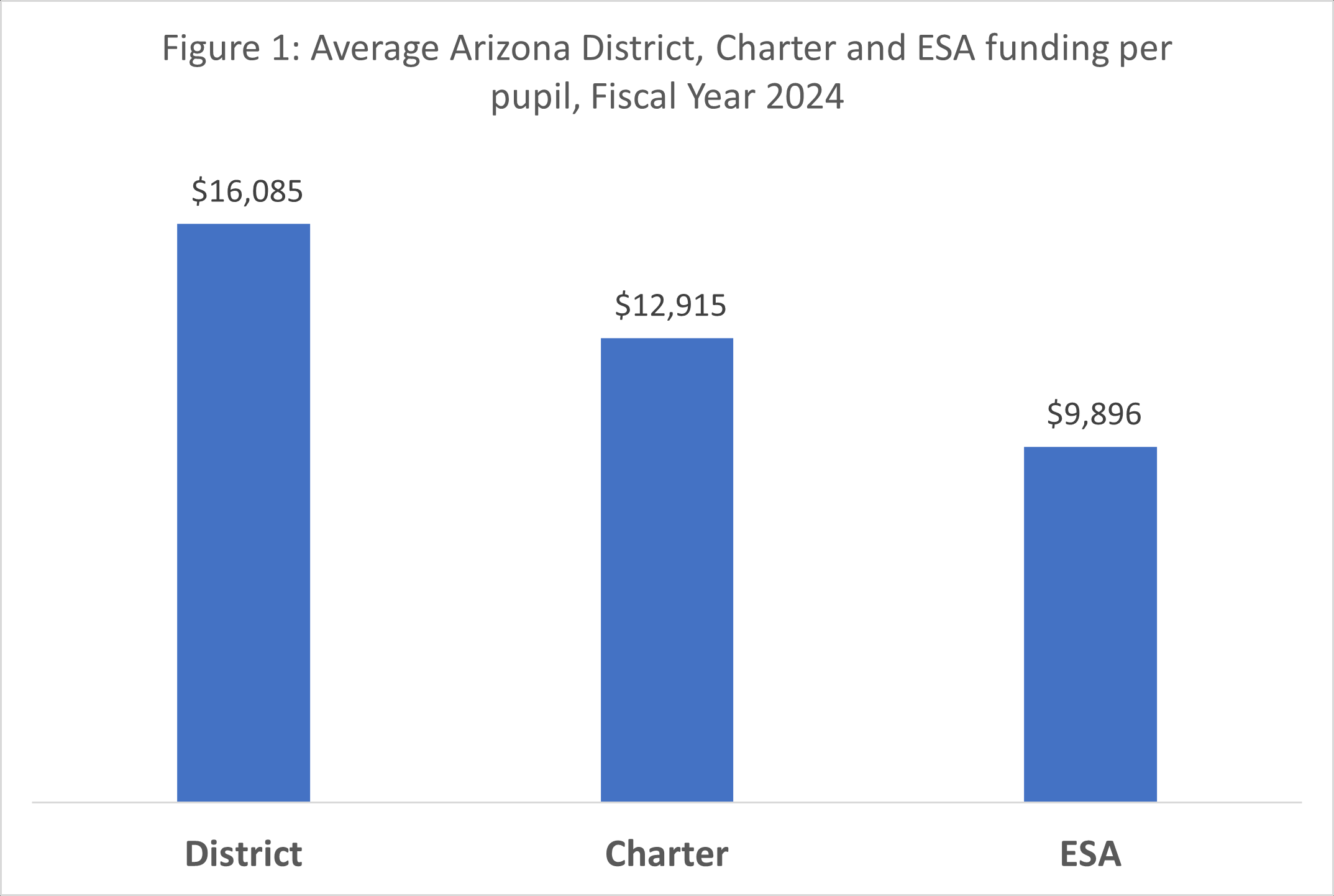
Arizona districts have exclusive access to local funding among other things and are by far the most generously funded K-12 system in the state. Districts, charters and ESAs all use the state’s weighted student funding formula, and ESAs get the lowest average funding despite having a higher percentage of students with disabilities participating than either the district or charter sector.
If you track the percentage of students served by the district, charter and ESA sectors respectively, and the funding used by each as a percentage of the total, you get:

So, there you have it; supposedly the sector educating 6% of Arizona students for 4% of the total K-12 funding is “bankrupting” the state of Arizona. Meanwhile the system, which generated an average of $321,700 for a classroom of 20 ($16,085*20), is “underfunded.”
A group of 20 ESA students receiving the average scholarship amount receive $123,780 less funding, but they are (somehow) “busting the budget.” The fact that a growing number of Arizona students opt for a below $10k ESA rather than an above $16k district education tells us something about how poorly districts utilize their resources. So does the NAEP.
There is a school sector weighing heavily upon Arizona taxpayers, but it is not the ESA program.
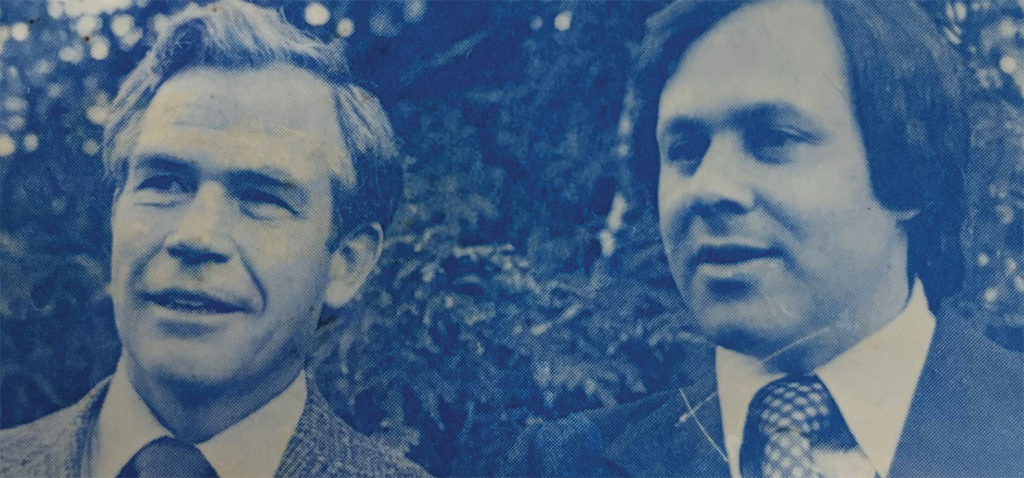
Berkeley law professors Jack Coons (left) and Stephen Sugarman described what we now call education savings accounts - and a system of à la carte learning - in their 1978 book, “Education by Choice.”
John E. Coons was ahead of his time.
Decades before the term “education savings account” became an integral part of the education choice movement, the law professor at the
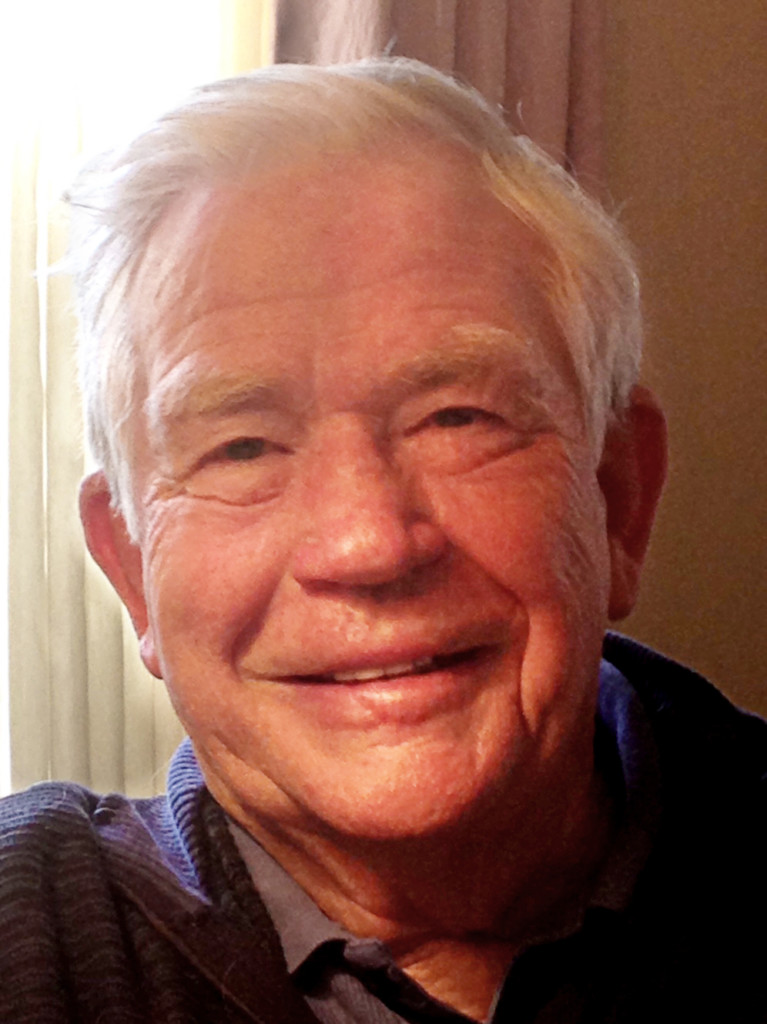
Jack Coons, pictured here, co-authored "Education by Choice" in 1978 with fellow Berkeley law professor Stephen Sugarman.
University of California, Berkeley, and his former student, Stephen Sugarman, were talking about the concept. In their 1978 book, “Education by Choice: The Case for Family Control,” the two civil rights icons envisioned a model drastically different from the traditional one-size-fits-all, ZIP code-based school system inspired by the industrial revolution:
“To us, a more attractive idea is matching up a child and a series of individual instructors who operate independently from one another. Studying reading in the morning at Ms. Kay’s house, spending two afternoons a week learning a foreign language in Mr. Buxbaum’s electronic laboratory, and going on nature walks and playing tennis the other afternoons under the direction of Mr. Phillips could be a rich package for a ten-year-old. Aside from the educational broker or clearing house which, for a small fee (payable out of the grant to the family), would link these teachers and children, Kay, Buxbaum, and Phillips need have no organizational ties with one another. Nor would all children studying with Kay need to spend time with Buxbaum and Phillips; instead, some would do math with Mr. Feller or animal care with Mr. Vetter.”
Coons and Sugarman also predicted charter schools, microschools, learning pods and education navigators, although they called them by different names.
Fast forward to Florida today, where the Personalized Education Program, or PEP, allows parents to direct education savings accounts of about $8,000 per student to customize their children’s learning. Parents can use the funds for part-time public or private school tuition, curriculum, a la carte providers, and other approved educational expenses. PEP, which the legislature passed in 2023 as part of House Bill 1, is the state’s second education savings account program; the first was the Gardiner Scholarship, now called the Florida Family Empowerment Scholarship for students with Unique Abilities, which was passed in 2014.
Coons, who turned 96 on Aug. 23, has been a regular contributor to Step Up For Students' policy blogs over the years. Shortly after the release of his 2021 book, “School Choice and Human Good,” he was featured in a podcastED interview hosted by Doug Tuthill, chief vision officer and past president of Step Up For Students.
 “It is wrong to fight against (choice) on the grounds that it is a right-wing conspiracy,” said Coons, a lifelong Catholic whom some education observers describe as “voucher left.” “It’s a conspiracy to help ordinary poor people to live their lives with respect.”
In 2018, Coons marked the 40th anniversary of “Education by Choice” by reflecting on it and his other writings for NextSteps blog.
He said he hopes his work will “broaden the conversation” about the nature and meaning of the authority of all parents to direct their children’s education, regardless of income.
“Steve (Sugarman) and I recognized all parents – not just the rich – as manifestly the most humane and efficient locus of power,” he wrote. “The state has long chosen to respect that reality for those who can afford to choose for their child. ‘Education by Choice’ provided practical models for recognizing that hallowed principle in practice for the education of all children. It has, I think, been a useful instrument for widening and informing the audience and the gladiators in the coming seasons of political combat.”
Arizonans have a pet peeve involving people from “back East” who judge us before they understand us. The Washington Post jumped into this with both feet by publishing a story with the headline Public schools are closing as Arizona’s school voucher program soars.
The story, which prominently features the long-troubled Roosevelt Elementary School District’s decision to close five schools, has multiple problems. The paragraphs below will document one of the main problems. Before moving to that, the reader should note that multiple people made efforts by both email and phone to alert the Post reporter to these data during the research process, including the sharing of many of the links to the same state data sources that will be used below.
Arizona K-12 choice is complex with multiple types of choice operating simultaneously and interacting with each other: the nation’s largest state charter school sector, multiple private choice programs, and (the granddaddy of them all) district open enrollment. No one should fault anyone for failing to appreciate the complexity of a situation from afar, but ignoring data to formulate a fundamentally misleading narrative is another matter.
Just to set the stage, under the Arizona education formula, spending follows the child. From the perspective of a school district, it makes little financial difference as to whether a child transfers to another district, enrolls in a charter, takes an ESA, or moves to California -- you either have enrollment to get funded, or you do not. Because districts also generate local funding with enrollment, they are (by a wide margin) the best-funded K-12 system in the state on a per-pupil basis on average.
The Arizona Department of Education tracks public school students by district of residence and by public district or charter school of attendance. The 2025 report includes a tab called “District by Attendance,” and it reveals that of the total public-school students residing with the boundary of Roosevelt Elementary and attending a Roosevelt Elementary district school amounts to 6,551 students. The same report reveals that 5,764 students live within the boundaries of Roosevelt but attend charter schools. Finally, the open enrollment report documents that 2,741 students live within the boundaries of Roosevelt but attend other district schools through open enrollment.
Separate reports from the Arizona Department of Education document ESA use by school district. The most recent quarterly report currently available finds that 803 students reside within the borders of Roosevelt Elementary and are enrolled in the ESA program (see page 22). If we stopped the story there, the conclusion that the fiscal impact on Roosevelt Elementary from other school districts was more than three times larger than that of the ESA program would appear unavoidable. “Public schools are closing as a majority of families choose other public schools” does not seem quite as exciting but would be far more accurate.
But we should not stop the story there. Another report from the Arizona Department of Education tracks not only which districts ESA students reside in, but also what school they previously attended. Page 17 of this report reveals that the number of students residing in Roosevelt Elementary district and which previously attended a Roosevelt Elementary school stood at 129. Put it all together, and the picture looks like this:

School boards don’t close five schools in a 6,551-student district because of the loss of 129 students. Enrollment in Roosevelt Elementary began to decline years before the ESA program existed. “Public schools are closing as Arizona voucher enrollment soars” is akin to “Sun rises as rooster crows” as it pertains to Roosevelt Elementary. If the ESA program did not exist, we have every reason to believe that a large majority of ESA students would employ other choice programs.
The fault lies not in Roosevelt’s stars, but in itself -- a large majority of the community it serves prefers schools other than the ones they are operating. Statewide Arizona school districts spend an estimated billion dollars annually on underutilized and vacant school buildings -- funds they could be spending on teacher salaries and academic recovery, and which also happens to approximately equal the budget of the ESA program, which 90,000 Arizona students use for K-12 education.
The Roosevelt school board has decided to focus their efforts, and good luck to them. The unstated thesis of the Washington Post’s narrative, however, is that readers should sympathize with the interests of Roosevelt employees rather than with those of the Roosevelt families exercising agency in the education of their children. This is the greatest misdirection of all. We fund schools first for the benefit of children, not the adults working in the schools.
This is all an all-too-common sort of thing in K-12 journalism these days, and it is hardly unique to Arizona. Florida, for example, has no shortage of hugely exaggerated claims regarding the impact of choice on school districts. Author Amanda Ripley, interviewed for a book she wrote on deep problems of journalism, noted the “strange and insular world of journalism prizes,” which encourage simplistic “us versus them” stories. “This adversarial model that we’ve got going in education, journalism, and politics no longer serves us. There’s a good guy and a bad guy, and everything’s super clear; it just breaks down. And we keep awarding prizes in that model. But 99 percent of stories are not that clear-cut,” Ripley noted.
What is clear-cut: Roosevelt Elementary may have 99 problems, but losing 129 kids to the ESA program ranks far from being one.

The Rev. H.K. Matthews, front row, second from left, and John Kirtley, front row, far left, joined more than 6,000 marchers at a 2010 Tallahassee rally to support expanding the income-based Florida Tax Credit Scholarship Program.
By John Kirtley
The Rev. H.K. Matthews passed away Monday at the age of 97. As I urge you to read in this obituary, he was one of the towering figures in the Florida civil rights movement.
He was arrested over 30 times fighting for equal rights in Northwest Florida. He was beaten, along with John Lewis and other brave activists, on the Edmund Pettus Bridge in their first attempt to march from Selma to Montgomery. There is now a park named in his honor in Pensacola. You can also read his autobiography, “Victory After The Fall.”.
On a 2010 visit to Pensacola to recruit schools for the Florida Tax Credit Scholarship program, former Step Up For Students grassroots organizer Michael Benjamin and I met the operator of a faith-based school in town. He urged us to meet with Rev. Matthews, who he thought might respond well to the social justice message of the scholarship program. At the time, the average household income of our students was less than $30,000, and 75% were minorities. Michael and I said we would love to meet him.
Rev. Matthews didn’t say much during our initial visit; Michael and I explained how the scholarship program empowered low-income families to choose a different school if the one they were assigned to wasn’t working for them. He seemed to just take it all in but offered neither affirmation nor disagreement.
Almost as an afterthought, I invited him to a march and rally we were having the next month in Tallahassee. We needed the legislature to pass a bill to expand the scholarship program to relieve our waitlist, and we asked scholarship families to come to the Capitol to show their support. To my surprise, he agreed to attend.
On that day, over 6,000 people marched from the convention center to the Capitol. I invited Rev. Matthews to walk in front of the crowd with other faith leaders. Normally I would never walk in the front row, but I wanted to make sure everything went smoothly for him. He was very quiet as the huge crowd marched.
When we had gathered for the rally in the Capitol, I placed him in a prominent seat on the stage. A few minutes into the event, he motioned me over and asked if he could speak to the crowd. I had no idea what he was going to say, but I wasn’t going to say no. I went to the minister running our show and asked him to introduce Rev. Matthews.
What would he say? Was he with us?
I soon had my answer.
“This reminds me of the old movement,” he said. “Seeing thousands walking in the streets, fighting for the right to determine their own future, to fight for what is best for their children. When I worked with Dr. King back in the day …”
When he said those words, there was a murmur in the crowd, both students and adults. These kids had read about Dr. King in their history books. Some of them knew that there were not one but two marches across the Pettus Bridge, and here was someone who was there at the first attempt, someone who took the blows.
He was indeed with us.
Immediately after the rally, Rev. Matthews was swarmed by students young and old, some asking questions about his time with Dr. King, some young ones who just wanted to touch him — I suppose just to make sure this hero was real. They did not let him go for at least 20 minutes.
I could tell at the time this moved him. He told me so later. After that day he would call me to ask if there was anything he could do to help the movement. We had him appear at events with donors, governors, and legislators.
He would lead another march for us in 2016, when over 10,000 people came to protest the lawsuit filed by the Florida teachers union demanding that the courts shut down the Tax Credit Scholarship, which would evict 80,000 poor kids from their schools. That day Rev. Matthews was joined at the front of the procession by Martin Luther King III, the son of the man Matthews marched with 50 years prior. You can watch a 60-second video of that march here.
I had the pleasure of joining him at his church in Brewton, Alabama, where he moved in later years. He was being honored for his years of service to that church. I was honored, though very surprised, when he called me up to speak that day. Luckily, the words to praise him came easily.
They come again easily today, but not without a few tears.
How fortunate I was to have my life intersect with his, however unlikely that would have been to me before this movement changed the course of my life.
How fortunate the education freedom movement was to have his blessing and his involvement.
How fortunate the state of Florida was to have his tireless efforts fighting for civil rights.
How fortunate, all.
Rest in peace, Rev. Matthews.
John Kirtley is founder and chairman of Step Up For Students.
Florida gives parents the ability to direct the education of their children. Today about half of all K-12 students in the state attend a school of choice, and 500,000 students participate in state educational choice scholarship programs.
Gov. Ron DeSantis accelerated these trends in 2023, when he signed HB 1 and made every student eligible for a scholarship. No school can take any student for granted, and state funding follows students to the learning options they choose.
Unfortunately, misleading claims amplified in the media have blamed this expansion of parental choice for school districts’ budget challenges.
Sarasota County Schools, for example, recently estimated that scholarships “siphoned” $45 million from its budget, a figure cited in a WUSF article. In reality, most of the $45 million represents funding for students that Sarasota was never responsible for educating, such as those already in private schools, homeschooling or charter schools. It also does not account for students who return to district schools after using a scholarship. Once those factors are considered, the actual impact is considerably smaller than the headline number suggests.
For the 2024-25 school year, Sarasota County lost just 330 public school students to scholarship programs, but only 245 of those students came from district-run public schools. If those students had stayed, they would have brought the district about $2 million, not $45 million. That figure still does not account for the students who returned to district schools after using a scholarship the prior year, so the real impact would be smaller.
Other districts have been vocal about their budget difficulties, often attributing them solely to growing scholarship demand, such as Leon County Public Schools, which in 2024-25 lost 240 students from district-run schools (0.8% of enrollment), and Duval County Public Schools, which lost 1,237 students (1.2% of enrollment).
Statewide, 32,284 students left public schools in 2024-25 to use a scholarship. That is only 1.1% of all public-school students in Florida, and even that total includes those who previously attended charter schools, university-affiliated lab schools, virtual schools, and other public-school options.
Looking at district-run schools alone, just 24,874 new scholarship students left for scholarship programs in 2024-25. Another 5,507 came from charters, and 1,897 came from virtual schools. In fact, as a percentage of their total enrollment, charter schools lost more students to scholarship programs (1.4%) than district-run schools did (1%).
This means that the expanded scholarship program may be having a bigger impact on charter schools than districts. Charter schools, however, haven’t been as vocal about vouchers, and that is likely because charters continue to grow enrollment while district schools have started to shrink.
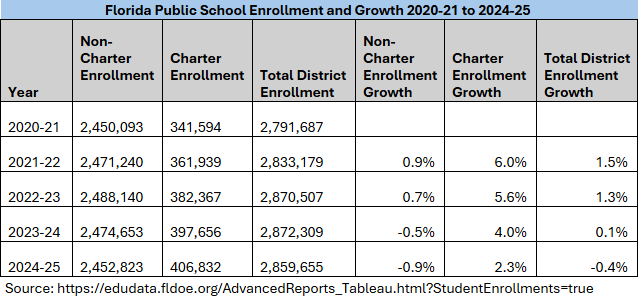
Enrollment declines in some districts have been real, even if the blame on scholarships is misplaced.
Declining enrollment is being driven by parent preferences – but also by shifting demographics and the ebb of the post-Covid population boom. Florida is one of the few states where overall K-12 population is expected to continue growing, but the growth will be uneven, and every school will have to compete for students.
Even as they face intense competition and demographic headwinds, Florida’s charter schools have kept growing. Some innovative district leaders have signaled a willingness to hear the demand signals from parents and create new solutions to meet their needs.
Understanding what parents seek in private and charter schools, and how new public-school models can better meet those demands, would be a good place for districts to start.
Pre-K and Voluntary Pre-Kindergarten (VPK) have also been major feeders for Florida’s scholarship programs. In 2024-25, 53,825 new scholarship students came from pre-K — somewhere between one-third and nearly half of all VPK students statewide.
Public schools have limited Pre-K offerings. Statewide, there are less than one-third as many Pre-K students as kindergartners enrolled in public schools. Private schools, by contrast, have used it as a key pipeline to recruit future students.
Districts have other avenues to respond to changing parent demands. Since 2014, when the Family Empowerment Scholarship for Students with Unique Abilities (FES-UA) was introduced as the Personal Learning Scholarship Accounts, districts have been allowed to offer classes and services to scholarship students.
The passage of HB1 in 2023 transformed every state scholarship into an education savings account. K-12 families now have more flexibility to use scholarships for “a la carte learning,” in which they pick and choose from a variety of educational options. By offering part-time instruction, tutoring, therapy, and other services, districts can win back students and the associated funding. So far, 21 of Florida’s 67 districts have taken advantage of this opportunity, with 10 more in the pipeline.
Florida’s enrollment shifts are real, but data shows the “voucher drain” narrative overstates the impact. The real challenge for districts is not money being “siphoned;” it is families choosing other options. Districts that adapt and compete for students will keep both enrollment and funding – leaving students, families and taxpayers better off.

