Established in 2001 as a ministry of Grace Covenant Church, Grace Covenant Academy in Cornelius, North Carolina, one of 844 private schools in the state serving more than 123,000 students, prides itself on excellence in Christian education, serving 3-year-olds through Grade 8.
Editor’s note: This commentary from John Hood, a board member at the John Locke Foundation, appeared Wednesday on carolinajournal.com.
The North Carolina General Assembly is about to make all children eligible for the state’s Opportunity Scholarship program. They won’t all receive the same amounts — poor and middle-income families will be eligible for vouchers in the range of $6,500 to $7,200 per student, while upper-income households will receive much less.
Nevertheless, both proponents and opponents are quite properly using the term “universal” to describe the policy, which will go into effect for the 2024-25 academic year.
School-choice advocates are ecstatic. Critics are despondent. Although my sympathies here are evident and longstanding, I think it would behoove both sides to temper their expectations a bit. There won’t be a gigantic exodus of children from district-run public schools in the fall of 2024.
For one thing, North Carolina’s current private schools don’t have the capacity to absorb such an enrollment boom. One of the best arguments for choice programs is their potential to foster entrepreneurship in education.
Just as the creation of charters gave educators, parents, and reformers the capacity to develop new models for public education, voucher expansion will give existing providers the capacity to add new grades and campuses while creating opportunities for new entrants to the K-12 space.
It can’t all happen in a year, though. It takes time to assemble teams, build or rent facilities, hire faculty, and develop content.
Furthermore, while some families will immediately take advantage of scholarships for which they’ll be newly eligible, many others will be intrigued but cautious. They’ll do their homework about what private options are already available, where new schools will open, and when they calculate the benefits of transferring their children will exceed the costs (which aren’t purely monetary, of course).
Still other families will have little interest in taking advantage of opportunity scholarships at all, either because they’re satisfied with the education their children are receiving in public schools — district or charter — or because they don’t like the private options available.
To continue reading, click here.
 Editor’s note: This commentary from Mike McShane, director of national research at EdChoice, appeared Wednesday on forbes.com.
The great scholar of deregulation and later Supreme Court Justice Stephen Breyer told a (possibly apocryphal) story of the late Sen. Ted Kennedy. During the 1970s, Kennedy held numerous hearings about deregulating the airline industry, a cause supported by everyone from Ralph Nader to Milton Friedman.
Kennedy, the story goes, was approached by one of his Boston constituents and asked, “Why are you holding hearings about airlines? I’ve never been able to fly.” To which Kennedy replied, “That’s why I’m holding the hearings.”
A decade ago, Derek Thompson, writing in the Atlantic, summed up the effects of airline deregulation. Airfares fell 50%. The per-mile cost of flying did too (even including fees). At the time, Kennedy’s constituent was complaining about what issues he was devoting his energy to, less than 20% of Americans had ever flown. By 2000, more than half of the country was taking at least one trip every year.
By breaking the vise-like grip that the federal government, through the Civil Aeronautics Board, had on controlling the prices and operations of airlines, air travel was democratized. Millions have benefited.
This year’s wave of school choice legislation has been about democratizing school choice. Historically, lots of people in America have had school choice if they have the money to purchase a house zoned to a good school, to pay for private school tuition, or to homeschool.
They also have been able to supplement their child’s traditional education with a host of other choices, from therapies to extracurriculars to tutors. Universal education savings accounts democratize both of those sets of opportunities, supporting families in their choices of schools and the surrounding services that they want for their child.
To continue reading, click here.
 Editor’s note: This commentary from Christian Barnard, senior policy analyst at Reason Foundation, appeared Monday on the foundation’s website.
The argument that private school choice programs save taxpayer money has been compelling and straightforward for decades. Most private school vouchers, tax credit scholarships, and education savings account programs have had income-based or other eligibility limits that ensured most school choice program participants—usually between 85 and 95% -- were previously public school students.
This high “switcher” rate—the share of school choice program participants who were previously enrolled or would have enrolled in public schools—saves taxpayer money because choice scholarships are cheaper than public schools. That’s why proponents have been able to argue that both participating families and taxpayers benefit from private school choice.
But in today’s policy environment, where states are adopting universal school choice programs—like Arizona, Arkansas, West Virginia, and Florida have recently—the taxpayer savings argument becomes more complicated.
By definition, universal school choice is available to all students. This makes it a far more impactful and widespread choice program but complicates the key variable responsible for fiscal savings—switcher rates.
When fully implemented and assuming there are no cost caps, universal school choice programs are open to entire populations of students already attending private schools or being homeschooled, and these students weren’t previously receiving taxpayer support.
This is new territory for school choice proponents since past programs were primarily designed to target low-income families or students with disabilities who were likely to be enrolled in public schools. By making choice scholarships quickly available to non-public school student populations with little incentive not to take the taxpayer funds, universal school choice programs have lower up-front switcher ‘
To continue reading, click here.
Providence Hybrid Academy, serving Pennsylvania’s Lehigh Valley, offers outdoor play, meaningful friendships, and a supportive community of like-minded parents influenced by the work of Charlotte Mason, a 19th century British educator and strong Christian believer.
Editor’s note: This commentary from Colleen Hroncich, a policy analyst at the Cato Institute’s Center for Educational Freedom, and Sharon Sedlar, founder and president of PA Families for Education Choice, appeared last week on realclearpennsylvania.com.
Enrollment in Pennsylvania district schools has fallen slightly more than 3% since 2019-20 – a drop of nearly 51,000 students. At the same time, homeschooling and private school enrollment have risen 53% and 5%, respectively.
There has clearly been an uptick in parents selecting options beyond their local district school, and the trends don’t show any signs of slowing as another school year wraps up.
Two increasingly popular options are microschools and hybrid schools. Unfortunately, these are often choices that seem foreign and complicated to many parents, keeping families who would likely thrive in one of these options from taking the leap.
The models don’t necessarily have strict definitions, and the terms aren’t mutually exclusive. A microschool can be a hybrid school, and vice versa. All of this can add to the confusion for parents exploring their options.
Microschools, as the name implies, are small – sometimes consisting of fewer than 10 children in a close age range. A larger microschool might serve 100 or so students in small, multiage groups, like ages 7-9, 10-13, and so on.
Microschools often place students based on where they currently are in a subject area rather than relying solely on their age. They also tend to be more student-directed compared to a conventional classroom, with learning coaches, tutors, or guides there to help the kids learn. There may or may not be a formal curriculum.
Hybrid schools utilize a combination of at-school and at-home learning, but there can be much variety in how they are structured. Students may meet in person two days and learn at home three days, or the other way around. Some hybrids meet half days in person, while the rest of the time is spent at home.
Parents, students, and teachers often call it the “best of both worlds,” as their children get the support of in-person instruction and the flexibility of homeschooling. No wonder recent polling shows 55% of Pennsylvania parents are interested in some level of hybrid schooling.
To continue reading, click here.
 Aaron Churchill, Ohio research director for the Thomas B. Fordham Institute, has released a new report on charter schools in his state for the institute.
Broadly speaking Churchill praises an effort that began in 2015 to tighten up accountability for authorizers, advocates for funding and other efforts to expand “quality” charters, and calls for funding equalization between brick-and-mortar district and charter schools.
Churchill writes: "Ohio can’t afford to slip back into the dark ages of lax accountability and anything-goes in the charter sector. Lawmakers need to maintain the commitment to accountability for sponsors and schools to ensure that student achievement remains a priority and that the performance of the sector continues its upward trend."
This bit of text in the study got your humble author’s attention: "Through much-needed reforms, state lawmakers have reinvented Ohio’s charter school sector. The Buckeye State is no longer the “wild west” of charter schools, as dozens of low-performing schools have closed, and more than forty sponsors have departed."
Out in Arizona, we take the “wild west” term as a badge of honor, given our remarkable results and the unfortunate stagnation of much of the rest of the charter movement. I don’t live in Ohio, and thus will offer no opinion on any of Chu’s recommendations. I will however offer a different perspective.
Let’s start with exhibit A, the Brookings charter school access map from 2014-15.
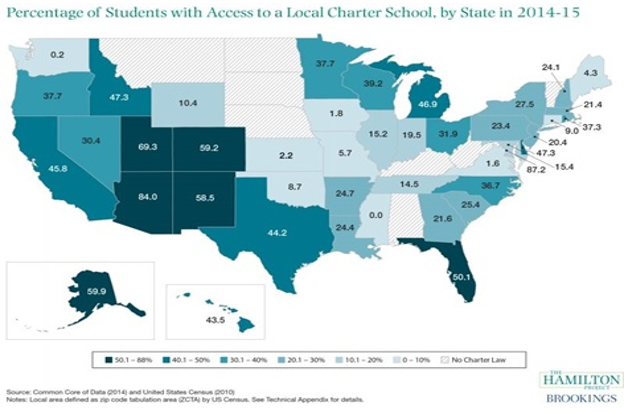
The map shows the percentage of students in each state with one or more charter schools operating in their ZIP code. Even before the 2015 reforms that Chu noted led to 100 Ohio charter schools eventually closing, the state’s charter school sector operated in fewer than one-third of all Ohio ZIP codes.
This was according to the initial design of the Ohio charter statute. Until a recent change in statute supported by both Fordham and yours truly effectively prevented charter schools outside urban areas.
The Stanford Educational Opportunity Project has compiled academic achievement data on schools from around the nation by linking state exams. This chart shows the average rate of academic growth by school for Ohio charter schools, 2008-2018.
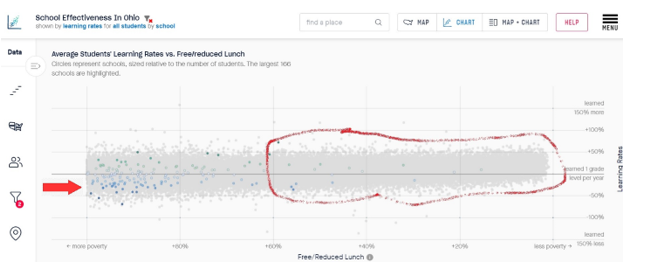 Figure 1: Average Academic Growth Rates for Ohio Charter Schools, 2008-2018 (Source: Stanford Educational Opportunity Project)
Two things to note: First, the circle. Ohio has very few charter schools with either median or low levels of student poverty. The lack of schools in the red circle constitutes further confirmation of the heavily geographically segregated nature of Ohio’s charter school sector seen in the Brookings map.
Second, note the red arrow. Ohio had a large number of high-poverty charter schools with low levels of average academic growth (blue dots below the “learned 1 grade level per year” line. This is disturbing. It means the already large achievement gaps grew in these schools over time.
Finally, take note of the blue-to-green dot ratio: High grow schools do not outnumber schools with low levels of growth.
Now, let’s compare Ohio’s geographically segregated charter sector to the nation’s most geographically inclusive charter sector in Arizona. As shown in the Brookings map, 84% of Arizona students had one or more charter schools operating in their ZIP code.
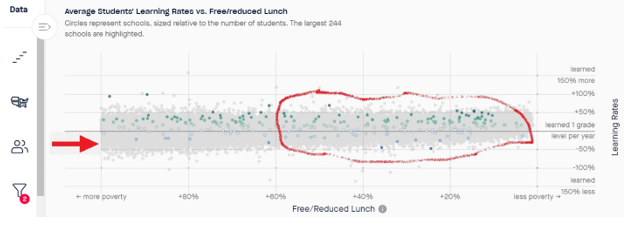
Figure 2: Average Academic Growth Rates for Arizona Charter Schools, 2008-2018 (Source: Stanford Educational Opportunity Project)
Look again in the red circle. Lots of charter schools and lots of charter schools with high levels of academic growth.
Next, let’s examine the high poverty area of the chart near the red arrow: very few low-growth schools.
Finally, notice the total ratio of green-colored schools to blue-colored schools in the entire chart. Arizona has high growth schools across the entire sector, relatively few low-growth schools.
Data from the National Alliance for Public Charter Schools reveal that Arizona has a larger absolute number of urban charter schools than Ohio. How did the state avoid a large number of low-growth schools-urban or otherwise? Closures, but largely not of the administrative variety.
The Arizona State Board for Charter Schools listed 106 charter school closures between 2010 and 2014 and the reasons for the closures, a few more than the 100 closed in Ohio since 2015. The board describes a wide variety of reasons for closures including lack of enrollment, loss of a facility, merger with another charter, etc. The explanations are broad enough to require interpretation, but approximately 16 of the school closures involve a clear administrative action by the board to either close or merge.
Arizona charter schools that closed between 2000 and 2013 had an average tenure of operation of four years and an average of 62 students enrolled in the final year of operation for closed Arizona charters. Arizona law grants 15-year charters, but the competitive environment in Arizona closes charters early and often.
Why does Ohio have so many low-growth charter schools? I believe that this map from the Fordham Institute explains much of the difference between Ohio and Arizona:
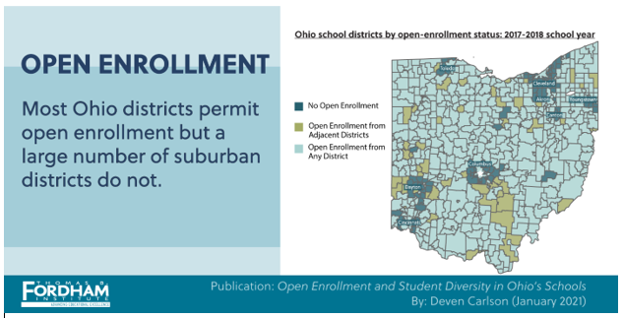
Notice that not every suburban district in Ohio participates in open enrollment. Notice also the sickly, green-colored districts that only participate in open enrollment with adjacent districts. One can’t help but wonder just which students they might be trying to avoid.
My theory is as follows. Low-growth urban charter schools survived in Ohio but quickly closed in Arizona because Arizona students have lots of other options. Nearly all Arizona school districts participate in open enrollment. This includes relatively affluent districts like Scottdale Unified, which brings in over one-quarter of its total enrollment from outside the district’s boundaries.
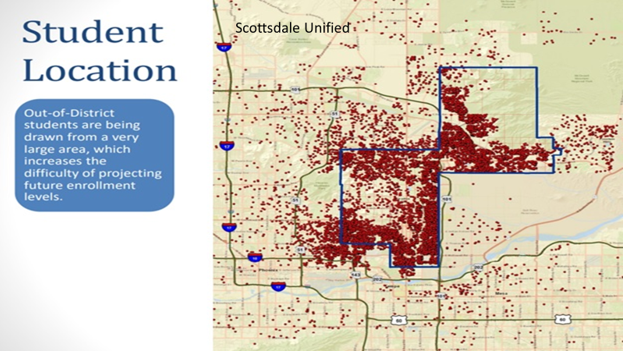
Scottsdale Unified enrolls approximately 20,000 students, with 4,500 students coming to the district through open enrollment. The 9,000 students who live within the boundaries of Scottsdale Unified who attend schools in charters, other districts, private schools, etc., doubtlessly play a large role in making open-enrollment opportunities available. Suburban districts in Arizona prefer to participate in open enrollment rather than close campuses.
Arizona’s suburban charter schools opened suburban districts to open enrollment, leading to closure of low-demand charter schools. This virtuous cycle does not have the chance of occurring in charter sectors constrained exclusively to urban areas.
Wisely, Ohio lawmakers recently expanded choice options by removing geographic restrictions on charters and expanding private choice options. The limitations of Ohio’s charter sector thus seem to owe more to poor central planning than to “wild west” liberality.
Author and podcast host Steven Berlin wrote: “The strange and beautiful truth about the adjacent possible is that its boundaries grow as you explore them. Each new combination opens up the possibility of new combinations.”
Arizona’s experience shows that choice programs, far from being siloed, interact with each other out in the field. Allowing families and teachers to shape the K-12 space is a much better idea than leaving it to state officials and is the best solution to the elimination of low-performing schools of any sort: more options.
Embracing liberality takes humility and wisdom, but without it, choice sectors quickly hit a low ceiling in serving the interests of the poor.
Ohio’s charter failure, by my way of thinking lies in central planning. The goal ought not be to replace bad central planning with better central planning. Rather, the goal should be to create a fully inclusive and demand-driven system of education that allows educators and families to act as the hands of a potter at a wheel, molding the K-12 space over time to create the types of schools educators want to run – and that families want to support.
 Editor’s note: This article appeared last week on yahoo.com.
The state Senate on Thursday gave initial approval to raising the income ceiling for parents to be eligible to receive taxpayer-funded grants to send their children to private, religious, home or alternative public school programs.
While the legislation (HB 367) heads to the Senate Finance Committee for further review, the party-line 14-10 vote for the House-approved measure virtually ensures it will pass the Legislature before the close of the 2023 session. All Senate Republicans backed the measure.
The grants, known as education freedom accounts, currently are limited to families that make up to 300% of the federal poverty level — $90,000 for a family of four.
The bill that cleared the Senate would raise the income limit for that same family to $105,000 annually, or 350% of the federal poverty level.
The Senate killed without debate a second House-passed bill (HB 464) to expand — regardless of income — EFAs for all children of active military families, bullied students, students in foster care, homeless students, those who have disabilities and those who attend under-performing schools.
Sen. Donovan Fenton, D-Keene, said the program doesn't have enough oversight to know whether the EFAs have led to better learning.
"I am unaware of a single program that is allowed to operate like this except the EFA program," Fenton said.
Sen. Daryl Abbas, R-Salem, said the Legislature should do all it can to allow more families to have options other than their assigned public schools.
"This is equity. That's the policy right I am looking at with this bill," Abbas said.
To continue reading, click here.
 Editor’s note: This commentary from Daniel Martnez, director of external affairs for Americans for Prosperity – Florida and a reimaginED guest blogger, is an exclusive to reimaginED.
The 2023 legislative session was truly historic, marking the beginning of truly meaningful education choice for parents across the state. This will result in even brighter futures for Florida's children. By enacting HB 1 into law, state leaders have dramatically boosted the opportunity for every child in the state to receive an education carefully tailored to their individual needs.
Major school choice reform was the number one legislative priority of Americans for Prosperity-Florida, and we couldn’t have achieved this success without a supportive Legislature – and, equally important, the overwhelming support of our members across the state.
So, when the new law takes effect July 1, what will it mean for you and your family? The biggest change is that it allows all Florida children to have Education Savings Accounts (ESAs), which will provide families with the freedom and flexibility to use state education funds to open up a wide range of education options – including public, private, magnet, or charter schools or home education, whether online or in person.
This legislation guarantees that the state money allocated for each student follows them, even if they leave the one-size-fits-all monolith of traditional public schools. Students and their parents will now be able to make the choice that’s best suited for each child’s unique abilities – opening access and opportunity by removing the barriers that ZIP codes or financial status currently pose for students hoping to receive a different form of education.
How can your family take advantage of this new educational opportunity? We expect school choice to be in full effect quite soon, so to begin your application, you’ll need to provide:
Once approved, you’ll be able to access a portal where you can view your funds and apply the money toward tuition and other pe-approved expenses.
To learn more about the scholarship programs, visit the Florida Department of Education.
As Florida continues to be a trendsetter in education, showing other states the path to true educational excellence, we look forward to seeing the far-reaching positive impacts of this education reform. We’re confident that it will continuously transform education in our state for the better, changing the lives of young Floridians and their families.
None of this would have been possible without Florida’s dedicated leaders, especially House Speaker Paul Renner and bill sponsors Rep. Kaylee Tuck, Rep. Rene Plasencia, Sen. Corey Simon. We thank them for their dedication to ensuring brighter futures for all of Florida’s children. With leadership like this, Florida will continue to lead the way for years to come.
 With the Texas Legislature ending its initial session on May 29, hopes for comprehensive school choice legislation are fading fast. But that doesn’t mean it won’t happen this year, and state legislators may want to cancel any summer travel plans they had until it does.
On one hand, the Texas Senate has done its part. It passed SB 8, which would not only establish a near-universal education savings account program but also greatly expand open enrollment opportunity and eligibility. In other words, all Texans would finally have the opportunity to choose the school that best fits their children’s needs.
The Texas House, on the other hand, seems rather uninterested in educational freedom. School choice legislation there faces the same obstacles that have stymied it for decades: special interests, lobbying from teachers unions, and — as silly as it sounds — concerns regarding high school football.
Dramatic increases in popular support for school choice have not changed this outcome. House members have already ripped SB 8 to shreds, turning it into a hollow shell of its former self.
The House’s actions are not entirely out of left field — there is an argument for incrementalism. Indeed, Texas does not currently have any private school choice programs, and in most cases, incremental gains in educational choice are better than no gains at all. This is what the Texas House is banking on.
The House, however, is misreading the room. Texans want more than just a barebones school choice program, and House members opposing school choice do not have the political power to resist. The only question is, how long will it take for them to realize it?
If they don’t want to spend their summer in session in Austin, they should change their tune sooner rather than later. Because of the governor’s powers to call a special session, the legislative process favors school choice supporters — opponents cannot simply just wait out the clock.
Though the Texas Legislature only meets for roughly 140 days every two years, under Texas law, the governor not only has the authority to call unlimited special sessions but can also delineate what exactly each session will focus on. In a state where the governor typically has very little direct authority, this bully pulpit is powerful and persuasive.
Gov. Greg Abbott, who has become a prominent educational freedom advocate, has already indicated that he’s going to use that bully pulpit to play hardball.
“Texas parents and their children deserve the time and effort it will take to pass critical school choice legislation this session,” Abbott said in a May 14 statement. “... failure to expand the scope of school choice to something close to the Senate version or the original House version of the Senate bill will necessitate special sessions.”
Abbott’s threat is not empty — he has called repeated special sessions before. They lasted all summer, and Abbott got what he wanted. There is little reason this time would be any different.
Moreover, there would be no political advantage to going back on his word. After all, more than 80% of Texans support expanding public school choice, and 60% of Texans support private school choice. Abbott does not have anything to lose and much to gain by calling repeated special sessions all summer for school choice.
House members, on the other hand, have much to lose. Voters will remember that their House representative denied parents the opportunity to offer their children a customized education. Indeed, several state representatives were successfully ousted by pro-school choice candidates last cycle, and the 2024 primaries are less than a year away.
If the House blocks school choice forever, several more will likely lose their positions. Eventually, they will have to recognize that standing with teacher unions, despite their donations, pays no electoral dividends.
Nevertheless, the House has remained exceptionally stubborn so far. The House Public Education Committee, even after Abbott’s warning, is planning to pass their watered-down version of SB 8. The legislation, if passed, will be vetoed, and special sessions will be called.
The odds that a comprehensive school choice program eventually passes in Texas are high. When it will happen — that, nobody knows.
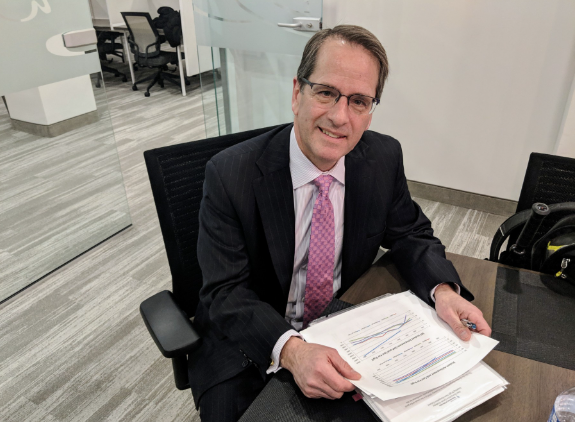
New Hampshire Education Commissioner Frank Edelblut is eager for families seeking a nontraditional instructional model for their children to find educational success.
Editor’s note: This commentary from Jason Bedrick, a research fellow with The Heritage Foundation's Center for Education Policy, appeared Tuesday on dailysignal.com.
The momentum for school choice is continuing to build nationwide.
Eight states have enacted new education choice policies or have expanded existing ones so far this year, including Indiana, Montana, and South Carolina earlier this month alone.
Of the eight, four states—Arkansas, Florida, Iowa, and Utah—enacted school choice policies that will be available to all K-12 students, joining Arizona and West Virginia in making every child eligible for education savings accounts or ESA-like policies that allow families to choose the learning environments that align with their values and work best for their children.
Indiana came close by expanding eligibility for its voucher and tax-credit scholarship policies to about 97% of K-12 students statewide. South Carolina’s new ESA is limited to low- and middle-income families, while Montana’s new ESA will expand education options for students with special needs.
More states have adopted robust education choice policies this year than ever before—and several state legislatures are still in session. This week, three state legislatures are making progress toward adopting new education choice policies or significantly expanding existing ones.
New Hampshire
This week, the New Hampshire state Senate will vote on a bill to raise the income-eligibility threshold for the state’s Education Freedom Accounts from 300% of the federal poverty line to 350% (about $97,000 for a families of four).
According to EdChoice, nearly 45% of Granite State families would be eligible. The bill has already passed the New Hampshire House of Representatives and the Senate Education Committee.
More than 3,000 students are currently enrolled in the program, which is nearly 2% of the approximately 165,000 K-12 students statewide.
“Half of the children enrolled are living below the poverty level,” said New Hampshire Education Commissioner Frank Edelblut. “These families are seeking a nontraditional instructional model for their children who may not have found educational success.”
According to the New Hampshire Department of Education, 1,504 of the 3,025 ESA students are eligible for the federally subsidized free and reduced-price lunch program, and 187 are students with special needs. Of the 1,453 students who enrolled in the ESA program for the first time during this academic year, about 400 switched from a public school.
To continue reading, click here.

Isaac Wilbanks, left, and Joshua Akabosu are two of the original seven students who still attend Dickens Sanomi Academy in Plantation, Florida.
Joshua Akabosu was nearly hit by a truck when he was 10. He had run from school that day, as he often did. Announced to the class he was going home, then bolted through a door and into the neighboring streets.
School officials told Joshua’s mom, Juliet Sanomi, what she already knew: that they could no longer accommodate her son. He was a flight risk and posed a danger to himself and others.
Joshua, now 20, is on the autism spectrum. He has attention-deficit/hyperactivity disorder. At the time of his accident, he was just learning to speak in complete sentences.
“I took him to (his district) school, they couldn’t handle him. I took him to private schools, same thing,” Juliet said. “And no fault to the schools. These children don’t come with manuals.”
But where does a single mother turn when she has nowhere else to go? When homeschooling is not an option because she is pregnant, and because she wants her son to interact with other children?
In Juliet’s case, she turned to herself. She started her own school.
Dickens Sanomi Academy in Plantation is celebrating its 10th year. It has 170 students, most of whom receive the Family Empowerment Scholarship for Students with Unique Abilities (FES-UA), which is managed by Step Up For Students.
Joshua graduates this spring. He was one of the original seven students during the school’s first year.
“I am very grateful for the (FES-UA) because it was difficult. He wasn’t asked to be born with autism and it’s been a difficult road,” Juliet said. “I thank God for the scholarship because he’s done very well, the best he’s able to do, and that’s because we had the funds to do that.”
Joshua was the school’s first student. The second student came through a chance meeting with the mother of an autistic child. The mother was standing in the parking lot outside of a school. She was crying because school officials just told her the same thing Juliet had recently been told about Joshua.
To continue reading, click here.

