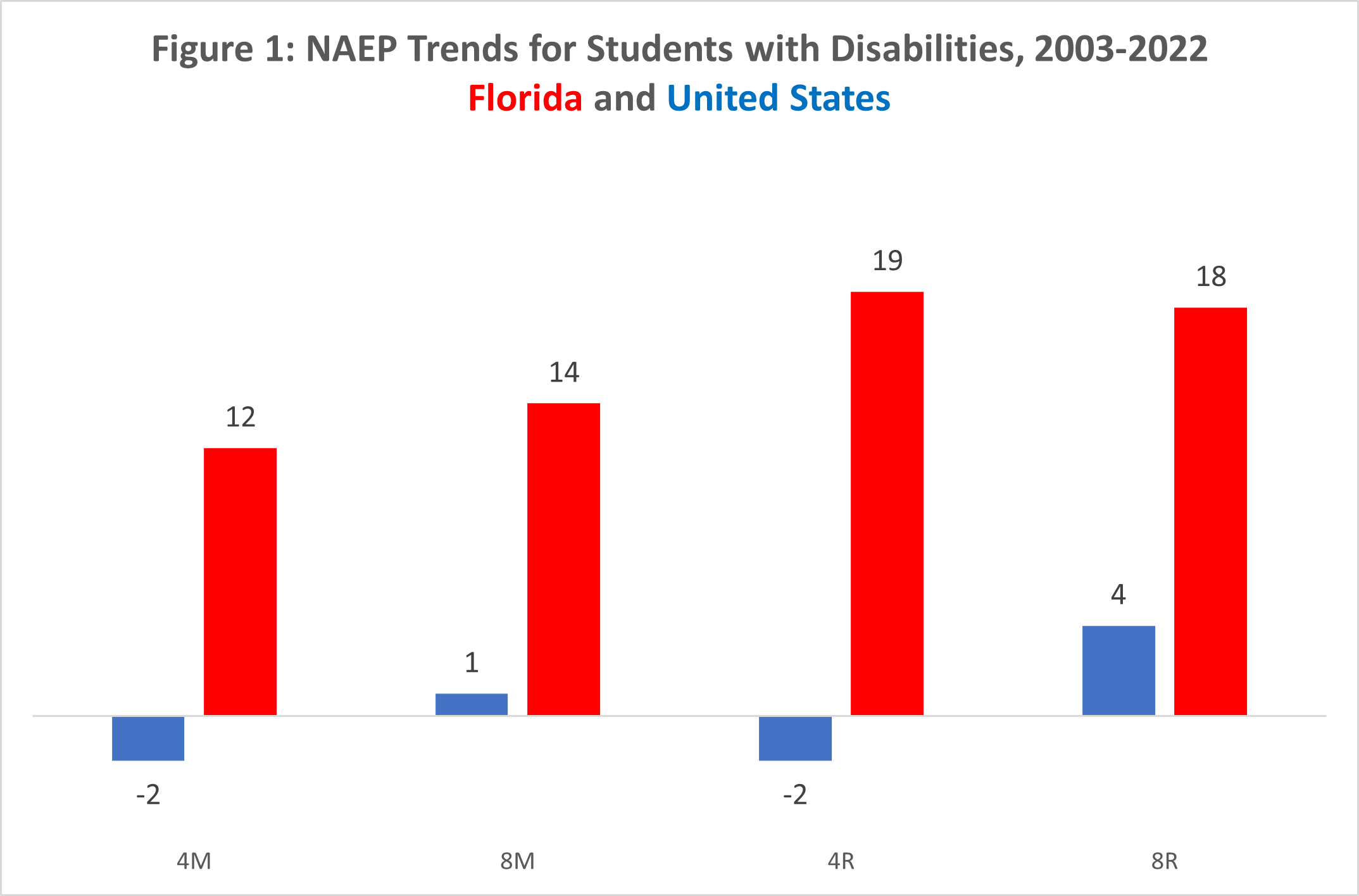
If you take the Nation’s Report Card data back as far as it will go to capture all 50 states (2003) and up until the most recent exams (2022), the trends for students with disabilities look like the chart above. For the United States across four exams you get a net 1-point increase. Let’s call that the midpoint between “spinning your wheels” and “playing in your food” spectrum. Meanwhile Florida made a net 63 points of progress, a grade level or more on each of the exams. A suite of reforms seems to have helped drive this progress.
Florida Gov. Jeb Bush’s reforms started in 1999 and included the creation of the nation’s first private choice program for students with disabilities. You can examine Figure 1 above and ponder whether the continual predictions of doom made by choice opponents seem the
least bit credible. Florida lawmakers created a separate education savings accounts, or ESA program, for students with unique abilities before consolidating the programs. Florida’s students with disabilities have had more choice access for a longer period of time than students in any other state.
Florida’s policies with a plausible connection to academic progress for students with unique abilities don’t end with choice. Florida pioneered the grading of schools A-F. Crucially, the Florida formula double weights the academic gains of the bottom 25% of students on the previous year’s state standardized exams.
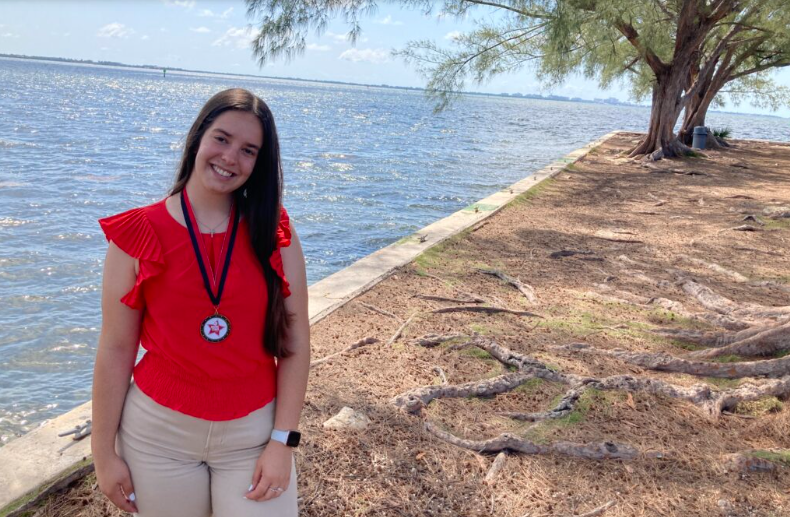
Among Ilen Perez-Valdez’ many accolades: National Honor Society member, Immaculate-LaSalle’s Spanish Honors Society president, Science Honors Society vice president, and English Honors Society treasurer.
MIAMI – Nery Perez-Valdes wanted to become a doctor, but life got in the way.
She fled Cuba for Miami with her mom when she was 11 and found herself working at 14 to help pay the bills. Nery would become a single mom and for a long stretch worked two jobs to keep the lights on and food on the table.
Nery always wanted a private school education for her daughter, Ilen, and a Florida Tax Credit Scholarship made possible by corporate donations to Step Up For Students allowed that to happen.
“I was a single mom since I was three months pregnant, and when I’m saying, ‘single mom,’ I’m telling you ‘single mom.’ No child support. No help. No nothing. Period. The end,” Nery said. “Thanks to Step Up For Students, Ilen was able to get the education I wanted for her.”
Ilen has made the most of that opportunity – and then some.
She graduated this spring near the top of her class at Immaculate-LaSalle High School, a prestigious Catholic school in Miami. She has a scholarship to the University of Miami and plans to major in neuroscience and double minor in business administration management and Spanish. Her goal is to attend medical school and become a pediatric oncologist.
“My mother never received a college education. She was barely able to graduate high school. All she has done since she got (to the United States) is work, work, work,” Ilen said. “She came here looking for the American dream. I feel like if I succeed, she can live out her American dream through me.”
Ilen has received a Florida Tax Credit Scholarship since kindergarten. She said she’s grateful for the opportunity to receive a quality education – first at Saint Agatha Catholic School, and then at Immaculata-LaSalle.
“It was really difficult to make ends meet when I was younger, so I wouldn’t have been able to attend a private school where I received such an excellent education,” she said.
To continue reading, click here.
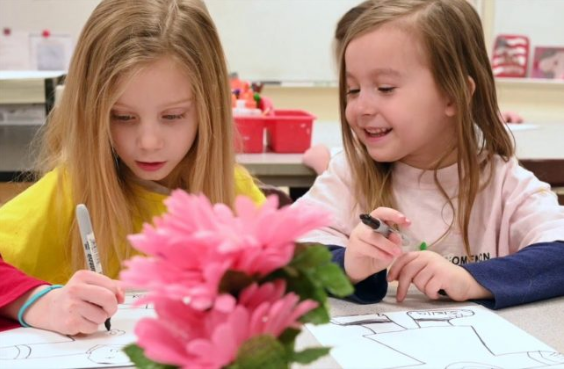
Crown Point Christian School in St. John, Indiana, is one of about 650 private schools in the state. Committed to academic excellence, Crown Point trains children to understand the world around them and to recognize that "every part belongs to God."
Editor’s note: This article appeared Tuesday on stateaffairs.com.
Eligibility for Indiana’s school choice voucher program is poised to dramatically increase next school year, enabling roughly 97% of students to use state money to attend private schools, according to school choice advocates.
State lawmakers have slowly expanded the program since they implemented it more than a decade ago. The state released its annual school choice report last month which provides insight into where the program stands ahead of arguably its largest expansion to date.
Already, between the 2021-2022 school year and the 2022-2023 school year, the cost to state taxpayers for the program grew by 30%, the report shows. That’s before the latest eligibility expansion goes into effect.
The 2022-2023 school year was the state’s largest increase in the number of students claiming vouchers since the 2014-2015 school year.
This past school year, a family of four had to earn around $154,000 per year or less for a student to qualify to receive state money to attend a private school. In the two-year state budget passed in April, lawmakers expanded the eligibility to allow those making 400% of the income required to qualify for free or reduced-price lunches to participate in the school choice program.
Likewise, state lawmakers simplified eligibility by removing other requirements.
That means a family of four earning up to $220,000 per year will qualify this upcoming year, including students who have already been attending private school on their family’s own dime. Robert Enlow, the president and CEO of EdChoice, called Indiana’s program “effectively universal.”
“It’s unfair to pay twice, once in taxes and once in tuition,” Enlow said. “[The new policy has] basically said to almost every parent in the state of Indiana that we trust your choices.”
Costs for the program are expected to balloon by more than 70% in the first year. By fiscal year 2025, the state will spend an estimated $600 million on vouchers per year.
To continue reading, click here.
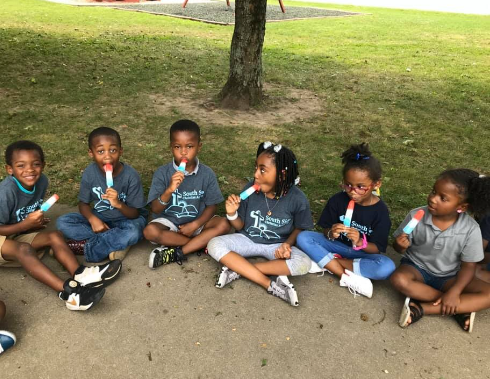
Serving students on the south side of Peoria, Illinois, an area that struggles with high unemployment, poverty and crime, South Side Christian Academy is a “faith-funded school,” self-described as one with faith that God will provide the funds needed to educate students.
Editor’s note: This commentary from Keri D. Ingraham, a fellow at Discovery Institute, director of the American Center for Transforming Education, and a visiting fellow at the Independent Women’s Forum, appeared earlier today on washingtonexaminer.com.
On the heels of a historic year of school choice advancement, including legislation that enacted universal or near-universal school choice programs in seven states, Illinois is poised to go in the opposite direction, delivering a blow to low-income families.
Specifically, the Democratic-controlled legislature in Illinois is positioned to let the Invest in Kids $100 million tax-credit scholarship program, enacted in 2017, sunset at the end of this calendar year. The action will nix a school choice program currently providing educational options to 9,000 low-income students.
As a tax-credit scholarship, the school choice program is not directly funded with taxpayer dollars but is privately funded by people and businesses who contribute through a qualified scholarship-granting organization.
Regardless, state lawmakers intentionally opted not to extend the program during the spring legislative session by failing to include it in the state’s budget implementation bill. Several other bills introduced during the session that would have extended the program also failed.
According to Myles Mendoza, founder and former President of Empower Illinois, the organization that led the inception of the tax credit scholarship policy, “despite daily pleas throughout the legislative session to extend the school choice program from parents, grandparents, foster parents, and guardians of children receiving the tax credit scholarship, Democratic House Speaker Chris Welch didn’t seem to even notice.”
The Democrat lawmakers’ loyalties lay with the public school teachers unions, who are stark opponents of school choice because having more children enrolled in public schools increases teacher staffing levels, equating to more members’ dues into union coffers, and who spend millions of dollars fueling Democratic political campaigns every year.
It’s a vicious funding cycle, with Democrat politicians and teachers union leaders pledging unwavering allegiance to each other in this quid pro quo relationship. Clearly, the importance of providing low-income students an opportunity to receive a better education pales in comparison.
But there was another reason the teachers unions pressured Illinois’ Democratic lawmakers to ensure the school choice program ends: The program shed a glaring light on the magnitude of parents seeking to free their children from the failing union-controlled Illinois public schools.
According to test data released by the Illinois State Board of Education, a startling 70% of Illinois public school students fail to read at grade level, and 75% fail to meet proficiency in math.
To continue reading, click here.
 A new study from a professor of economics in the Gatton College of Business and Economics at the University of Kentucky finds positive correlation between states’ K-12 student achievement and their education choice policies.
According to the paper, “Enhancing economic freedom via school choice and competition: Have state laws been enabling enough to generate broad-based effects?” released in early May, states with school choice programs saw large improvements in statewide test scores.
The report follows a study released earlier this year from Patrick J. Wolf, Jay P. Greene, James D. Paul and Matthew Ladner that shows similar results.
“This paper’s basic findings indicate strikingly large fourth grade reading and math test score gains for states that have adopted voucher programs and/or Education Savings Accounts,” wrote the researcher, John Garen.
The study shows that charter schools produced positive test score improvements, though only if the state’s enabling charter school law was not deemed “restrictive.”
Additionally, Garen found that increases in per-pupil spending correlated with improved test scores, but this impact was significantly smaller than offering a voucher or education savings account.
The paper compared National Assessment of Educational Progress (NAEP) scores from 1992 to 2019 and to the availability of school choice programs and the restrictions on student eligibility, as well as scholarship funding. However, the research did not include home education or district open enrollment policies in the results.
The study also considers whether school choice laws permit or restrict enrollment and new school entry, total public school per-pupil spending, and adjusts for the student’s race, income and learning disability status.
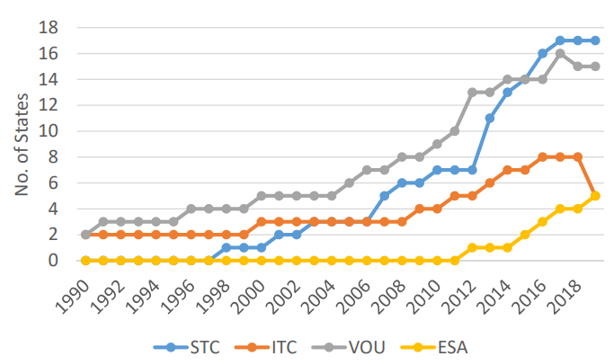
The number of states offering private school choice programs has grown steadily over the last two decades. (Scholarship Tax Credit (STC), Individual Tax Credit (ITC), Voucher (VOU), Education Savings Account (ESA))
According to Garen, for every $1,000 increase in per-pupil spending, there was a corresponding increase of 0.25 points in reading and 0.14 in math.
States with charter schools, however, saw decreases in both math and reading scores, but this may be impacted by restrictive charter school laws. States with less restrictive charter school laws, which would allow more students and schools, saw an increase of 0.65 points on the NAEP, the equivalent of increasing per-pupil spending by $2,500.
A statewide voucher program improved reading by 2.25 points, and the education savings account improved reading scores by 3.46 points, an effect that is 13 times stronger than simply increasing per-pupil spending.
Math scores also improved significantly in states with voucher and ESA programs. According to the researcher, the effect of an ESA program on statewide math scores was 27 times stronger than increasing per-pupil spending by $1,000.
States with ESA programs observed in the study include Arizona, Mississippi, North Carolina, Tennessee, and Florida.
Here are some additional findings:
According to Garen, vouchers and education savings accounts were better funded than tax credit scholarships but funded less than traditional public schools.
“Such programs,” the research concludes, “are associated with large improvements in Grade 4 reading and math NAEP test scores and are much bigger than the effect of school funding. Moreover, they are associated with lower school costs, implying a double dividend of better outcomes at lower cost.”
The report was published May 1.
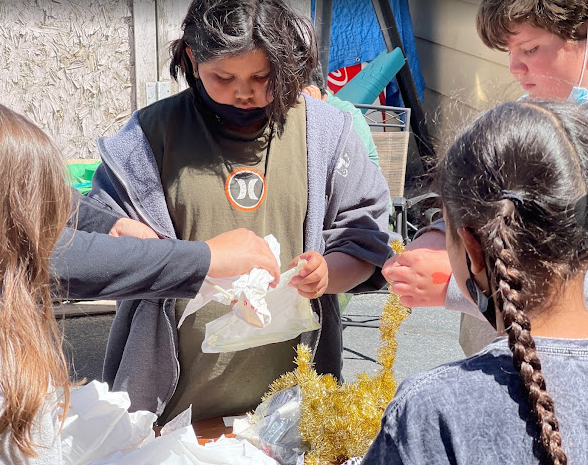
The Oceti Sakowin Educational Learning Center in Rapid City, South Dakota, is a Lakota-led microschool founded on Indigenous education principles and one of many educational environments recognized by The Canopy Project that are designing more equitable, student-centered experiences.
Where are the nation’s most innovative schools, and what are they doing that distinguishes them from the rest of the pack?
The Center for Reinventing Public Education and Transcend, two nonprofit organizations that support innovation in education, has put together The Canopy Project, a comprehensive public database of 251 schools that include district, charter and independent schools and microschools, all with core practices that raise the level of student-centered learning.
The project began in 2019 as a joint effort between Transcend and the Christensen Institute and is fueled by participation from hundreds of organizations and schools.
Last year’s report focused on the increasing number of programs developed for underserved populations who have historically been marginalized, such as students with disabilities. The year before that focused on creative ways of educating students during the challenges posed by the coronavirus pandemic.
A full report on this year’s project won’t be released until this fall, but analysts have already noted the following trends:
Other findings from the survey of leaders at these innovative schools show that three-quarters of them are focusing on developing a sense of community among students.
About 61% have designed advisories where groups of students meet regularly with adult advisers to set learning goals, reflect on progress, and build relationships. Some report increased mental health supports and train adults to recognize and respond to students who are impacted by traumatic stress, and pair students with an adult in school for regular individualized mentoring.
Almost two-thirds of schools reported the use of self-directed learning. This model allows students to set and pursue learning goals largely without adult supervision. About the same number reported an emphasis on practicality, with students learning topics and skills that directly relate to their lives and the world around them.
The survey also showed that 57% are offering learning beyond academics and college prep through career-focused opportunities such as practice job interviews and apprenticeships, while about half were providing learning though community service.
The report is searchable by state, by type of schools, by innovations employed or by student demographics. A user guide explains how to access and filter the data. The organizers hope it will be useful for policy makers, potential donors, and journalists, but most important, educators and entrepreneurs seeking to boost innovation.
“A redesigned school is far easier to imagine than implement. But too often, pessimism about the potential for change persists because educators, leaders, and families can’t picture what viable alternatives would look like,” wrote Chelsea Waite, senior researcher at CRPE and team leader on The Canopy Project, who introduced this year’s project in The 74.
“Amplifying the efforts of hundreds of schools designed to be equitable and student-centered is an exercise in optimism. Canopy offers hope that all kinds of schools can deliver on what students and families value most.”

An Oklahoma board made history last week by approving the nation’s first religious charter school, a move that could set the stage for a legal battle over whether such schools, which receive taxpayer money but are independently managed, are public or private.
Editor’s note: This compilation of commentaries from the Thomas B. Fordham Institute appeared last week on the institute’s website. To read a report of the Oklahoma decision from reimaginED senior writer Lisa Buie, click here.
In a 3-2 decision last week, an Oklahoma state board defied the attorney general and approved the nation’s first religious charter school. Those of us at Fordham have been following the debate closely.
These blog posts and podcasts will help you get up to speed:
Education Gadfly Show #872: The religious charter school debate, with Kathleen Porter-Magee (2023)
Just last week, Kathleen Porter-Magee—choice advocate and superintendent of a network of urban Catholic schools—spoke with Mike Petrilli and David Griffith about religious charter schools on our podcast.
3 reasons why religious charter schools should give us pause (2023) by Kathleen Porter-Magee
In a guest post, Porter-Magee raised cautions about the religious charter school movement.
The extended case for faith-based charter schools (2023) by Andy Smarick
In another guest post, Manhattan Institute Senior Fellow Andy Smarick reflected on legal developments opening the door to religious charter schools.
Education Gadfly Show #853: The Supreme Court and religious charter schools, with Nicole Garnett (2023)
Nicole Garnett, law professor at Notre Dame and expert on faith-based schools, spoke with Mike Petrilli and David Griffith on the podcast.
Is It Finally, At Long Last, Time for Religious Charter Schools? (2020) by Chester E. Finn, Jr.
Checker Finn reflected on the U.S. Supreme Court’s landmark decision in Espinoza v. Montana Department of Revenue (2020), which determined that publicly-funded vouchers could not be barred from religious schools.
Why Not Religious Charter Schools? (2003) by Chester E. Finn, Jr.
Two decades ago, when the concept was far less mainstream, Checker asked Gadfly readers to consider religious charter schools as a way to grow quality choices for children.
 In October 2001, your humble author was in Austin, Texas, at a Hank Williams III concert, and had to make a decision. Williams' first set featured very catchy roadhouse rock/country, but before the second set, Hank delivered a stark warning, something to the effect of:
“If you are only a country music fan, you are not necessarily going to like what happens next!” An explosion of punk rock and one of the most violent mosh pits I’ve witnessed unfolded.
 Thrilled, I took off my glasses, put them in my front pocket, and prepared to enter the melee. Then, alas, the voice of reason made itself heard over the din of punk rock, reminding me that I was only about 10 hours away from boarding a flight to D.C. to make a conference presentation.
“If you get your nose broken in there, you might not make the conference,” my inner McBossypants cautioned. Sourly, I took my glasses out of my pocket and observed the shoves, elbows, and punches from a positively boring but safe distance.
I’ve regretted it ever since. I should have listened to the other voice, the one I’ll introduce you to momentarily.
 My ESP just informed me that some of you are wondering why I’m telling this story on an education blog. I’m getting to that part presently. The point is: Sometimes you just have to cry havoc and let slip the dogs of war.
This is basically the situation the school choice movement finds itself in after its 2023 victories.
As recently as at some point last year, America had zero choice programs with universal, or even nearly universal, funded eligibility. Two programs passed in 2022, followed by a whole gaggle more in 2023, and 2023 isn’t over yet.
Like a Hank III mosh pit, this is GLORIOUS, but it’s also going to be a bit unruly. It’s currently unavoidable regarding choice implementation, so gird your proverbial loins, ignore your inner McBossypants, and prepare to MOSH.
It’ll be fine in the end, and if you approach the task with the correct mindset, you just might have fun.
Yes, yes, I know: Some of you still live in fear of what the New York Times thinks. Meh. Give them something to cry about. Some of you feel a special kind of terror that someone, somewhere, will misuse choice funding. Duh. There is a certain level of misspending in any publicly funded program.
Reasonable steps should be taken to minimize it, but only reasonable steps that continue to allow programs to function well for families.
As Jason Bedrick helpfully noted regarding the original ESA program in Arizona:
Under the new system, the latest auditor general’s “review of all 168,020 approved transactions identified in the Department’s Program account transaction data” over the prior fiscal year had “found only 1 successful transaction at an unapproved merchant totaling $30.”
In other words, the rate of improper payments to unapproved merchants has fallen to 0.001 percent.
Indeed, education savings accounts have proven far more financially accountable than other government programs. According to a 2021 analysis by the federal Office of Management and Budget, the government-wide improper payment rate is 7.2 percent. Federal school meals programs are among the worst offenders.
A 2019 report by the U.S. Government Accountability Office found that “the school meals programs have reported high improper payment error rates, as high as almost 16 percent for the National School Lunch Program and almost 23 percent for the School Breakfast Program over the past 4 years.”
Approximately zero percent of choice opponents would support abolishing the National School Lunch Program despite the fact that the mispending rate is btween 160,000 to 230,000 times greater than the mispending rate of the Arizona Empowerment Scholarship Program.
We interrupt this blog post to bring you a live debate between your inner voice of reason and your inner punk rocker:
“But … but … but … even that $30 misspending will be seized upon by opponents! It has to be ZERO misspent dollars!”
Are you willing to seize up the entire program, make parents afraid to spend their money, and wind up with misspending anyway? Put your glasses in your pocket and stop being a chinless wonder.
“Someone in the blatantly partisan press might criticize the program!”
They are going to criticize it anyway! Don’t be a gutless knob! Your nose would look better after a break anyway!
The school choice movement is about setting families free. This is a task too great to entrust to the timid. We’ve already watched one choice movement regulate itself to death, and we sadly watch on as its ability to liberate fades.
If we are going to make mistakes, it’s time to make some new mistakes rather than repeat the old ones.
 Editor’s note: This commentary from Garrett Ballengee, executive director of the Cardinal Institute for West Virginia Policy and a reimaginED guest blogger, appears in the Spring 2023 issue of Education Next.
There is a common misconception among education reform advocates that passing universal choice legislation is akin to summiting Mount Everest. Upon universal choice’s enactment into law, it is done. Time to exhale and pop the champagne, for the mountain has been scaled.
Not so fast. What has actually been achieved, in mountaineering terms, is that a base camp has been established. When the governor puts pen to paper, planning must begin anew to ensure post-passage success.
West Virginia passed its path-to-universal education choice bill in March of 2021. At the time, it was the broadest education choice program in the country. It was subsequently held up in the courts for several months while its constitutionality was confirmed. If your state passes a universal education savings account bill, it too, will almost certainly be challenged in the courts and will likely find itself in front of your state’s highest court.
Since then, in West Virginia, implementation has been challenging in some obvious, and not-so-obvious, ways that can be grouped into five main categories: 1) supply/demand considerations, 2) evolving coalitions, 3) outreach, 4) public relations, and 5) case management.
Supply and Demand
Upon passage, demand for choice will likely surge for a bit, temper, then steadily increase as families become aware of the program and hear from neighbors, fellow church attendees, and other connections about their new options.
Education reformers who advocated for the legislation’s passage can play a key role in shaping the demand. How should the program be advertised and to whom? Where will deliver the most bang for each marketing buck? How will public awareness be generated?
There must be someone willing to build awareness around the new program. Many choice programs languish with public awareness levels that would make most reform advocates blush. Failure for an education choice program does not often come in the form of mistakes, fraud, or incompetence. More frequently, the problems are apathy and ignorance.
The flip side of demand is supply, built by expanding existing capacity, attracting providers from elsewhere, and cultivating new supply from within. Consider how your organization or coalition can engage on this level.
Shrewd advocates will begin working on solving the lack-of-supply problem before it becomes a problem. Make sure local private schools are aware of the legislation—believe it or not, many of them won’t be. Help them sign up.
Identify successful programs or schools across the country and reach out and let them know about new opportunities catalyzed by your new program. Be on the lookout for the edupreneurs in your state.
Who’s leading a successful education program? Who is building a new microschool? Who are the connectors within the nontraditional education ecosystem? Who simply needs a bit of help or encouragement to start something new? They are out there. Find ways to find them.
Coalitions, Outreach, Public Relations
A post-passage choice coalition will be different than what is required for pre-passage. Begin thinking about who needs to be involved and what role they can play. You won’t have control over this entire process. Coalitions will naturally and spontaneously evolve, but it doesn’t hurt to start thinking about whose role should now be expanded, who should take a back seat, and who should be welcomed into the effort.
What about outreach? The nexus of a successful choice program will shift somewhat from legislative considerations, lobbying, and bill design towards family outreach and relationship cultivation, specific government agency relationships, and broad marketing campaigns.
Let’s face it, your newly enacted program will have bumps, bruises, and will proceed with some fits and starts. Perfection is not of this world. Setbacks are to be expected with anything new, let alone something of the size and scope of a universal choice program.
Not everyone in the world is as happy as you that universal choice is now a reality. There are legions of entities, from the public education establishment to unions and union-friendly media, looking for any anecdote or half-truth to besmirch the new program.
Take a deep breath and begin planning for this reality.
Gather stories about successes—big and small—and cultivate relationships with storytellers who see the world you do. Be ready to tell the story many people not only don’t want to read themselves, but also do not want others to read: education choice is good and a moral necessity.
Case Management
Finally, one last push up Reform Everest.
You have to figure out how – not if – to help the families about to embark on this journey for the first time. Families are the reason you started out to base camp in the first place, so now is not the time to abandon them to the crevasses of uncertainty. You must figure out how to manage each “case” not only for the sake of the family and child but also for the overall health of the program.
There will be grandparents who have never used a computer now asked to upload a birth certificate on their grandchild’s behalf. There will be parents with limited education who know only one thing when it comes to navigating this fresh bureaucratic concoction: “My child needs something different.” Be sympathetic, but, more importantly, develop competence.
Learn the law and accompanying statutes backwards and forwards or find someone who does. You must have a path or contact for families to use. “I don’t know the answer, but I know someone who might” will become one of the most useful phrases in your reform handbook.
Set boundaries for engagement with families. Parents and legal guardians will, understandably, want an answer at all hours of the day, but be cautious, for this is where burnout lies. Be intentional about when, where, and how questions will be answered. Reasonable limits will ensure a process in which all parties are satisfied or put on the path to satisfaction.
Though the last few steps up the mountain are the steepest and most difficult, they are also closest to what we are looking for when we embark on our journey: helping children find their own path to their own personal summit.
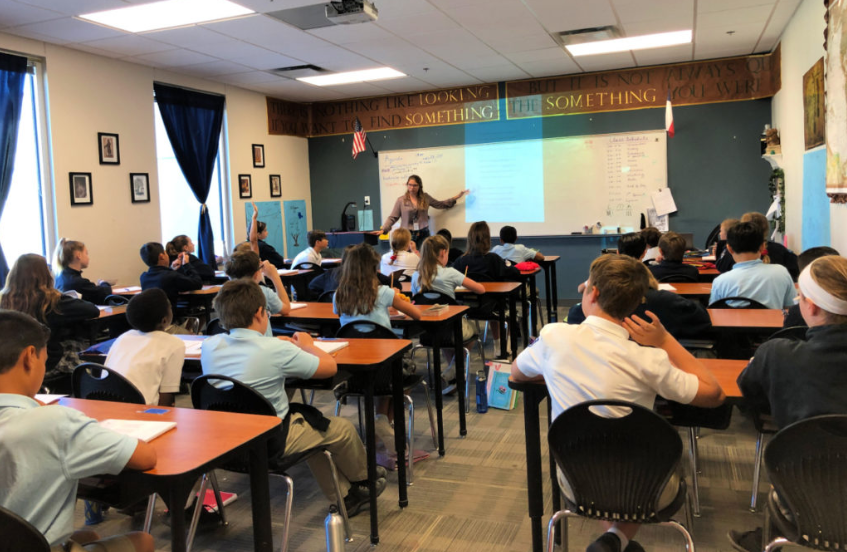
Great Hearts Northern Oaks in San Antonio, Texas, is part of a system of state-chartered public schools that offer a tuition-free, liberal arts education rooted in the literary and philosophical tradition of the West. Great Hearts Northern Oaks students learn about historical events, literary characters, poetry, scientific facts and mathematical proofs.
Editor’s note: This analysis from Cassidy Syftestad, a doctoral academy fellow in the Department of Education Reform at the University of Arkansas, and Albert Cheng, an assistant professor in the Department of Education Reform at the University of Arkansas, appeared Thursday on The Fordham Institute’s website.
Recent shifts in enrollment patterns across Texas school sectors have gone in one direction—out of traditional public schools. Within those shifts, a disproportionately large swath of students has left for classical charter schools.
These trends reflect a wider renaissance of classical schooling across the United States. Parents from all manner of backgrounds increasingly sought out classical schools during the pandemic, but also beforehand. And that trend appears to be continuing.
In a new report, we use data from the Texas Education Agency and the National Center for Education Statistics to uncover exactly how much classical charters have grown in Texas since 2011 and the reasons behind such growth.
Texas is home to several classical charter schools. Great Hearts, Valor, and ResponsiveEd operate networks throughout the state. Other classical charters such as Houston Classical and Trivium Academy, though not part of larger networks, are well known in their respective communities.
What do these schools have in common? As Jennifer Frey explains on the Flypaper blog:
On this model, to become educated is, at least in part, to become a person of good character—to become habituated into recognizable patterns of correct thinking, acting, and feeling so that one is disposed to judge and choose well on the whole, in order to live a purposeful and meaningful life that contributes to the common good.
As depicted in Figure 1, Texas’s charter sector has grown dramatically in the past decade. However, the most prolific growth within the sector appears to be concentrated among classical charter schools. While enrollment in other Texas charters doubled between 2011 to 2021, enrollment in Texas classical charter schools increased nearly sevenfold to 20,000 students over the same period. Several thousand students remain on waitlists for seats in them.
The classical charter sector also grew along ethnic lines, with the most pronounced increase for Asian American (a thirteenfold increase) and Hispanic students (a ninefold increase).
To continue reading, click here.

