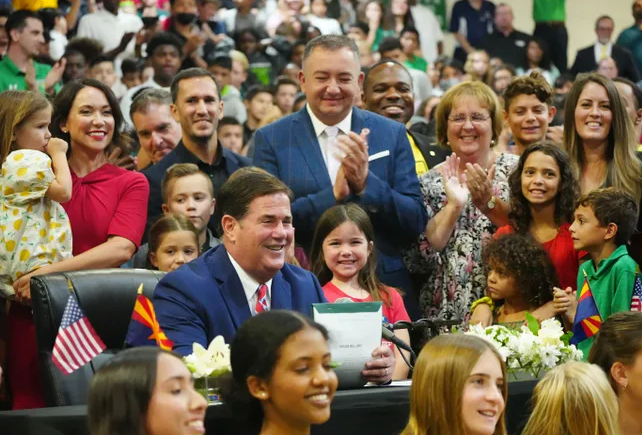
Arizona Gov. Doug Ducey signed HB 2853 at Phoenix Christian Prep in August.
Editor’s note: This article appeared last week on azcentral.com.
Over 10,000 applications for education savings accounts poured in over the course of less than a week, according to the Arizona Education Department.
As of Wednesday, the state had received nearly 22,500 universal eligibility applications, the Education Department said on Twitter. Arizona started accepting universal eligibility applications in mid-August, and the program was officially greenlit last week.
Those numbers show significant interest in the expanded ESA program, now the biggest of its kind in the nation.
The universal program provides families with funding that can be used for educational expenses outside of traditional district-run or charter schools, including private school tuition, curriculum, homeschooling and tutoring. The ESAs are expected to be worth about $7,000 per student, with some variability based on the applicant's district school and student characteristics.
All Arizona students are eligible to receive funding. Before the program was expanded by the Legislature this year, families could only apply if they met certain criteria and, in most cases, had been previously enrolled in a public district or charter school. Families with special education needs, foster families and military families were among the groups that could previously access Arizona's school choice program.
To continue reading, click here.
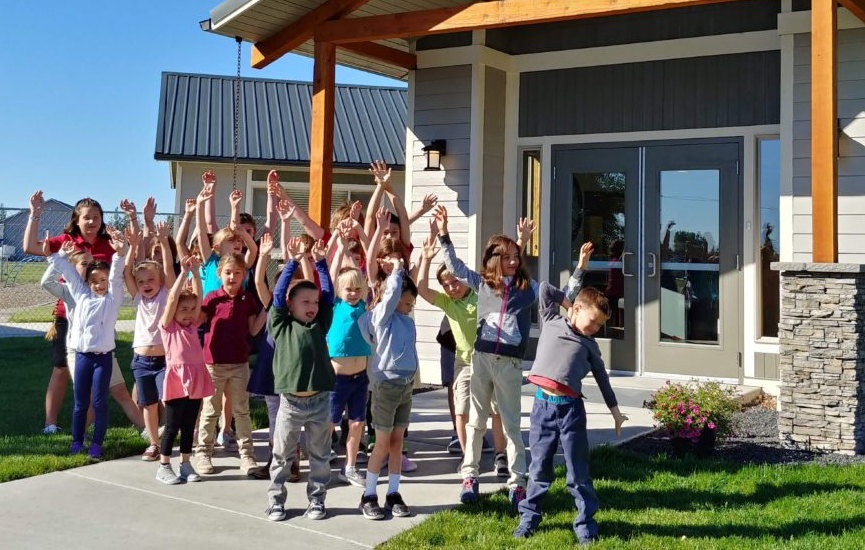
Three Sisters Adventist Christian School, in Bend, Oregon, is one of 458 private schools in the state serving more than 57,000 students. Three Sisters’ purpose is to provide a Christ-centered academic environment where students are nourished spiritually, intellectually, socially, physically and emotionally.
Editor’s note: This article appeared Tuesday on washingtontimes.com.
Oregon officials have cleared the way for school choice advocates to add two constitutional amendments to the November 2024 ballot.
One amendment would allow parents to enroll their children in any K-12 public or charter school in the state. It proposes an “equitable lottery process” for schools where the applicants exceed the number of spaces.
The other amendment would provide state funding for K-12 private, religious and homeschooling options. It would allow parents opting out of public schools to transfer a portion of the state’s public education funds to an account for their private use.
In two rulings signed on Sept. 26 and Oct. 5, Oregon Secretary of State Shemia Fagan approved the amendments as being compliant with the state Constitution.
The advocacy group Education Freedom for Oregon, which is sponsoring the amendments, must collect 250,000 petition signatures for each measure.
“These two school choice constitutional measures shift the decision-making power from bureaucrats to parents regarding which school setting is best for the students,” Donna Kreitzberg, a member of the group’s executive committee, said in a statement.
To continue reading, click here.
 In Baltimore, local media are reporting that a student with a 0.13 GPA ranked in the top half of his class. After finishing four years of high school, district officials shocked this student (who is not named, though his mother, Tiffany France, is quoted in the story) and his family when they sent him back to ninth grade, saying he lacked enough credits to graduate.
Questions abound: Why was the student moved to the next grade from one year to the next? Why were the parents not informed earlier?
And perhaps most importantly, why was he not the only one? This student had 58 classmates with GPAs at this dismal level. In a sad indictment of a school where “no one…told France her son was failing and not going to class,” France said her son “feels like a failure.”
Examples such as these are only useful if they represent the whole, and sadly, this case may not be extreme. The Nation’s Report Card showed historic declines in September when results found that 9-year-old scores had fallen drastically in math and reading.
In Illinois, data from 2019—before the pandemic—finds that the percentage of third graders reading at grade level in some districts is in the single digits. Statewide, barely one-third of these young children can read. Scores are likely worse today.
It is remarkable that we even have data from some places. New York City school officials delayed release of the test scores and only recently provided school-level data. California school leaders are refusing to release student test score results on time. Parents will not know how their children are doing until an “undetermined date later this year,” according to EdSource.
The poet William Wordsworth said, “The world is too much with us”—the world’s problems, that is—and in the process of “getting and spending, we lay waste our powers.” For assigned school systems like Baltimore’s, the world’s problems appear to be too much for the system.
Some still appear to be interested in “getting and spending,” though, at the expense of education’s power to give students hope for the future.
A recent study estimates that schools would need $700 billion in additional money to help students get back to where they were before COVID-19. Education Week says the researchers “don’t imagine their study will lead to Congress suddenly deciding to increase school aid,” a prescient observation.
In fact, as the outlet reports, schools have two more years to spend the $200 billion that federal taxpayers sent to schools during the pandemic to prevent these problems, and as of March, Dan Lips of the Foundation for Research on Equal Opportunity reports that some $154 billion was still unspent.
If more money did not prevent the problem and has not been spent to slow the disastrous results, how can anyone make the case that money is the answer?
Perhaps this is why the recent education news from Arizona and West Virginia is so significant. In Arizona, an education special-interest group devoted to “getting and spending” for public schools failed to gather enough signatures to challenge the new law that allows every child to apply for an education savings account (ESA). In West Virginia, the state Supreme Court of Appeals’ upheld an account option now available to nearly every child in the state.
Some state officials are in a rush to catch up. Tennessee Gov. Bill Lee posted on Twitter last week about the number of applicants to his state’s education savings accounts and said he’s “just getting started.” Texas Gov. Gregg Abbott made his intentions clear for the 2023 session earlier this year.
In states such as Missouri and Kentucky, lawmakers have approved ESAs, though the options are not yet available to families—which means that if policymakers successfully launch the accounts, the best is yet to come.
Washington Post columnist George Will says Wordsworth’s poem means that “what we more urgently need, always, is attention paid to the ideas that have consequences,” not the world’s problems that sometimes look like too much to solve.
State leaders who are paying attention today will see the declines in student achievement and ignore the vast sums that are not coming. But they will have a vision for calling on parents’ and students’ untapped powers.
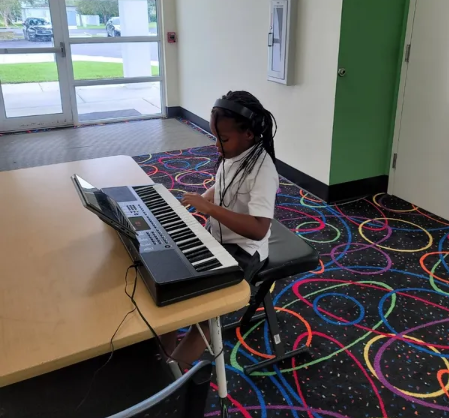
Permission To Succeed Education Center partners with families to provide self-paced in-person, hybrid and remote learning to students in Broward County, Florida, as well as students across the globe. Offerings include one-to-one teaching, independent study, and academic/lie coaching for students who need flexibility to learn in whatever way benefits them most.
Editor’s note: This commentary from Kerry McDonald, an education policy fellow at State Policy Network and senior education fellow at the Foundation for Economic Education, appeared Tuesday on forbes.com.
Nestled in a warm and colorful classroom space in a sprawling Salvation Army building in Ft. Lauderdale is Permission To Succeed Education Center, one of more than two dozen private microschools and similarly small, multi-age, co-learning communities in South Florida.
Felicia Rattray decided to launch Permission To Succeed in the summer of 2020 after schools shut down due to the pandemic and the shift to remote schooling gave her an up-close look at her nephew’s classroom.
Her sister had died in a car accident when Rattray’s nephew was just 8 days old and he then lived for several years with his grandmother until she grew too frail. Rattray and her husband, Amnon, assumed care of the boy, who was a third grader in a nearby public school.
A certified teacher, Rattray had been working as a social studies teacher and school counselor in public and charter schools in Florida since 2007. She knew her nephew was behind in school, and she had worked with him one on one during the afternoons and weekends to help him catch up. But Covid changed everything.
“During the pandemic, that’s when I saw just how behind he was,” said Rattray. “The spotlight was on it enough for me to see just how much he was suffering in the classroom.”
Rattray decided to create a microschool that would help students like her nephew, whom she discovered was working at a kindergarten grade level, to have a more personalized, mastery-based learning environment.
“The public schools can’t slow down the curriculum enough for the kids to catch up,” she said. “I’ve always had the desire to marry school counseling and education my way, my non-traditional way. In our microschool, each one of our students has a different curriculum that’s customized. I purchase different math curriculum, different reading curriculum depending on what is right for each child.”
To continue reading, click here.
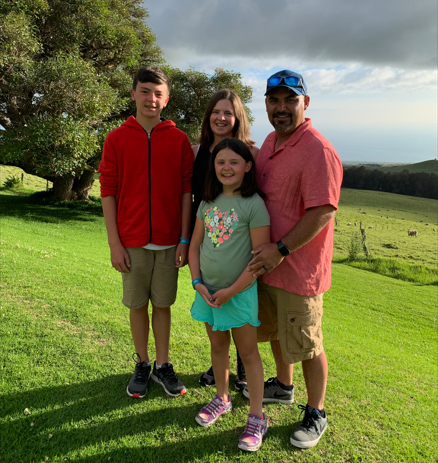
The Guerra family: parents Ashley and Keith and children Caden and Emma
On this episode, reimaginED senior writer Lisa Buie talks with Ashley Guerra, a New Mexico parent who for years has customized the education of her two children, Caden, 12, and Emma, 10. New Mexico, while offering robust public school choice, does not have a private school choice option.
Guerra and her husband, Keith, began by observing their children’s learning styles, making notes on how they absorb material. Then they modeled an education program based on Caden and Emma’s strengths.
https://nextstepsblog.org/wp-content/uploads/2022/10/reimagined.guerra_mixdown-final.mp3
“We … are constantly open to changing arrangements as we see them evolve in their educational journey. We really engage them in regular discussion so we can see how they feel they are doing. We want our children to feel fully invested in their education. We want them to take ownership, so their educational experience remains a complete reflection of themselves, their desires, and their areas of interests.”
EPISODE DETAILS:
 Editor’s note: This article appeared Monday on washingtonexaminer.com.
West Virginia families won in court on Thursday when the Supreme Court of Appeals of West Virginia gave the new Hope Scholarship the green light.
It’s an amazing story. In early 2019, West Virginia had no school choice programs. When the Legislature considered a limited school choice bill, teacher unions went on strike to block it. Later that summer, lawmakers approved open enrollment and just three charter schools. Then came 2021.
West Virginia’s Hope Scholarship education savings account program, open to nearly every student in the state, was the crown jewel. The Hope Scholarship would allow families to use state education funding for a variety of eligible expenses, including tuition, tutoring, and educational services and therapies.
Parents like Katie Switzer began making plans for how they would customize their children’s education using Hope. Her daughter has a speech delay, so Switzer planned to use a Hope Scholarship to choose an educational approach that would work best for her unique needs.
But opponents derailed the program by filing a lawsuit against it in January 2022 — less than two months before the application window was set to open. The Institute for Justice intervened to defend the program, representing Switzer and another mother, Jennifer Compton.
While the case made its way through the courts, the state began accepting applications on March 1 and received more than 3,000 before the May 16 deadline. Those applications went into limbo when a circuit court judge ruled the program unconstitutional in July.
In August, the Supreme Court of Appeals of West Virginia agreed to expedite the appeal.
Thursday’s decision to reverse the lower court’s decision and allow the Hope Scholarship program to proceed was a tremendous relief to the thousands of parents seeking new educational options for their children.
To continue reading, click here.
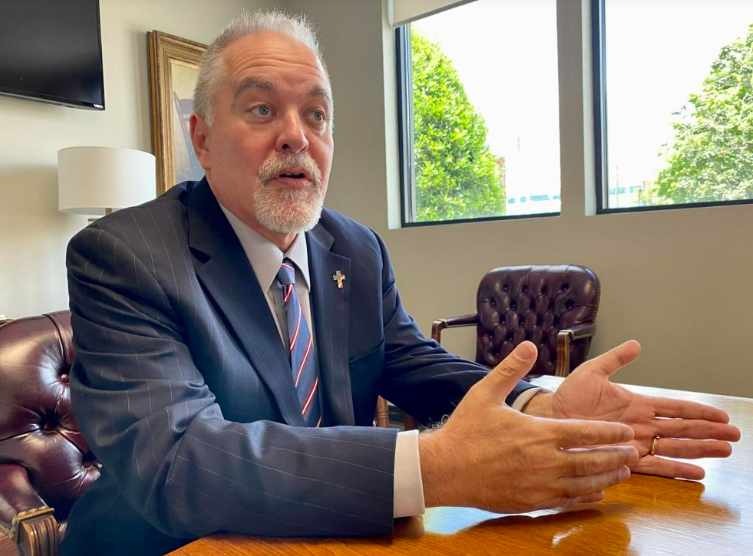
Georgia Republican schools superintendent Richard Woods, who hopes to be elected to a third term in November, says he sees the role of the Department of Education as “service and support” and “compassion over compliance.” PHOTO: Jon Gillooly
Editor’s note: This article appeared last week on the74million.org.
Among the six candidates the Georgia Association of Educators endorsed for statewide office, all were Democrats, save one: Republican schools Superintendent Richard Woods.
The two-term incumbent’s support of a controversial new “divisive concepts” law that restricts what teachers can say about race and diversity in the classroom was apparently less worrisome to the union than the platform of Alisha Thomas Searcy, his Democratic challenger.
“His opponent, regrettably, has a long history of advocating for taxpayer funding of private schools that we cannot overlook,” President Lisa Morgan said when announcing the union’s slate of candidates.
Searcy was elected to the state House at just 23 and consistently advocated for school choice legislation during her 12 years in office. She co-authored a law that allows students to transfer to other schools within their district, voted in favor of the state’s tax credit scholarship program and championed a constitutional amendment creating the State Charter Schools Commission.
Groups seeking to start a new charter school can apply directly to the commission instead of their local district.
“It’s opening up opportunities within public education for literally hundreds of thousands of children,” Searcy said, noting that her views are likely to earn her some Republican votes. “I have a track record of working across the aisle and having bipartisan relationships.”
Woods also supports charter schools but expanding choice has not been the focus of his campaign.
To continue reading, click here.
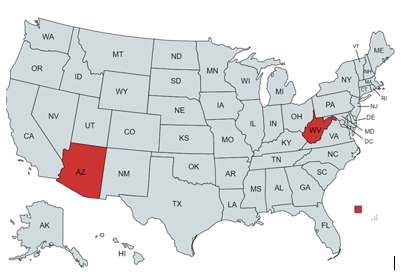 Arizona had only a few days as the only state with broadly available K-12 choice until the West Virginia Supreme Court had the Mountain State join the party.
Which state might be next?
States like Florida, Indiana, New Hampshire and North Carolina have established momentum. Several states in the west, such as Idaho, Nevada and Utah, have been experiencing strong population growth. Both candidates for governor in Pennsylvania have endorsed expanding choice.
Michigan has something cooking. Wisconsin, the state that pioneered the modern choice movement, has been making steady progress. Determined governors in Iowa and Oklahoma look poised to make a fresh run.
Texas Gov. Greg Abbott leads in the polls and has pledged a serious effort. Other states may lead the line in 2023. Stay tuned.
We are entering an era in which both workers and students constitute scarce commodities. I’ve written before about how West Virginia could offer a profoundly better quality of life to long-suffering families in Northern Virginia, Washington, D.C., and Southern Maryland.
Lower taxes, control over the education of your child, and less expensive property appears to be a potentially powerful combination. Imagine suffering from higher taxes for a long time (forever?), along with a hapless public-school system as a young family in New Mexico. Suddenly, the state next door adopts a low flat tax and universal school choice.
Meanwhile, every time I read the latest story about companies and people fleeing California, Illinois and New York, this Isaac Asimov quote comes to mind:
“The fall of Empire, gentlemen, is a massive thing, however, and not easily fought. It is dictated by a rising bureaucracy, a receding initiative, a freezing of caste, a damning of curiosity – a hundred other factors. It has been going on, as I have said, for centuries, and it is too majestic and massive a movement to stop.”
Winston Churchill noted that “the Empires of the future are the empires of the mind.” Free people with dynamic and pluralistic education systems will have a distinct advantage over states where lawmakers allow special interests to stymie progress.
Look for family choice to become an important consideration in economic development in the years ahead.

SailFuture in St. Petersburg, Florida, a unique, seafaring educational innovation that helps troubled teens chart new courses for their lives, is a quarterfinalist for a $1 million award powered by the Center for Educational Reform.
Five Florida education providers are among 64 quarterfinalists from 33 states and the District of Columbia who are in the running for a prestigious $1million award for educational excellence.
SailFuture in St. Petersburg, RCMA Immokalee Community Academy, Hope Ranch Learning Academy in Hudson, Colossal Academy in Davie, and Kind Academy in Coral Springs all are vying for the prize that recognizes those providers who strive to offer education that meets the four adjectives whose first letters spell the acronym for the award: Sustainable, Transformational, Outstanding, and Permissionless.
(reimaginED profiled three of the quarterfinalists here, here, and here.)
Yass Prize founder Janine Yass said it was her goal this year to find the best innovators in education in the country.
“Their ideas and enthusiasm are pushing the status quo for children who deserve access to awe-inspiring education,” Yass said.
She and her husband, Jeff, launched the prize, which is powered by the Center for Education Reform, to find and advance the work of education providers who continued to serve children despite the challenges brought on by the COVID-19 pandemic.
Center founder Jeanne Allen, who also serves as director of the Yass Foundation for Education, said she looks forward to getting to know the new quarterfinalists, who deserve recognition for their efforts to transform education.
“If we could just clone them and the thousands more who applied, we could more than make up the deficiencies brought on by years of mediocrity and COVID learning that have wrought havoc on our kids,” Allen said. “This is a start.”
Each of the 64 finalists are guaranteed a STOP award of $100,000. They now move into the next round, where 32 providers will be selected and will have a chance to receive a $200,000 award and take part in a “hybrid accelerator program” that will pair them with technology leaders and investors who could help them expand their ideas and methods.
At the end of the “accelerator process,” seven finalists will be named, one of whom will win the $1 million prize. Each of the other finalists will receive a $250,000 award.
Michael Moe, CER director and founder of Global Silicon Valley, a growth investment platform in California who served as an early adviser to the initiative, cited education entrepreneurs as a critical piece of the country’s continued economic strength and growth.
“The work that all of these quarterfinalists are accomplishing to educate the future generations is truly transformative,” Moe said.
 Editor’s note: This analysis from Mike McShane, director of national research at EdChoice and a reimaginED guest blogger, appeared last week on forbes.com.
Last week, we at EdChoice released our annual Schooling in America survey. For the past 10 years, we have asked a representative sample of Americans a battery of questions about the American education system. Each year, it gives us the opportunity to see what Americans think about our nation’s schools.
It also gives us the chance to see how opinions have changed over time. I can’t give every finding justice, but here are five things that stood out to me.
General opinion on education doesn’t change that much.
The survey asks Americans if they believe that the education system is heading in the right direction or if it is on the wrong track. Looking at the last decade of responses, we don’t see a great deal of change.
In 2013, 62% of Americans thought that the education system was on the wrong track and 26% thought it was headed in the right direction. By 2022, it was 61% wrong track and 34% right direction. When we ask parents specifically, we see a similar result.
In 2014, 54% of parents thought schools were on the wrong track and 40% thought it was headed in the right direction. By 2022 it was 52% wrong track and 48% right direction.
There have been two presidential elections, a pandemic, the Royals have won the World Series, and there have been a host of other unexpected events in that time period, and yet, opinions on schools have barely budged.
Opinions on school choice policies have changed.
In the first four years of the survey (2013 to 2016) support for education savings accounts, tax-credit scholarships, vouchers, and charter schools all declined among the general population. After starting with levels of support between 60 and 66%, they dropped to between 52 to 59% over that time period.
To continue reading, click here.

