Allison
The school choice advocacy group Parents for Educational Freedom in North Carolina is out with a poll showing nearly 60 percent of black parents in the Tarheel State agree that: "School choice gives parents the right to use the tax dollars associated with their child's education to send them to the public or private school which best serves their needs."
North Carolina is home to a growing charter school sector, as well as a voucher program that's expected to serve tens of thousands of students in the coming years.
Darrell Allison, PEFNC's president, said some 40 percent of the nearly 23,000 Opportunity Scholarship applicants to date are African-American. He said that statistic, coupled with the poll results, suggests that for politicians looking to court black voters, "there is much to be gained and little to be lost" by backing school choice. (more…)
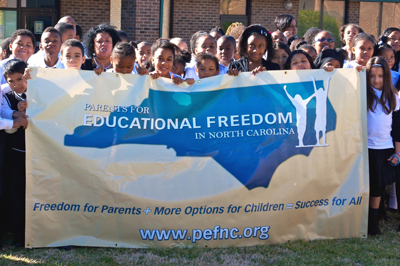 An attempt to bring a tax credit scholarship to low-income children in North Carolina succumbed to a short session and broader tax and education politics as the General Assembly adjourned on Tuesday. But the effort is worth noting in part because of the group pushing it.
Parents for Educational Freedom in North Carolina is a diverse, progressive organization with a membership of 60,000 and is led by a home-grown talent, Darrell Allison, who has a legal and civic mind and has worked in the White House and the U.S. Department of Justice. Allison and his team bring both a zeal to help struggling low-income children and a concern for getting the policy right and making the program accountable. (Disclosure to readers: I worked with PEFNC in preparations for the bill.)
The bill that ultimately was filed, HB 1104, fell short of the type of academic testing requirements the group was seeking. But overall the language kept faith with the 1,200 people who rallied at the Capitol in May, the 4,000 calls and emails that urged lawmakers to act, and the Democrats who signed on as co-sponsors. Importantly, at a time when some tax credit scholarship programs are coming under scrutiny for laws that lack genuine accountability and transparency, Allison and his team were trying to make sure their program had plenty of both.
The “Equal Opportunity Scholarship” was to be funded by contributions from companies that in turn received a dollar-for-dollar tax credit, and the scholarships were to be restricted to students with genuine economic disadvantage – those with household incomes not exceeding 225 percent of poverty. Scholarship organizations could not be tied to any school and could not allow donors to designate that their money go toward any particular student or school. The scholarship itself was to be $4,000, or just under half the amount the state and local governments spend on each public school student. Early fiscal evaluations showed that some versions of the bill saved money even when factoring only the state portion. (more…)
Two new parental choice videos offer messages that work well in tandem. The first, released today by the American Federation for Children, pushes back hard against the paternalistic attitudes that some in the education establishment have towards parents who want more choice. "Enough is enough," it says. "It's time to stand up for our kids." The video includes a snippet from St. Petersburg, Fla. mom Shannon Coates: "I have the right as a parent to choose the best school that I feel fits for my child."
The second video, released yesterday by the 60,000-strong Parents for Educational Freedom in North Carolina, offers a gentler message: Public and private schools are not rivals. And strengthening their "symbiotic relationship" can give families more options to help their kids.

