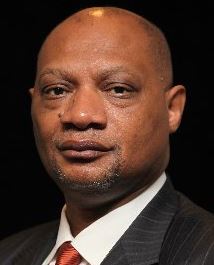
Bishop Jackson
An influential black minister endorsed Republican New Jersey Gov. Chris Christie this week because of the governor’s support for school vouchers. In doing so, Bishop Reginald Jackson also offered a harsh assessment of the Democratic Party.
“It is sad for me to see my party, which embraced the civil rights movement, now in New Jersey blocking low-income and minority children from escaping the slavery of failing schools,” Jackson said, according to several news outlets. Of black Democratic lawmakers in particular, he added, “Every day, they see children who are not getting a quality education and that doesn’t seem to move them.”
In an interview with redefinED, Jackson went further. Many black Democratic lawmakers “have placed the special interests above the interests of their constituents," he said in the podcast attached below. "The unions … have more influence and more bearing on them than the children who live in their districts.”
Bishop Jackson is a household name in New Jersey and often considered the state’s most powerful black leader. His resume includes a long list of progressive causes. He led efforts to deter racial profiling by state police and predatory lending by banks. He worked to secure more funding for public schools. Asked if supporting school choice was in line with Democratic values, Jackson said, “School choice is in fact an America value.”
His comments come as New Jersey lawmakers continue to beat back efforts to expand school choice while their counterparts in other states – Democrats included – are warming to them.
The key to getting more Democrats to come around, Bishop Jackson said, is educating parents about where Democrats stand. “They have to become aware that the folk whom they’ve elected to represent them right now do not have their children as their No. 1 interest,” he said. “Once we are able to open up their eyes so they can see this, then hopefully they will make better choices in terms of who they put in the Legislature.”
If that means more black voters going Republican, he suggested, so be it.
by John Merrifield

Merrifield
For years, it was lost in the wreckage from the crash of the politically incorrect “tracking” of students. But now, the worthy concept of “ability grouping” is making a comeback. A June 9 New York Times article on its resurgence is good news, but in the current public school system the much-needed ability grouping by subject is especially costly, with a very a limited upside. If parents had more school choice - more freedom to choose within a system that could easily diversify its instructional offerings in response to families’ interests and needs - the power and attractiveness of the concept would be much greater.
Unlike tracking, which assumes an across-the-board, one-dimensional level of student ability - i.e., students are uniformly brilliant, average, or slow - ability grouping by subject recognizes children have strengths and weaknesses. Strengths probably correlate with interest/talent, so in a system of genuine school choices, parents recognizing those interest/talents would tend to enroll their children in schools specializing in those particular areas. They’d be in classrooms with children who are similarly passionate and able to progress at similar, fast rates. And, likewise, for necessary subject matter in which they are not as adept, again, they’d be in a room and school building full of kids more similar to them. Stigma gone; no self-esteem threat.
This is not to contend that all students in say, an arts- and music-focused school or in a science- and technology-focused school, wouldn’t study some or both those subjects along with standards such as English, math and history. But students in those schools are likely to be more connected and engaged because of the emphasis on things they have strong interest in and an aptitude toward. Undoubtedly, each type of school will attract some students that are strong across the curriculum, but many of the science school students might have a more difficult time with English and the arts and vice versa.
In a traditional public school, children don’t have a common level of ability in particular subjects or means of instruction because they only have their neighborhood in common. You can see the effect in the photo in the Times article. The system would benefit from the option of having a relative uniformity of subject ability in each classroom, but in traditional public schools, ability grouping means dividing classrooms into sets of kids with different abilities for the subject matter at hand. The teacher has to circulate between tables of children with similar abilities, dividing her time between groups and finding the time to differentiate lesson plans; something that taxes time and teaching talent. (more…)

Hage
Vouchers, here. Charters, there. Virtual, over there. Politically, school choice sectors have been islands. But there are signs the movement is building bridges to advance common goals.
Florida's lead here surfaced at this week’s American Federation for Children summit, during a panel discussion on just that topic. In the Sunshine State, charter schools and supporters of vouchers and tax credit scholarships have teamed up to advance legislation, said panelist Jon Hage, founder and CEO of Florida-based Charter Schools USA.
“We realized it was time to join forces,” Hage said. “We felt we were sort of the Army, and they were the Navy … What we’re trying to do is have a common Department of Defense.”
The Florida school choice coalition doesn’t stop at two sectors. Through a group formed in 2010 – the Florida Alliance for Choices in Education – it includes online providers, home-schoolers and district school choice options like magnet schools. In the middle of this year’s legislative session, the group held a rally that, for the first time, brought parents together from across the spectrum.
Panelists suggested the benefits of a united front included strength in numbers, a more focused message and crossover appeal.
In response to a question from moderator Nina Rees, CEO of the National Alliance for Public Charter Schools, Hage said some Democratic lawmakers in Florida were more willing to support charter bills this year because they had supported tax credit scholarships in the past. Plus, the coalition offered a tighter, more compelling argument – one that emphasized school choice options even more and better deflected the usual criticisms. (more…)

