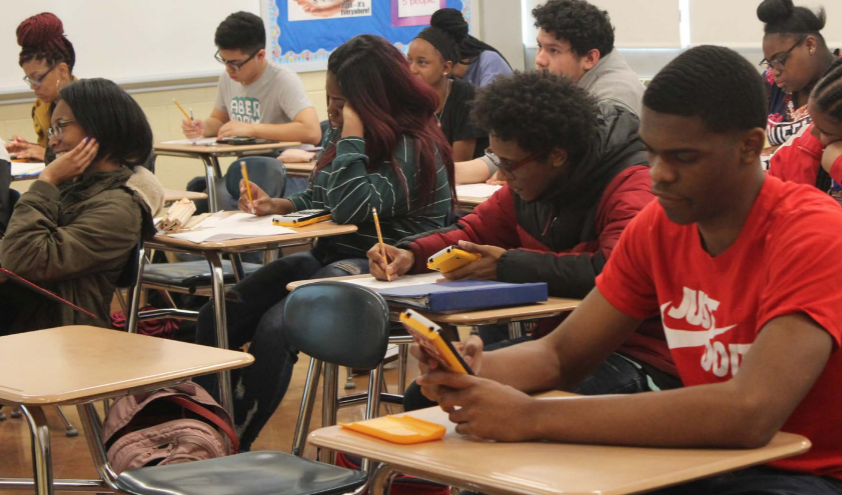
One of the largest and oldest Lutheran high schools in the nation, Milwaukee Lutheran High School participates in the Milwaukee Parental Choice Program, allowing families who meet the household income requirements to attend at no charge or for significantly reduced tuition.
America’s oldest urban private school choice program has the vital effects of steering young adults away from both crime and out-of-wedlock births, thus laying a strong foundation for them to live more successful lives.
What predicts future life success for young adults from disadvantaged backgrounds? Two vital factors are avoiding a criminal record (see here and here) and an out-of-wedlock birth.
That reality might be one reason why private schools often describe their mission as educating the “whole child,” mind, body and soul. Education should shape the character of students in positive ways. Strong character traits, such as conscientiousness and self-restraint, are especially important for youth growing up in challenged family circumstances. They rarely get second chances.
Given that avoiding a criminal record and refraining from causing a non-marital birth are keys to life success, and private schools may have advantages over public schools in promoting the character traits of their charges, it is shocking that almost no research has been conducted on the effects of private school choice programs on rates of crime and out-of-wedlock births.
Corey A. DeAngelis, director of school choice at the Reason Foundation, and I have set out to fill that gaping hole in our understanding of the potential long-term, life-changing effects of school choice.
Our first foray examined the medium-term effects of the Milwaukee Parental Choice Program (MPCP) on the likelihood of a person being charged with a crime by age 22-25. The MPCP is restricted to low-income families in Milwaukee. We matched more than 1,000 eighth- and ninth-grade students in the MPCP in 2006 with Milwaukee public schools (MPS) students in the same grade, with the same race, gender, English Language Learner status, and similar initial achievement test scores.
Importantly, we also matched the MPCP students with peers from their own neighborhood. Family values and behavioral expectations tend to be similar in urban neighborhoods, so matching students based on where they lived likely helped us control for vital unmeasured factors.
We then searched the public database of all criminal records for the state of Wisconsin as of fall 2015. The searchers were not aware if a given student was in the MPCP group or the MPS group when they looked to see if that study participant had committed a crime in the state. We found that MPCP students who remained in their private school of choice throughout their high school years were significantly less likely to have committed a crime during young adulthood, compared to their matched peers in MPS.
When MPCP students who switched from their private high school to a public school were included in the analysis, however, the effect of the MPCP on reducing crime became less clear. We concluded that students may need a steady “dose” of the character education treatment of private schooling for it to change their life trajectory.
Our initial study was published last year in the peer-reviewed journal Social Science Quarterly.
This year, we returned to the question with more and better data. We also employed more conservative analytic methods, to be even more confident that the selectivity of MPCP students was not biasing our results. In a study published in the peer-reviewed Journal of Private Enterprise, we revisited the same set of MPCP and matched MPS students three years later, when they were 25-28 years old. The additional three years gave the MPCP students more time to distinguish themselves from their MPS peers regarding avoiding criminal behavior.
We also found data on paternity suits in Wisconsin and added that key outcome variable to our study. Finally, we did not separate out students who stayed in the MPCP for their entire high school career from those who switched back to MPS. Thus, we conservatively tested to see if experiencing the private school choice program for any length of time from eighth to twelfth grade affected crime outcomes or non-marital birth rates. In these three ways, our recent study improved upon our original one.
We found that participating in the Milwaukee Parental Choice Program reduced the likelihood of a young adult having a drug conviction by 53%. The MPCP also decreased the chances of a person having a conviction for a property damage crime by an astounding 86%. MPCP alums were 38% less likely than their matched MPS peers to have been named in a paternity suit by age 25-28.
The positive effects of the private school choice program on reducing criminality were larger for males, who commit most crimes, and for participants with lower initial achievement test scores. The benefit of the MPCP in reducing the likelihood of causing a non-marital birth was similar for both males and females, since it takes two to tango.
Our research was not designed to reveal what the private schools in the MPCP did to generate these reductions in crime and out-of-wedlock births. Religion, re-enforcing parental values, and the influence of better-behaved peers all may have played a role. Future research should continue to study those questions.
For now, we can say that America’s oldest urban private school choice program had the vital effects of steering young adults away from both crime and out-of-wedlock births, thus laying a strong foundation for them to live more successful lives.
That’s a big deal.
 Editor’s note: This commentary from Ashley Berner, deputy director of the Johns Hopkins Institute for Education Policy and associate professor at the Johns Hopkins School of Education, is the third of a four-part series that examines the importance of high-quality materials for state leaders, schools, and parents.
Family background dictates a hefty portion of students’ academic outcomes (samples from the voluminous literature here, here, and here). It isn’t a shock to find out that kids from well-resourced homes out-score their less advantaged peers on standardized tests and high-school completion rates.
We all hope for schools that nullify the predicted trajectory, that push against the odds and facilitate social mobility. But because these schools are sadly a rarity, the field debates whether we should put our education reform eggs in the school-improvement, charter, and choice baskets, or rather into funding to diminish economic and social disparities.
But two factors lie more firmly within schools’ control: curriculum and school culture. The two previous columns focused on current research and policy with respect to curriculum, with an emphasis on state leadership. I want to focus in this column on why curriculum should matter to private schools, particularly those with a religious framework.
Why should private school leaders take a fearless inventory of their curriculum, with a focus on the knowledge-building it offers and the quality with which it does so? For some leaders, learning that a knowledge-rich curriculum manifestly benefits students is a persuasive reason. They’re all in and want to know if their own school’s curriculum measures up. Others are not convinced, and to them, I offer at least three reasons why the exercise is worth undertaking.
First, they would be joining the most forward-looking and effective district and charter schools, many of which are surging ahead in achievement as a result. Progress is uneven, of course, but many state and district leaders are placing big bets on high-quality curriculum and instruction. Look at Duval County’s implementation of Eureka Math, Core Knowledge Language Arts, and Expeditionary Learning; Baltimore City Public Schools’ adoption of Wit & Wisdom; and Chicago Public Schools’ success with International Baccalaureate.
A knowledge-rich curriculum is a signature of high-performing charter networks, too, from Success Academy and Public Prep in New York, to Great Hearts, IDEA, and BASIS in the South and Southwest. These district and charter school systems offer potentially life-changing educational experiences to some of our nation’s least advantaged children. Even in states with generous private-school scholarship funding, do private schools want to fall behind, perhaps forever?
Second, parents really do care about academic content. It is true that first-generation families care first and foremost about school safety. But that is not the final word.
Patrick J. Wolf, distinguished professor of education policy and 21st Century Endowed Chair in School Choice in the Department of Education Reform at the University of Arkansas, is the scholar of record on the Opportunity Scholarship Program (OSP) in Washington, D.C. – a voucher plan that helps a modest number of families send their children to private schools. His five-year study (here and here) found that what parents wanted for their children changed over time. Initially, they wanted a safe school that their children enjoyed. Over time, however, they came to want more: academic attainment, college preparedness and intellectual depth. Their vocabulary and focus changed. A better environment alone does not suffice.
That parents care about academics comes out in other studies, too, such as a 2018 national survey conducted by Foundations and Donors Interested in Catholic Activities (FADICA). The organization found a link between parents’ perceptions that some Catholic schools did not provide sufficient intellectual heft, and low enrollment rates. And when Education Next’s 2019 nationally representative survey asked, “How much should schools focus on student academic performance versus student social and emotional wellbeing,” parents from all demographic backgrounds gave a resounding preference for academics – in some groups, by a ratio of 2:1.
Finally, and critically for religious schools, a robust worldview and a challenging curriculum need not stand in opposition. This is a point of contention in some religious circles. The debate comes down to whether knowledge that lies outside of a tradition’s sacred text(s) is viewed as part of the sacred order (and therefore good), or outside of it (and therefore damaging).
This is a complex issue. There is substantial variability between and especially within religious traditions. Most religious traditions celebrate the pursuit of the mind and view “reason” as a divine gift (for a small sample of a vast literature, see here, here, here, and here). This becomes a priority that influences these communities’ schools and accrediting bodies. Many religious schools, in other words, take a “high” view of intellectual formation and emphasize a rigorous liberal arts approach.
Other religious groups and their schools do not. As Mark Noll famously put it in 1994, “The scandal of the Evangelical mind is that there is not much of an Evangelical mind.” (He wrote not only as an eminent scholar but also as an Evangelical.) This skepticism can translate into a belief that non-Biblical, non-sacred texts are inherently wicked, or even to an overt rejection of academic success.
As a person of faith and a scholar of educational systems, it pains me to see religious “worldview” as an excuse for academically thin curricula and instruction. Our institute at Johns Hopkins reviews English, social studies, and soon science, materials for their depth and rigor. Among the explicitly religious curricula we have examined are some resources that we find poorly written and shockingly weak on academic content. What will be the consequences for children who graduate from institutions that choose these curricula?
Research suggests that many of them will be helpful contributors to society and law-abiding citizens. But what opportunities will have been foreclosed to them along the way? Which doors will have remained not only closed, but not even perceived? Religious school leaders, I would submit, have an obligation to provide not only spiritual formation but access to beauty, profundity, excellence – alongside the capacity to debate and critique artifacts that are deemed unworthy according to their particular tradition.
Most religious schools in other countries do this as a matter of course. In the Netherlands, the United Kingdom, most provinces of Canada, Indonesia, Israel, Sweden and France (to name a few), governments fund non-state schools generously and hold them accountable for academic results. These pluralistic systems separate schools’ ethos, which vary profoundly, from academic content, which should not. The most significant scholar of educational pluralism, Boston University Wheelock College of Education professor emeritus Charles Glenn, describes how school systems around the world thread the ethos and content needle here.
Of course, curricula are not morally neutral; all information is learned and interpreted through specific lenses, whether explicit or tacit. Some plural systems (the Netherlands is the most obvious example) fund curricular materials that are worldview specific and that also convey content deemed necessary for an educated citizenry.
Unlike many of our democratic peers, the United States will never have a common curriculum at the national or even at the state level. This does not mean, however, that religious schools should de-value intellectual knowledge-building, explicitly or implicitly. There are reasons (including religious reasons) to take knowledge seriously.
Read Ashley Berner’s previous posts in this series here and here.

