Students at the University of Austin are getting an overview of the nation’s rapidly expanding education choice movement, including its storied history in Florida.
The survey course includes guest lectures delivered by top national researchers and thought leaders, including Ron Matus, director of research and special projects at Step Up For Students. The nonprofit organization is Florida’s and the nation’s largest education choice scholarship funding organization. Matus, who spent 25 years as a journalist and eight years as the state education reporter at the Tampa Bay Times, has authored many white papers on education innovation in Florida for Step Up.
The topic of Matus’s lecture was “Freedom, Pluralism and School Choice: Competing Rationales and Contemporary Practice” and included a special emphasis on education innovation in the Sunshine State.
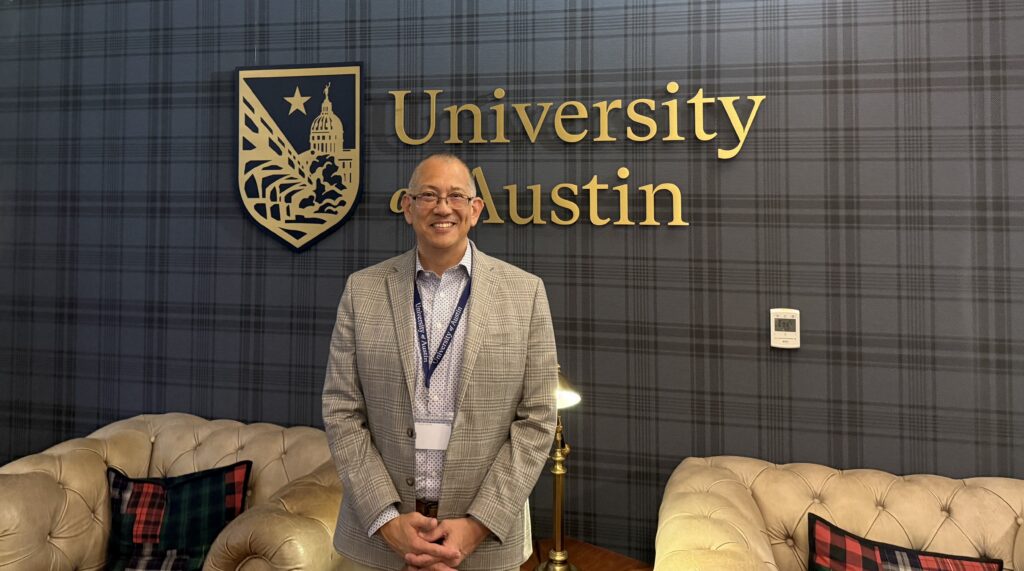
Matus shared the evolution of public education in Florida from its first model of neighborhood zoned district schools to the rise of charter schools, homeschooling, private school scholarships, educational savings accounts, a la carte learning, and even public schools now offering individual courses paid for with education savings accounts. He also described the many learning options now available, from traditional private schools to farm and forest schools to microschools and programs customized by families.
Matus also recommended reading that exposed students to various arguments in favor of education choice, including economist Milton Friedman’s 1955 groundbreaking essay “The Role of Government in Education,” which emphasized free markets and competition, and John E. Coons, a professor emeritus at the University of California, Berkeley, School of Law, who focused on dignity and fairness to all families regardless of income.
Erin Davis Valdez, executive director of the university’s Center for Education and Public Service, developed the course, which followed two K-12 practicums with rotations that began in the fall of 2025 at participating private and charter schools.
She describes the program as being in “the incubator phase,” and hopes to expand it into an academic minor.
“What we’re trying to do every term is offer a course for students interested in education policy as a career or in teaching as a career or something adjacent to it, like entrepreneurship,” she said. “But for now, students can take these as elective classes, and it builds their interest in the field.”
Valdez, who was homeschooled as a young child in Lakeland, Florida, a year before it became legal, said she chose the guest lecturers by looking for the best researchers and thought leaders in the movement. In addition to Matus, the list includes Eric Wearne, an associate professor in the Education Economics Center at Kennesaw State University and director of the Hybrid Schools Project. Wearne, who once described most traditional teacher prep programs as “thinly veiled arms of the HR department of the school district,” spoke on “Design Policy for New School Models.”
Others included Patrick Wolf, Distinguished Professor and 21st Century Chair in School Choice at the University of Arkansas, who spoke about the history of school choice policy, Jay P. Greene, senior fellow at the Defense of Freedom Institute, who spoke on the national responsibility of American universities; Katherine Bathgate, CEO and founder of SchoolForward, who spoke about economic foundations and emerging policy issues I education freedom; Mary K Wells, managing partner at Bellwether, who spoke on the last 30 years of education reform efforts; and Anita Scott, director of public policy for the Texas Home School Coalition, who spoke on connecting policy and practice in the homeschooling community.
Matthew Ladner, a senior adviser for education policy implementation at The Heritage Foundation’s Center for Education Policy and former executive editor of the NextSteps blog, is scheduled to lecture on June 1 about new directions in education choice and the question of accountability. The class will conclude June 8 with a lecture by Robert Pondiscio, a senior fellow at the American Enterprise Institute, whose topic is “The Last Days of Public School.”
 “There are more things in heaven and Earth, Horatio, than are dreamt of in a test score analysis …” Shakespeare by way of Ladner
Learning to read proficiently and to understand math are two jolly important goals for our schools. They are by far, however, not the only goals.
Americans want students equipped with the academic knowledge and training for success, but they also aspire to broader types of success in the formation of character – the ability to exercise citizenship responsibly and to function as productive members of society, for instance.
A new study from Patrick Wolf, a professor of education policy at the University of Arkansas, and Corey DeAngelis of the Reason Foundation, published in the Journal of Private Enterprise, tracks long-term outcomes associated with the Milwaukee Parental Choice Program. The MPCP makes low-income students eligible to receive a voucher to attend a private school.
The authors carefully construct a comparison group and analyze the long-term social welfare effects on students who have been offered a voucher after controlling for a variety of student background characteristics. They found that exposure to the MPCP is associated with a reduction of about 53% in drug convictions, 86% in property damage convictions and 38% in paternity suits. Effects tend to be largest for males and students with lower levels of academic achievement at baseline.
So, in addition to academic benefits of the program, including a higher high school graduation rate, MPCP participants also have lower criminal conviction rates and less time in family court. The average MPCP voucher was worth $7,943 in 2018-19 while the average total spending per pupil in the Milwaukee Public Schools was $15,250 in 2017-18.
Just imagine what Milwaukee students might do if they got equitable funding, and if their families could utilize that funding for educational benefits beyond private school tuition. There would almost be enough money left over to pay for the sort of enrichment activities that the top decile American families pay for things like summer camps and tutors.

A study from the University of Arkansas reveals that students who participated in Milwaukee's voucher program showed a reduced rate of criminal activity
While most studies of private school choice programs have focused on academic outcomes as measured by standardized tests, some recent studies have begun to look at other indicators of success.
The Urban Institute, for example, in a study released earlier this month, found that lower-income, mostly minority students using the Florida Tax Credit Scholarship to attend private schools are up to 43 percent more likely to enroll in four-year colleges than like students in public schools.
Those same students, the study found, are up to 20 percent more likely to earn bachelor’s degrees – and the outcomes are even stronger for students who use the scholarship four or more years.
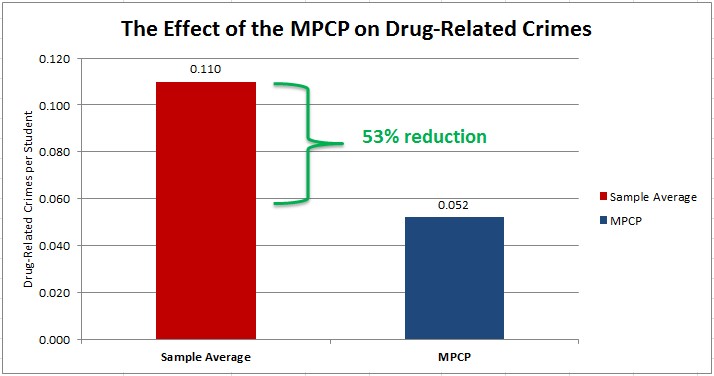
The Effect of the MPCP on Drug-Related Crimes
Now, a new study from the University of Arkansas shows that students who participated in a school voucher program showed a reduced rate of criminal activity as well as lower rates of paternity suits by ages 25 to 28.
The study by Corey A. DeAngelis and Patrick J. Wolf, titled “Private School Choice and
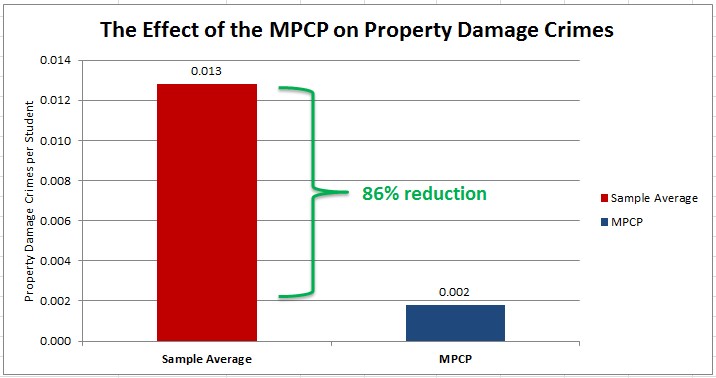
The effect of the MPCP on Property Damage Crimes
Character: More Evidence from Milwaukee,” found that students who were exposed to the Milwaukee Parental Choice Program voucher in grades 8 or 9 experienced an approximately 53 percent reduction in drug convictions, an 86 percent reduction in property damage convictions, and a 38 percent reduction in paternity suits.
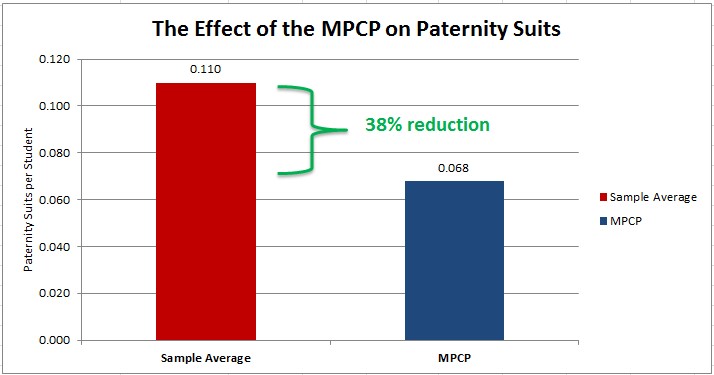
The Effect of the MPCP on Paternity Suits
A reduced rate of drug convictions and property damage convictions tend to be greater for males than females. Across the board, positive outcomes are greater for students with lower levels of academic achievement.
The Milwaukee Parental Choice Program is a voucher program for low-income students living in Milwaukee. The voucher, worth up to $8,400 for high school students, helped 28,917 students attend 129 private schools this academic year. Wisconsin’s second, statewide voucher program, which serves another 7,140 students, was not covered in the report.
School vouchers and tax credit scholarships may not always improve participants' standardized test performance, but a growing crop of studies suggest they are cost-effective when it comes to encouraging economically disadvantaged students to pursue a college education.
Two recent Urban Institute studies, one on Milwaukee and the other on Washington, D.C., continue that trend. The reports follow similar results from a 2017 Urban Institute study of Florida's Tax Credit Scholarship program.
Students in Milwaukee using vouchers to attend private schools were more likely to attend college, while students in Washington were no more or less likely, to attend college than their public-school peers. Past Urban Institute research in Florida showed modest positive college attendance and associate degree gains among school choice participants.
Researchers Patrick Wolf, John Witte and Brian Kisida found Milwaukee voucher students were 6 percentage points more likely to attend a four-year college than their public school peers. Milwaukee choice students were 1-2 percentage points more likely to graduate college, but that difference was not statistically significant.
The researchers conclude, "students in the Milwaukee Parental Choice Program tend to have higher levels of many measures of educational attainment than a carefully matched comparison of Milwaukee Public School students."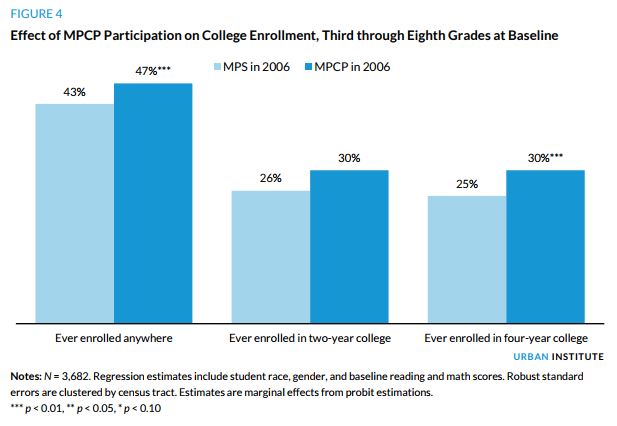
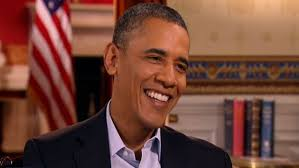 In a recent television interview with Bill O’Reily, President Obama discussed the D.C. Opportunity Scholarship program and stated the private school vouchers “didn’t actually make that much of a difference” and have not “significantly improved the performance of kids in these poorest communities.”
President Obama seems to be relying on the final report of the D.C. Opportunity Scholarship Program which stated, “there is no conclusive evidence that the OSP affected student achievement.” But it seems Obama’s (and some of the media’s) familiarity with the report ends here.
It’s true the final report did not find statistically significant reading gains, but earlier reports over the first three years did. The report also found large gains in graduation rates. And importantly, even the lead author of the final report, Patrick Wolf, supports expanding the D.C. voucher program. A deeper understanding of the report explains why.
First, the study examines the impact of being offered a voucher (after applying, qualifying and winning in the lottery process) – not the impact of using a voucher. This was done to set a really high bar for determining whether the vouchers made a difference. To achieve statistically significant achievement results, all the kids who won a voucher and used it to attend private schools had to score high enough to lift the scores of all the kids who won a voucher but stayed in public schools.
Next, random assignment studies (as great as they are) suffer from a major methodological flaw called “the real world.” Students were randomly assigned to a control group (no voucher offered) and a treatment group (a voucher was offered). Students in the control didn’t have vouchers, but that didn’t stop them from enrolling in private schools or charter schools. Students who were offered vouchers weren’t required to use them and if they did, they didn’t have to stay in the private schools.
By the final year report, 47 percent of students in the control group (who were not offered a voucher) ended up in private schools or charter schools at some point during the study. Regarding the treatment group, 78 percent of the students offered a voucher used a voucher, but only 27 percent used it to attend a private school during every year of the study. That means 51 percent of students offered a voucher used it inconsistently — returning to public, charter and private schools as they pleased.
In other words, one could summarize the study as examining the impact of some students using school choice vs. slightly fewer students using school choice. The DC study is not, as President Obama believes, proof that vouchers do not work. (more…)
by Allison Hertog
Hertog
I have dedicated my life to helping disabled students – first as a special education teacher and, for the last many years, as an attorney for parents of disabled children. As strongly as I support the rights of disabled students to be educated on an equal playing field with their typical peers, I do not completely agree with the kind of heavy governmental oversight of private schools that the U.S. Department of Justice mandated last month in its much-publicized letter to the Wisconsin superintendent of public schools.
In that letter, the DOJ finds the State of Wisconsin is obligated to “eliminate discrimination” against students with disabilities in its private school voucher program, regardless of whether the private schools accept federal funds.
Because they take federal funds, states are of course charged with meeting certain federal civil rights mandates in their administration of public schools. I am not an expert in school choice law, or the Americans with Disabilities Act for that matter. But what appears to be new here is that because Wisconsin administers a school choice program, it must “ensure” that participating private schools, regardless of whether they take federal funds, adhere to some of the most important mandates of the ADA.
The private and religious status of the individual voucher schools does not absolve DPI of its obligation to assure that Wisconsin’s school choice programs do not discriminate against persons with disabilities as required under Title II [of the Americans with Disabilities Act.]
The letter was precipitated by a complaint filed in June 2011 by the American Civil Liberties Union and Disability Rights Wisconsin. It alleged the Milwaukee voucher program discriminates against kids with disabilities and segregates them in public schools. It claimed that of the 21,000 students enrolled in private voucher schools, 1.6 percent had plans that specified special needs services, compared to about 20 percent of students in the Milwaukee public school system. Voucher advocates such as Patrick Wolf, who completed a study in 2012, have found less discrepant rates of disability in the Milwaukee program.
An important note: Wisconsin’s voucher programs are not designed specifically to serve children with special needs, such as Florida’s John M. McKay Scholarship for Students with Disabilities. They are designed to serve all students with family incomes up to 300 percent above the poverty level.
Nonetheless, the result of the DOJ letter is the state must seriously ramp up its oversight of the private secular and religious schools participating in its voucher programs, including the Milwaukee Parental Choice Program, the oldest voucher program in the country.
Some oversight is, of course, warranted. In our country, private schools can’t discriminate against students based on their race for instance, regardless of whether the schools take government funds. And private schools which don’t take federal funds shouldn’t discriminate in their admissions and suspensions process against students who can meet the demands of the school if provided with reasonable accommodations and supports.
However, not all private entities in our society have a public purpose. Some private schools choose to forego the benefits of federal monies because they want to provide a certain type of education to a certain type of student population - be it a nunnery or a secular feeder high school to the Ivies. In the later case, even a private school which takes federal funds is totally within the confines of the ADA to discriminate against a child applicant with intellectual disabilities who cannot meet its academic demands. When a private school foregoes government money, it should not be subject to the same government oversight as a school which reaps the benefits of it. (more…)
 Last year, Indiana stole the spotlight for school choice. This year it was Louisiana. And next year, if Virginia Walden Ford has anything to do with it, it just might be Arkansas.
“Miss Virginia,” the heart and soul of the Opportunity Scholarship voucher program in Washington D.C., moved back to her home state of Arkansas last summer and slipped a bit off the national radar. But she didn't go to retire. She’s meeting with parents, talking with lawmakers – and making bold predictions.
Vouchers and tax credit scholarships in Arkansas are now “being seriously discussed,” Walden Ford, 60, said in a phone interview with redefinED. “I believe in 2013 there will be school choice legislation that will pass in this state.”
After three decades in the nation’s capital, Walden Ford said she wanted to be closer to her family (her mother is 90). But the daughter of public school educators also wanted to take the knowledge gained from 15 years of grassroots activism in D.C. and apply them to Arkansas, a state that does not have a voucher or tax credit program but may be ripe for a strong move in that direction.
Among the reasons: The University of Arkansas has a young but hard-charging Department of Education Reform, with nationally known voucher experts like Jay Greene and Patrick Wolf. The state’s leading newspaper, the Arkansas Democrat Gazette, has a reform-minded publisher. The state is earning a reputation, through indicators like Education Week’s Quality Counts report (where it ranked No. 5 this year) of being a state on the move. And constitutionally, it does not appear to have the legal hurdles that could snare choice programs in other states.
“The people here in reform in Arkansas are much further ahead than I had anticipated,” Walden Ford said. “I fought the D.C. fight so … I’m very much a realist. But this is what I’m seeing. I’m quite excited about it. I don’t think it’s going to be easy … but it’s on the minds of people now, legislators and citizens, that we have to change something.”
Are Democratic legislators among them? (more…)

