 Charter schools. Palm Beach County makes it harder to open a new charter school. South Florida Sun-Sentinel.
School choice. Growing participation in private school scholarship programs is good for the state, an Orlando Sentinel guest column argues.
Testing. Florida gets one bid to review the validity of its testing system. Gradebook. The Algebra I end-of-course exam is still must-pass. Palm Beach Post. The Lee school board delays a final decision on how to count testing results. Fort Myers News-Press.
Preschool. Lawmakers need to pass a bill aimed at improving preschool quality, Orlando Sentinel columnist Beth Kassab writes.
STEM. Middle schoolers at a Palm Beach magnet program take home a world robotics title. Palm Beach Post.
College credit. Some Miami-Dade grads take on high school and college at the same time. Miami Herald.
The state of Florida is asking a judge to dismiss an attempt to include the state's preschool program in a lawsuit challenging multiple aspects of its K-12 system.
The groups suing the state over education funding and other issues widened the five-year-old lawsuit in late May, adding new arguments about charter schools, McKay scholarships, and tax credit scholarships. They also added a new argument that the state's preschoolers do not have access to a "high quality pre-kindergarten learning opportunity" required in the state's constitution.
Lawyers for the state argued in court papers filed last week that the pre-K claims raise an issue outside the scope of the original lawsuit, and deal with a separate provision of the state constitution, approved by voters in 2002, that led to the creation of Florida's Voluntary Pre-K program. They said if someone wants to take the state to court over its early learning system, they should do so in a separate suit.
"The new claims regarding Florida's voluntary pre-kindergarten program do not involve facts or law in common with the current case," their motion says. "The voluntary pre-kindergarten program arises under a different constitutional provision from the K-12 public education system with a different structure and different constitutional standards."
They also say none of the plaintiffs, who include public school students and several persistent critics of Florida's education policies, has direct ties to the state's Pre-K system.
The K-12 portion of the case deals with issues from funding and standardized testing to student safety and school choice. All of those arguments could technically center on a provision of the state constitution requiring a "uniform" and "adequate" K-12 public education system.
The state's lawyers say arguments on those issues are expected to last four to six weeks when the case comes before a Leon County judge more than a year from now. Adding Pre-K to the mix, they write, could drag the case out even longer.
More students attended Florida private schools this year than in any year since the onset of the economic downturn, and there are now more private schools operating in the state than in any year on record.
But Florida's private school enrollment is still less than it was 10 years ago, according to the state Department of Education's latest annual report on private schools, released this month.
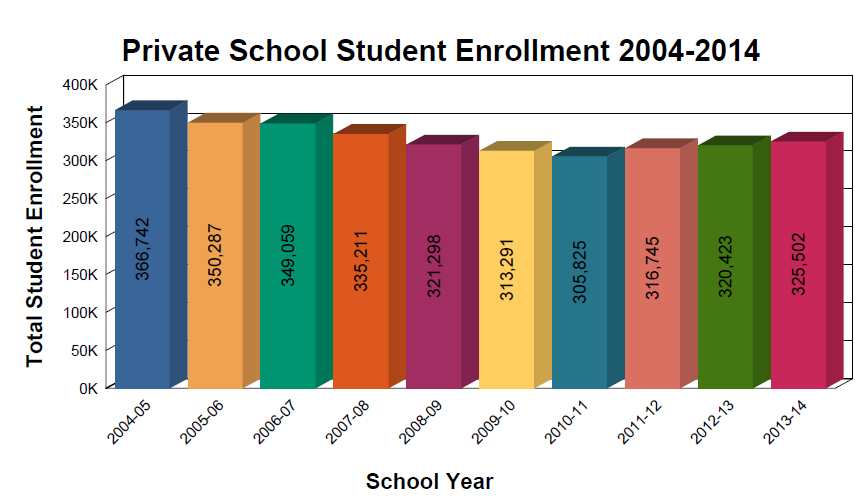
Chart by Florida Department of Education
Let's break down some of the trends highlighted by the report.
Pre-school is hot – again. It has been so, off and on, since ancient Greece. Plato’s ideal state would have imposed full-time boarding school starting at day one for all newborns, keeping them permanent strangers to their parents – those natural enemies of his perfect Republic.

Does NYC Mayor de Blasio's vision of pre-K include parental school choice?
The spirit of Plato has played a larger role in American public schooling than often we recognize. Still, contra Plato, our imperfect Republic still allows parents to keep their children home until age five or six, then lets those who can afford it to choose among all schools, public and private. But for the less fortunate family, it is difficult or impossible to avoid their child’s conscription for seven hours, five days a week. To that extent, Plato wins, they lose.
Many now propose extending public schooling to younger children. Would this new deal in education be undertaken in the platonic spirit? For whom, and at what age? Would lower-income families be subsidized in order to make their own choices among public, private, and religious providers? Or would pre-K school be designed as the government strong-arm long familiar to post-K families, especially those forced into public schools in the cities? Exactly what is the intention of government enthusiasts, such as the new mayor of New York City?
We just don’t know; if Mr. de Blasio wants to replicate for infants the income-based conscription of K-12, he has not yet told us. And one full-length recent article and three New York Times’ editorials on pre-K in one week never touch the issue. Does government aim to frustrate even further the exercise of responsibility by the low-income family; or to the contrary, will Mr. de Blasio respect, for these few early years, the authority of such families to exercise in practice the role that their middle-class fellow citizens take for granted? (more…)
District app: The Broward County school district redesigns its website to make it more parent-friendly, adding a mobile app and translating into more than 40 languages. Sun Sentinel.
 Virtual school: The Palm Beach County School Board plans to urge state lawmakers to repeal a new funding approach that slashed dollars for the state-run Florida Virtual School. Palm Beach Post.
District vs. charter: Palm Beach County's L.C. Swain Middle School opens a medical sciences academy and plans a pre-law academy to help the district compete with charter school offerings. Extra Credit.
Charter schools: Sarasota County School Board members say the district has been too generous with charter school funding and needs stricter rules over the process. Sarasota Herald-Tribune.
Tony Bennett: The latest Whiteboard Advisors' survey looks at the departure of the former Florida education commissioner and the impact on Common Core, PARCC and other issues. StateImpact Florida.
College ready: A new report finds only 19 percent of Florida's class of 2013 scored "college-ready" on all four ACT exams — English, math, reading and science. Orlando Sentinel.
Illegal passing: A one day survey shows Orange County drivers illegally passed school buses loading or unloading children 1,851 times. Statewide, 11,684 violations were noted. Orlando Sentinel.
Back pay: The Broward County school district owes its teachers $20 million for teaching an extra period last school year, but wants 20 years to repay the debt. Miami Herald. (more…)
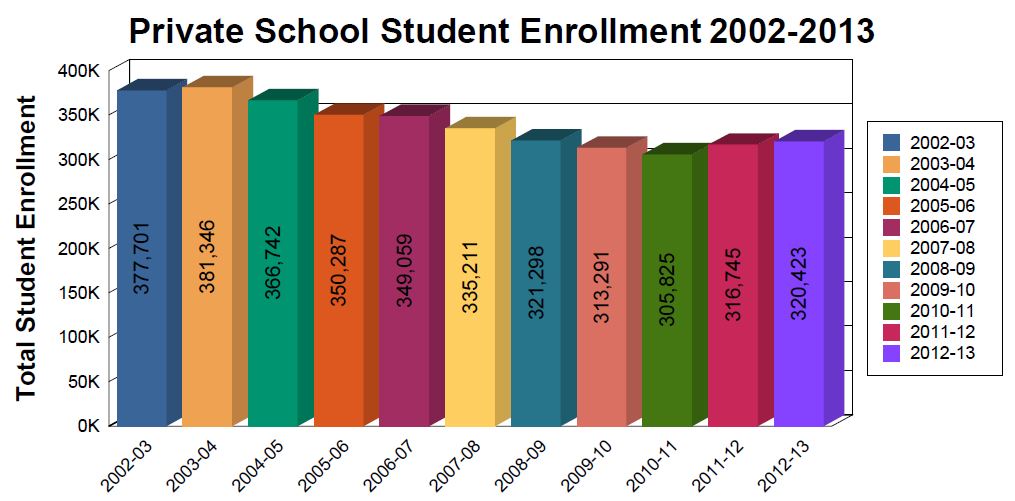
After seven years of decline, Florida private school enrollment ticked up modestly for a second year in a row last year.
Enrollment grew from 316,745 in 2011-12 to 320,423 in 2012-13, an increase of 1.2 percent, according to a report released last month by the Florida Department of Education.
Source: Florida Department of Education
The latest numbers are still a far cry from a decade ago, when the state wasn’t crawling out of the Great Recession and private school enrollment topped 380,000. But private school supporters see more than a short-term spike.
Private schools, too, have had to step up their game because of increased competition, said Howard Burke, executive director of the Florida Association of Christian Colleges and Schools. They’ve responded to the explosion in charter and magnet schools by beefing up technology, improving communication with parents and seeking multiple accreditations, he said.
He pointed to growth in pre-K and kindergarten enrollment in private schools as evidence that parents have responded in turn. Private schools made up 14.6 percent of all pre-K enrollment in 2012-13, up from 12.9 percent five years ago. In raw numbers, private school pre-K enrollment is up more than 5,000 over that span.
“The foundation is being rebuilt,” Burke said.
It's clear from the latest enrollment numbers that publicly funded, private school choice options, particularly tax credit scholarships, are giving the private school sector a boost. They also suggest that many parents still prefer private schools despite massive growth in tuition-free charter schools. (more…)
School turnarounds. Tampa Bay Times education editor Tom Tobin offers his take on what it takes: "a long, slow slog that requires principals and teachers to keep on task, stay inspired and fight through times when things don't seem to be working." The Times also offers a statistical snapshot of the five Pinellas schools on the turnaround list.
Legislature. Fund Education Now co-founder Christine Bramuchi offers her take on what happened in this year's session in a Q&A with the Orlando Sentinel. John Romano does here. The Palm Beach Post does here. Orlando Sentinel rundown here. Tallahassee Democrat here. Times/Herald here.
Florida's progress. Accountability through school grades has made a positive difference, writes Matt Ladner at Jay P. Greene Blog.
Teachers unions. The Florida Education Association has been operating without its tax-exempt status since January. Florida Center for Investigative Reporting.
Teacher pay. The Broward County School Board agrees to give extra money to high-performing teachers at low-performing schools. Fort Lauderdale Sun Sentinel.
Teacher conduct. A Broward County band teacher is accused of marijuana-fueled, sexual trysts with a student, reports the South Florida Sun Sentinel. In another teacher conduct case, the Palm Beach Post has the latest on a former private school teacher accused of giving students candy in return for sex acts.
Parent trigger. StateImpact Florida does a Storify on the post-trigger battle over #parentempowerment. Margo Pope from Florida Voices: "Parents already have options in state law that empower them. They don’t need another law. They need to know how to use what is already on the books." (more…)
School recognition funds. About 1,700 schools will get about $134 million, reports Gradebook. More from SchoolZone, Miami Herald, South Florida Sun Sentinel, TCPalm.com, Florida Times Union, Naples Daily News.
Charter schools. Palm Beach Post: "Palm Beach County has pledged to help a nonprofit charter school sell $10.5 million in mostly tax-exempt bonds so it can open a new campus in Juno Beach — a move that has upset County Commissioner Paulette Burdick, who questions whether the county should aid privately run charters that pull students away from the public school district." More on Cape Coral charter schools asking the Lee County school district for facilities funding from NBC2.
Pre-K. Florida's pre-K isn't the reason its students are surging ahead of Nevada's. Heartland Institute.
Parent trigger. Lakeland Ledger weighs in.
Zero tolerance. Despite changes in the law, thousands of students are still arrested in Florida schools every year for minor infractions. StateImpact Florida.
FCAT. Time again for students to "brace" for the "dreaded" test, reports the South Florida Sun Sentinel. This year, teachers and students better prepared for tougher writing standards, reports the Orlando Sentinel.
Grad rates. Another report notes Florida's rate is low but improving. SchoolZone. (more…)
I am more politically incorrect than your average guy, so when I heard President Obama call for universal pre-K for 4-year olds in the State of the Union, I cringed. With all the raucous enthusiasm ringing around this issue since the speech, adapting Warren Buffet’s investment approach to public policy might be wise: when everyone is bold, it’s time to be cautious.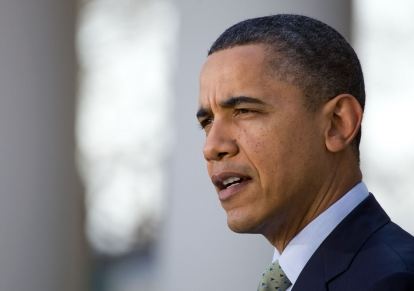
In 2006, when I was with California Parents for Educational Choice, we were part of a coalition of organizations that defeated Rob Reiner’s ballot initiative to bring universal pre-K to the state. It was introduced to widespread public approval, but by Election Day garnered only 39 percent of the vote. The electorate came to understand three major elements they did not like:
* Expanding pre-K to everyone, including middle class and upper income families, is hugely expensive and precious little, if any evidence, supports much educational value added for the middle class and wealthy.
* The initiative vastly expanded the existing public school monopoly, which hardly has a resounding record of educational success, especially with poor and minority students. It also mandated collective bargaining, swelling the ranks and economic power of the California Teachers Association, an organization that systematically stands in the way of innovation and reform.
* The academic outcomes were questionable. A Reason Foundation analysis found from 1965 to 2005, 4-year old participation in preschool programs had grown nationwide from 16 percent to 66 percent, but we had virtually no evidence of increased student learning on the National Assessment of Educational Progress (NAEP) by fourth grade. Oklahoma, with a universal program since 1998, finished dead last on the 2005 NAEP, actually losing four points.
But that was close to seven years ago and admittedly, I haven’t followed the pre-K issue regularly. So I spent the last few days reviewing some studies and data. The key word in the Obama proposal is quality.
We likely can justify a highly targeted effort on kids in failed families or families that simply have no resources - financial, social, emotional, or cultural - to allow their children to mature and develop normally. But when Obama declares, “We know this works,” he overstates and simplifies our experience. (more…)

Colburn
David Colburn is a respected former University of Florida provost and progressive academic who should have done more homework before he blithely characterized those who support private school options as salesmen and hucksters. His recent commentary in the state’s largest newspaper, the Tampa Bay Times, rather pointedly ignored important evidence in his own backyard.
Dr. Colburn is good thinker on education issues, but somehow managed to treat all school vouchers as though they are inherently unaccountable. “There is something basically wrong when public funds are earmarked for these private schools,” he wrote, “and the state fails to insist on accountability measures for student achievement outcomes.”
That assumption is demonstrably false, and he need look no farther than his own state. The state’s first voucher program, which was declared unconstitutional in 2006, required students to take the state test. The current pre-K voucher that served 145,551 4-year-olds last year requires pre- and post-academic evaluations that are used to rate providers.
Lincoln Tamayo, who runs the highly successful Academy Prep Centers of Tampa and St. Petersburg that serve underprivileged middle school students, was also quick to note in a letter to the editor that the Florida Tax Credit Scholarship serving 49,000 low-income students has required nationally norm-referenced tests since 2006. The test scores for Tamayo’s students, who are treated to an intensive six-day-a-week, 11-months-a-year program, reveal both year-to-year academic gains and 8th grade reading and math scores in the 70th and 76th percentile range.
There is ample room for principled debate over whether the current testing approach for these private options is sufficient to assure that students are making academic progress. For example, there are certainly challenges in trying to compare the test results of low-income students in private schools with their low-income colleagues remaining in public schools, in part because the scholarship students tend to be much poorer.
But Dr. Colburn instead seemed content to assert that vouchers “court disaster,” as though every one of these programs is flying blind. His lack of intellectual rigor was, needless to say, disappointing.

