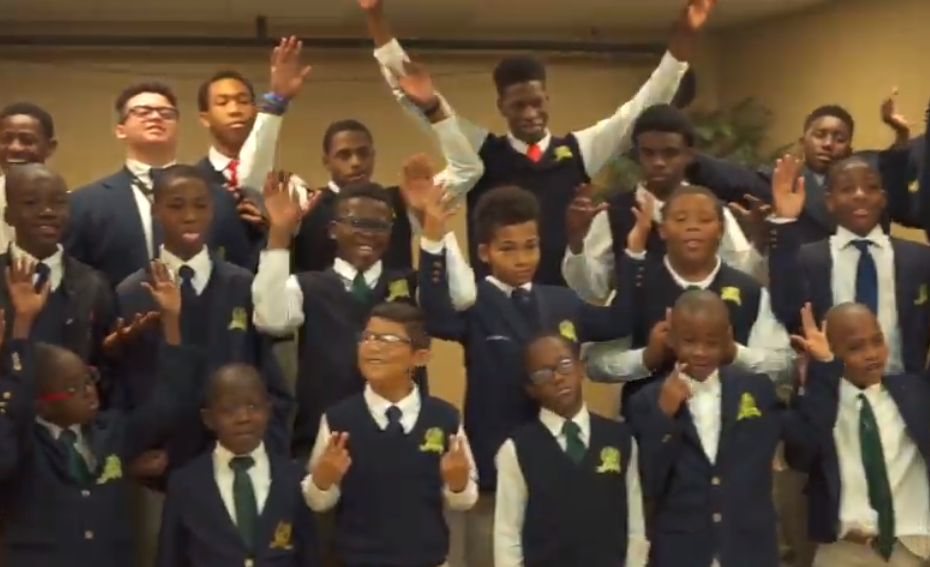
Piney Grove Academy in Fort Lauderdale, a college-preparatory school for boys from kindergarten through high school, is one of two Florida private schools that had an exploratory conversation with innovative education leader Prenda.
A network of non-traditional schools that has attracted nationwide attention from families seeking safe learning options during the pandemic could be part of Florida’s future.
Arizona-based Prenda, which launched in 2018 and now boasts more than 200 partnerships with private schools, public school districts and individual public charter schools, features online learning programs adaptable to individual students that are aligned with state learning standards. The Prenda learning model has been described as a cross between a school and a scout meeting, with students gathering in homes, community centers, libraries and other public spaces to work on individual lessons and group projects.
Prenda leaders recently held a call with a couple of Florida private school principals to gauge interest in starting partnerships here. No decisions were made, but school director Frances Bolden from Piney Grove Academy in Fort Lauderdale said she was impressed with Prenda’s model.
“When I hear about something new or innovative, I want to learn more about it,” Bolden said.
Faith-based Piney Grove serves boys in kindergarten through high school. Bolden, who started a one-room schoolhouse for a small group of U.S. military children in Bangkok while her husband served in the Air Force, acknowledged that finding a Prenda micro-school host location would be challenging in South Florida, one of the hardest hit places in the nation for COVID-19 cases, where most schools are re-opening online.
A bigger challenge is equity. In Arizona, education scholarship accounts give parents the flexibility to choose Prenda or other private options without having to pay tuition. Prenda founder Kelly Smith said the company is working on a low cost, private pay model for families in states that don’t provide school choice funding as more parents are seeking alternatives to district schools amid the pandemic.
Florida’s model for education choice has been to grant private school scholarships to lower-income families, with education scholarship accounts limited to students with certain special needs. Education choice advocates say that allowing all families to have flexible spending would allow innovation to not only flourish but also create more equity in education.
Jason Bedrick, director of policy at EdChoice, a national nonprofit that advocates for more private options in education, said the average per-pupil spending on education nationwide is $15,000. “If a portion of those funds … were to follow the child into the learning environment of their choice, that would allay a lot of equity concerns and provide more opportunities to lower income students,” Bedrick said.
Despite the challenges, it’s clear that school leaders nationwide are tempted by the model’s practice of pairing groups of eight or 10 students with an adult “guide,” a teacher, parent or another individual who has experience working with young people and has passed a background check. The guide leads students through projects such as building robots, staging theatrical productions, and hosting and judging their own debates. Students also create reports, artwork, videos, computer programs and dance routines. Lessons are self-paced, with students setting their own goals.
The Prenda micro-school model now spans 29 states, with a huge upsurge of interest since COVID-19 struck, as evidenced by website traffic: a whopping 737% increase in June compared to June 2019.
To listen to Step Up For Students’ president Doug Tuthill’s podcast with Prenda CEO Kelly Smith, click here.

Hedge fund analyst Sal Khan began making math tutorials for his cousins in 2004. By 2016, Khan Academy had more than 42 million registered users from 190 countries with tutorials on math, economics, art history, health, computer science and more.
Last week, Lindsey Burke authored an interesting piece for redefinED titled, “Do pandemic pods represent disruptive technology?” A different question could be: Do pods represent the incremental improvement to digital learning that will bring that type of learning into disruptive territory?
Typically, a disruptive technology starts as what is perceived to be an inferior but more accessible product or service “competing against non-consumption.” A classic example from the early computer era featured mainframe computers as the dominant technology and personal computers as the disruptive technology. Early personal computers weren’t great, but access to mainframe computers was a very scarce commodity. Thus, personal computers were better than nothing.
The key comes with the flip: Personal computers got better over time, and at some point, people realized they were just as good or better than mainframe access. Personal computers displaced mainframe computers as the dominant technology.
Rather than thinking of pandemic pods as a disruptive technology, they may fit in the disruption model better as the incremental improvement to digital learning. Digital learning, in other words, may have been advancing in a “pre-flip” disruptive technology until innovators improved it sufficiently for many people to see it as a better form of learning.
Digital learning often competes against non-consumption by serving students who, for a variety of reasons, would otherwise drop out of school. It serves other student niches as well. Most people, however, view education as an inherently social activity – with classmates, group activities and in-person instruction. Pods can scratch all these itches in ways that purely digital learning will struggle to do.
It is too early to know much about the combination of digital learning and pods in terms of academic outcomes. It is obvious walking in the door of a school taking advantage of both that the teachers and students are having fun, a quality often lacking in large, impersonal schools. As I discussed in a recent column, I had the opportunity to observe at group of students engaged in 3-D printing at a Prenda micro-school on the Apache Nation in San Carlos, Arizona. The thought that would not leave my head was, “Scout troop meets Sal Khan = fun school model!”
The very impressive digital learning techniques developed by Success Academy, for instance, could have a significant staying power after the pandemic. We see hints of South Korean super-star instructors in dividing teachers into digital lecturers and small group leaders. Nothing screams “impersonal” louder than a district (NYC) which numbers rather than names its schools, and the digital version of Success Academy could be offered to waitlisted students.
If, however, Success Academy organized students into pods and enrolled them in its distance learning program, something truly disruptive could emerge. The pod leader would take on the role of the small group leader in this scenario, leading discussions and facilitating group projects in scout troop leader fashion. Digital learning would provide real-time instruction and access to Success Academy’s finest lecturers from its entire network of schools. It would not be necessary to battle Bill de Blasio to follow the laws of New York and provide space.
Pods are small enough to meet in informal spaces, and equity concerns, such as money to pay guides, provide devices and academic transparency, all could be addressed.
I suspect that combining the in-person element of pods to digital learning is something that a many families and educators will find appealing long after the pandemic has faded. Big-box schooling already was set to struggle to replace retiring Baby Boom teachers in Florida and around the country. Just guessing, but those eligible may be retiring at a faster rate given the pandemic.
A new school model that is fun and empowering to teachers just might be the solution we need, when we need it.
 Science writer Matthew Ridley has described the innovation process as one of trial and error in which individuals combine pre-existing techniques and/or technologies.
One example: Horizontal drilling and hydraulic fracturing were around for many years before innovators figured out how to put them together to revolutionize the energy market.
Another example: Rick Astley’s “Never Gonna Give You Up” and Nirvana’s “Smells Like Teen Spirit” were around for decades before some unknown innovator combined them to create the greatest song in the English language.
Likewise, a new policy brief posted to the Arizona Charter Schools Association website suggests that combining project-based micro-schools with rigorous live distance learning can create a new path, to scale, for high-demand schools and can unleash new opportunities for teachers while addressing equity concerns with pandemic pods.
A Phoenix radio host interviewed a 44-year (!) classroom veteran teacher last year. The teacher observed that the main problem with education today isn’t a lack of funding, which he said has “always been tough.” The real problem, he said, is that “the joy of teaching has been strangled out of the profession.”
This can and must change, and combining small education communities with rigorous distance learning just might do the trick.
If you’ve ever visited a project-based learning micro-school, you quickly see the joy so sorely lacking in most education settings. With Sal Khan, founder of a free educational video library that allows blending learning, as your scout-troop/school leader, you’re watching an excited group of kids engaging in 3-D print design. An education guide leads students through some daily academic work on computers, but then the students tackle group projects.
I watched students engaged in 3-D print design at a Prenda micro-school on the Apache Nation in San Carlos Arizona. These kids were not just learning, they were learning and loving it. These types of schools have great potential because they do not require educators to raise funds for multi-million facilities.
This style of education, which took an early hold prior to the pandemic, has been thrust into the limelight now through the advent of pandemic pods. Educators can address equity concerns, such as a low-income family’s ability to pay teachers and gain access to computers, with enlightened public policy.
Success Academy of New York developed another innovation to pair with micro-schools. Success Academy changed the roles of instructional staff for distance learning, with teachers variously tackling the roles of lecturers and small group facilitator/student problem solvers.
The most skilled math instructor in the network gave a live internet broadcast lecture via the internet. Students divided into small groups to interact with teachers to discuss the material and work out issues. Teachers then graded and monitored student achievement and scheduled individual online tutoring sessions with struggling students.
The Success Academy distance learning model is itself potentially revolutionary. In theory, the network could offer this version of itself to both enrollment lottery winners and enrollment lottery losers. Many parents on the waitlist might very much prefer this option over a spot in a district that numbers rather than names schools.
Education, however, is very much a social enterprise for many, as most of us want and need access to instructors and classmates. We need community. The Arizona Center for Student Opportunity brief referenced above calls for educators to combine Prenda-style micro-schools with Success Academy-style distance learning programs.
This proposal could take a variety of forms. Education service providers could reach agreements with pandemic pod providers to “adopt” them into their distance learning programs. Alternatively, high-demand schools could gauge interest in creating pods among their current students and their waitlisted families.
Equity-related concerns connected to pandemic pods could be addressed through funding students. Private choice programs focusing on disadvantaged student populations, such as Florida’s scholarship programs, could be used to help low-income students and those with disabilities afford micro-schools. Alternatively, public school distance-learning statues could defer costs.
In Arizona, Prenda operates schools through district, charter and private choice mechanisms. All Prenda students take the state’s AZMerit exam, and students whose education is funded through district and charter mechanisms have their results factored into school ratings.
In partnering with a Success Academy-style distance learning provider, the “mothership” would provide the live lecture, while the small group facilitation function would be conducted by in-person by guides. Different flavors of micro-schools can be created through affiliation with different mothership institutions. Teachers can run the show rather than being part of all-too-often hugely indifferent bureaucracies. All we need are some trailblazing educators and enlightened policy.
To paraphrase the Gen-X bard:
“With the schools out, it’s less dangerous! Here we are now, liberate us! Don’t feel stupid or contagious! Here we are now, educate us!”
 In this episode, Tuthill speaks with the founder and CEO of Arizona-based Prenda, an organization on the frontlines of the micro-school tsunami that has ensued during the global pandemic. These home learning environments, catering to fewer than a dozen similarly aged students, are gaining traction as concerns about health and safety in brick-and-mortar schools continue to rise.
Smith discusses how he was inspired to create Prenda after realizing he didn’t “know how to learn” while studying at MIT and how that inspiration led him to envision countless opportunities to change the way America thinks about learning. Rejecting the notion that education is a passive activity, Smith launched Prenda as an organization “starting with the heart, honoring each child’s “divinity and infinite value.”
"We're focused on the question, ‘What does it mean for children to engage in the world and learn things?’ ... to go out and build the life you want?"
EPISODE DETAILS:
Prenda’s learning model of “conquer, collaborate, create”
How micro-schoolteachers act as guides to activate student learning
Equity issues and ensuring that the most vulnerable have access to Prenda programs
Criticisms surrounding ignoring pedagogical best practices in favor of Prenda’s holistic approach
Prenda’s expansion plans into additional states including Florida
LINKS MENTIONED:
Conquer, Collaborate, Create – Prenda Learning Model
Washington Post: For parents who can afford it, a solution for the fall: Bring teachers to them
 The opening scene of Saving Private Ryan follows our protagonists as they invade the beaches of Normandy. Pinned under inadequate cover and facing heavy German machine gun fire, Captain Miller, played by Tom Hanks, bellows an order for his men to move out.
Observing with incredulity the heavy machine gun fire, one of the men asks the captain where they should move out to. Miller responds, “Anywhere but here!” If there is a more apt metaphor for 2020, I’m not sure what it is.
We will circle back to Captain Miller in a bit.
Pandemic era K-12 has been a different flavor of interesting in Arizona. Anecdotally, kids did not stop moving around even after schools shut down, although outcomes went unmeasured and schools that picked up students did not receive additional funding.
Looking ahead, schooling, alas, seems in danger of heading toward the political event horizon, seeming to threaten to spaghettify student learning in the process.
The National Education Association and the American Federation of Teachers have demanded huge infusions of federal dollars into schools – or else. President Trump responded by threatening to withhold federal funds from schools that do not reopen. In addition to this polarized saber-rattling, COVID-19 cases have surged in Arizona, further rattling the cage regarding the reopening of schools in a few weeks.
In stark contrast to the panicked nature of much of the conversation, the Scottsdale Unified School District recently held a board meeting to discuss plans for Fall 2020. District staff calmly and professionally laid out three options for families and educators: online learning; in-person learning; and, if families showed sufficient interest, a hybrid model with students attending in-person instruction some days and digital learning other days.
Families and educators will have to weigh their preferences and the district will have to sort through a “choose-your-own-adventure” scramble. Compared to mosh-pits observed elsewhere, this seems delightfully competent. There will be a lot to sort through, but the district seems to be on it, so bully for Scottsdale Unified.
Interestingly, one of the presenters noted the expectation that 20% of Scottsdale Unified students would not enroll in the fall – relatively few overall. The number amounts to approximately 4,000 students, which raises the question of what these families are planning to do to satisfy the state’s mandatory school attendance law in a few weeks.
The plans may in fact be fluid. New options, however, may become available.
Arizona Gov. Doug Ducey granted $1 million from the governor’s Emergency Education Relief fund through federal CARES Act monies to the non-profit A for Arizona Expansion and Innovation Fund. A for Arizona will combine this grant with support from philanthropists to provide micro grants to proven innovative K-12 schools that have reimagined how best to serve their students in the 2020-2021 school year.
A for Arizona will award micro grants to schools with new ideas that are contingent on seed funding or to proven innovative K-12 schools that have reimagined how best to serve their students in the 2020-2021 school year.
CNN recently featured Arizona micro-school leader Prenda, noting that traffic to the organization’s website increased by 737% in June. Prenda schools feature eight to 10 students and a single adult guide; exposure to a smaller number of people may be helping to drive demand. It’s certainly not the only factor, however, as Prenda students not only learn but have fun doing it.
The Kyrene School District, a K-8 district covering parts of Tempe, Chandler, Guadalupe, Phoenix and the Gila River Indiana Community, has announced the creation of a Digital Academy that is open to any student in the state. “Now every Arizona kid can be a Kyrene kid,” says the announcement.
I wonder if any Cleveland kid can become a Lakewood kid.
Oh wait, I don’t.
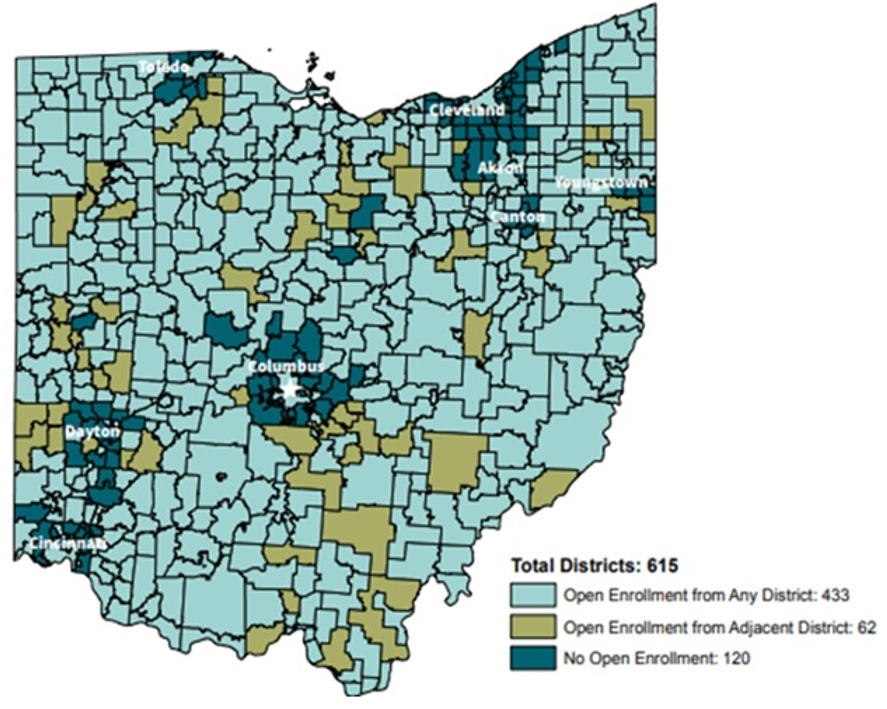
A district not terribly distant from Kyrene allegedly sent a hundreds-page-long PDF to families, in English only, and then invited the families to sort through it to fill out worksheets for their child’s grade. I would be eager to explore becoming a Kyrene kid, a Prenda kid, or an anywhere-but-here kid under those circumstances.
K-12 life is tough everywhere during the pandemic, but it’s better for families to have options. Moreover, I do not know about the rest of you, but I’m ready to take my chances on moving on to 2021.

