This is the website image that greets families of Saint Francis Academy in Bally, Pennsylvania, with the closure of the 277-year-old school.
A new report from the Cato Institute finds that no fewer than 132 private schools have announced permanent closure over the past year, at least partially due to economic effects of the pandemic. Additional findings indicate private school enrollment has dropped as much as 5% overall.
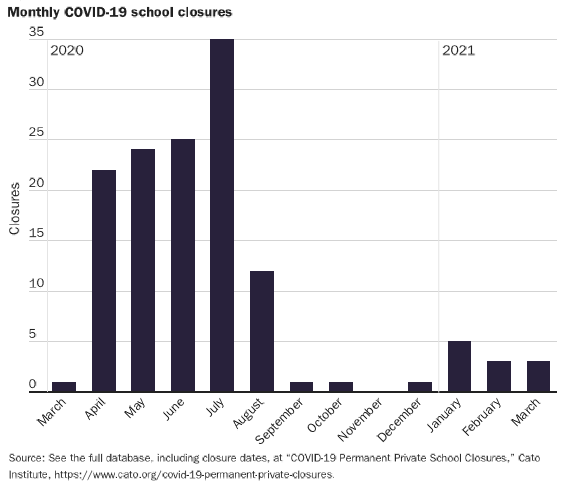
Cato’s COVID-19 Permanent Private School Closures tracker shows closures struck hardest at the beginning of the pandemic and climbed steadily each month from April through July, when closures peaked at 35. The hardest hit sector appears to be schools that are disproportionately low-cost.
 The data show the pandemic impacted schools as young as five years old but also claimed 277-year-old Saint Francis Academy in Bally, Pennsylvania, which was founded in 1743. Only the school’s early-education program remains.
Of shuttered schools, most were Roman Catholic (84%), and most were in the Northeast (66%).
The average tuition at the closed private schools was just $7,066, less than half the cost of the average per pupil spending in American public schools ($14,891). Closed private school tuition was also significantly cheaper than the national average private school tuition of $11,173.
Income data for families sending students to these private school was not available, but Cato used Census data as a proxy.
According to Cato, the median household income for families living near pandemic closed private schools was $89,953, close to the overall national median household income of $88,149.
Private schools that closed were more likely to serve Black or Hispanic students than private schools that remained open throughout the pandemic.
Also noteworthy: 111 of the 132 closed schools already had experienced financial difficulty prior to the pandemic.
Despite the uneven financial playing field between tuition-charging private schools and “free” public schools, private school closures have been lower than expected. Government aid may have been one reason why.
According to Cato, the Paycheck Protection Program made an estimated $4.5 billion in forgivable loans available to private schools. The Coronavirus Aid, Relief and Economic Security (CARES) Act provided an estimated $715 million in “equitable services” provided by local school districts paid for by federal grants.
The Coronavirus Response and Relief Supplemental Appropriations (CRRSA) Act and American Rescue Plan Act (ARPA) will provide another $2.75 billion each in aid to non-public schools. Both programs give priority funding to private schools serving low-income students.
The total aid to private schools will amount to about $2,500 per pupil. Despite this aid, public schools’ financial advantage has grown even larger. According to Cato, public schools will receive an estimated $3,900 per pupil, 56% more than what private schools will receive.
The aid, however, helped private schools remain open for in-person learning, something the Cato report believes reduced the expected enrollment losses as parents shopped for learning options.
The report concludes by celebrating the rise in voucher, tax credit and education savings account legislation, “which would move states closer to a level playing field.”
 This commentary from Neal McCluskey, director of the Cato Institute’s Center for Educational Freedom, first published on the RealClear Policy blog.
A new Gallup poll that surveyed parents with school-aged kids has startling results, much more because of how opinions are split than the opinions themselves.
Given the COVID-19 threat, 36% of parents want their children to receive fully in-person education, 36% want an in-person/distance hybrid, and 28% want all distance. Each mode was preferred by essentially one-third of parents, neatly capturing a now undeniable reality: Families need school choice.
The basic problem is that diverse people have different needs, but a school district is unitary. This is always trouble — diverse people are stuck with one dress code, history curriculum, etc. — but COVID-19 makes the stakes far higher and more immediate than usual. You might be willing to engage in a protracted school board battle to improve curricula, but COVID-19 could put your child’s life, or basic education, in potentially huge danger right now.
In many places, the public schools have taken the side of maximum COVID caution. The school districts in Los Angeles, Chicago, and elsewhere will, at least to start the year, only offer distance education.
That may be fine for kids who learn better at home, have medical conditions that make them high-risk, or who live with elderly relatives. But it is a huge hit to children with poor internet connectivity, learning disabilities, or those who simply thrive in a physical classroom.
It appears that a spontaneous, nationwide eruption of parent-driven, in-person education is the response to such closings. The “pod” phenomenon is perhaps the most buzzy sign of this, generating both fascinated and skeptical coverage in major media outlets. Basically, parents are pooling their money to hire teachers and create closed learning communities for their kids.
We may also be seeing more families moving to traditional private schools, with reports of privates receiving increased interest, and sometimes definite enrollment boosts, around the country. There is no systematic data to confirm a national movement, but the Cato Institute’s Center for Educational Freedom has been tracking private school closures connected to COVID-19 since March and has only recorded eight since July 14. This low number may well reflect new enrollments in private schools.
Of course, affording a private alternative can be difficult for lower-income families, and many people worry that the move to private schooling will fuel greater inequality.
Thankfully, there is a solution, and it is straightforward: Instead of education funding going directly to public schools, let it follow children, whether to a pod, private school, charter school, or traditional public. With public school spending exceeding $15,000 per student, most privates, which charge roughly $12,000 on average, would be in anyone’s reach, while families pooling 10 kids could offer $150,000 to a pod teacher.
The Trump administration has been pushing choice, and certainly any federal aid should follow kids. But constitutional authority over education lies with the states, and it is from them that choice should come. Indeed, more than half-a-million children already attend private schools through voucher, tax credit, and education savings account programs in 29 states and Washington, D.C. But that is far below the number who need choice — states that already have it should expand it, and those without it should enact it.
But expanding funding may not be enough to supply the COVID choice people need. In some places, including much of California, public authorities are forbidding many private institutions from teaching in-person. Such prohibitions must be lifted.
These actions may be intended to protect public schools’ pocketbooks. For instance, the chief health official in Montgomery County, Maryland, has said no private school can open until at least October 1, a date right after the enrollment “count day” that determines how much state and federal funding public schools get.
Of course, health concerns may be the only driver of such decisions. But school-aged children appear to face very low levels of COVID danger. According to CDC data, Americans ages 5 to 17 account for fewer than 0.1% of all COVID-19 deaths, and since tracking began, it has accounted for less than 1% of all deaths in the 5-to-14 age group. While increasing safety measures is important, kids appear to face greater dangers than COVID-19.
What about teachers and administrators? Adults are at greater risk than children, but private schools will do many things to protect them, including mandatory mask wearing, face shields, social distancing, improved air filtration, and more. And teachers unwilling or unable to work in-person could choose jobs in online-only schools.
The simple fact is all communities, families, and children are different, and they need educational options reflective of that diversity.
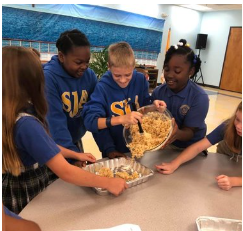
St. Joseph Academy families have launched an effort to save the school, where 78 of 162 K-8 students participated in the Florida Tax Credit Scholarship or Family Empowerment Scholarship programs for lower-income students.
An 82-year-old Catholic school in Florida has abruptly announced its closure, another telling sign that COVID-19 is eroding the financial ground beneath private schools.
At the beginning of the school year, the Catholic Diocese of Orlando had been discussing the possibility of revamping the St. Joseph Academy in Lakeland, Florida, a half-hour east of Tampa. But in a letter to parents Friday, the Very Rev. Timothy LaBo, pastor of St. Joseph Church, said the financial devastation wrought by the pandemic quickly led to a “serious impact on our re-enrollment numbers.”
“What we could not have imagined was the COVID-19 pandemic and its effect upon our world in such a short time,” LaBo wrote in the letter obtained by Lakeland Now.
The closure of the K-8 school shocked St. Joseph parents, who immediately launched an effort to save the school. But it’s not a surprise to those watching private schools across America struggle as parents lose jobs, businesses close and charitable contributions evaporate.
A survey by Step Up For Students, the nonprofit scholarship funding organization that hosts this blog, found 73 percent of Florida private schools said they are experiencing declines in re-enrollment last year, and 58 percent said they’re worried about their viability for the coming school year. The research and advocacy group EdChoice got similar results when it surveyed private schools nationwide last month. More than 20 million Americans lost their jobs in April, including 893,000 in Florida.
The Sunshine State has one of the biggest private school sectors in the country, and some of the nation’s biggest school choice programs. But those programs are primarily for lower-income students and students with special needs. It remains to be seen how much they will help private schools trying to retain working-class and middle-class parents who may be forced, in coming months, to make agonizing decisions about their children’s educations.
Seventy-eight of St. Joseph Academy’s 162 K-8 students used the Florida Tax Credit Scholarship or Family Empowerment Scholarship for lower-income students, while 26 used the Gardiner Scholarship or McKay Scholarship for students with special needs. (The FTC, FES and Gardiner programs are administered by nonprofits like Step Up.)
To date, the most meaningful government relief for private schools has come from the Paycheck Protection Program, which offer a two-month respite for small businesses and nonprofits. Other federal relief streams for education are aimed primarily at public schools, and attempts to steer a more equitable share to private schools has met with relentless pushback.
Other potential remedies, including the possibility of temporary tuition tax credits, have so far generated little debate. Likewise for the potential negative impacts on public schools, which will likely have to absorb former private school students in the face of massive financial and logistical challenges.
As the coronavirus pandemic continues to exert economic pressure on private school families like those whose children attend Crestwell School in Fort Myers, where about 20 students use a state choice scholarship, four-dozen private school and choice organizations have reached out to Congressional leaders for relief.
Federal pandemic relief efforts must include help to private school families to stave off closure of an “alarming number” of private schools and mitigate the financial stress those closures will inflict on public schools, private school leaders told Congressional leaders Wednesday.
Providing “immediate and direct aid to families” in the form of tuition payment relief will help students remain in private schools, rather than flooding district schools that are facing their own massive financial challenges, 48 private school and school choice organizations said in this letter.
“Private school closures would be devastating for families, students and communities,” said the letter, which was also signed by Step Up For Students, the Florida nonprofit that hosts this blog. “It will be equally devastating, financially, for public school districts.”
“If private schools are shuttered because families aren’t paying tuition for an extended period of time, the increase of public education expenditures for millions of new students coming back into the district systems would be staggering,” the letter continued. “If 20 percent of private school students have to be reabsorbed into the public system, it would cost the public system roughly $15 billion.”
To date, little federal relief targeted to K-12 education has offered meaningful help to private schools. Some private schools have secured funding from the Paycheck Protection Program, which was designed to help small businesses and nonprofits. But that help is a two-month respite. Growing numbers of parents are telling private schools they won’t be able to afford tuition in the fall, and surveys suggest many private schools fear the economic downturn and continued closure of brick-and-mortar operations could bring their demise.
Besides assurances that federal relief is equitably distributed, the private school groups offered a list of other potential long- and short-term remedies. Among the ideas (which you can read about in the letter): emergency education tax credits and a means-tested federal education savings account.
The groups suggested 10 percent of any new federal education relief be targeted toward private school parents, in line with the national proportion of private to public school students.

