
St. Michael the Archangel High School in Baton Rouge is one of 128 private schools that participate in the Louisiana Scholarship Program. The program enrolled 6,141 students in 2020-21.
A new poll from the state of Louisiana’s voice for educational choice has found widespread support among families who participate in the Louisiana Scholarship Program.
Nearly 93% of families who utilize the program to provide their children with additional opportunities to attend the school of their choice say they are happy with their children’s academic progress. Ninety-one percent say they are satisfied or very satisfied with their child’s current scholarship school, and nearly all – 97.8% – say their child feels safe in his or her scholarship school.
Additionally, 54.8% are pleased with how their scholarship school handled the COVID-19 crisis.
The Louisiana Federation for Children conducted the survey from March 18-March 31 to evaluate the level of parental satisfaction with the scholarship program formerly known as the Student Scholarships for Educational Excellence Program.
“Facing extreme obstacles, Louisiana Scholarship Program schools created safe learning environments for parents who prioritized in-person learning,” said Ann Duplessis, Louisiana Federation for Children President and American Federation for Children Board Member. “At the same time, families who preferred a virtual education for their children were accommodated.”
The Louisiana Department of Education reported 6,141 students were enrolled in the Louisiana Scholarship Program during the 2020-21 school year. Every child in the program, which was enacted in 2008 by a bipartisan group of legislators, comes from a low-income family, and 85% of students in the program are minority students.
Louisiana lawmakers recently expanded school choice options with the approval of HB 85, which established a statewide reading scholarship program named for the late state Rep. Steve Carter, a former Louisiana House education chairman who died in January from COVID-19 complications.
The program, approved on a unanimous bipartisan vote, was modeled after a similar one in Florida. You can read more here.
To view complete poll results, click here.
The Ohio Senate’s education plan for the state budget for 2022–23 would prioritize families’ needs and wants.
Editor’s note: this commentary from Aaron Churchill, the Ohio director for the Thomas B. Fordham Institute, appeared recently on the Institute’s website.
Across the nation, state lawmakers have been heeding the call for parents to have more control over their children’s education.
Recognizing that there is no “one-size-fits-all” model that meets every kid’s need, legislators have been actively strengthening school-choice policies and expanding options for families. Florida, for instance, recently expanded its nation-leading private school scholarship programs. Iowa just significantly improved its charter school law. West Virginia and Kentucky created brand-new educational savings account (ESA) programs that offer parents flexibility in how they meet (and pay for) their kids’ educational needs.
So far this year, Ohio’s education debates have paid scant attention to choice. Lawmakers have focused on technical issues with the school funding formula and overall spending levels. But that changed last week with the unveiling of the Senate’s education plan for the state budget for the fiscal years 2022–23 (HB 110). If enacted, its proposals would be a huge step forward in putting families’ needs and wants at the center of education policy. Here are highlights of the Senate approach:
Removes caps on the number of EdChoice scholarships available. EdChoice, the largest of Ohio’s scholarship programs, allows children from low- and middle-income households to attend private schools of their choice. The program has grown significantly over the past decade, but legislators have limited the number of available scholarships, which in the past has left some children in the lurch. The Senate plan would ensure that any eligible student applying for an EdChoice scholarship receives one.
Increases the EdChoice and Cleveland scholarship amounts. The EdChoice and Cleveland scholarship amounts have fallen well behind public school spending. Today, they’re worth just $4,650 in grades K–8 and $6,000 in grades 9–12, even as Ohio’s public schools spend on average $14,000 per pupil. The Senate plan narrows that gap somewhat by lifting these scholarship amounts to $5,500 and $7,500 in grades K–8 and 9–12, respectively. Importantly, it also ensures that in future budgets, scholarship amounts will automatically rise in proportion to any increase in public schools’ base funding. This provision would create more predictability and fairness for families that rely on these programs.
To continue reading, click here.
 For centuries, the vampire has haunted folklore across cultures. Because these bloodsuckers “become what we fear most at any given time,” it’s not surprising that opponents of education choice see private school vouchers in a similar, uh, vein – draining money from public schools just as a vampire sucks the lifeblood from his victims:
“'Choice' is a false pretext for draining money from public schools”
“They drain money from public schools…”
But these “vampire vouchers” actually are quite toothless, as explained in this three-minute video ...
[penci_video url="https://www.youtube.com/embed/8avQof7xC_k" align="center" width="750" /]
… which drives these stakes through the heart of the myth:
· Research shows vouchers actually save taxpayers money that can be reinvested into public education; and,
· Public school student performance does not suffer from an expansion of choice options.
So put away that garlic necklace. These “vampires” won’t hurt you.
 Recently, I looked under the hood of Arizona’s nation-leading academic growth by examining district and charter schools in downtown Phoenix. Two things stood out: lots of academic growth and a great deal of variety in approaches.
District and charter schools in combination operating within the boundary of Phoenix Elementary (a high poverty district covering downtown Phoenix) have a rate of academic growth 27% higher than average. I believe that the variety of approaches is key; Phoenix kids had access to two classical/traditional schools, two Montessori schools, two schools focused on the arts, and a school sponsored by Arizona State University.
The options for these students don’t end there, however. About one-third of Phoenix-area students utilize open enrollment to attend a district school that is not their zoned school. Phoenix kids can attend suburban districts like Madison Unified and Scottsdale Unified. Arizona also has scholarship tax credit programs and the Empowerment Scholarship Program to enable students to attend private schools.
All is far from perfect. Charter schools have waitlists, as to do School Tuition Organizations providing tax credit assistance. Only about one-quarter of Arizona students qualify for the education savings account program. Open enrollment is available, but transportation is the sole responsibility of families.
Downtown Phoenix may look great from a growth and choice perspective relative to most central city areas, but work remains to be done. Every waitlist is a policy failure.
This system continues to evolve, and educators continue to create new opportunities for Arizona’s inner-city families. State lawmakers are considering transportation assistance for low-income students. Moreover, the Arizona Black Mothers Forum has begun opening micro-schools as another option for inner-city families.
Click here to learn more about Black Minds Matter’s inaugural Black-Owned Schools tour. The video gives a glimpse into what empowerment means to people via an interview conducted by Florida’s own Denisha Merriweather with Janelle Wood, founder of the Arizona Black Mothers Forum Micro-school. The interview is a tour de force of community empowerment.
“It’s time for the mothers to take over and do what we need to do,” Wood states. “We can’t just talk about it, we need to be about it.”
I highly encourage you to watch the interview in full, as I cannot do it justice.
Millions of mothers made the decision to leave the workforce during the COVID-19 pandemic. Choice policies give these women the tools they need to take control of their children’s education.
Another big trend we may see in Arizona: districts expanding and replicating their high-demand schools. #TeamEdsel of course will resist, but the positive incentives are in place and there are highly capable and innovative professionals operating in Arizona districts.
Stay tuned to this channel for updates.
 The full Florida House heard for the first time earlier today an education choice bill that would simplify the state’s K-12 scholarship programs by merging five programs into three.
If given final approval on a House floor later this week, HB 7045, which has been approved in two House committees, would simplify navigation of the programs for families by merging the state’s two scholarship programs for students with unique abilities, McKay and Gardiner, and combining them with the Family Empowerment Scholarship program approved in 2019.
One category of the Family Empowerment Scholarship would serve students with unique abilities and special needs while the other would continue to serve lower-income families.
The bill would leave intact the Florida Tax Credit Scholarship program, which is funded by corporate tax donations, and the Hope Scholarship program for students who have experienced bullying at their district schools. Additionally, the bill would simplify eligibility requirements by aligning qualifying income levels of the Florida Tax Credit Scholarship with the Family Empowerment Scholarship. Each program currently has different income requirements.
The bill also would provide one-stop shopping for families by placing management of the Family Empowerment program under nonprofit scholarship organizations, which include Step Up For Students, host of this blog.
Under the bill, families currently receiving flexible spending dollars under the Gardiner program would continue to receive their scholarships as education savings accounts; McKay’s traditional scholarships would be converted to education savings accounts starting in the 2022-23 school year. Families currently participating in each program would receive whichever dollar amounts were higher, whether that was in current law or in HB 7045.
“This is going to make more children eligible for scholarships; it’s going to provide them with more money, and it’s going to provide more flexibility,” said the bill’s sponsor, Rep. Randy Fine, R-Palm Bay.
HB 7045 also would make it easier for lower-income families to qualify for their category of the Family Empowerment Scholarship program by eliminating a requirement that students attend a district school the previous year to qualify for the scholarship.
That requirement resulted in some families whose incomes took a hit due to a tragedy or during the pandemic from being turned down for scholarships that would have helped them keep their children in their private schools.
This has been a longstanding issue,” Fine said.

A new study commissioned by the U.S. Department of Education’s Institute of Education Sciences has found that students participating in Indiana’s education choice program are more likely to enroll in college than their public-school peers.
The report, released this week by the Midwest Regional Education Lab, found that 61% of students utilizing the Indiana Choice Scholarship Program enroll in college within one year of graduating from high school compared with 52% of their peers in district public schools.
Of those who enroll in college, 78% of scholarship students graduate compared with 71% of public-school students.
“Add this new Indiana research to the litany of studies showing that when families are empowered with educational options, their children in K-12 schools of choice do better in the long-term,” said Tommy Schultz, vice president of the American Federation for Children. “The question is: When will the lawmakers opposed to educational options finally listen to the research and put children and families first?”
Report co-authors Megan J. Austin and Max Pardo controlled for a rich set of key characteristics of students and their schools, including family income, race, gender and eighth-grade test scores, as well as high school size and location.
While the study relied on observational data, its findings regarding the positive effects of private school choice on student outcomes are consistent with evaluations of such programs in Florida, the District of Columbia, Milwaukee and New York City.
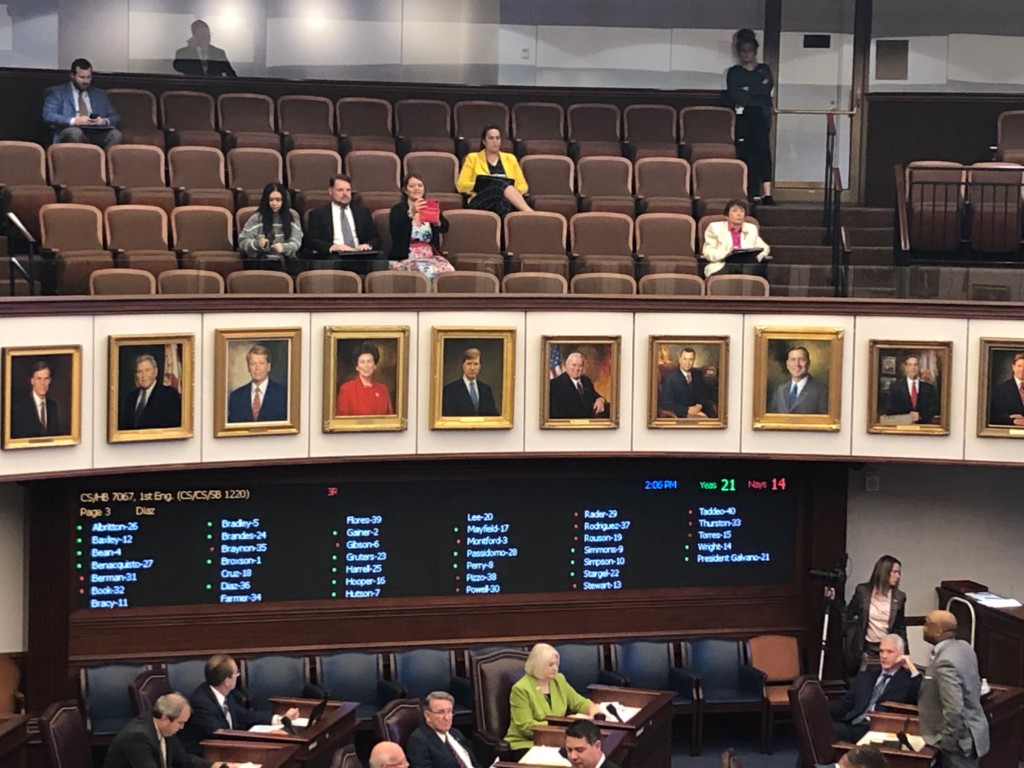
The Florida Senate gave final approval in March to HB7067, aimed at aligning policies between two education choice scholarship programs.
A bill that expands and aligns two K-12 scholarship programs for economically disadvantaged students has been sent to Gov. Ron DeSantis for his expected signature.
HB 7067 is aimed at aligning policies between the Family Empowerment Scholarship, adopted last year and serving 18,000 students, and the Florida Tax Credit Scholarship, created in 2001 and serving 108,000 students.
“This session, revising the Family Empowerment Scholarship Program was our state’s priority, because no matter what economic challenges a student has, investing in the education of our children is always a win,” Sen. Manny Diaz Jr., R-Hialeah, told senators when the bill won final approval in March.
Diaz, who was chairman of the Senate Education Committee, shepherded the bill through the legislative process. Eight Democrats joined the Republican majority in supporting the bill.
The bill would increase the allowed enrollment growth in the Family Empowerment Scholarship program. Under current law, the program can grow by up to 0.25 of total public-school enrollment each year, which is roughly 7,000 students. The bill would increase that growth to 1 percent, or roughly 28,000 students.
The bill gives clear priority to renewal students in both programs and provides for a gradual increase in household income eligibility over time. That provision allows the eligible income level in the Family Empowerment Scholarship, currently 300 percent of federal poverty, to increase by 25 percentage points in the next year if more than 5 percent of the available scholarships remain unawarded.
The income limit for Tax Credit Scholarships would remain at 260 percent of poverty.
The bill also allows students who receive scholarships in either program to remain on the scholarship until they graduate or turn 21.
DeSantis has until June 30 to act on the bill.
School choice success stories are everywhere.
Earlier this month, National Public Radio aired an episode of WHYY's Fresh Air, in which New York Times Andes Bureau Chief Nicholas Casey talked about the collapse of oil prices in Venezuela, how Donald Trump resembles Hugo Chavez, and the time he spent embedded with Colombian FARC guerrillas.
The interview with host Terry Gross eventually turned to Casey's childhood, growing up in a mobile home in a working-class enclave of Northern California.
He said that, when he first enrolled in elementary school, his mother drove him to the best public school she could find. She later transferred him to a segregated school, where nearly all the children were black and Hispanic.
Later, he received a scholarship that may have changed the course of his life. (more…)

